In this article
- Why does everyone start Mounjaro on 2.5 mg?
- Mounjaro first week: what to expect day by day
- What side effects are common in the first week, and how do you handle them?
- What should you eat and drink in the first week on Mounjaro?
- What does a sample day look like, vegetarian and non-vegetarian?
- What should you avoid in the first week?
- When will you notice weight change, and why does early loss vary?
- What should you track in the first week?
- What are the warning signs that need urgent care?
- What should you check before your first injection?
- What happens at week 5?
- Common myths about the first week on Mounjaro
- Questions to ask your healthcare provider
- How The Prime Fit helps
- Frequently asked questions
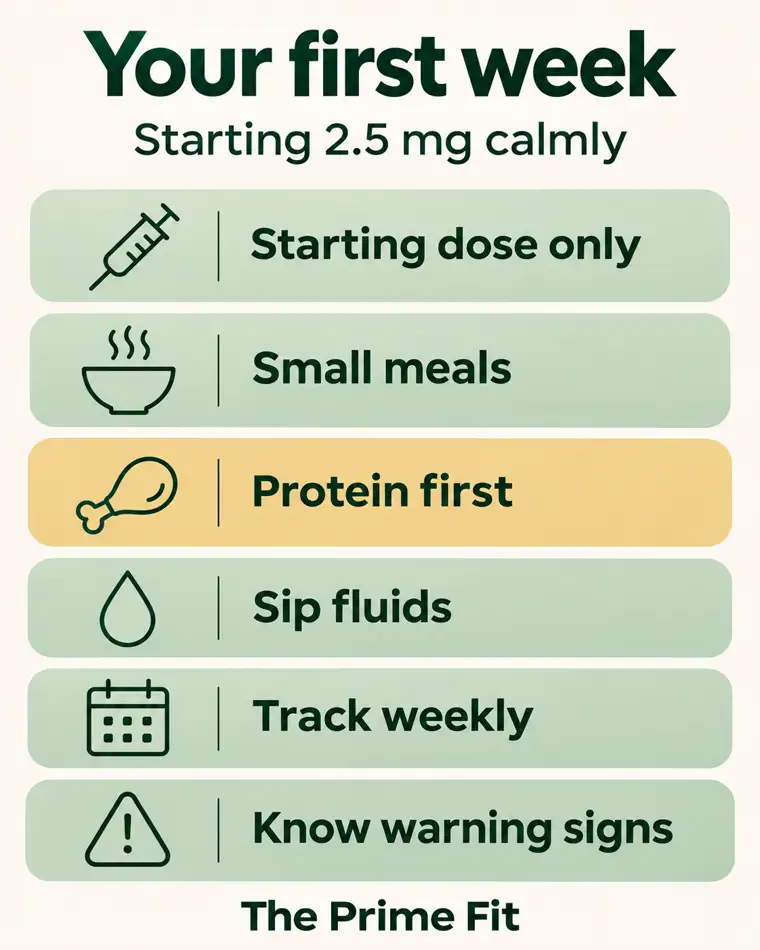
For the Mounjaro first week, what to expect is mostly a gentle start: many people notice slightly less hunger and earlier fullness within a few days, some have mild nausea, burping or a change in bowel habit, and some feel almost nothing at all. All three patterns are normal. Starting Mounjaro 2.5 mg is meant to let your body get used to the medicine, and it is not the dose intended for the main part of treatment.
So the first week is not a test of whether the medicine “works”. It is a settling-in period. Your job is to take the injection correctly, eat smaller balanced meals, drink enough, and notice how you feel so that you can report it at your review.
This guide describes a typical week day by day, how to handle early effects with everyday Indian food, what to track, and the warning signs that need urgent attention. It is general information, and your prescriber’s advice for your own situation comes first.
Why does everyone start Mounjaro on 2.5 mg?
Mounjaro (tirzepatide) is a once-weekly injection that acts on two gut hormone pathways, GIP and GLP-1, which influence appetite, fullness and blood sugar. The prescribing information sets 2.5 mg once weekly as the starting dose for the first four weeks. It describes this as a dose for starting treatment, so that the stomach and gut can adapt, and not as the dose meant for ongoing blood sugar control or weight management.
After four weeks the dose is normally raised to 5 mg, and further increases, if needed, are made in steps with at least four weeks at each level. Starting low and going slowly is the main way of keeping stomach-related effects manageable. The full ladder is explained in our Mounjaro dosage guide.
Set the right expectation
If you feel little in week one, the medicine has not failed, and you should not ask to skip ahead. If you feel a clear drop in appetite, that is also normal. Responses at 2.5 mg vary widely from person to person.
Mounjaro first week: what to expect day by day
The table below is a general pattern drawn from what people commonly report. It is not a timetable your body must follow, and the timing of appetite change in particular differs a great deal.
| Day | What people often notice | What helps |
|---|---|---|
| Day 1 (injection day) | Often nothing beyond a brief prick. Some feel slightly full or tired by evening | Eat a normal light meal, drink water, note the time and site |
| Days 2 and 3 | Appetite may ease and fullness may arrive sooner. Mild nausea, burping or acidity, if they occur, often show up here | Smaller portions, slow eating, avoid fried and very spicy food |
| Days 4 and 5 | Bowel habit may change: constipation for some, loose stools for others. Energy may dip if you are eating too little | Fluids, fibre from vegetables and fruit, regular small meals with protein |
| Days 6 and 7 | Effects often feel lighter, and some people notice hunger returning before the next dose | Keep to the routine and take the next dose on the same weekday |
What side effects are common in the first week, and how do you handle them?
The most frequently reported effects of tirzepatide in trials were stomach and gut related: nausea, diarrhoea, reduced appetite, vomiting, constipation, indigestion and abdominal discomfort. They tend to be mild to moderate, appear mostly when treatment starts or the dose rises, and ease with time for most people.
| Effect | What to try | Indian food examples |
|---|---|---|
| Nausea | Small meals every few hours, eat slowly, stop at the first sign of fullness, stay upright after eating | Khichdi, idli, plain dal with soft rice, toast, curd rice, a little ginger or saunf after meals |
| Early fullness | Halve your usual portion and eat the protein first | Dal, paneer, egg, curd or chicken before roti and rice |
| Constipation | More fluid, more fibre, a daily walk | Papaya, guava, cooked vegetables, salad, soaked chia or isabgol if advised |
| Loose stools | Replace fluid and salts, eat plain food, limit milk and oily dishes for a day or two | ORS, chaas, curd rice, banana, moong dal khichdi |
| Burping, acidity, bloating | Avoid fizzy drinks and large late dinners, leave a gap between dinner and bed | Lighter dinners such as vegetable soup with dal, fewer fried snacks and rich gravies |
| Tiredness | Check that you are eating and drinking enough, sleep on time | Lemon water with a pinch of salt, coconut water, regular protein |
| Injection site redness | Usually settles without treatment, rotate the site next week | Not food related |
If constipation becomes a pattern, our guide to constipation, acidity and bloating on Mounjaro goes into more depth. Do not start anti-sickness tablets, laxatives or antacids on your own for more than occasional use: ask your prescriber what is suitable for you.
What should you eat and drink in the first week on Mounjaro?
You do not need a special or extreme diet in week one. The medicine slows how quickly the stomach empties, so large, oily meals sit heavily. A few principles make the week easier.
- Protein first. With a smaller appetite, protein is the easiest thing to miss, and it is what protects muscle as weight falls. Your dietitian will set a personal target.
- Small meals, eaten slowly. Three modest meals and one or two small snacks suit most people better than two large meals.
- Vegetables and fruit daily, for fibre and to keep the bowels regular.
- Whole grains in measured portions: one or two rotis, or a small katori of rice, not both piled high.
- Fluids through the day. Thirst can fade along with hunger, so sip water regularly. People with heart or kidney conditions should follow the fluid limit they have been given.
- Stop when comfortably full. Finishing the plate out of habit is the commonest cause of first-week nausea.
As an illustrative example, if a dietitian set a protein target of 1 g per kg of body weight for a person weighing 80 kg, that would be 80 g of protein a day, or roughly 20 g at each of three meals plus 20 g from snacks. Your own target may be different.
What does a sample day look like, vegetarian and non-vegetarian?
This is an illustrative example of a first-week day, not a prescription. Portions should be adjusted to your appetite, health conditions and your dietitian’s advice.
| Meal | Vegetarian | Non-vegetarian |
|---|---|---|
| On waking | A glass of water, a few soaked almonds | A glass of water, a few soaked almonds |
| Breakfast | 2 moong dal chillas with paneer filling, or vegetable poha with a bowl of curd | 2-egg vegetable omelette with 1 slice of toast |
| Mid-morning | 1 fruit such as guava or papaya, a glass of chaas | 1 fruit, a glass of chaas |
| Lunch | 1 katori dal or rajma, sabzi, salad, 1 roti, curd | Chicken or fish curry with less oil, sabzi, salad, 1 roti or a small katori of rice |
| Evening | Roasted chana or a small bowl of sprouts, tea with little sugar | 1 boiled egg or roasted chana, tea with little sugar |
| Dinner (early and light) | Paneer or tofu bhurji with sauteed vegetables, 1 phulka, or moong dal khichdi with curd | Grilled or tandoori chicken or fish with vegetables and dal, 1 phulka |
For a full week of ideas, see our Mounjaro diet plan with a 7-day Indian menu.

What should you avoid in the first week?
- Skipping meals entirely. A low appetite is not an instruction to stop eating. Very low intake causes weakness, headaches, constipation and muscle loss.
- Heavy fried or rich meals: chole bhature, pakoras, biryani in large portions, creamy gravies and wedding buffets are the usual triggers for nausea and vomiting.
- Alcohol binges. Alcohol can worsen nausea, acidity and dehydration, and can lower blood sugar in people on certain diabetes medicines. See alcohol on GLP-1 medicines.
- Sugary and fizzy drinks, which add bloating and calories without fullness.
- A strict fast in week one, unless you have discussed it with your prescriber. If a religious fast falls in this period, ask for advice in advance.
- Changing the dose yourself, whether taking extra because you feel nothing or taking doses closer together.
When will you notice weight change, and why does early loss vary?
Some people see the scale move in the first week or two, and others see little until the dose rises. Both are common. Early changes partly reflect eating less salt and carbohydrate, which shifts body water, so a quick early drop is not all fat and a flat first week is not a failure.
In the large SURMOUNT-1 trial in adults with obesity or overweight without diabetes, average weight loss over about 72 weeks was roughly 15 to 21% of starting weight on the 5 mg to 15 mg doses, alongside diet and activity support. Those results built up gradually over many months and at doses above 2.5 mg, and individual results ranged widely. Our article on Mounjaro results month by month sets out the usual pace.
What should you track in the first week?
- Weight, once a week, on the same scale, in the morning after using the toilet. Daily weighing mostly records water shifts.
- Waist, measured at the level of the navel at the start and then every two to four weeks. For Asian Indians, risk rises above 90 cm in men and 80 cm in women.
- Symptoms, with the day they began and what you had eaten.
- Fluid and protein, roughly, for the first few days, to check you are not under-eating.
- Bowel movements, so constipation is caught early.
- Blood sugar, if you have diabetes, as often as your care team has advised.
- Injection day, time and site.
What are the warning signs that need urgent care?
Seek urgent medical help for any of these
Severe abdominal pain that does not go away, with or without vomiting, especially if it spreads to the back. Repeated vomiting or diarrhoea with inability to keep fluids down. Signs of dehydration such as very dark or very little urine, dizziness, a racing heart or fainting. Swelling of the face, lips, tongue or throat, trouble breathing or swallowing, or a widespread rash. Pain under the right ribs with fever or yellowing of the eyes or skin. If you take insulin or a sulfonylurea, sweating, shaking or confusion that does not settle after taking sugar. Sudden changes in vision.
These are uncommon, but they should not be waited out at home. For milder problems that persist beyond a few days, or any symptom that worries you, contact your prescriber before the next dose. Background on the rarer risks is in our complete guide to GLP-1 side effects.
What should you check before your first injection?
- You have had a proper assessment and any baseline blood tests your prescriber requested.
- You have told your prescriber about every medicine and supplement you take, any history of pancreatitis, gallbladder or kidney problems, and any personal or family history of medullary thyroid cancer or multiple endocrine neoplasia type 2.
- You are not pregnant, planning a pregnancy soon or breastfeeding, and you have discussed contraception. Women on the oral contraceptive pill are advised to ask about extra precautions around starting and each dose increase.
- If you have diabetes, you know whether any of your other diabetes medicines need adjusting and how to treat low blood sugar.
- You have been shown how to use your specific pen, and the pen has been stored in the fridge and is in date.
- You have chosen a weekly day, ideally one followed by a quiet day at home.
- The kitchen is stocked with easy, light foods and ORS.
- You know whom to contact with questions, and where the nearest emergency department is.
What happens at week 5?
After four weekly doses of 2.5 mg, the standard schedule is to move to 5 mg once weekly. Before that step, your prescriber will usually ask how you tolerated the starting dose, how you are eating and whether there were any concerning symptoms. If side effects are still troublesome, the increase may be delayed. The stomach-related effects can return briefly after each increase, so the same food habits you practised in week one are worth repeating in week five.
From there, the dose is reviewed at intervals of at least four weeks. Not everyone needs the highest dose: the aim is the lowest dose that gives good results with acceptable side effects.
Common myths about the first week on Mounjaro
“If I do not feel sick, it is not working”
Side effects are not a measure of effect. Many people who do well have very few.
“2.5 mg is too low to bother with, so start higher”
The starting dose exists to reduce side effects. Skipping it is not what the prescribing information recommends.
“You should eat as little as possible to speed things up”
Under-eating costs muscle, energy and hair, and makes constipation worse.
“Weight should fall every single day”
Body weight moves up and down with water, salt and bowel habit. Look at weekly trends.
“The injection replaces diet and exercise”
The medicine was studied alongside diet and activity, and works best with them.
Questions to ask your healthcare provider
- What should I do if I vomit, or cannot eat, in the days after my injection?
- Which anti-nausea, antacid or laxative options are safe for me if I need them?
- Do my diabetes, blood pressure or other medicines need adjusting as I eat less?
- What is my protein and fluid target?
- What should I do if I miss a dose?
- When is my review before the week 5 increase, and what would make you delay it?
- Which symptoms should make me call you, and which mean going straight to emergency care?
How The Prime Fit helps
At The Prime Fit, starting treatment begins with an assessment of your health, weight history and goals, to decide whether a medicine such as Mounjaro is suitable for you. Our team then explains what to expect in the early weeks, offers nutrition support built around the foods your household already cooks, and arranges follow-up so that side effects and dose decisions are reviewed and not left to guesswork. To understand how this is organised, read about our GLP-1 support programme.
Frequently asked questions
How soon does Mounjaro 2.5 mg start working?
Some people notice less hunger within a few days of the first dose, while others notice little until the dose is increased. Both are normal, because 2.5 mg is a starting dose meant to help the body adjust.
Will I lose weight in the first week on Mounjaro?
You may or may not. Early changes vary and partly reflect water shifts. Meaningful weight loss builds gradually over months, usually at doses above the starting dose.
Is it normal to feel nothing on 2.5 mg?
Yes. Feeling little in the first weeks does not predict your later response. Do not increase the dose yourself.
What are the most common side effects in the first week?
Nausea, early fullness, burping or acidity, constipation or loose stools, and tiredness. They are usually mild and tend to ease as the body adapts.
What should I eat after my first Mounjaro injection?
Small, light, balanced meals with protein first: for example dal, curd, paneer, eggs or chicken with vegetables and a modest portion of roti or rice. Avoid fried and very rich food and sip fluids through the day.
Can I drink alcohol in the first week?
It is wiser to avoid it while you learn how your body responds. Alcohol can worsen nausea and dehydration, and can lower blood sugar in people taking certain diabetes medicines.
What if I vomit after my injection?
Sip fluids or ORS, eat plain food when you can, and rest. If vomiting is repeated, you cannot keep fluids down, or you have severe abdominal pain, seek urgent medical care.
When does the dose go up from 2.5 mg?
Normally after four weeks, to 5 mg once weekly, if you are tolerating treatment. Your prescriber decides the timing and may delay the increase if side effects are troublesome.
This article is general information for patients in India and is not a substitute for an individual consultation. Trial figures are approximate and individual results vary. Always follow your prescriber’s advice and the leaflet supplied with your medicine, and seek urgent care for any of the warning signs described above.