In this article
- Why muscle matters when you are losing weight
- How much muscle is lost on GLP-1 treatment?
- The principles of strength training, in plain language
- Safety first on GLP-1 medicines
- Warm-up and cool-down
- The exercises
- The 12-week beginner plan
- If you prefer the gym
- Where walking and cardio fit in
- Protein: the other half of the equation
- Adapting the plan
- How to track your strength
- A 15-minute routine for busy days
- How muscle responds to training
- Staying consistent
- After 12 weeks: where next?
- Common mistakes
- How The Prime Fit helps protect your muscle
- Frequently asked questions
GLP-1 medicines such as Mounjaro (tirzepatide), Wegovy and Ozempic (semaglutide) make it far easier to eat less. The scale responds. What the scale cannot tell you is where the weight is coming from. Without the right signals, the body gives up muscle along with fat, and muscle is the tissue you most want to keep.
The signal muscle needs is simple: use it against resistance, and feed it protein. Strength training two or three times a week is the single most effective thing you can do, alongside your nutrition plan, to make sure the weight you lose is mainly fat. It also makes you stronger, steadier and better able to keep the weight off.
This guide is written for beginners, including people who have never exercised, are carrying a lot of extra weight, or have sore knees. It explains why muscle matters, the principles of safe training, a 12-week programme for home and gym, and how to eat around your sessions. It is general information. If you have heart disease, uncontrolled blood pressure, diabetes complications, joint problems or have been inactive for a long time, speak to your healthcare provider before starting.
Why muscle matters when you are losing weight
- Metabolism. Muscle uses energy even at rest. Losing it lowers the number of calories you burn each day, which makes weight regain more likely.
- Blood sugar. Muscle is the main site where glucose is taken up after meals. More working muscle means better insulin sensitivity.
- Strength and independence. Climbing stairs, carrying shopping, getting up from the floor and playing with children all depend on muscle.
- Bones and joints. Loading muscles also loads bones, which helps maintain bone density, and strong muscles protect the knees, hips and back.
- Shape. Two people at the same weight can look and feel very different. Preserved muscle gives a firmer, healthier body composition.
- Healthy ageing. Low muscle mass in later life is linked with falls, frailty and loss of independence.
How much muscle is lost on GLP-1 treatment?
In body-composition studies within the major trials, roughly a quarter to a third of the weight lost was lean mass, and the rest was fat. Lean mass includes water and organ tissue as well as muscle, so the true muscle loss is smaller than the headline figure. Body-fat percentage improved overall. Even so, for someone losing 15 to 20 kg, several kilograms of lean tissue is a meaningful amount.
The loss is not fixed. Studies of weight loss by diet, surgery and medication consistently show that resistance exercise combined with adequate protein preserves substantially more lean mass than weight loss alone.
Who is at higher risk?
- Adults over 50, and women after menopause
- People losing weight very quickly, more than about 1 kg a week over several weeks
- Those eating little protein, including many vegetarians
- People who are inactive or have desk-based jobs
- Anyone on higher doses with a very small appetite
- People with diabetes, kidney disease or long-term illness
The principles of strength training, in plain language
| Principle | What it means |
|---|---|
| Frequency | Train the whole body two or three times a week, with at least one rest day between sessions |
| Major muscle groups | Legs, hips, back, chest, shoulders, arms and core in every session |
| Sets and repetitions | Start with 1 to 2 sets of 8 to 12 repetitions; build to 2 to 3 sets |
| Effort | The last two or three repetitions of a set should feel challenging while your form stays good |
| Progressive overload | Gradually do a little more over time: more repetitions, more sets, a harder version or more weight |
| Rest | Rest 60 to 90 seconds between sets; sleep and rest days are when muscle rebuilds |
| Consistency | Two sessions every week for a year beat six sessions a week for a month |
You do not need a gym. Body weight, a sturdy chair, a wall, a resistance band and two filled water bottles are enough for the first three months.

Safety first on GLP-1 medicines
- Eat before you train. Exercising on an empty stomach while eating very little can cause dizziness. Have a small snack with carbohydrate and protein one to two hours beforehand, such as a banana with curd or a small bowl of poha with peanuts.
- Hydrate. Thirst is blunted on these medicines. Drink a glass of water before, sip during, and drink again afterwards.
- Stand up slowly. Blood pressure may be lower as you lose weight. Avoid jumping up quickly from floor exercises.
- If you have diabetes and take insulin or sulfonylureas, check your sugar before and after sessions at first, and carry a quick source of sugar.
- Respect your joints. At a higher body weight, choose low-impact movements. Avoid jumping until you are lighter and stronger.
- Time it around your injection. If you feel nauseous for a day or two after your dose, schedule harder sessions for later in the week.
- Breathe. Breathe out on the effort and in on the return. Do not hold your breath.
- Pain is a signal. Muscle effort and mild soreness the next day are normal. Sharp, pinching or joint pain is not; stop that exercise and seek advice.
Stop and seek medical help if
You have chest pain or tightness, unusual breathlessness, palpitations, fainting or severe dizziness, or symptoms of low blood sugar that do not settle with sugar.
Warm-up and cool-down
Warm-up (5 minutes): march on the spot or walk briskly for 2 minutes, then 10 each of arm circles, shoulder rolls, hip circles, gentle side bends and ankle rotations, and 5 slow practice sit-to-stands.
Cool-down (5 minutes): slow walking for 2 minutes, then hold gentle stretches for the calves, thighs, hips, chest and shoulders for 20 to 30 seconds each, without bouncing.
The exercises
These nine movements cover the whole body. Learn them slowly. Quality matters more than quantity.
| Exercise | Works | How to do it | Easier / harder |
|---|---|---|---|
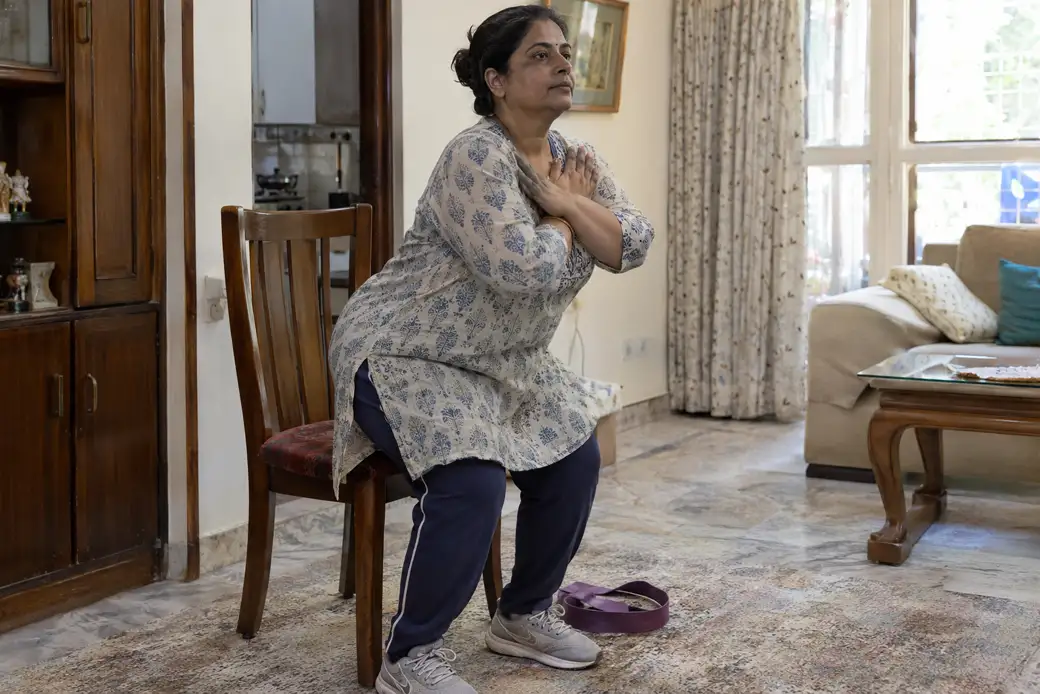
| Sit-to-stand (chair squat) | Thighs, hips | Sit on a sturdy chair, feet hip-width apart. Lean forward slightly and stand up without using your hands. Lower slowly until you touch the seat | Easier: use your hands on your thighs. Harder: hover above the seat; hold a weight at your chest |
| Wall push-up | Chest, shoulders, arms | Stand an arm’s length from a wall, hands at shoulder height. Bend the elbows to bring your chest towards the wall, then push back | Harder: hands on a table or bed edge, then knee push-ups on the floor |
| Glute bridge | Hips, hamstrings, lower back | Lie on your back, knees bent, feet flat. Press through the heels and lift the hips until the body is straight from shoulders to knees. Lower slowly | Harder: pause for 3 seconds at the top; single-leg bridge |
| Band row | Upper back, arms | Loop a resistance band around a door handle or your feet when seated. Pull the hands to your ribs, squeezing the shoulder blades together | Easier: lighter band. Harder: stronger band; dumbbell row in the gym |
| Step-up | Thighs, hips, balance | Step up onto the bottom stair with one foot, bring the other up, step down. Repeat, then change the leading leg. Hold the railing | Easier: lower step. Harder: higher step; hold weights |
| Overhead press | Shoulders, arms | Sitting or standing, hold two filled bottles at shoulder height and press them overhead. Lower with control | Harder: heavier bottles or dumbbells |
| Hip hinge (good morning) | Hamstrings, hips, back | Stand with soft knees, hands on hips. Push the hips back and tilt the chest forward with a flat back, then return to standing | Harder: hold a weight at the chest; progress to a deadlift with guidance |
| Dead bug | Core | Lie on your back with arms up and knees bent at 90 degrees. Lower the opposite arm and leg towards the floor, keeping the lower back flat, then swap | Easier: move legs only. Harder: straighten the legs fully |
| Farmer’s carry | Grip, core, whole body | Hold a weight in each hand, such as two full bottles or shopping bags, stand tall and walk for 30 to 60 seconds | Harder: heavier load or longer time |
The 12-week beginner plan
Train on two or three non-consecutive days, for example Monday, Wednesday and Friday. Each session takes 25 to 40 minutes including warm-up.
| Weeks | Goal | Sessions per week | Sets × repetitions | What to do |
|---|---|---|---|---|
| 1 to 2 | Learn the movements | 2 | 1 × 8 to 10 | Sit-to-stand, wall push-up, glute bridge, band row, dead bug. Easy versions. Stop each set with energy to spare |
| 3 to 4 | Build the habit | 2 to 3 | 2 × 10 | Add step-up and overhead press |
| 5 to 8 | Build strength | 3 | 2 to 3 × 10 to 12 | All nine exercises. Move to harder versions when 12 repetitions feel comfortable |
| 9 to 12 | Progress the load | 3 | 3 × 8 to 12 | Add weight or the next harder version for each exercise. Add the farmer’s carry at the end |
The progression rule
When you can complete all sets at the top of the repetition range with good form on two sessions in a row, make the exercise slightly harder next time. Small, steady increases are safer and more effective than big jumps.
A sample week
| Day | Activity |
|---|---|
| Monday | Strength session; 10-minute walk after dinner |
| Tuesday | 30-minute brisk walk |
| Wednesday | Strength session; 10-minute walk after dinner |
| Thursday | 30-minute walk, cycling or swimming; gentle yoga or stretching |
| Friday | Strength session |
| Saturday | Longer walk or an activity you enjoy |
| Sunday | Rest, light stretching |

If you prefer the gym
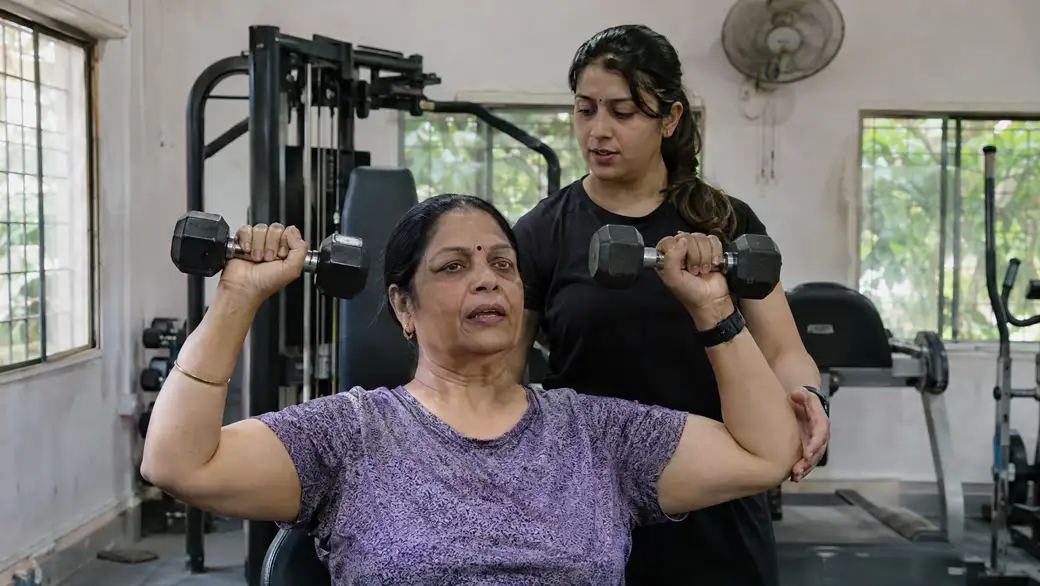
Machines are a good option for beginners because they guide the movement. Ask a qualified trainer to show you the settings, and tell them you are on a weight loss medicine and want to protect muscle.
| Exercise | Main muscles | Sets × repetitions |
|---|---|---|
| Leg press | Thighs, hips | 2 to 3 × 10 to 12 |
| Seated row or lat pulldown | Back, arms | 2 to 3 × 10 to 12 |
| Chest press machine | Chest, shoulders, arms | 2 to 3 × 10 to 12 |
| Leg curl | Hamstrings | 2 × 10 to 12 |
| Shoulder press | Shoulders | 2 × 10 to 12 |
| Cable or dumbbell hip hinge with guidance | Hips, back | 2 × 8 to 10 |
| Plank or dead bug | Core | 2 × 20 to 30 seconds or 8 each side |
Start with a weight you could lift about 15 times, and do 10 to 12. Increase the weight by the smallest step available when the set becomes easy.
Where walking and cardio fit in
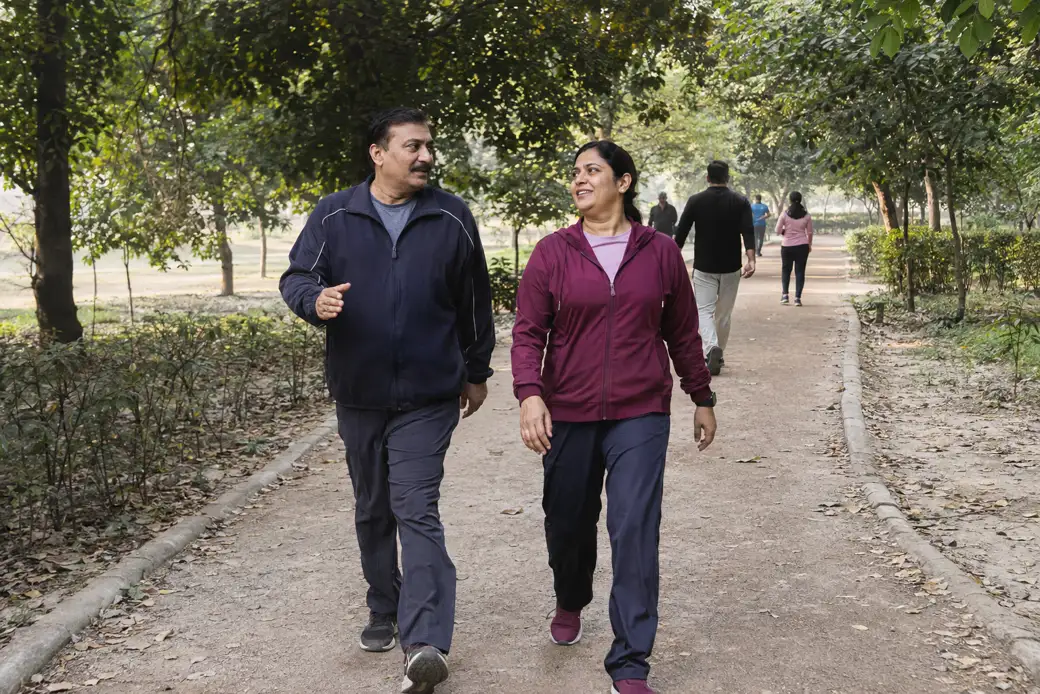
Aerobic activity is good for the heart, mood, blood sugar and weight maintenance, and guidelines recommend at least 150 minutes a week of moderate activity such as brisk walking. It does not replace strength training. Walking alone does little to preserve muscle in the upper body or to build strength. The ideal week includes both: two to three strength sessions and regular walking. If time is short, protect the strength sessions and add short walks after meals.
Yoga and Pilates improve flexibility, balance and core control, and some styles build strength. They are valuable additions. For muscle preservation, make sure your week also includes movements that challenge the legs, back and arms against real resistance.
Protein: the other half of the equation
Exercise tells the body to keep muscle. Protein provides the material.
- Daily target: for many adults on treatment, roughly 1.0 to 1.5 grams per kilogram of body weight, adjusted by your dietitian and healthcare professional, particularly if you have kidney disease.
- Per meal: aim for about 20 to 30 grams at each of three meals, rather than most of it at dinner.
- After training: have a protein-containing meal or snack within a couple of hours.
- Protein first: with a small appetite, eat the protein part of the meal before the roti or rice.
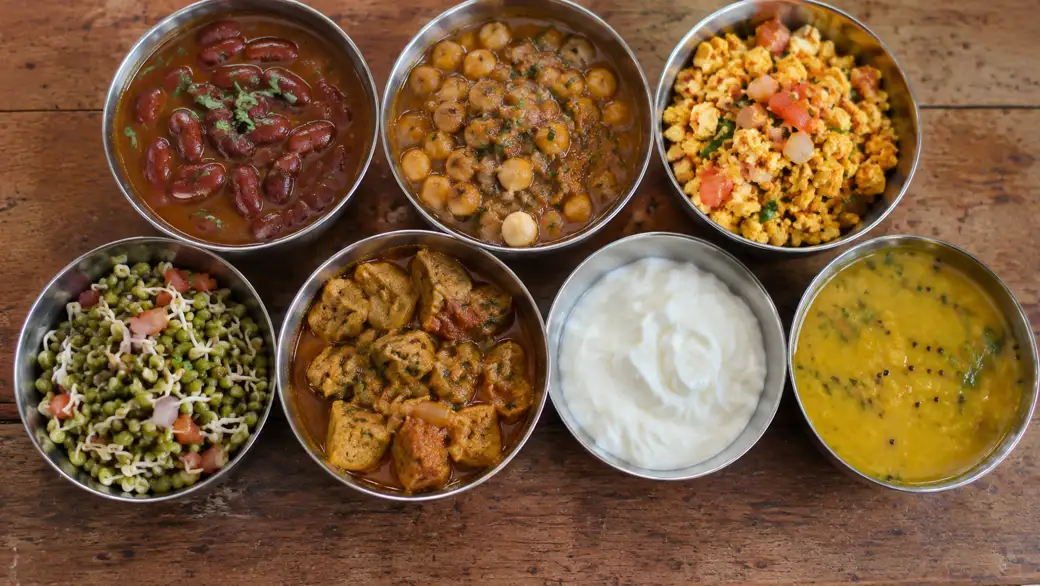
Protein in Indian foods
| Food | Serving | Approximate protein |
|---|---|---|
| Paneer | 100 g | 18 g |
| Curd | 1 katori (about 200 g) | 6 to 8 g |
| Hung curd or Greek-style yoghurt | 150 g | 12 to 15 g |
| Milk | 1 glass (250 ml) | 8 g |
| Cooked dal | 1 katori | 7 to 9 g |
| Cooked chana or rajma | 1 katori | 12 to 15 g |
| Soya chunks (dry weight) | 30 g | 15 g |
| Tofu | 100 g | 10 to 12 g |
| Egg | 1 whole | 6 g |
| Chicken breast, cooked | 100 g | 25 to 30 g |
| Fish, cooked | 100 g | 20 to 22 g |
| Sprouted moong | 1 katori | 7 g |
| Roasted chana | 30 g (a handful) | 6 g |
| Peanuts | 30 g (a handful) | 7 g |
| Besan chilla | 2 medium | 10 to 12 g |
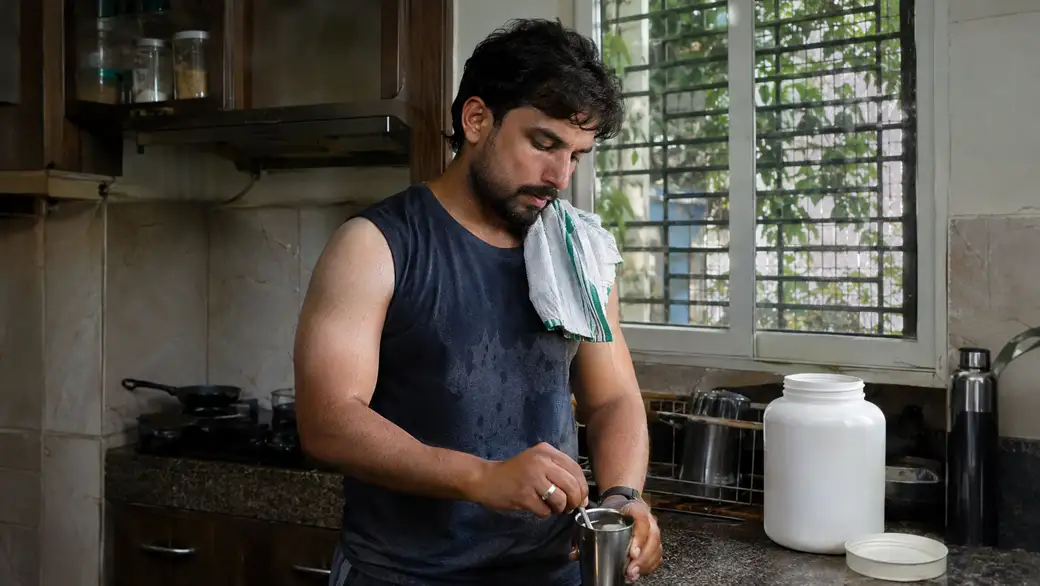
Figures are approximate. If you cannot meet your target with food because your appetite is small, your dietitian may suggest a protein supplement.
Easy pre- and post-workout snacks
| When | Vegetarian | Non-vegetarian |
|---|---|---|
| 1 to 2 hours before | Banana with a small bowl of curd; or 1 slice toast with peanut butter | 1 boiled egg with a fruit |
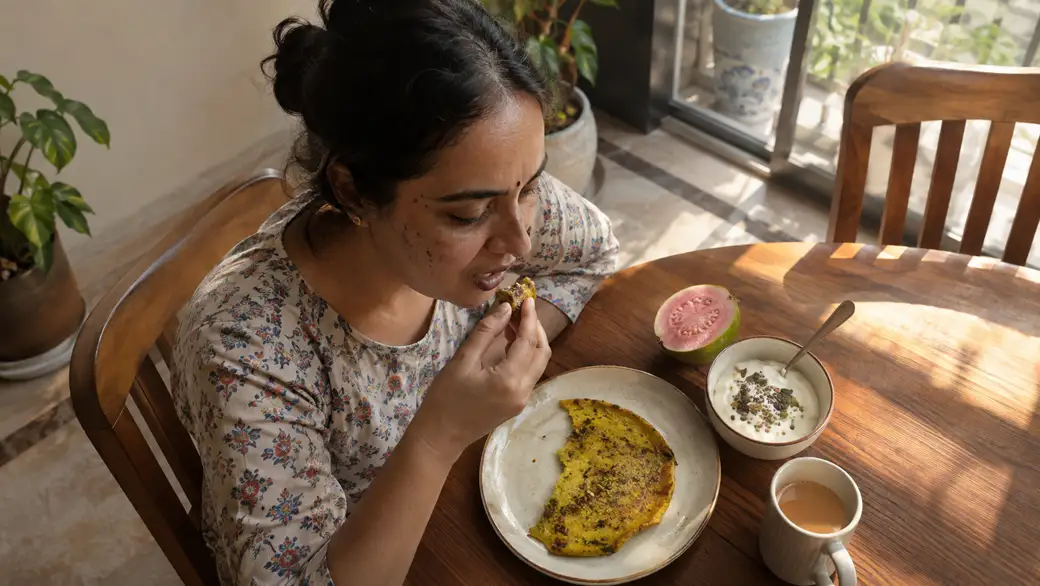
| Within 2 hours after | Paneer bhurji with 1 roti; moong chilla with curd; milk with roasted chana; sprouts chaat | 2-egg omelette with toast; chicken and vegetable wrap; fish with rice and vegetables |

Adapting the plan
Knee pain or osteoarthritis
Strengthening the thighs and hips reduces load on the knees, so exercise is part of the treatment. Use a higher chair for sit-to-stands, keep the movement within a pain-free range, choose glute bridges, seated leg extensions with a band and straight-leg raises, and avoid deep squats, lunges and stairs until stronger. Water-based exercise is excellent.
Back pain
Keep the spine neutral, favour dead bugs and bridges for the core, and learn the hip hinge with guidance. Avoid sit-ups and heavy lifting from the floor initially.
Higher body weight or very low fitness
Start seated. Seated marches, seated band rows, seated overhead presses and sit-to-stands from a high chair build a foundation. Five minutes, twice a day, counts.
Adults over 60
Add balance practice: stand on one leg near a counter for 20 seconds each side, and walk heel-to-toe along a line. Progress more slowly, and prioritise leg strength and safe technique.
Women
Lifting weights will not make you bulky. Women have much lower levels of the hormones that drive large muscle gains. Strength training produces a firmer shape, stronger bones and better blood sugar control, which matters especially around and after menopause.
How to track your strength
- Training log: note the exercise version, sets, repetitions and weight each session. Seeing progress is motivating.
- 30-second sit-to-stand test: count how many times you can stand up from a chair in 30 seconds. Repeat monthly.
- Body composition: if your centre measures it, review fat and muscle every two to three months.
- Everyday markers: stairs without stopping, carrying shopping, getting up from the floor.
- Grip: how long you can carry a fixed load in the farmer’s carry.
If your weight is falling but your strength is rising or holding steady, you are losing the right kind of weight.
A 15-minute routine for busy days
On days when a full session is not possible, a short circuit keeps the habit alive and still sends the signal your muscles need. Do the five exercises one after another, rest for a minute, and repeat the circuit two or three times.
| Exercise | Repetitions |
|---|---|
| Sit-to-stand | 10 to 12 |
| Wall or table push-up | 8 to 10 |
| Glute bridge | 12 |
| Band row | 10 to 12 |
| Dead bug | 8 each side |
How muscle responds to training
Understanding the process makes it easier to trust. In the first few weeks, most of your improvement comes from the nervous system learning to use the muscle you already have: movements feel smoother and you can do more repetitions. From about four to six weeks, the muscle fibres themselves begin to adapt. During weight loss, the realistic aim is to hold on to muscle while fat falls, which is a real achievement because the body would otherwise break muscle down for energy. Beginners, and people returning after a long gap, can sometimes gain a little muscle even while losing weight, provided protein is adequate. Soreness a day or two after a new exercise is normal and fades as you adapt. It is not a measure of how effective the session was.

Staying consistent
- Fix the days and time. Put the sessions in your calendar like appointments. Morning sessions are least likely to be displaced.
- Link training to an existing habit, such as after your morning tea or before your evening bath.
- Keep the equipment visible. A band on the door handle is a reminder.
- Train with someone. A family member or friend makes it harder to skip.
- Follow the two-day rule. Never miss more than two planned sessions in a row.
- Lower the bar on hard days. One set of each exercise is far better than none.
- Record every session. Progress on paper keeps you going when the scale is flat.
After 12 weeks: where next?
By the end of the programme you should be able to do three sets of the harder versions comfortably. From here, continue to add load gradually. Good options are a set of adjustable dumbbells at home, a gym membership with an induction from a qualified trainer, or a supervised class. Introduce new movements such as lunges, deadlifts with light weights and floor push-ups one at a time. Keep training two or three days a week for as long as you are on treatment and afterwards. Strength training is not a phase of weight loss. It is the habit that protects your result for years.
Common mistakes
- Waiting until the weight is off. Muscle is lost during weight loss, so training should start with treatment, not after it.
- Only walking. Good for health, but not enough to protect muscle.
- Using weights that are too light forever. Without progression, the body has no reason to maintain or build strength.
- Doing too much too soon. Severe soreness or injury in week one ends many good intentions.
- Training without eating. Low energy and dizziness follow, and muscle cannot rebuild without protein.
- Skipping legs. The largest muscles are in the lower body, and they matter most for metabolism and mobility.
- Ignoring sleep. Muscle repair happens during rest. Aim for seven to eight hours.
- Stopping when the scale stalls. A plateau with rising strength often means fat is still being lost while muscle is preserved.
How The Prime Fit helps protect your muscle
At The Prime Fit, muscle protection is part of the treatment plan from the first week. Your dietitian sets a protein target that fits your appetite and food preferences, and your progress is tracked with body-composition measurements, not weight alone. We guide you on a safe starting routine for your fitness level and joints, and your healthcare provider adjusts the pace of weight loss if muscle or strength begins to fall.
To start treatment the right way, book a consultation or read about our GLP-1 support programme.
Frequently asked questions
Do I really need strength training if I am losing weight on the injection?
Yes. The medicine reduces how much you eat, but it does not decide whether you lose fat or muscle. Resistance exercise and adequate protein are what protect muscle during weight loss.
How many days a week should I train?
Two to three sessions a week, on non-consecutive days, working all the major muscle groups, is enough for most beginners.
Can I do this at home without equipment?
Yes. Body-weight exercises, a chair, a wall, a resistance band and filled water bottles are sufficient for the first few months.
Is walking enough to prevent muscle loss?
Walking is valuable for the heart and blood sugar, but it does not provide enough resistance to preserve muscle throughout the body. Combine it with strength training.
When should I exercise in relation to my injection?
Any day is fine if you feel well. If you tend to feel nauseous or tired for a day or two after your dose, schedule harder sessions later in the week.
I feel weak and tired on the medicine. Should I still exercise?
Check that you are eating enough protein, drinking enough and not skipping meals. Start with short, gentle sessions. If weakness persists, tell your healthcare provider; your dose or diet may need adjusting.
How much protein do I need?
Many adults on treatment are advised about 1.0 to 1.5 grams per kilogram of body weight a day, spread across meals, adjusted for kidney health. Your dietitian will set your target.
Will lifting weights make me bulky?
No. During weight loss the goal is to maintain muscle, and significant bulk requires years of heavy training and surplus calories. You will look firmer, not bigger.
I have knee pain. Can I still do strength training?
Usually yes, with modifications such as a higher chair, glute bridges and avoiding deep bends. Stronger thigh and hip muscles often reduce knee pain. Ask your healthcare provider or physiotherapist for guidance.
How soon will I notice a difference?
Most beginners feel stronger within three to four weeks, mainly from better coordination. Visible changes in tone and measured improvements in strength follow over two to three months.
This article is general information and is not a substitute for a consultation. Check with your healthcare provider before starting a new exercise programme, particularly if you have a medical condition, and stop any exercise that causes pain.