In this article
- The overall picture
- How the dose and the weight curve fit together
- The month-by-month timeline
- What the percentages mean in kilograms
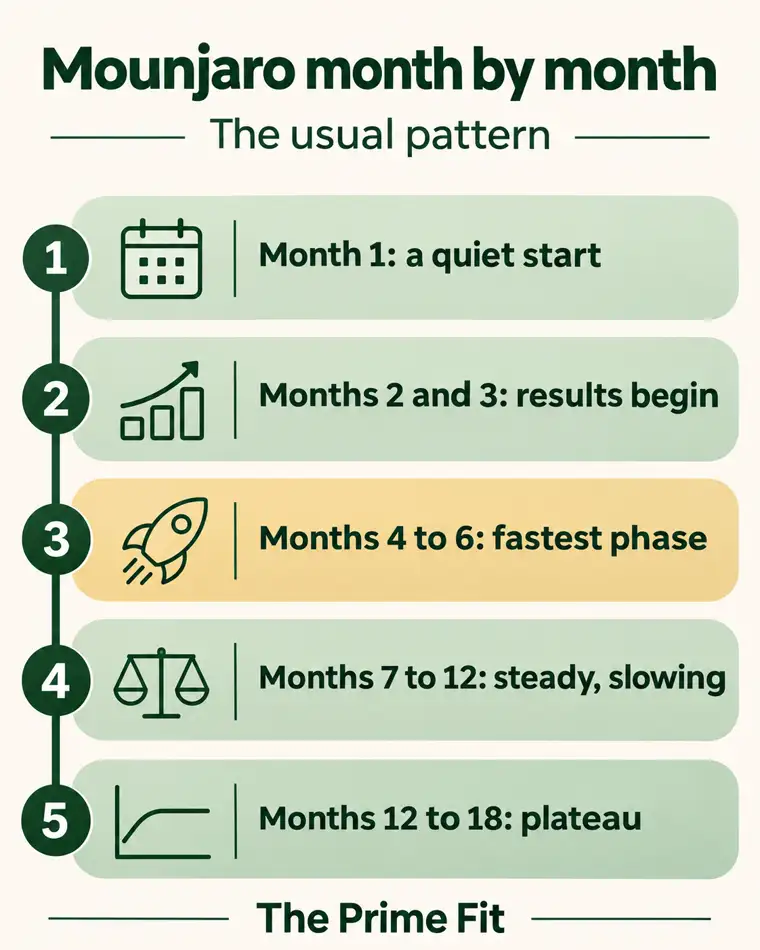
- Month 1: the quiet start
- Months 2 and 3: results begin
- Months 4 to 6: the fastest phase
- Months 7 to 12: steady progress, slowing down
- Months 12 to 18: reaching the plateau
- Beyond 18 months: maintenance
- If you take a break: how the timeline changes
- What a normal month looks like
- What changes besides weight
- Why your timeline may differ
- Are you on track? Simple checkpoints
- A healthy pace
- Fat, not just weight
- How to track progress properly
- If you have type 2 diabetes
- Three illustrative journeys
- Common mistakes at each stage
- Questions to ask your healthcare provider
- Common myths
- How The Prime Fit tracks your progress
- Frequently asked questions
Social media compresses a year of treatment into a before-and-after photograph. Real results on Mounjaro (tirzepatide) unfold slowly, over many months, and the pace changes along the way. People who know what to expect at each stage are far less likely to give up in month two because “nothing is happening”, or to panic in month fourteen because the scale has stopped.
This guide lays out the journey month by month. The figures are drawn from the shape of the weight curves in the main clinical trial of tirzepatide for weight management, in which adults without diabetes were followed for 72 weeks alongside diet and activity advice. They are averages and approximations. Your own path will differ, depending on your dose, your biology, whether you have diabetes, and what you eat and do.
It is general information and not a prediction for any individual. Your healthcare provider is the right person to set expectations for your own case.
The overall picture
| Maintenance dose | Average weight loss at 72 weeks | Lost at least 5% | Lost at least 20% |
|---|---|---|---|
| 5 mg | About 15% | About 85 in 100 | About 30 in 100 |
| 10 mg | About 19 to 20% | About 89 in 100 | About 50 in 100 |
| 15 mg | About 21% | About 91 in 100 | About 57 in 100 |
| Placebo | About 3% | About 35 in 100 | About 3 in 100 |
Waist circumference fell by about 14 to 18 cm on tirzepatide. Blood pressure, blood sugar, triglycerides and liver enzymes improved. Body-composition scans showed that roughly three-quarters of the weight lost was fat.
People with type 2 diabetes lose somewhat less: about 13 to 15 percent at the higher doses over the same period.
How the dose and the weight curve fit together
The timeline makes sense once you see how the dose rises. Everyone starts at 2.5 mg, and the dose goes up by 2.5 mg no more often than every four weeks.
| Weeks | Dose if every step is taken on time | Phase |
|---|---|---|
| 1 to 4 | 2.5 mg | Starting; adjustment |
| 5 to 8 | 5 mg | First treatment dose |
| 9 to 12 | 7.5 mg | Stepping up |
| 13 to 16 | 10 mg | Stepping up |
| 17 to 20 | 12.5 mg | Stepping up |
| 21 onwards | 15 mg | Maximum dose |
In practice, many people stay longer on each step or settle at 5 or 10 mg. That shifts the timeline but does not spoil the result. Slower escalation usually means fewer side effects and better staying power.
The month-by-month timeline
The table shows indicative averages for people who went on to the higher doses. Treat them as a rough guide, not as targets.
| Time | Typical dose | Approximate total weight loss so far | What is happening |
|---|---|---|---|
| Month 1 | 2.5 mg | 2 to 3% | Appetite begins to fall; body adjusting |
| Month 2 | 5 mg | 4 to 6% | Clearer appetite control; steady loss begins |
| Month 3 | 5 to 7.5 mg | 6 to 8% | First review of response |
| Month 4 | 7.5 to 10 mg | 8 to 11% | Fastest phase for many |
| Month 5 | 10 to 12.5 mg | 10 to 13% | Clothes clearly looser; others notice |
| Month 6 | 10 to 15 mg | 12 to 15% | Half-year review; health markers improving |
| Month 9 | Maintenance dose | 16 to 19% | Loss continuing but slowing |
| Month 12 | Maintenance dose | 18 to 21% | Most of the loss achieved |
| Month 15 | Maintenance dose | 19 to 22% | Approaching the plateau |
| Month 18 | Maintenance dose | About 20 to 22% | Plateau; maintenance begins |
People who remain on 5 mg follow the same shape at a lower level, reaching about 15 percent. People with diabetes typically run a few percentage points lower at each stage.
What the percentages mean in kilograms
| Starting weight | Month 3 (about 7%) | Month 6 (about 13%) | Month 12 (about 19%) | Month 18 (about 21%) |
|---|---|---|---|---|
| 80 kg | 5.6 kg | 10.4 kg | 15.2 kg | 16.8 kg |
| 90 kg | 6.3 kg | 11.7 kg | 17.1 kg | 18.9 kg |
| 100 kg | 7 kg | 13 kg | 19 kg | 21 kg |
| 110 kg | 7.7 kg | 14.3 kg | 20.9 kg | 23.1 kg |
| 120 kg | 8.4 kg | 15.6 kg | 22.8 kg | 25.2 kg |
These are mid-range illustrations for someone on a higher dose who responds like the trial average. About half of people lose more than this and half lose less.

Month 1: the quiet start
Dose: 2.5 mg. Typical loss: 1 to 3 kg, sometimes none.
The starting dose is chosen so that your body can adapt, not to produce results. Within the first week or two, most people notice that they feel full sooner and think about food less. Some lose two or three kilograms, part of it water. Others see no change on the scale. Neither predicts how the next year will go.
Mild nausea, burping or a change in bowel habit can occur in the first few days after each injection.
- Learn the injection routine and choose your day.
- Start the habits that will matter later: small plate, slow eating, protein first, a water target of 2 to 3 litres.
- Cut back fried food, sweets and sugary drinks now.
- Begin a daily walk.
- Record your starting weight, waist and a photograph.
Months 2 and 3: results begin
Dose: 5 mg, perhaps 7.5 mg. Typical total loss: 6 to 8 percent by the end of month three.
At 5 mg, appetite control becomes obvious. Portions shrink without effort, and the urge to snack fades. Weight starts to fall by roughly half a kilogram to a kilogram a week. Each dose increase may bring a few days of nausea or loose stools, which usually settle within a week or two.
This is when under-eating can creep in. If you are down to tea, biscuits and one small meal, the scale will reward you and your muscles will pay.
- Eat three times a day by the clock, with a protein food at each meal.
- Start strength exercise twice a week.
- Add fibre and fluid to prevent constipation.
- Treat the first week after each dose increase as a gentle week.
- At about three months, review progress with your healthcare provider. A loss of at least 5 percent by this stage on a treatment dose suggests you are responding.
Months 4 to 6: the fastest phase
Dose: 7.5 to 15 mg, or holding at 5 or 10 mg. Typical total loss: 12 to 15 percent by six months.
For many people this is when weight falls most steadily. Clothes are a size or two smaller. Family and colleagues notice. Energy and mobility improve, and joints complain less. Blood tests at six months often show lower blood sugar, triglycerides and liver enzymes, and blood pressure may have fallen enough for tablets to be reduced.
It is also the period when side effects of rapid weight loss can appear: temporary hair shedding, tiredness if intake is too low, and constipation. Gallstone symptoms are uncommon but more likely with very fast loss.
- Check your pace. More than about 1 kg a week for several weeks is a reason to hold the dose.
- Count your protein for three days. Many adults need about 1.0 to 1.5 grams per kilogram of body weight daily.
- Have iron, vitamin B12 and vitamin D checked if you are tired or shedding hair.
- Do not increase the dose simply because four weeks have passed. If you are losing steadily, stay where you are.
- Ask for a body-composition measurement if available.
Months 7 to 12: steady progress, slowing down
Dose: your maintenance dose. Typical total loss: 18 to 21 percent by twelve months on the higher doses.
Weight continues to fall, but more slowly: perhaps one to two kilograms a month, then less. This is expected. A lighter body needs fewer calories, and the gap between what you eat and what you use narrows. Weeks with no change become more common, followed by a drop.
By now, digestive side effects have usually settled. The challenge shifts from tolerating the medicine to keeping up the habits, since the novelty has worn off and old patterns can drift back.
- Keep weighing weekly, and measure your waist monthly.
- Progress your strength training. This is the time to build.
- Watch for liquid calories, grazing and alcohol returning.
- Review your other medicines with your healthcare provider; doses for blood pressure, diabetes and thyroid often need lowering.
- Start discussing what maintenance will look like.
Months 12 to 18: reaching the plateau
Typical total loss: about 20 to 22 percent on the higher doses; about 15 percent on 5 mg.
In the trial, weight on tirzepatide was still edging down at 72 weeks, later than is typical with semaglutide, but the curve was flattening. Most people reach a stable weight somewhere between 12 and 18 months.
The plateau is not the medicine wearing off. Your body has reached a new balance at a lower weight. It is the intended result.
- Review your health goals with your healthcare provider: blood sugar, blood pressure, lipids, liver tests, sleep, joints.
- If goals are met, move to maintenance at the lowest dose that holds your weight.
- If you are still short of an important goal, discuss options: a dose change, more structured nutrition, or other treatments.
- Do not respond to the plateau by eating less and less.

Beyond 18 months: maintenance
Longer studies are reassuring about staying on treatment and clear about stopping it.
- In a three-year study of people with obesity and prediabetes, weight loss on tirzepatide was largely sustained, at about 12 percent on 5 mg and about 19 to 20 percent on 10 and 15 mg, and far fewer people progressed to diabetes.
- In a trial where people who had lost about 21 percent over nine months were then either continued on tirzepatide or switched to placebo, those who continued lost a further 5 to 6 percent over the next year. Those switched to placebo regained about 14 percent.
Maintenance therefore usually means continuing treatment, often at a lower dose, with regular reviews. Any plan to stop should be made with your healthcare provider and supported by a strong eating and exercise routine.
If you take a break: how the timeline changes
Travel, illness, surgery, supply problems or cost sometimes interrupt treatment. A single missed week makes little difference. A gap of several weeks does: appetite returns, some weight may come back, and tolerance to the medicine fades, so your healthcare provider will usually restart you at a lower dose and step up again. In effect, the timeline is pushed back by the length of the break plus the weeks needed to climb back to your previous dose. Results after restarting are generally similar to before, but repeated stopping and starting means more time on low doses and more exposure to side effects. If cost is the reason for breaks, discuss it openly; a steady lower dose is usually better than an intermittent higher one.
What a normal month looks like
Even in a good month, weight does not fall in a straight line. A typical four weeks in the middle phase might show a drop of a kilogram, a week with no change, a small rise before a period or after a salty weekend, and then a further drop. Seen day by day, this looks erratic. Seen as a four-week trend, it is steady progress. Decide in advance that you will judge only by the monthly trend, your waist and how your clothes fit, and you will spare yourself a great deal of worry.
What changes besides weight
| Change | When it is usually noticed |
|---|---|
| Less hunger and fewer thoughts about food | Weeks 1 to 4 |
| Lower blood sugar after meals | Weeks 2 to 8 |
| Looser clothes; smaller waist | Months 2 to 3 |
| More energy; easier movement | Months 2 to 4 |
| Lower blood pressure | Months 2 to 6 |
| Improved HbA1c, triglycerides and liver enzymes | Months 3 to 6 |
| Less snoring; better sleep | Months 3 to 9 |
| Less knee and back pain | Months 3 to 9 |
| More regular periods in PCOS | Months 3 to 6 |
| Visible change in face and body shape | Months 3 to 6 |
| Reduction in other medicines | Months 3 to 12, decided by your healthcare provider |
Waist size often changes before the scale reflects it, because abdominal fat is among the first to go.
Why your timeline may differ
| Factor | Effect |
|---|---|
| Slower dose escalation or a lower maintenance dose | The same curve, later or lower |
| Type 2 diabetes | Smaller loss on average |
| Sex | Women lost a somewhat higher percentage than men in trials |
| Starting weight | More kilograms lost at higher weights; similar percentages |
| Missed doses or breaks | Slower progress; side effects on restarting |
| Diet quality and protein | Affects how much is lost, and whether it is fat or muscle |
| Activity and strength training | Better body composition and maintenance |
| Sleep, stress, alcohol | Can slow loss noticeably |
| Other medicines and conditions | Some promote weight gain; thyroid problems slow loss |
| Individual biology | Some people respond more, some less, for reasons outside their control |
Are you on track? Simple checkpoints
| Checkpoint | On track if | Review with your healthcare provider if |
|---|---|---|
| End of month 1 | You tolerate the dose and appetite has begun to fall | Severe side effects |
| End of month 3 | About 5% or more lost on a treatment dose | Less than 5%, or no change in appetite |
| End of month 6 | About 10% or more lost, or steady continuing loss | Stalled for 6 to 8 weeks well short of your goal |
| End of month 12 | About 15% or more, with improved health markers | Weight rising, or health goals unmet |
| Month 18 | Weight stable; maintenance plan agreed | Regain of more than about 3% |
These are guides, not pass marks. A loss of 8 percent that brings your blood sugar back to normal is a success.
A healthy pace
After the first few weeks, 0.5 to 1 kg a week is a good rate. Faster is not better. Very rapid loss costs more muscle and increases the chance of hair shedding, gallstones, tiredness and loose skin. If you are losing much faster than this for several weeks, tell your healthcare provider; holding the dose is often the right response.
Fat, not just weight
In the body-composition part of the trial, fat mass fell by about a third, and lean mass by about a tenth. Roughly three-quarters of the weight lost was fat. You can improve on that. Protein at every meal and resistance exercise two to three times a week protect muscle, which keeps you strong and makes the result easier to hold.
| Meal | Vegetarian | Non-vegetarian |
|---|---|---|
| Breakfast | 2 moong chillas with paneer, curd | 2-egg vegetable omelette, 1 whole wheat toast |
| Lunch | Dal or chana, sabzi, salad, 1 roti, curd | Fish or chicken curry, sabzi, salad, small katori of rice |
| Evening | Roasted chana or sprouts; a glass of milk | Boiled egg or roasted chana |
| Dinner | Paneer or tofu with vegetables, dal, 1 phulka | Grilled chicken or fish with vegetables, dal, 1 phulka |
How to track progress properly
- Weigh once a week, same day, same time, same scale, and look at the four-week trend.
- Measure your waist monthly, midway between the lowest rib and the hip bone.
- Take a photograph monthly in the same clothes and light.
- Record strength: how many sit-to-stands in 30 seconds, or the weights you lift.
- Repeat blood tests at three to six months and yearly.
- Note how you function: stairs, sleep, energy, pain.
- Use body-composition measurements where available.
Day-to-day weight varies by a kilogram or more with salt, fluid, bowel habit and the menstrual cycle. Ignore single readings.
If you have type 2 diabetes
Expect the same shape with smaller numbers: roughly 5 percent at three months, 9 to 10 percent at six months, and 13 to 15 percent at 18 months on the higher doses. Blood sugar improves faster than weight. HbA1c typically falls by about two percentage points within six months. Your healthcare provider will reduce insulin or sulfonylureas as your sugars improve, which also helps weight loss.

Three illustrative journeys
These invented examples show how different a normal course can look. They are not predictions.
A steady responder
A 39-year-old woman starts at 92 kg. She loses 2 kg in month one, reaches 85 kg at three months, 79 kg at six months and 73 kg at twelve months, settling at 72 kg on 10 mg. That is a loss of about 22 percent.
A slow start
A 48-year-old man starts at 108 kg and loses nothing in the first six weeks. Nausea keeps him on 5 mg for three months. From month four he loses about 2 kg a month, reaching 94 kg at twelve months and 91 kg at eighteen, about 16 percent, with normal blood sugar and a smaller dose of blood pressure medicine.
With diabetes
A 56-year-old woman with type 2 diabetes starts at 86 kg. She reaches 81 kg at three months and 77 kg at six. Her sulfonylurea is stopped. At eighteen months she weighs 74 kg, a loss of 14 percent, and her HbA1c has fallen from 8.3 to 6.4 percent.
Common mistakes at each stage
| Stage | Mistake | Better approach |
|---|---|---|
| Month 1 | Judging the medicine on the starting dose | Wait until you have been on a treatment dose for about three months |
| Months 2 to 3 | Skipping meals because you are not hungry | Three small protein-based meals |
| Months 4 to 6 | Pushing the dose up to go faster | Hold if you are losing 0.5 to 1 kg a week |
| Months 7 to 12 | Letting habits slip as the novelty fades | Keep reviews, weigh weekly, progress strength training |
| Plateau | Concluding the medicine has stopped working | Recognise it as the goal; plan maintenance |
| After the goal | Stopping abruptly | Lowest effective dose, or a planned taper with support |
Questions to ask your healthcare provider
- Given my starting weight and health, what result is realistic for me?
- Is my pace of weight loss healthy?
- Should my dose go up, stay the same or come down?
- Which health markers should we recheck, and when?
- How will we know when I have reached my plateau?
- What is the plan for maintenance?
Common myths
“You lose 20 kg in three months”
Typical loss at three months is 6 to 8 percent of body weight. The larger figures take a year or more.
“If month one is slow, it is not working”
Month one is on a starting dose.
“Weight falls at the same rate every month”
It is fastest in the middle months and slows towards the plateau.
“The plateau means I need a higher dose”
Not if your health goals have been met.
“Everyone reaches 20 percent”
About half do at the higher doses. Many do very well with less.
“Once I reach my goal the job is done”
Maintenance is the longer part of the journey.
How The Prime Fit tracks your progress
At The Prime Fit, you are given realistic expectations at the start, based on your own weight and health. We record weight, waist and body composition at regular intervals, repeat blood tests at three to six months, and review your dose at each step. Your dietitian follows you weekly, so that a slow month is understood and corrected early, and we plan maintenance with you well before you reach the plateau.
To find out what you can expect, book a consultation or read about our Mounjaro programme and GLP-1 support programme.
Frequently asked questions
How much weight will I lose in the first month on Mounjaro?
Typically 2 to 3 percent of body weight, often 1 to 3 kg, and sometimes none. The first month uses a starting dose and does not predict your final result.
How much weight can I lose in 3 months?
On average about 6 to 8 percent of body weight, as the dose rises through 5 mg and 7.5 mg.
How much in 6 months?
About 12 to 15 percent on average for people moving to the higher doses.
How much in a year?
About 18 to 21 percent on 10 to 15 mg, and somewhat less on 5 mg, with diet and activity support.
When does weight loss stop?
Most people reach a plateau between 12 and 18 months. This is expected and reflects the body reaching a new balance.
How fast is too fast?
More than about 1 kg a week for several weeks. Tell your healthcare provider; holding the dose may be advised.
Why did I lose nothing in the first few weeks?
The starting dose is low, and responses vary. Appetite usually changes first, and weight follows as the dose increases.
Do people with diabetes lose weight more slowly?
Yes, on average. Expect about 13 to 15 percent at 18 months on the higher doses, with large improvements in blood sugar.
Will I keep losing if I stay on it for years?
Weight levels off after about 18 months. Continued treatment maintains the loss; it does not usually produce further large reductions.
What happens to my results if I stop?
Appetite returns and weight tends to rise. In one trial, people who stopped regained about 14 percent over a year.
This article is general information and is not a substitute for a consultation. The timeline is an approximation based on trial averages and does not predict individual results. Follow your healthcare provider’s advice on dosing.