In this article
- Why protein matters more on a GLP-1 medicine
- How much do you need?
- Where a typical vegetarian day falls short
- The best vegetarian protein foods
- Protein quality for vegetarians
- How to fit protein into a small appetite
- The 7-day vegetarian menu, with protein counted
- A closer look at one day
- Vegan and dairy-free swaps
- Jain and no-onion, no-garlic diets
- If you eat eggs
- Protein powders: do you need one?
- Managing gas and bloating from pulses
- Other nutrients vegetarians should watch
- Keeping the calories sensible
- Quick high-protein vegetarian ideas
- A weekly preparation routine
- Shopping list
- Protein needs exercise to do its job
- Troubleshooting
- Common myths
- How The Prime Fit helps
- Frequently asked questions
When appetite falls on a GLP-1 medicine such as Mounjaro (tirzepatide), Wegovy or Ozempic (semaglutide), people naturally eat less of everything. That is the point. The risk is that protein falls along with the rest. Without enough protein, a larger share of the weight you lose is muscle, and the consequences follow: weakness, tiredness, hair shedding, a slower metabolism and faster regain later.
Vegetarians face this risk more than most. The usual Indian vegetarian day, built around tea, roti, rice, sabzi and a katori of dal, supplies only about 35 to 45 grams of protein. Most adults on treatment need roughly double that. The gap can be closed without meat or eggs, but not by accident. It takes a plan.
This guide provides one. It explains how much protein you need, which vegetarian foods deliver it most efficiently, how to fit it into small meals, and a full seven-day Indian menu with the protein in each meal counted. It also covers vegan and Jain variations, protein powders and common problems. It is general information. If you have kidney disease, your protein target must be set by your healthcare provider.
Why protein matters more on a GLP-1 medicine
- It protects muscle. In body-composition studies, roughly a quarter to a third of the weight lost on these medicines was lean tissue. Adequate protein, together with resistance exercise, reduces that share.
- It keeps your metabolism up. Muscle uses energy even at rest. Preserving it makes weight easier to maintain.
- It steadies blood sugar. Muscle is where most glucose is used, and protein slows the rise in sugar after a meal.
- It keeps you full on small portions.
- It supports hair, skin, immunity and healing.
How much do you need?
For many adults on treatment, dietitians aim for about 1.0 to 1.5 grams of protein per kilogram of body weight a day. Where body weight is very high, the calculation is often based on a target or adjusted weight. People with kidney disease need an individual, usually lower, target from their healthcare provider.
| Body weight | Daily protein range | A realistic first goal | Per meal, over three meals |
|---|---|---|---|
| 60 kg | 60 to 90 g | 60 to 70 g | About 20 to 25 g |
| 70 kg | 70 to 105 g | 70 to 80 g | About 25 g |
| 80 kg | 80 to 120 g | 80 to 90 g | About 25 to 30 g |
| 90 kg | 90 to 135 g | 85 to 95 g | About 30 g |
| 100 kg | 100 to 150 g | 90 to 100 g | About 30 to 35 g |
Spreading protein across the day matters. The body uses about 20 to 30 grams at a time most effectively for maintaining muscle, so three meals each containing that amount work better than a little at breakfast and lunch and a large amount at dinner.
Where a typical vegetarian day falls short
| Meal | Typical choice | Approximate protein |
|---|---|---|
| Morning | Tea with 2 biscuits | 2 g |
| Breakfast | Poha or 2 plain parathas with pickle | 6 g |
| Lunch | 2 rotis, sabzi, 1 small katori thin dal, rice | 14 g |
| Evening | Tea with namkeen | 3 g |
| Dinner | 2 rotis, sabzi, a little curd | 12 g |
| Total | About 37 g |
On a GLP-1 medicine, with smaller portions, this easily drops below 30 grams. The solution is not larger meals. It is to change what the small meals contain.
The best vegetarian protein foods
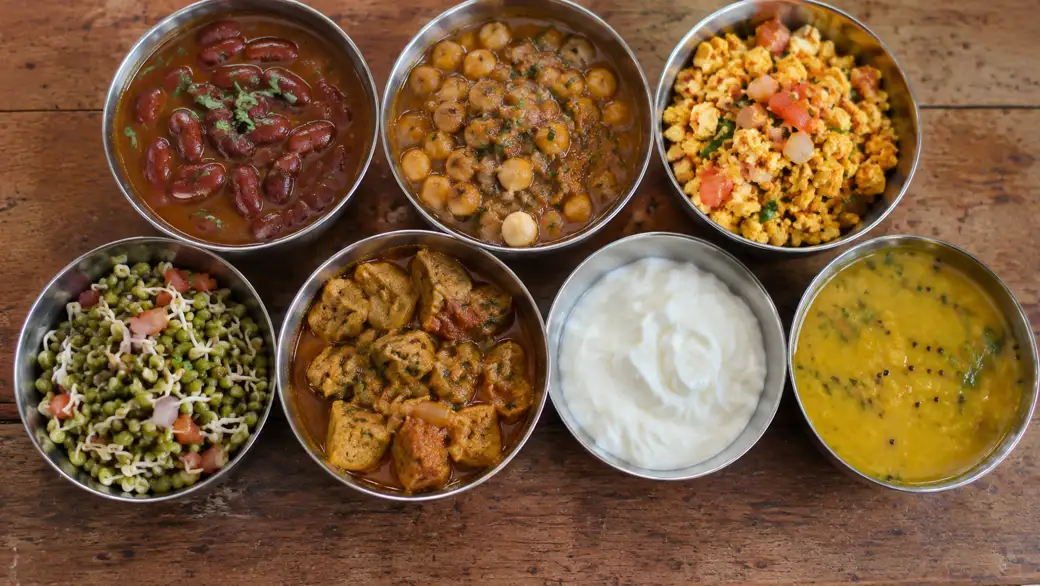
These are the foods to build meals around. Values are approximate and vary with brand and preparation.
| Food | Serving | Protein | Notes |
|---|---|---|---|
| Paneer | 100 g | 18 g | Dense and easy to eat in small amounts. Paneer made from toned milk is lower in fat |
| Soya chunks or granules | 30 g dry | 15 g | One of the most concentrated and economical sources; complete protein |
| Tofu | 100 g | 10 to 12 g | Complete protein; lower in fat than paneer |
| Hung curd or Greek-style yoghurt | 150 g | 12 to 15 g | Twice the protein of ordinary curd; easy on a queasy stomach |
| Curd | 1 katori (200 g) | 6 to 8 g | Adds up when taken twice a day |
| Milk | 1 glass (250 ml) | 8 g | Useful as a drink when solid food is hard |
| Chana, rajma, lobia, cooked | 1 katori | 12 to 15 g | Protein with fibre; soak and cook well |
| Dal, cooked thick | 1 katori | 7 to 9 g | Thin dal contains much less |
| Sprouted moong | 1 katori | 7 g | Light; good as chaat or in poha |
| Besan or moong chilla | 2 medium | 10 to 12 g | Higher when stuffed with paneer |
| Pesarattu | 2 medium | 12 g | Whole moong dosa |
| Sattu (roasted chana flour) | 30 g (2 heaped tablespoons) | 6 g | A traditional drink with water, lemon and salt |
| Roasted chana | 30 g (a handful) | 6 g | Convenient snack |
| Peanuts | 30 g (a handful) | 7 g | Also high in calories; keep to a handful |
| Almonds | 10 | 3 g | A supplement to meals, not a main source |
| Whey, soy or pea protein powder | 1 scoop | 20 to 25 g | Helpful when appetite is very small |
Foods that contribute less than people think
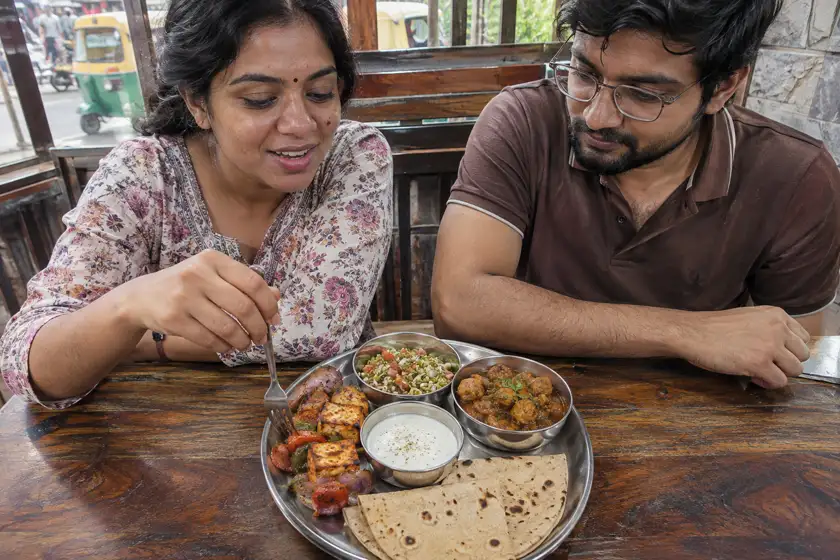
Roti provides about 3 grams each, a small katori of rice about 2, a katori of sabzi about 2, and a handful of nuts 3 to 7. They are part of a healthy diet, but they cannot carry the protein load. A katori of thin dal with two rotis is not a high-protein meal.
Protein quality for vegetarians
Proteins are made of amino acids, nine of which must come from food. Milk products and soya contain all nine in good proportions. Pulses are low in one and cereals are low in another, and the two make up for each other. This is why traditional combinations such as dal with roti or rice, khichdi, idli with sambar and rajma-chawal work so well. The two foods do not have to be eaten in the same mouthful, only across the day.
One amino acid, leucine, acts as the signal for muscle building. Dairy and soya are relatively rich in it, pulses less so. In practice, this means including a dairy or soya food at each main meal, alongside pulses, is the most reliable way for a vegetarian to protect muscle.
A simple rule
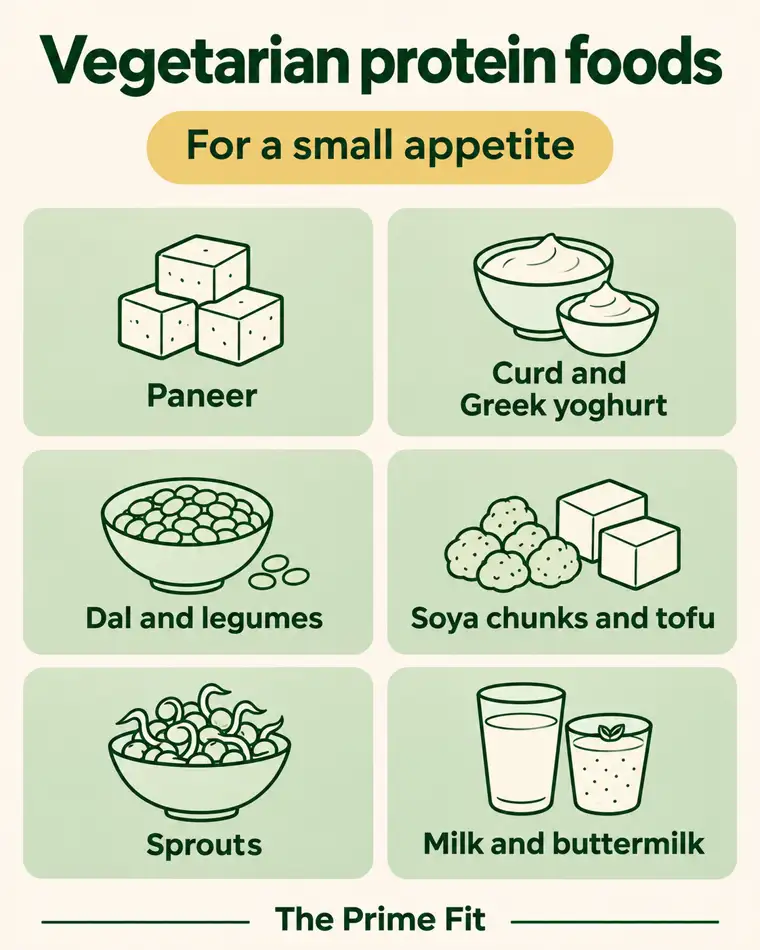
At every meal, include one food from this list: paneer, tofu, soya, hung curd, curd, milk, or a full katori of thick dal or pulses. Ideally two.
How to fit protein into a small appetite
- Eat the protein first. Dal, paneer and curd before the roti. If you are full, it is the roti that is left.
- Choose dense sources. Fifty grams of paneer or a small bowl of hung curd delivers what a large plate of other food would.
- Thicken your dal. Use less water, and add a second pulse or a spoon of besan.
- Drink some of it. Milk, chaas, a sattu drink, thick dal soup or a protein shake go down more easily than solids on difficult days.
- Add protein to what you already make: paneer or soya granules in sabzi, besan or sattu in roti dough, sprouts in poha and upma, curd in everything.
- Use five small eating occasions if three meals feel too large.
- Do not skip meals because you are not hungry. Eat by the clock.
- Keep ready-to-eat protein in the house: roasted chana, hung curd, boiled chana, paneer cubes, chilla batter.
The 7-day vegetarian menu, with protein counted
Portions are modest, to suit a reduced appetite. The figure in brackets after each meal is its approximate protein content in grams, and the last column shows the day’s total. Adjust with your dietitian. Drink 2 to 3 litres of fluid through the day.
| Day | Breakfast | Lunch | Evening | Dinner | Day total |
|---|---|---|---|---|---|
| Mon | 2 moong chillas with 50 g paneer filling, 1 katori curd (27) | 1 katori chana, 1 roti, sabzi, 1 katori curd (25) | 1 glass milk, a handful of roasted chana (14) | 75 g paneer with vegetables, 1 katori dal (23) | About 89 g |
| Tue | 150 g hung curd with 40 g oats and 10 almonds (22) | 1 katori rajma, small katori rice, sabzi, 1 katori curd (24) | Sprouts chaat, 1 glass chaas (10) | Soya chunk curry (30 g dry), 1 roti, 1 katori dal (26) | About 82 g |
| Wed | 2 besan chillas with 100 g hung curd dip (20) | 1 katori dal, palak paneer (75 g), 1 roti, salad (24) | Protein shake, 1 scoop in water (22) | Moong dal khichdi, kadhi, 1 katori curd (22) | About 88 g |
| Thu | 2 idlis, 1 katori sambar, peanut chutney, 1 glass milk (20) | 1 katori lobia, 1 roti, sabzi, 1 katori curd (25) | Paneer tikka, 75 g (13) | 100 g tofu stir-fry, dal soup, 1 roti (22) | About 80 g |
| Fri | 2 pesarattu with 1 katori curd (19) | Sambar, small katori rice, beans poriyal, half katori sundal, 1 katori curd (23) | Sattu drink, a handful of roasted chana (12) | Paneer bhurji (100 g), 1 roti, sabzi (23) | About 77 g |
| Sat | Sprouts poha with peanuts, 1 glass milk (18) | 1 katori mixed dal, soya-matar sabzi, 1 roti, raita (26) | 150 g hung curd with fruit (14) | Paneer and vegetable soup (75 g paneer), 1 katori dal (21) | About 79 g |
| Sun | Paneer-stuffed roti (60 g paneer), 1 katori curd (21) | 1 katori chole, 1 roti, salad, 1 katori curd (23) | 1 glass milk, a handful of peanuts (15) | Thick moong dal soup, 50 g paneer or tofu, sabzi (21) | About 80 g |
If your target is higher, add a scoop of protein powder to a glass of milk in the evening for a further 20 to 25 grams, or increase the paneer, tofu or hung curd at one meal. If your target is lower, reduce the roti and rice first, not the protein foods.
A closer look at one day
| Monday | Item | Protein |
|---|---|---|
| Breakfast | 2 moong chillas | 11 g |
| 50 g paneer filling | 9 g | |
| 1 katori curd | 7 g | |
| Lunch | 1 katori chana | 13 g |
| 1 roti | 3 g | |
| Sabzi | 2 g | |
| 1 katori curd | 7 g | |
| Evening | 1 glass milk | 8 g |
| Roasted chana, 30 g | 6 g | |
| Dinner | 75 g paneer with vegetables | 13 g |
| 1 katori dal | 8 g | |
| Sabzi | 2 g | |
| Total | 89 g |
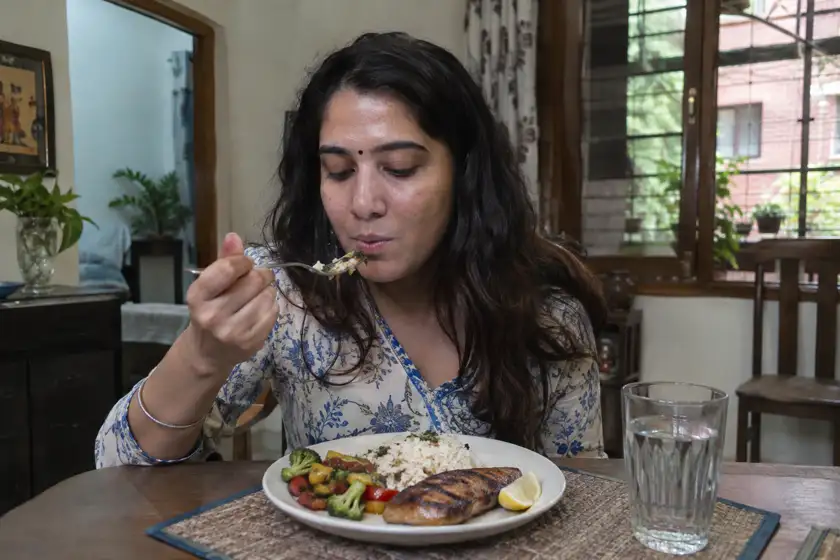
Notice where the protein comes from: paneer, curd, milk, chana, dal and the moong chillas supply about nine-tenths of it. The roti and sabzi supply the rest.
Vegan and dairy-free swaps
Without dairy, soya and pulses carry the load, and a protein supplement is more often needed.
| Instead of | Use | Protein |
|---|---|---|
| Paneer, 100 g | Firm tofu, 150 g | 15 to 18 g |
| Curd, 1 katori | Unsweetened soya curd, 1 katori | 6 to 7 g |
| Milk, 1 glass | Unsweetened fortified soya milk, 1 glass | 7 to 8 g |
| Hung curd | Silken tofu blended with lemon and salt | About 8 g per 100 g |
| Whey protein | Pea, soya or blended plant protein powder | 20 to 25 g per scoop |
| Paneer bhurji | Tofu or soya granule bhurji | 15 to 18 g |
Almond, oat, rice and coconut milks contain very little protein and are not substitutes in this respect. Vegans need a reliable source of vitamin B12, usually a supplement.
Jain and no-onion, no-garlic diets
The protein foods in this plan, dals, pulses, paneer, curd, milk, soya and besan, fit these diets without change. Prepare them in your usual way, and replace root vegetables in the sabzi with gourds, beans, cabbage, capsicum, tomatoes and leafy greens as your practice allows. If you avoid sprouted pulses or eat before sunset, shift the evening protein to an earlier snack and a slightly larger lunch. Because eating hours are shorter, a glass of milk or a protein drink in the afternoon helps you reach your total.
If you eat eggs
Eggs are an easy addition for those who accept them. Two eggs add 12 grams of high-quality protein in a small volume. Replace one item a day in the menu, for example the breakfast chillas, with a two-egg omelette or boiled eggs.
Protein powders: do you need one?
Food first. But on higher doses, with a very small appetite, a supplement can make the difference between meeting your target and falling well short.
| Type | Source | Points to know |
|---|---|---|
| Whey | Milk | Rich in leucine; quickly absorbed. Whey isolate is lower in lactose for those who are sensitive |
| Casein | Milk | Digested slowly; often taken at night |
| Soya | Soybean | Complete plant protein |
| Pea, or pea and rice blends | Pulses and grain | Suitable for vegans; blends improve the amino acid balance |
- Choose a product with about 20 to 25 grams of protein per scoop, little added sugar, and a short ingredient list.
- Prefer established brands with quality testing, bought from a reliable seller. Avoid products making weight loss or muscle-building claims with added stimulants.
- One scoop a day is enough for most people.
- Mix with milk, curd or water. Blending with fruit and a spoon of oats or seeds adds fibre.
- Sip slowly. A large shake drunk quickly can cause nausea on a GLP-1 medicine.
- If you have kidney disease, do not use protein supplements without your healthcare provider’s advice.
Traditional options work too. A sattu drink, milk with roasted chana, or hung curd with fruit are home-made protein supplements.
Managing gas and bloating from pulses
A slowed stomach and more pulses can mean more gas. These steps help.
- Soak whole pulses for 8 to 12 hours and discard the water.
- Pressure-cook until very soft.
- Add hing, ginger, jeera and ajwain to the tadka.
- Start with split, skinned dals such as moong and masoor, which are easiest to digest, and add chana and rajma gradually.
- Sprouting improves digestibility for many people; lightly steam sprouts if raw ones cause discomfort.
- Increase the amount slowly over two to three weeks.
- On nausea days, rely more on curd, hung curd, paneer, milk and thin moong dal.
- Walk for ten minutes after meals.
Other nutrients vegetarians should watch
| Nutrient | Why it matters on treatment | Vegetarian sources |
|---|---|---|
| Vitamin B12 | Energy, nerves, blood; commonly low in vegetarians and with metformin | Milk, curd, paneer; fortified foods; supplement if low |
| Iron | Prevents fatigue and hair shedding | Spinach, methi, bajra, ragi, chana, rajma; with lemon or amla, away from tea |
| Zinc | Hair, skin, immunity | Pumpkin and sesame seeds, peanuts, chana, whole grains |
| Calcium | Bone during weight loss | Milk, curd, paneer, ragi, sesame |
| Vitamin D | Bone and muscle | Sunlight, fortified milk; supplement if deficient |
| Omega-3 fats | Heart and skin | Walnuts, flaxseed, chia |
| Fibre | Prevents constipation | Vegetables, fruit, whole pulses, oats |
Ask your healthcare provider to check B12, iron stores and vitamin D before or early in treatment.
Keeping the calories sensible
Some vegetarian protein foods carry a good deal of fat. Full-fat paneer, nuts and peanut butter are nutritious but concentrated. To raise protein without overshooting on calories:
- Use paneer made from toned milk, or tofu, for some meals.
- Choose hung curd and low-fat curd.
- Grill, sauté or add paneer to gravies made with little oil, in place of frying it.
- Keep nuts to a small handful.
- Rely on soya, pulses and curd, which are lean.
- Measure cooking oil by the teaspoon.
Quick high-protein vegetarian ideas
| Idea | Approximate protein |
|---|---|
| Hung curd bowl with fruit and a spoon of seeds | 15 g |
| Paneer cubes tossed with capsicum and pepper | 14 to 18 g |
| Soya granule bhurji in a small roti wrap | 18 g |
| Besan chilla rolled with paneer and mint chutney | 15 g |
| Boiled chana chaat with lemon and tomato | 13 g |
| Milk with a scoop of protein powder | 28 to 30 g |
| Thick moong dal soup with a squeeze of lemon | 10 g |
| Tofu and vegetable stir-fry | 12 to 15 g |
| Sattu drink with roasted chana on the side | 12 g |
| Dhokla, 4 pieces, with curd | 12 to 15 g |
A weekly preparation routine
- Sunday: soak and pressure-cook chana and rajma; refrigerate in portions. Hang a batch of curd. Make chilla batter. Sprout moong.
- Midweek: make a second batch of hung curd and sprouts. Cook a large pot of thick dal and freeze single servings.
- Daily: set curd at night; cut paneer or tofu into cubes for the next day; fill your water bottle.
- Before a dose increase: stock moong dal, curd, idli batter and paneer for a gentle week.

Shopping list
| Category | Items |
|---|---|
| Dairy | Toned milk, curd, paneer, hung curd or Greek-style yoghurt |
| Soya | Soya chunks and granules, tofu, unsweetened soya milk |
| Pulses | Moong (whole and split), masoor, toor, chana, kabuli chana, rajma, lobia, besan, sattu |
| Grains | Whole wheat atta, bajra or jowar flour, oats, dalia, idli batter |
| Snacks | Roasted chana, peanuts, almonds, walnuts, makhana, mixed seeds |
| Vegetables and fruit | Leafy greens, gourds, beans, capsicum, tomatoes, cucumber; papaya, guava, apple, orange |
| Flavour and digestion | Ginger, jeera, hing, ajwain, lemon, mint, coriander |
| Optional | Whey, soya or pea protein powder |
Protein needs exercise to do its job
Protein supplies the material for muscle. Resistance exercise supplies the reason to keep it. Two or three sessions a week of simple strength work, sit-to-stands, wall push-ups, bridges and band rows, along with daily walking, make sure the protein you eat is used well. A protein-containing meal or snack within a couple of hours of training is ideal.
Troubleshooting
| Problem | Try this |
|---|---|
| “I cannot eat that much.” | Use dense foods and liquids: hung curd, paneer, milk, shakes. Five small occasions. Protein first |
| “Paneer feels heavy.” | Smaller amounts more often; tofu or hung curd instead; grilled or in soup, not in rich gravy |
| “Milk does not suit me.” | Curd and paneer are often tolerated; lactose-free milk; soya milk; whey isolate or plant protein |
| “Dal gives me gas.” | Soak, cook soft, add hing and ginger; use moong; increase slowly |
| “I am bored of the same foods.” | Rotate chillas, pesarattu, dhokla, sundal, tofu, soya, different dals and regional dishes |
| “I am losing hair and feel tired.” | Check protein intake over three days; test iron, B12 and vitamin D; review the pace of weight loss |
| “I have no time.” | Batch-cook pulses, keep chilla batter and hung curd ready, carry roasted chana |
| “My weight is not moving.” | Check portions of paneer, nuts and oil; keep protein, reduce refined carbohydrate; add strength training |
Common myths
“Vegetarians cannot get enough protein”
They can, with planning. The menu in this guide provides about 77 to 89 grams a day.
“Dal is a high-protein food, so dal and roti are enough”
A katori of dal has 7 to 9 grams. It needs support from dairy, soya or pulses in larger amounts.
“Soya is harmful”
Soya foods in normal amounts are safe for most people and are an excellent protein source. If you take thyroid tablets, keep soya a few hours apart from them.
“Protein damages the kidneys”
The amounts described here are safe for people with healthy kidneys. Those with kidney disease need individual advice.
“Protein powder is unnatural or only for bodybuilders”
It is food-derived protein in a convenient form, and can be useful when appetite is small.
“Plant protein must be combined at every meal”
Combining across the day is enough.
How The Prime Fit helps
At The Prime Fit, every patient on GLP-1 treatment has a dietitian who sets a personal protein target and builds a menu around the food you already cook, whether vegetarian, vegan, Jain or eggetarian. We count your protein with you, check vitamin B12, iron and vitamin D, review your plan every week, and track body composition so that you can see your muscle being preserved.
To get a vegetarian plan made for you, book a consultation or read about our GLP-1 support programme.
Frequently asked questions
How much protein do I need on a GLP-1 medicine?
Many adults are advised about 1.0 to 1.5 grams per kilogram of body weight a day, spread across three meals. Your dietitian will set your target, and it will be lower if you have kidney disease.
Can a vegetarian get enough protein on Mounjaro or Wegovy?
Yes. Build every meal around paneer, tofu, soya, hung curd, curd, milk, dals and pulses, and consider a protein supplement if your appetite is very small.
What are the best vegetarian protein foods?
Paneer, soya chunks, tofu, hung curd, curd, milk, chana, rajma, lobia, thick dal, sprouts, besan and sattu.
Is dal enough for protein?
Not on its own. A katori of thick dal provides 7 to 9 grams. Add dairy or soya, or a larger serving of pulses, at each meal.
Do I need a protein powder?
Not necessarily. It helps if you cannot reach your target with food, particularly on higher doses. One scoop a day is usually enough.
Which protein powder is best for vegetarians?
Whey is rich in leucine and widely used. Soya or pea-rice blends suit vegans. Choose a product with little added sugar from a reliable brand.
How do I eat enough protein when I am not hungry?
Eat the protein first, choose dense foods such as paneer and hung curd, use liquids like milk and shakes, and have five small eating occasions.
Can vegans meet their protein needs on treatment?
Yes, with tofu, soya chunks, soya milk, pulses and usually a plant protein powder, plus a vitamin B12 supplement.
Will more protein slow my weight loss?
No. Protein helps you lose fat while keeping muscle. Watch the fat that comes with paneer and nuts.
Is too much paneer unhealthy?
Paneer is nutritious but high in fat. Use moderate portions, prefer toned-milk paneer, and rotate with tofu, soya, curd and pulses.
This article is general information and is not a substitute for a consultation. Protein values are approximate. People with kidney disease or other medical conditions should follow the protein target set by their healthcare provider and dietitian.