In this article
- What Wegovy is, and why the dose rises gradually
- The Wegovy dose schedule at a glance
- Step by step: what each dose is for and what to expect
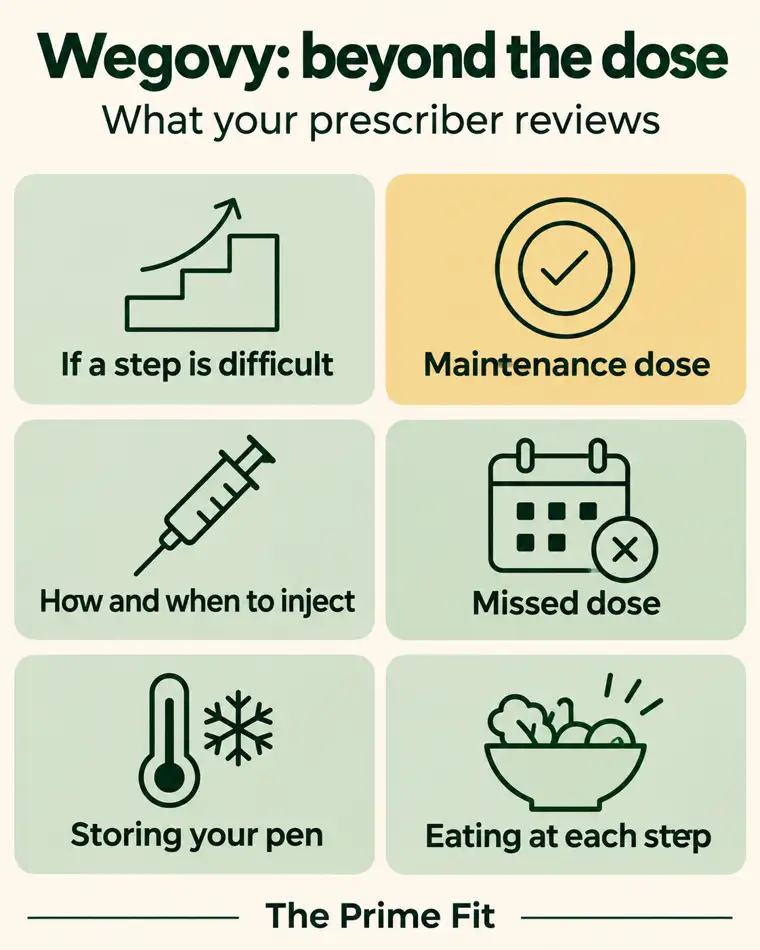
- If side effects make a step difficult
- The maintenance dose
- How and when to inject
- What to do if you miss a dose
- Storing your pen
- Eating well at each dose step
- Side effects and the dose
- How your healthcare provider decides when to move up
- A 16-week checklist
- A gentle-day menu for the days after an increase
- Questions to ask at each dose review
- Wegovy and Ozempic: the same ingredient, different doses
- How Wegovy doses compare with Mounjaro
- Special situations
- Common dosing mistakes
- A realistic timeline
- How dosing is managed at The Prime Fit
- Frequently asked questions
Wegovy (semaglutide 2.4 mg) is a once-weekly injection for long-term weight management. Like other medicines in its class, it is not started at the full dose. The amount is raised in steps over about four months, so that the body can adapt and side effects are kept to a minimum.
Understanding the schedule makes treatment easier. You will know what each dose is for, why your healthcare provider may slow down, what “maintenance” means and what to do when life gets in the way of a dose. This guide covers the full dosing journey in plain language, with practical advice on food at each step.
It is general information to help you understand your treatment. Your dose and timing must come from your prescriber, and the leaflet supplied with your pen is the final reference for your particular product.
What Wegovy is, and why the dose rises gradually
Wegovy contains semaglutide, which copies the action of the gut hormone GLP-1. It reduces appetite and cravings, increases the feeling of fullness and slows the emptying of the stomach. It is used alongside a reduced-calorie diet and physical activity in adults who meet medical criteria for treatment. The same ingredient is used at lower doses, under the name Ozempic, for type 2 diabetes.
Semaglutide stays in the body for a long time. Its half-life is about one week, which is why it is injected weekly, and it takes four to five weeks at any dose for the level in the blood to become steady. That is the reason each step lasts four weeks: by the end of the fourth week your body has fully experienced that dose, and you and your healthcare provider can judge how you are tolerating it before moving on.
Digestive side effects, mainly nausea, are closely linked to how quickly the dose rises. A gradual schedule gives the stomach and the brain’s appetite centres time to adjust.
The Wegovy dose schedule at a glance
| Weeks | Weekly dose | Purpose |
|---|---|---|
| 1 to 4 | 0.25 mg | Starting dose; lets the body adjust |
| 5 to 8 | 0.5 mg | Step dose |
| 9 to 12 | 1 mg | Step dose |
| 13 to 16 | 1.7 mg | Step dose; can serve as a maintenance dose for some people |
| 17 onwards | 2.4 mg | Recommended maintenance dose |
Three rules summarise it:
- Start at 0.25 mg once a week.
- Increase every four weeks, one step at a time, if the current dose is tolerated.
- Aim for 2.4 mg once a week as the maintenance dose, and do not exceed the dose prescribed.
If every step is taken on time, the maintenance dose is reached in week 17. Many people take longer, and that is perfectly acceptable.
Step by step: what each dose is for and what to expect
0.25 mg: weeks 1 to 4
This is an introductory dose. It is too low to produce much weight loss in most people, and that is intentional. You may notice a slightly smaller appetite or feel full sooner. Some people feel nothing at all. Mild nausea, burping or a change in bowel habit can occur, usually in the first few days after each injection.
Use this month to build the habits that will make the higher doses comfortable: smaller plates, slower eating, protein with every meal, less oil, and a daily water target.
0.5 mg: weeks 5 to 8
Appetite reduction becomes more noticeable. Portions shrink without much effort, and snacking between meals often falls away. Weight usually starts to move. If nausea appears after the increase, it tends to settle within one to two weeks.
1 mg: weeks 9 to 12
This is the dose at which many people first feel clearly in control of their eating. It is also the highest dose commonly used for diabetes under the Ozempic name in many countries, so there is a great deal of experience with it. Steady weight loss is typical. Constipation may become more of an issue as food intake falls, so fluids and fibre matter.
1.7 mg: weeks 13 to 16
A larger step. Some people notice a return of nausea, fullness or reflux for a week or so. Eating lightly in the days after the first 1.7 mg injection helps. For people who cannot tolerate 2.4 mg, healthcare professionals may keep this as the long-term dose.
2.4 mg: week 17 onwards
This is the dose studied in the main weight-management trials. Over 68 weeks, adults without diabetes lost about 15 percent of their body weight on average with semaglutide 2.4 mg and lifestyle support, compared with 2 to 3 percent on placebo. About half lost 15 percent or more, and around one in three lost 20 percent or more. People with type 2 diabetes lost somewhat less, about 10 percent on average.
Trial averages are not promises
These figures are averages from clinical trials in which participants also received diet and activity support. Individual results vary, and roughly one person in seven loses less than 5 percent.

If side effects make a step difficult
The schedule is a guide, not a race. If you have significant nausea, vomiting, diarrhoea or constipation at any step, tell your healthcare provider before the next increase. The usual options are:
| Option | What it means |
|---|---|
| Delay the increase | Stay on the current dose for another four weeks, or longer, before stepping up |
| Step back | Return to the previous dose until symptoms settle, then try again |
| Maintain at 1.7 mg | If 2.4 mg is not tolerated, remain on 1.7 mg long term |
| Supportive treatment | Short-term medicines for nausea, reflux or constipation, and dietary changes |
| Change medicine | If semaglutide does not suit you, another medicine in the class may |
Slowing down does not reduce your eventual result. It usually improves it, because people who are comfortable stay on treatment.
The maintenance dose
Once you reach 2.4 mg, or 1.7 mg if that is your tolerated dose, you continue at that level. Weight loss carries on for many months and typically levels off after about a year to 16 months. That plateau is expected. It marks the point at which your body has reached a new balance at a lower weight.
Obesity is a long-term condition, and trials show that weight tends to return when semaglutide is stopped: on average, about two-thirds of the weight lost was regained within a year of stopping. For this reason maintenance is usually planned as continued treatment, with regular reviews, at the lowest dose that holds your result. Any plan to reduce or stop should be made with your healthcare provider.
A higher dose of semaglutide than 2.4 mg has been studied in trials. Whether and where it is available depends on local approvals, and your healthcare provider can tell you what applies to you.
How and when to inject
- Once a week, on the same day each week. Pick a day you will remember. If you tend to feel queasy for a day or two after the injection, choose a day followed by quieter days.
- Any time of day, with or without food.
- Under the skin of the abdomen, the front of the thigh or the upper arm.
- Rotate the injection site each week. You can stay in the same area, but use a different spot.
- Avoid skin that is tender, bruised, scarred or hard.
- Follow the instructions for your pen. Wegovy is supplied in different devices in different countries, including single-dose pens and multi-dose pens. The steps for selecting the dose, attaching a needle and giving the injection differ. Ask your healthcare provider, nurse or pharmacist to demonstrate, and read the leaflet in the pack.
Changing your injection day
You can change the day of the week, provided there are at least two days (48 hours) between two doses. Then continue weekly on the new day.
What to do if you miss a dose
| Situation | What to do |
|---|---|
| You have missed a dose and the next scheduled dose is more than 2 days (48 hours) away | Take the missed dose as soon as possible, then continue on your usual day |
| You have missed a dose and the next scheduled dose is less than 2 days away | Skip the missed dose and take the next one on your usual day |
| You have missed doses for more than 2 weeks | Contact your healthcare provider before restarting. You may continue as scheduled or be advised to restart at a lower dose and build up again, to reduce side effects |
Do not take a double dose. A weekly phone reminder, or linking the injection to a fixed weekly routine, prevents most missed doses.

Storing your pen
- Keep it in the refrigerator, between 2°C and 8°C, in its carton to protect it from light.
- Do not freeze it, and do not use a pen that has been frozen.
- Pens can usually be kept at room temperature for a limited time. The permitted period and temperature differ between single-dose and multi-dose pens, so follow the leaflet for your product.
- With a multi-dose pen, note the date of first use and discard it after the in-use period stated in the leaflet, even if some medicine remains.
- Keep the cap on when not in use. Remove the needle after each injection.
- Check that the liquid is clear and colourless before injecting.
- In hot weather and when travelling, carry it in an insulated pouch with a cool pack, not touching ice directly.
- Dispose of needles in a puncture-proof container.
Eating well at each dose step
Food choices strongly influence how each step feels. Treat the first week after every increase as a gentle week.
| Stage | Food focus | Indian examples |
|---|---|---|
| 0.25 to 0.5 mg | Build the pattern: three small meals, protein at each, less oil and sugar | Moong chilla with curd; dal, sabzi and 1 to 2 rotis; paneer or egg bhurji with vegetables |
| Week after any increase | Light, low-fat, easy to digest; fluids between meals | Khichdi, idli with sambar, curd rice, dalia, clear soups, soft phulka with dal |
| 1 to 1.7 mg | Protect protein as appetite falls; add fibre and fluid to prevent constipation | Curd, sprouts, chana, tofu, eggs, fish, chicken; papaya, guava, vegetables; 2 to 3 litres of fluid |
| 2.4 mg maintenance | Protein first at every meal; strength training twice a week; regular meal times even without hunger | Protein food, then vegetables, then roti or rice; a protein supplement if your dietitian advises |
The foods most likely to trigger nausea are deep-fried snacks, rich gravies, very sweet desserts, large portions and alcohol. Keep them small, especially around dose increases.
Side effects and the dose
The most common side effects are nausea, diarrhoea, vomiting, constipation, abdominal discomfort, headache and tiredness. In the main trial, about four in ten people reported nausea at some point, and around one in fifteen stopped treatment because of side effects. Most symptoms are mild to moderate, appear around dose increases and settle with time.
Seek medical help urgently if
You have severe, persistent abdominal pain, with or without vomiting; repeated vomiting and cannot keep fluids down; yellowing of the eyes or skin; signs of dehydration such as very little urine or dizziness on standing; or swelling of the face or throat or difficulty breathing. Do not take your next dose until you have been assessed.
For a full explanation, see our complete guide to GLP-1 side effects.
How your healthcare provider decides when to move up
At each four-week point, your healthcare provider looks at more than the calendar. The usual questions are:
- Are you tolerating the current dose? No vomiting, and any nausea or bowel changes are mild and settling.
- Are you eating and drinking enough? Three meals with protein, and adequate fluids.
- How fast is your weight falling? About 0.5 to 1 kg a week is a healthy pace. Faster loss is a reason to pause.
- Are your other medicines in order? Blood sugar and blood pressure treatment may need adjusting first.
- Is the timing right for you? A dose increase just before travel, a wedding or exams may be better postponed.
If the answers are satisfactory, the next step goes ahead. If not, staying where you are for another month is a sound decision, not a setback.
A 16-week checklist
| Weeks | Dose | Your focus | Check with your team |
|---|---|---|---|
| 1 to 4 | 0.25 mg | Learn the injection; set meal times; water target; start walking daily | Any early side effects; injection technique |
| 5 to 8 | 0.5 mg | Protein at each meal; smaller plate; reduce fried food and sugar | Tolerance before the next step; weight trend |
| 9 to 12 | 1 mg | Add strength training twice a week; fibre and fluids for the bowel | Blood sugar or blood pressure medicines if you take them |
| 13 to 16 | 1.7 mg | Gentle week after the increase; track protein for a few days | Whether to move to 2.4 mg or hold |
| 17 onwards | 2.4 mg | Keep the routine; monthly waist measurement; body composition if available | Three-month review of weight, tests and side effects |
A gentle-day menu for the days after an increase
| Meal | Vegetarian | Non-vegetarian |
|---|---|---|
| Breakfast | 2 idlis with sambar, or 1 moong chilla with curd | 2 soft-scrambled eggs with 1 slice of toast |
| Mid-morning | Chaas or papaya | Coconut water or chaas |
| Lunch | Small bowl of moong dal khichdi with lauki and curd | Small portion of rice with light fish curry and vegetables |
| Evening | Roasted makhana with ginger tea | Boiled egg with ginger tea |
| Dinner | Vegetable dal soup with 1 soft phulka and paneer | Clear chicken and vegetable soup with 1 phulka |
Portions are small on purpose. Eat slowly, stop at the first sign of fullness, and sip fluids between meals.
Questions to ask at each dose review
- Should I move to the next dose, stay, or step back?
- Is my rate of weight loss healthy?
- Am I getting enough protein, and is my muscle being protected?
- Do any of my other medicines need to change?
- When is my next blood test or review?
Wegovy and Ozempic: the same ingredient, different doses
Both contain semaglutide. The difference lies in the doses supplied and the licensed use.
| Wegovy | Ozempic | |
|---|---|---|
| Licensed for | Weight management | Type 2 diabetes |
| Dose steps | 0.25, 0.5, 1, 1.7, 2.4 mg weekly | 0.25, 0.5, 1 mg weekly (2 mg in some countries) |
| Maintenance dose | 2.4 mg (or 1.7 mg) | 0.5 to 1 mg, or 2 mg where available |
| Average weight loss in trials | About 15% without diabetes | Smaller, at the lower doses used for diabetes |
If your healthcare provider moves you from Ozempic to Wegovy, the dose can usually be carried across at the equivalent strength and then increased within the Wegovy range.
How Wegovy doses compare with Mounjaro
Mounjaro contains a different molecule, tirzepatide, with its own dose steps of 2.5 to 15 mg. Milligrams of one cannot be compared with milligrams of the other. A dose of 2.4 mg of semaglutide is not “weaker” than 5 mg of tirzepatide in any simple arithmetic sense. If you switch between them, your healthcare provider will choose the starting dose and build it up again.

Special situations
Type 2 diabetes
The schedule is the same. If you take insulin or a sulfonylurea, those doses may need to be reduced to prevent low blood sugar. People with diabetic eye disease should have their eyes checked, because a rapid improvement in blood sugar can temporarily worsen retinopathy.
Pregnancy and breastfeeding
Wegovy is not recommended in pregnancy or while breastfeeding. Because semaglutide clears slowly, it is usually stopped at least two months before a planned pregnancy. Use effective contraception during treatment.
Contraceptive pills
Semaglutide has not been shown to reduce the effectiveness of oral contraceptives to a clinically important degree. If you have severe vomiting or diarrhoea, follow the usual missed-pill advice.
Kidney and liver conditions
No routine dose change is needed, but dehydration from vomiting or diarrhoea can affect the kidneys. Drink enough and report persistent symptoms.
Older adults
The same steps apply. Slower increases, good protein intake and strength exercise are sensible to protect muscle.
Surgery, endoscopy and anaesthesia
Tell your surgeon and anaesthetist that you are on semaglutide. Because it slows stomach emptying, they may ask you to pause it or adjust fasting instructions.
Travel, festivals and busy periods
Weekly dosing is flexible enough to fit around real life. If a dose increase falls just before a long journey, a wedding or a festival, ask your healthcare provider whether to stay on the current dose until afterwards; a familiar dose is far less likely to cause nausea when your meals and routine are disrupted. When travelling, keep the pen cool in an insulated pouch, carry it in your hand luggage with your prescription, and set a reminder in the time zone you will be in. If your usual day becomes inconvenient, you can move it, keeping at least two days between doses.
Who should not take it
Anyone with a personal or family history of medullary thyroid carcinoma or MEN 2, or a previous serious allergic reaction to semaglutide. Caution is needed with a history of pancreatitis, gallbladder disease or severe stomach or bowel disease.
Common dosing mistakes
- Expecting results at 0.25 mg. The first month is for adjustment. Judge the treatment once you have been on a full dose for about three months.
- Jumping steps to speed things up. This is the commonest cause of severe nausea and vomiting.
- Increasing despite ongoing side effects. Hold or step back first.
- Counting clicks or splitting doses on a multi-dose pen without medical advice.
- Doubling up after a missed dose.
- Restarting at a high dose after several missed weeks.
- Using a pen beyond its in-use period, or one that has been left out too long.
- Skipping meals because you are not hungry, which leads to fatigue, constipation, hair shedding and muscle loss.
- Sharing a pen with someone else.
- Buying from unverified sources.
A realistic timeline
| Period | Dose | What usually happens |
|---|---|---|
| Month 1 | 0.25 mg | Adjustment; little or no weight change |
| Month 2 | 0.5 mg | Appetite begins to fall; weight starts to move |
| Month 3 | 1 mg | Clear appetite control; steady loss |
| Month 4 | 1.7 mg | Further loss; watch protein and constipation |
| Months 5 to 12 | 2.4 mg | Most of the weight loss occurs |
| Months 12 to 16 | 2.4 mg | Gradual levelling off |
| Beyond | Maintenance | Weight held with continued treatment and regular reviews |
How dosing is managed at The Prime Fit
At The Prime Fit, Wegovy is prescribed only after an expert-led assessment of your history, medicines and blood tests. The dose is stepped up when you are ready, not simply when the calendar says so, and held or reduced if side effects appear. Your dietitian plans meals around Indian food for each step, with protein targets and weekly follow-up, and the team is available between visits if you have questions about a dose or a pen.
To find out whether Wegovy is suitable for you, book a consultation or read more about our Wegovy programme and GLP-1 therapy.
Frequently asked questions
What is the starting dose of Wegovy?
The starting dose is 0.25 mg once a week for four weeks. It allows the body to adjust and is not expected to produce much weight loss.
How long does it take to reach 2.4 mg?
Sixteen weeks if each four-week step is taken on time: 0.25, 0.5, 1 and 1.7 mg, then 2.4 mg from week 17. Your healthcare provider may extend any step if you have side effects.
Can I stay on a lower dose?
The recommended maintenance dose is 2.4 mg. If you cannot tolerate it, 1.7 mg can be used long term. Staying on lower doses is a decision for you and your healthcare provider, based on your response.
What if I get side effects when the dose goes up?
Tell your healthcare provider. The increase can be delayed by four weeks or more, or the dose stepped back, until you feel well.
What should I do if I miss a dose?
If your next dose is more than two days away, take the missed dose as soon as you can. If it is less than two days away, skip it. If you have missed more than two weeks, speak to your healthcare provider before restarting.
Can I change my injection day?
Yes, as long as there are at least two days between doses. Then continue weekly on the new day.
Is Wegovy the same as Ozempic?
Both contain semaglutide. Wegovy is licensed for weight management and goes up to 2.4 mg. Ozempic is licensed for type 2 diabetes at lower doses.
How much weight will I lose on 2.4 mg?
In trials, adults without diabetes lost about 15 percent of body weight on average over 68 weeks, with diet and activity support. Results vary between individuals.
Can I increase the dose faster to lose weight sooner?
No. Faster increases cause more side effects and do not give better long-term results.
How long will I need to take Wegovy?
It is intended for long-term use. Weight usually returns after stopping, so any plan to reduce or stop should be made with your healthcare provider.
This article is general information and is not a substitute for a consultation. Wegovy is a prescription-only medicine. Always follow your healthcare provider’s instructions and the leaflet supplied with your medicine.