In this article
- Why Mounjaro causes side effects
- How common are side effects at each dose?
- When side effects appear and how long they last
- The common side effects and how to manage them
- Uncommon and rare but serious side effects
- Two interactions that are specific to Mounjaro
- Who is more likely to have side effects?
- A dose-by-dose survival guide
- A gentle-week menu
- How Mounjaro’s side effects compare with Wegovy and Ozempic
- What long-term data show
- When should the dose be changed?
- Keep a simple side-effect diary
- Questions to ask your healthcare provider
- Ten habits that prevent most side effects
- Common myths
- How The Prime Fit keeps treatment comfortable
- Frequently asked questions
Before starting Mounjaro (tirzepatide), almost everyone asks the same two questions: “How much weight will I lose?” and “What will the side effects be like?” The second question often decides whether people start at all, and whether they continue.
The honest picture is reassuring but not trivial. In the main weight-management trial, most participants had at least one side effect, usually nausea, loose stools or constipation. Most of these were mild or moderate, appeared when the dose was started or increased, and faded within days to a couple of weeks. Only about one person in twenty stopped treatment because of side effects. Serious problems were uncommon.
This guide explains what is known about Mounjaro’s side effects specifically: how often each occurs at different doses, when they tend to appear, how to manage them with food and routine, and which symptoms need medical attention. It is general information and does not replace advice from your prescriber or the leaflet supplied with your medicine.
Why Mounjaro causes side effects
Tirzepatide activates receptors for two gut hormones, GIP and GLP-1. The effects that help with weight are the same ones that cause most symptoms.
- Slower stomach emptying: food stays in the stomach longer. You feel full sooner, and if you eat too much or too richly, you feel nauseous, bloated or acidic.
- Action on appetite centres in the brain: hunger falls. Eating and drinking too little can then cause tiredness, dizziness, constipation and headaches.
- Changes in bowel movement: some people get loose stools, others constipation.
- Insulin release when blood sugar is high: on its own this rarely causes low sugar, but it can when combined with insulin or sulfonylurea tablets.
The body adapts to these effects over a few weeks at each dose. That is the reason for the stepwise schedule: 2.5 mg for four weeks, then increases of 2.5 mg no more often than every four weeks.
How common are side effects at each dose?
The figures below are approximate, taken from the main 72-week trial of tirzepatide in adults with obesity or overweight who did not have diabetes. They show the proportion of people who reported each symptom at any time during the trial.
| Side effect | 5 mg | 10 mg | 15 mg | Placebo |
|---|---|---|---|---|
| Nausea | About 25 in 100 | About 33 in 100 | About 31 in 100 | About 10 in 100 |
| Diarrhoea | About 19 in 100 | About 21 in 100 | About 23 in 100 | About 7 in 100 |
| Constipation | About 17 in 100 | About 17 in 100 | About 12 in 100 | About 6 in 100 |
| Vomiting | About 8 in 100 | About 11 in 100 | About 12 in 100 | About 2 in 100 |
| Indigestion | About 9 in 100 | About 10 in 100 | About 11 in 100 | About 4 in 100 |
| Hair shedding | About 5 in 100 | About 5 in 100 | About 6 in 100 | About 1 in 100 |
| Stopped treatment because of side effects | About 4 in 100 | About 7 in 100 | About 6 in 100 | About 3 in 100 |
Three things stand out. Side effects are somewhat more frequent at 10 and 15 mg than at 5 mg, but the difference is modest. A fair number of people on placebo also reported these symptoms, which are common in everyday life. And the great majority of people, more than nine in ten, did not stop treatment because of them.
How to read these numbers
“About 25 in 100” means that a quarter of people had nausea at some point over nearly a year and a half, often for a few days after a dose increase. It does not mean a quarter of people felt sick all the time.
When side effects appear and how long they last
| Time | What is typical |
|---|---|
| Days 1 to 3 after an injection | The most likely time for nausea, fullness or a loose stool, particularly after the first dose at a new strength |
| Weeks 1 to 4 (2.5 mg) | Mild effects in some; many people feel very little. Appetite begins to fall |
| First 1 to 2 weeks after each increase | A brief return of digestive symptoms, usually milder each time |
| Weeks 3 to 4 on a given dose | Symptoms have usually settled |
| Months 3 to 6 | Constipation may persist if fluids and fibre are low; temporary hair shedding may begin in some people |
| On a stable maintenance dose | Most people have few or no digestive symptoms |
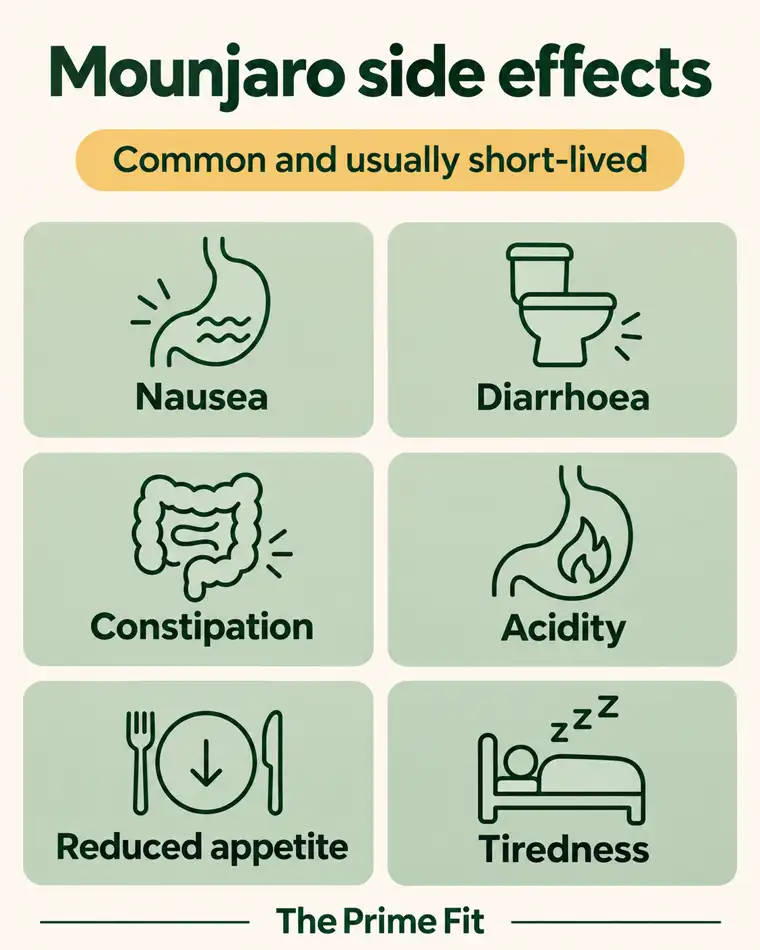
In the trials, nausea, vomiting and diarrhoea were most frequent during the dose-escalation period, roughly the first five months, and declined afterwards.

The common side effects and how to manage them
Nausea
Nausea is the most frequent complaint. It is usually triggered by eating a little too much, too quickly, or too richly for a stomach that is emptying slowly.
- Halve your usual portion and eat over 15 to 20 minutes. Stop at the first hint of fullness.
- Choose light, low-fat food: khichdi, dal with soft phulka, idli with sambar, curd rice, dalia, clear soups, boiled or lightly sautéed vegetables, eggs.
- Avoid fried snacks, rich gravies, very sweet foods and strong cooking smells for a few days.
- Sip fluids between meals. Ginger tea, jeera water, nimbu pani with little sugar or cold water help many people.
- Do not lie down for two hours after eating.
- Keep plain foods handy: toast, khakhra, banana, roasted makhana.
If nausea persists beyond two weeks at the same dose or stops you eating, tell your healthcare provider. Staying longer on the current dose, stepping back, or a short course of anti-nausea medicine usually solves it.
Vomiting
Vomiting most often follows a large or oily meal. An isolated episode after a dose increase is not unusual. Rest the stomach for an hour, then sip water or ORS, and return to light food. Do not take an extra injection.
Diarrhoea
Loose stools tend to come in short bouts. Replace fluid and salts with ORS, chaas, coconut water or salted nimbu pani. Eat curd rice, banana, khichdi and toast for a day or two, and avoid oily, spicy and very sweet foods. Sugar alcohols in “sugar-free” sweets and some protein bars can worsen it.
Constipation
Constipation is common and, unlike nausea, may not fade by itself, because the gut is moving more slowly and you are eating and drinking less.
- Drink 2 to 3 litres of fluid a day unless your healthcare provider has set a limit.
- Add fibre gradually: vegetables twice a day, papaya, guava or pear, whole dals, oats, soaked chia or isabgol with plenty of water.
- Walk daily, and sit on the toilet at a regular time after breakfast.
- Ask your healthcare provider about a gentle laxative if this is not enough.
Acidity, burping and bloating
Reflux and sulphur-smelling burps come from food remaining in the stomach. Smaller meals, an early dinner, less oil and fewer fizzy drinks help. Limit fried food, heavy gravies, chocolate, strong coffee on an empty stomach and alcohol. An antacid can be prescribed if needed.
Reduced appetite
This is the intended effect, but it can go too far. If you are eating fewer than two proper meals a day, or struggling to drink, tell your care team. Eat by the clock, protein first, and use liquids such as milk, chaas, dal soup or a protein shake.
Tiredness, headache and dizziness
These usually reflect low food or fluid intake, or blood pressure and blood sugar running lower than you are used to. Eat three small meals with protein and some whole-grain carbohydrate, drink regularly, add a pinch of salt to chaas or nimbu pani in hot weather, and stand up slowly. If you take blood pressure or diabetes medicines, the doses may need reducing as you lose weight.
Injection-site reactions
Redness, itching or a small lump at the injection site occurs in a few people in every hundred and usually settles within days. Rotate between the abdomen and thighs, let the alcohol swab dry before injecting, and do not inject into the same spot each week. A spreading rash, hives, or swelling of the face or throat is different and needs urgent attention.
Hair shedding
About one person in twenty reported hair loss in the trial. It is linked to rapid weight loss and low protein or iron, typically begins two to four months into treatment, and usually recovers once weight stabilises. Adequate protein and correcting iron, vitamin D and B12 deficiency are the main preventive steps.
A slightly faster pulse
Medicines in this class raise the resting heart rate by a few beats per minute on average. Most people do not notice it. Tell your healthcare provider about palpitations, a racing heart at rest or breathlessness.
Uncommon and rare but serious side effects
| Problem | How often | Warning signs | What to do |
|---|---|---|---|
| Gallstones and gallbladder inflammation | Uncommon; under 1 in 100 for gallbladder inflammation in the main trial | Steady pain under the right ribs or in the upper centre, often after a meal, sometimes with fever or yellow eyes | See a healthcare professional promptly; urgently with fever or jaundice |
| Pancreatitis | Rare; about 2 in 1,000, similar to placebo in the trial | Severe, persistent upper abdominal pain, often through to the back, with vomiting | Stop the injection and seek emergency care |
| Dehydration and kidney injury | Uncommon; follows prolonged vomiting or diarrhoea | Very little urine, dizziness on standing, marked weakness | Rehydrate and contact your healthcare provider the same day |
| Low blood sugar | Mainly with insulin or sulfonylureas | Shaking, sweating, hunger, confusion, palpitations | Take fast-acting sugar, recheck, and tell your healthcare provider so doses can be adjusted |
| Severe allergic reaction | Rare | Swelling of the face, lips or throat; difficulty breathing; widespread rash | Emergency care immediately |
| Severe stomach slowing or bowel blockage | Rare | Persistent vomiting of undigested food, severe bloating, unable to pass stool or gas | Urgent medical assessment |
| Worsening of diabetic eye disease | In people with existing retinopathy, when blood sugar falls quickly | New blurring or loss of vision | Report promptly; keep regular eye checks |
| Changes in mood | Not shown to be caused by the medicine, but should be reported | Persistent low mood, anxiety, thoughts of self-harm | Contact your healthcare provider; seek urgent help for thoughts of self-harm |
The thyroid warning
In studies in rats, tirzepatide caused thyroid C-cell tumours, including medullary thyroid carcinoma. It is not known whether this happens in humans, and this type of cancer is rare. As a precaution, Mounjaro must not be used by anyone with a personal or family history of medullary thyroid carcinoma or multiple endocrine neoplasia syndrome type 2 (MEN 2). Common thyroid conditions such as hypothyroidism do not prevent treatment. Report a lump in the neck, persistent hoarseness or difficulty swallowing.
Anaesthesia and procedures
Because the stomach empties slowly, food may remain in it despite normal fasting. Tell your surgeon, anaesthetist or endoscopist well in advance that you take Mounjaro and when your last dose was.
Seek medical help urgently if you have
Severe or persistent abdominal pain; repeated vomiting and cannot keep fluids down; yellowing of the eyes or skin; very little urine or fainting; swelling of the face or throat or difficulty breathing; or severe low blood sugar. Do not take your next dose until you have been assessed.
Two interactions that are specific to Mounjaro
The oral contraceptive pill
Tirzepatide can reduce and delay the absorption of oral contraceptives, mainly after the first dose and after each dose increase. Women using the pill are advised to add a barrier method, or switch to a non-oral method, for four weeks after starting and for four weeks after every increase.
Diabetes medicines
If you take insulin or a sulfonylurea such as glimepiride or gliclazide, your healthcare provider will usually lower the dose when Mounjaro is started or increased, to prevent low blood sugar. Check your sugars more often around dose changes.
Slower stomach emptying can also affect how some other tablets are absorbed. Give your healthcare provider a full list of your medicines.

Who is more likely to have side effects?
- People whose dose is increased quickly, or before symptoms from the previous step have settled
- Those who continue to eat large, oily or late meals
- People who drink little water
- Women, who report nausea more often than men
- People with a history of reflux, gastritis or motion sickness
- Those taking other medicines that slow the gut or upset the stomach
- People with long-standing diabetes affecting the stomach
- Anyone who drinks alcohol around injection days
None of these rules out treatment. They are reasons to go slowly and prepare.
A dose-by-dose survival guide
| Dose | What to expect | What to do |
|---|---|---|
| 2.5 mg | Often very little. Possibly mild nausea or a change in bowel habit in the first days | Set up habits now: small plate, protein first, water target, less fried food |
| 5 mg | The first real appetite change. Nausea or loose stools for a few days in some | Gentle week after the first 5 mg dose. Start fibre and a daily walk to prevent constipation |
| 7.5 mg | A brief return of symptoms is common | Light meals for a week; no restaurant meals in the first few days |
| 10 mg | Stronger appetite suppression; constipation and fatigue if intake is low | Track protein and fluids; eat by the clock; consider a protein shake |
| 12.5 mg | Similar to the previous step; some people reach their limit here | If symptoms have not settled by week four, ask to stay or step back |
| 15 mg | Highest rate of digestive effects, though not much higher than 10 mg | Only if needed and if lower doses were well tolerated. Five small eating occasions may suit better than three meals |
Remember that four weeks on each step is the minimum. Staying longer is allowed, and many people never need the top dose. The 5 mg dose produced about 15 percent weight loss on average in its main trial.
A gentle-week menu
Use this pattern for the first few days after any dose increase. Portions are small on purpose.
| Meal | Vegetarian | Non-vegetarian |
|---|---|---|
| On waking | Warm water or jeera water | Warm water or ginger tea |
| Breakfast | 2 idlis with sambar, or 1 moong chilla with curd | 2 soft-scrambled eggs with 1 slice of toast |
| Mid-morning | Chaas or a small bowl of papaya | Coconut water or chaas |
| Lunch | Moong dal khichdi with lauki, curd | Small portion of rice with light fish or chicken curry and vegetables |
| Evening | Roasted makhana with ginger tea | Boiled egg with ginger tea |
| Dinner, early | Vegetable dal soup, 1 soft phulka, a little paneer | Clear chicken and vegetable soup, 1 phulka |
How Mounjaro’s side effects compare with Wegovy and Ozempic
The types of side effects are the same across these medicines. In their separate main trials, nausea and vomiting were reported less often with tirzepatide than with semaglutide 2.4 mg. In a trial that compared the two directly, overall rates of digestive side effects were broadly similar, and slightly fewer people stopped tirzepatide because of them. Injection-site reactions are reported a little more often with tirzepatide. The interaction with the contraceptive pill applies to tirzepatide and not, to any important degree, to semaglutide. Individuals vary: some people who struggle with one medicine tolerate the other well.
What long-term data show
In studies lasting up to three years, no new safety concerns emerged over time, and digestive side effects became less frequent after the dose-escalation phase. Research continues, including large trials of cardiovascular outcomes. As with any long-term medicine, regular reviews matter: weight, blood pressure, blood tests, nutrition and muscle should be checked at intervals.
When should the dose be changed?
Contact your care team, and consider pausing an increase, if you have:
- Vomiting more than once or twice a week
- Nausea that prevents you from eating or working
- Constipation that does not respond to fluids, fibre and a simple laxative
- Dizziness, fainting or marked weakness
- Weight loss of more than about 1 kg a week for several weeks with fatigue
- Difficulty meeting your protein and fluid needs
The options are to stay on the current dose for longer, go back one step, add short-term supportive medicine, or, if tirzepatide does not suit you, try a different medicine. Stopping altogether is rarely the first answer. Do not change the dose yourself, split doses, or use a pen other than as instructed.
Keep a simple side-effect diary
A few notes each week make your reviews far more useful. Record the date and dose of each injection, any symptoms and how many days they lasted, what you had eaten before a bad episode, your bowel pattern, roughly how much you are drinking, and your weight once a week. After two or three dose steps, a pattern usually appears: for example, nausea only on the second day, or constipation whenever fluids fall. Your healthcare provider can then decide with confidence whether to increase, hold or step back, and your dietitian can adjust the meals around your injection day.

Questions to ask your healthcare provider
- Which side effects should I expect at my next dose, and for how long?
- What can I take if nausea or constipation is troublesome?
- Do my diabetes or blood pressure medicines need to change?
- What should I do about contraception while my dose is being increased?
- At what point should I call you instead of waiting for my next appointment?
- If this dose does not suit me, can I stay on a lower one?
Ten habits that prevent most side effects
- Eat small portions slowly, and stop early.
- Put protein first at every meal.
- Keep meals low in oil, especially around dose changes.
- Eat three times a day by the clock.
- Drink 2 to 3 litres of fluid, between meals.
- Add fibre gradually and walk daily.
- Avoid alcohol and fizzy drinks around injection days.
- Choose an injection day followed by quieter days.
- Do not rush the dose; four weeks is a minimum.
- Report problems early.
Common myths
“Everyone feels sick on Mounjaro”
Most people have mild, short-lived symptoms or none. About one in twenty stops because of side effects.
“Side effects mean the medicine is working”
Weight loss does not depend on feeling unwell. Many people lose weight steadily with no nausea at all.
“Higher doses cause far more side effects”
Rates rise only modestly between 5 and 15 mg. Speed of escalation and eating habits matter more.
“If I feel fine, I should increase faster”
The schedule exists to keep you feeling fine.
“Vomiting is normal and should be tolerated”
Occasional vomiting can occur. Repeated vomiting is a reason to adjust the dose.
“The injection damages the stomach permanently”
The slowing of the stomach is an effect of the medicine while it is in the body, and it wears off after stopping.
How The Prime Fit keeps treatment comfortable
At The Prime Fit, Mounjaro is started only after an expert-led assessment, and the dose is raised when you are ready, not simply when four weeks have passed. Before each increase your dietitian prepares a gentle-week menu, and your protein, fibre and fluids are reviewed weekly. If a side effect appears, you can message the team, and your plan is adjusted quickly.
To start treatment with the right support, book a consultation or read about our Mounjaro programme and GLP-1 support programme.
Frequently asked questions
What are the most common side effects of Mounjaro?
Nausea, diarrhoea, constipation, vomiting, indigestion and reduced appetite. They are mostly mild to moderate and occur mainly when starting or increasing the dose.
How long do Mounjaro side effects last?
Usually a few days to two weeks after starting or after each dose increase. Constipation can last longer and needs fluids, fibre and activity.
Are side effects worse at higher doses?
Slightly. In the main trial, nausea affected about a quarter of people at 5 mg and about a third at 10 to 15 mg. Going up slowly reduces the difference.
What helps with nausea on Mounjaro?
Small, light, low-fat meals eaten slowly, fluids between meals, ginger or jeera water, and avoiding fried and very sweet foods. If it persists, your healthcare provider can hold or lower the dose.
Does Mounjaro cause hair loss?
About one person in twenty reported it in the trial. It is linked to rapid weight loss and low protein or iron, and the hair usually regrows.
Can Mounjaro cause pancreatitis or gallstones?
Pancreatitis is rare and was no more frequent than with placebo in the main trial. Gallbladder problems are uncommon and linked with rapid weight loss. Severe abdominal pain needs urgent assessment.
Does Mounjaro affect the contraceptive pill?
Yes. Use a barrier method as well for four weeks after starting and after each dose increase, or switch to a non-oral method.
Can Mounjaro cause low blood sugar?
Rarely on its own. The risk rises with insulin or sulfonylureas, whose doses usually need lowering.
Should I stop Mounjaro if I get side effects?
Not without speaking to your healthcare provider. Most problems are solved by eating differently, staying longer on a dose or stepping back one level.
When should I go to hospital?
For severe or persistent abdominal pain, repeated vomiting with inability to drink, signs of dehydration, yellow eyes, difficulty breathing or swelling of the face or throat, or severe low blood sugar.
This article is general information and is not a substitute for a consultation. Trial figures are approximate. Follow your healthcare provider’s advice and the leaflet supplied with your medicine, and do not change a prescribed dose yourself.