In this article
- How Wegovy changes eating
- The foundations
- Eating at each dose step
- The gentle-week pattern
- The 7-day Indian menu
- Foods to limit, and when
- Fluids
- Fixing problems with food
- Quick protein add-ons
- Injection day and the days after
- If you have diabetes
- Supplements
- Eating out, travel and occasions
- A three-day gentle menu
- Regional swaps
- A weekly preparation routine
- Eating in maintenance
- Exercise completes the plan
- A grocery list
- Common mistakes
- Common myths
- How The Prime Fit helps
- Frequently asked questions
Wegovy (semaglutide 2.4 mg) is started at a low dose and increased in five steps over about four months. Each step changes your appetite a little more, and each brings a few days in which the stomach is sensitive. Eating the same way through all of it does not work well. What suits week two, when appetite is almost unchanged, is different from what suits week fourteen, when a few spoonfuls can feel like a full meal.
The aims are constant, though. Eat enough protein to protect your muscle. Choose food that sits comfortably in a slower stomach. Take enough fibre and fluid to keep the bowel moving. And build habits you can keep when the weight has come off.
This guide sets out how to eat at each dose step, with a seven-day Indian menu and practical solutions for common problems. It is general information. Your own plan should be adjusted by a dietitian, particularly if you have diabetes or kidney disease.
How Wegovy changes eating
- You feel full sooner. Portions that used to be normal now feel too large.
- Hunger between meals fades. You may forget to eat.
- Cravings quieten, particularly for sweet and fried foods.
- The stomach empties more slowly. Large, rich or hurried meals cause nausea, reflux and burping.
- Thirst is reduced. It is easy to drink too little.
- Tastes may change. Some people go off tea, coffee, meat or very sweet things.
Semaglutide has a long half-life, so the effect of each dose builds over four to five weeks. That is why a step that feels easy in the first week can feel stronger by the third.
The foundations
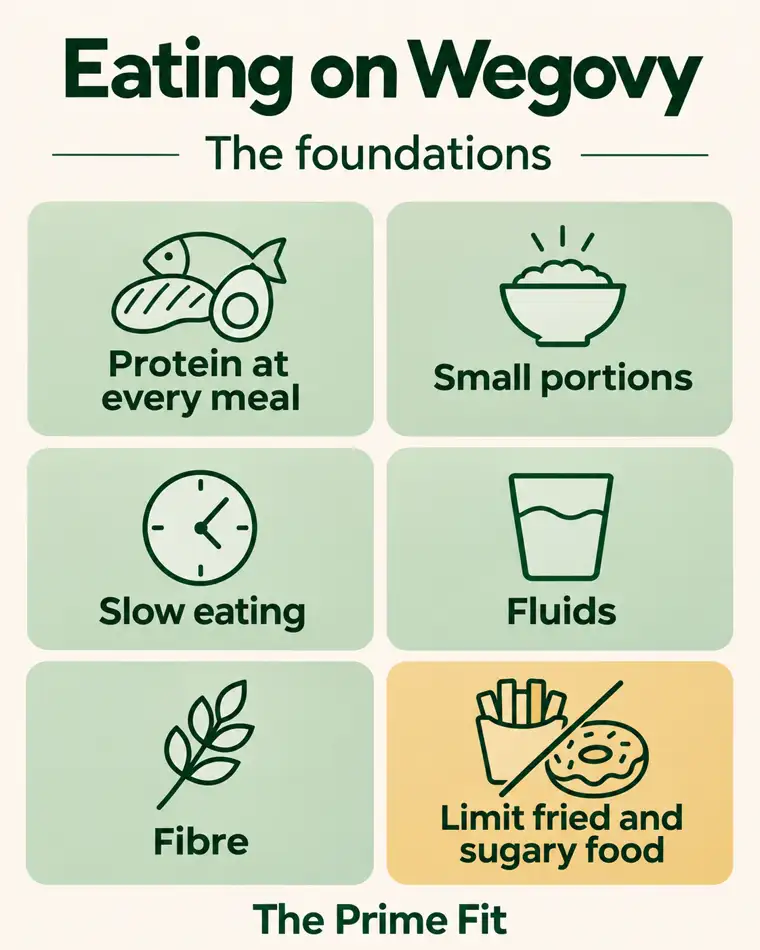
| Principle | In practice |
|---|---|
| Protein first | Start each meal with dal, pulses, paneer, curd, soya, eggs, fish or chicken |
| Three meals by the clock | Fixed times; one or two planned snacks; no long gaps |
| Small portions, slowly | Quarter plate; fifteen to twenty minutes; stop at the first hint of fullness |
| Low oil | About one teaspoon per meal in cooking; grill, steam, pressure-cook or sauté |
| Vegetables and fibre | Cooked vegetables at lunch and dinner; one or two fruits; whole dals |
| Fluids | 2 to 3 litres a day, mostly between meals |
| Little sugar and maida | Tea with less sugar; no daily biscuits, bakery items or sweetened drinks |
| Light, early dinner | Two to three hours before bed |
Protein target
Many adults on treatment are advised about 1.0 to 1.5 grams of protein per kilogram of body weight a day, with a lower target if you have kidney disease.
| Body weight | Daily range | Per meal, over three meals |
|---|---|---|
| 60 kg | 60 to 90 g | 20 to 30 g |
| 75 kg | 75 to 112 g | 25 to 37 g |
| 90 kg | 90 to 135 g | 30 to 45 g |
| 105 kg | 105 to 157 g | 35 to 52 g |
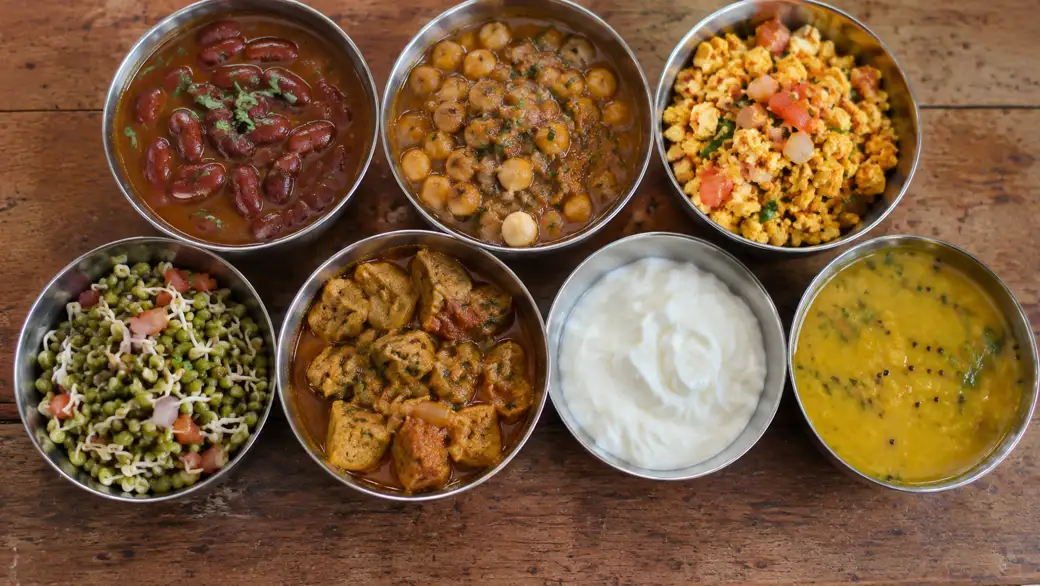
The lower end is a realistic first goal on a small appetite. For reference, 100 g of paneer has about 18 g of protein, a katori of thick dal 7 to 9 g, a katori of chana or rajma 12 to 15 g, a katori of curd 6 to 8 g, an egg 6 g, and 100 g of cooked chicken or fish 20 to 28 g.
Eating at each dose step
| Weeks | Dose | What you may notice | How to eat |
|---|---|---|---|
| 1 to 4 | 0.25 mg | Little change, or slightly earlier fullness; perhaps mild queasiness in the first days | Set the routine. Switch to a smaller plate, put protein first, fix your water target, and cut down fried food, sweets and sugary drinks now |
| 5 to 8 | 0.5 mg | Appetite begins to fall; snacks lose their pull; nausea for a few days after the first dose in some people | Gentle first week. Then three structured meals. Count protein for three days to see where you stand. Start fibre and a daily walk |
| 9 to 12 | 1 mg | Clear reduction in appetite; constipation may begin as intake drops | Dense protein in small volume: paneer, hung curd, eggs, soya. Fruit and cooked vegetables every day. Two to three litres of fluid without fail |
| 13 to 16 | 1.7 mg | A bigger step. Fullness is strong; reflux or nausea may return for a week or two | Gentle week or two. Five small eating occasions if three meals are too much. Very little oil. Early dinner. Liquids such as milk, chaas and dal soup count |
| 17 onwards | 2.4 mg | Appetite at its lowest; risk of eating and drinking too little | Eat by the clock. Protein at every occasion; consider a supplement. Check your pace of weight loss. Tell your team if you cannot meet protein and fluid needs |
| After the plateau | Maintenance dose | Appetite steadier; weight stable | The same pattern with slightly larger portions of whole grains, fruit and healthy fats; planned treats |
If a step is difficult, the increase can be delayed, and 1.7 mg can be used as a long-term dose. Tell your healthcare provider before the next step if you are struggling to eat.
The gentle-week pattern
Use this for the first five to seven days after each increase, and whenever nausea flares.
- Half your usual portion, eaten slowly.
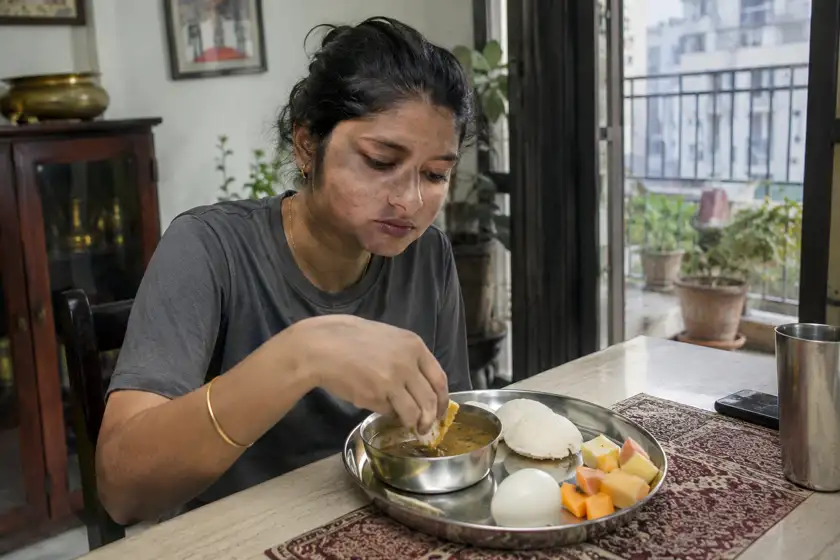
- Soft, bland, low-fat food: khichdi, dalia, idli with thin sambar, curd rice, dal with soft phulka, clear soups, boiled or lightly sautéed vegetables, soft-cooked eggs.
- Nothing fried, creamy or very sweet.
- Fluids sipped between meals: water, jeera or saunf water, ginger tea, chaas, coconut water.
- Plain foods to hand: toast, khakhra, banana, makhana.
- No lying down for two hours after eating.
- No restaurant meals, alcohol or celebrations in these days if you can avoid them.
The 7-day Indian menu
This menu suits the steady phase, when you have settled on a dose. Portions are modest. Depending on how much you eat, it provides very roughly 1,300 to 1,500 calories and 70 to 90 grams of protein a day. Have water through the day, and tea or coffee with little or no sugar.
Vegetarian
| Day | Breakfast | Lunch | Evening | Dinner |
|---|---|---|---|---|
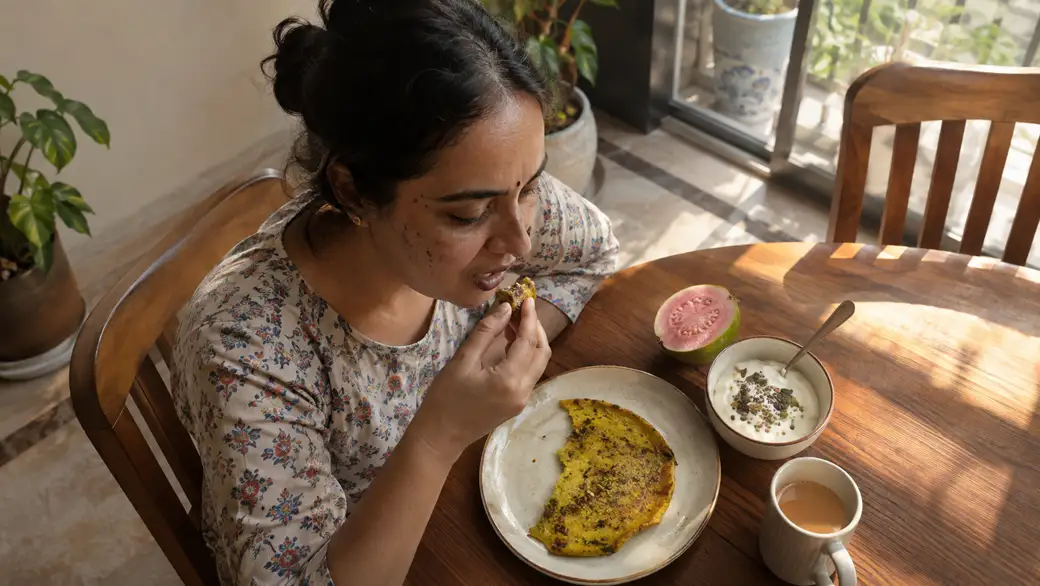
| Mon | Vegetable oats cooked in milk with almonds; 1 boiled-chana katori or a glass of milk | 1 phulka, 1 katori masoor dal, bhindi sabzi, cucumber raita | Sprouts chaat with lemon | Palak paneer (75 g paneer), 1 phulka, salad |
| Tue | 2 besan chillas with grated vegetables, 1 katori curd | Small katori rice, 1 katori rajma, cabbage-pea sabzi, salad | Roasted chana; chaas | Moong dal khichdi with vegetables, kadhi |
| Wed | 2 idlis with a large katori of sambar, peanut chutney | 1 jowar roti, chana masala, lauki sabzi, curd | 150 g hung curd with fruit | Tofu and mixed vegetable stir-fry, dal soup |
| Thu | Paneer bhurji (75 g) with 1 phulka | 1 phulka, toor dal, beans-carrot sabzi, 1 katori curd | A glass of milk; a handful of peanuts | Soya chunk curry, tori sabzi, 1 phulka |
| Fri | 2 pesarattu with curd | Small katori rice, sambar, poriyal, half a katori of sundal, curd | Roasted makhana with a few almonds; chaas | Lobia curry, sautéed capsicum and paneer, 1 phulka |
| Sat | Sprouted moong and vegetable upma; a glass of milk | 1 bajra roti, mixed dal, methi-aloo with more methi than aloo, raita | Paneer tikka, 3 to 4 pieces | Vegetable and dal soup with paneer cubes, 1 small multigrain roti |
| Sun | Dhokla, 4 pieces, with curd and green chutney | Family meal: salad and sabzi first, a serving of chole or paneer, 1 roti or a little rice, curd | Fruit bowl with a spoon of seeds | Light: thin moong dal with vegetables, curd rice in a small bowl |
Non-vegetarian
| Day | Breakfast | Lunch | Evening | Dinner |
|---|---|---|---|---|
| Mon | Vegetable oats with milk; 1 boiled egg | 1 phulka, chicken curry in little oil, bhindi sabzi, raita | Sprouts chaat | Grilled fish with lemon, sautéed vegetables, dal |
| Tue | 2-egg vegetable omelette, 1 slice whole wheat toast | Small katori rice, fish curry, cabbage sabzi, salad | Roasted chana; chaas | Moong dal khichdi with vegetables, curd |
| Wed | 2 idlis with sambar; 1 boiled egg | 1 jowar roti, dal, lauki sabzi, tandoori chicken pieces | 150 g hung curd with fruit | Chicken and vegetable soup, 1 phulka |
| Thu | Egg bhurji (2 eggs) with 1 phulka | 1 phulka, egg curry (2 eggs), beans-carrot sabzi, curd | A glass of milk; peanuts | Fish stew with vegetables, small portion of rice |
| Fri | Besan chilla with curd | Small katori rice, sambar, poriyal, tawa fish | Chicken tikka, 3 to 4 pieces | Dal, tori sabzi, 1 phulka, curd |
| Sat | 2 boiled eggs, 1 toast, 1 fruit | 1 bajra roti, lean keema with peas, salad, raita | Fruit with a few nuts | Grilled chicken, mixed vegetables, dal soup |
| Sun | Masala omelette or egg dosa | Family meal: salad first, a serving of chicken or fish, 1 roti or a little rice | Chaas; roasted chana | Light: clear chicken or dal soup with vegetables |
Eggetarians can follow the vegetarian plan and replace one protein item a day with two eggs. For Jain and no-onion, no-garlic diets, the same menus work with your usual preparations.
Foods to limit, and when
| Food | Why | Guidance |
|---|---|---|
| Samosa, pakora, puri, vada, chips, namkeen | Fat lingers in a slow stomach; common trigger for nausea | Avoid in gentle weeks; a small taste at other times |
| Cream, butter and cashew-based gravies | Heavy and rich | Choose dal, light curries and grilled dishes |
| Mithai, desserts, sweetened drinks, juices | Empty calories; can cause loose stools | Small portion on occasions, after a meal |
| Maida: white bread, biscuits, naan, noodles | Low fibre and protein | Replace with whole wheat, millets, oats |
| Large portions of rice, potato or roti | Leave no room for protein | Half a katori of rice or 1 to 2 phulkas, eaten last |
| Fizzy drinks | Bloating and burping | Water, chaas, fresh lime without sugar |
| Strong tea or coffee on an empty stomach | Acidity | With or after food; limit to two or three cups |
| Very spicy food | Reflux in some people | Mild spices in gentle weeks |
| Alcohol | Nausea, reflux, dehydration, low blood sugar in diabetes | Best avoided around dose increases; small amounts with food at other times, if at all |
Fluids
Drink to a schedule: a glass on waking, a one-litre bottle finished by lunch and another by evening. Water, chaas, nimbu pani with little sugar, coconut water, clear soups, dal water and jeera or saunf water all count. If you fill up quickly, drink between meals instead of with them. People with heart or kidney conditions who have been given a fluid limit should follow it.
Fixing problems with food
| Problem | What to do |
|---|---|
| Nausea | Smaller portions; khichdi, idli, curd rice, soup; ginger or jeera water; eat slowly; cold or room-temperature food if smells bother you |
| Vomiting after a meal | Rest the stomach for an hour, sip ORS or water, then light food. Review the portion and oil in that meal. Tell your healthcare provider if it recurs |
| Acidity, burping | Early light dinner; no fried food or fizzy drinks; do not lie down after eating; raise the head of the bed |
| Constipation | More fluid; papaya, guava, soaked figs; vegetables and whole dals; soaked chia or isabgol; daily walk; toilet time after breakfast |
| Loose stools | ORS, chaas, curd rice, banana, khichdi; avoid oily, spicy and very sweet foods |
| Tiredness, dizziness | Three meals with protein and some cereal; salted chaas or nimbu pani; check iron and vitamin B12 |
| No appetite | Eat by the clock; liquids and soft foods; five small occasions; tell your healthcare provider |
| Food aversions | Swap, do not skip: if eggs or meat put you off, use paneer, curd, dal or tofu |
| Hair shedding | Check protein intake; test iron, B12 and vitamin D; slow the pace |
| Sweet cravings returning | Protein at breakfast; planned evening snack; fruit with curd; better sleep |
Quick protein add-ons
When meals are tiny, these small additions raise protein without much volume.
- A spoon of hung curd on dal, sabzi or chilla
- Paneer or tofu cubes stirred into vegetables or soup
- Soya granules cooked into sabzi or upma
- Besan or sattu mixed into roti dough
- Sprouts added to poha, upma or salad
- Milk in place of water in oats and dalia
- A boiled egg on the side
- Roasted chana as the snack with tea
- A scoop of protein powder in milk or curd, if your dietitian advises
Injection day and the days after
- Eat normally but lightly on injection day, and avoid a heavy or late dinner.
- The one to three days after the injection are when queasiness is most likely. Keep those days simple.
- Towards the end of the week, appetite may return a little. Use it to make up protein with slightly larger meals, not to revisit old snacks.
- Choose your injection day so that the following days are quieter.
If you have diabetes
The same plan applies, with extra care. Do not skip meals if you take insulin or a sulfonylurea, since eating much less can cause low blood sugar; your healthcare provider will usually reduce those doses. Spread cereal evenly over three meals, choose whole grains, and check your sugars as advised.
Supplements
Reduced intake can leave you short of iron, vitamin B12 and vitamin D. Have them tested and replaced if low. A protein supplement helps if food alone does not meet your target. Isabgol with plenty of water is useful for constipation. Avoid high-dose supplements without advice.
Eating out, travel and occasions
- Order a starter-sized portion or share.
- Choose grilled, tandoori or steamed dishes, dal, a vegetable and one roti.
- Protein first, slowly; stop early.
- Water or fresh lime soda without sugar.
- At weddings, eat a protein snack before leaving home, choose three or four dishes and take a small portion of dessert after the meal.
- When travelling, carry roasted chana, nuts, khakhra and a water bottle.
- Avoid feasts in the first days after a dose increase.
A three-day gentle menu
For the days after a dose increase. Portions are small; sip fluids between meals.
| Day 1 | Day 2 | Day 3 | |
|---|---|---|---|
| Breakfast | 2 idlis with thin sambar | Dalia cooked in milk | 1 moong chilla with curd, or 2 soft-scrambled eggs with toast |
| Mid-morning | Coconut water | Papaya bowl | Chaas |
| Lunch | Moong dal khichdi with lauki, curd | Soft phulka, thin dal, tori sabzi, curd | Small portion of rice, dal or light fish curry, boiled vegetables |
| Evening | Roasted makhana; ginger tea | Banana; jeera water | Curd, or a boiled egg |
| Dinner, early | Vegetable and dal soup, 1 soft phulka | Curd rice with grated carrot | Clear vegetable or chicken soup with a little paneer or tofu |
Regional swaps
| If your kitchen is | Use more of | Go easy on |
|---|---|---|
| North Indian | Dal, rajma, chole, paneer bhurji, tandoori dishes, curd, phulka | Butter parathas, naan, cream gravies, sweet lassi |
| South Indian | Sambar with extra dal, pesarattu, idli, sundal, egg or fish curry, curd, poriyal | Large servings of rice, fried vada and bonda, coconut-heavy gravies in quantity |
| Gujarati or Maharashtrian | Dal, kadhi, usal, dhokla, thepla with little oil, bhakri in small portions | Farsan, sev, sweetened dal and shaak, shrikhand |
| Bengali or Odia | Fish in light jhol, dal, egg curry, vegetables, small portions of rice | Fried fish and bhaja, luchi, large rice portions, sweets |
A weekly preparation routine
- Weekend: soak and pressure-cook chana and rajma; make chilla and idli batter; hang curd; sprout moong; boil a few eggs if you eat them.
- Midweek: refresh sprouts and hung curd; cook a large pot of dal and freeze single portions.
- Each evening: set curd, cut vegetables for the next day, fill your water bottle.
- Before each dose step: stock moong dal, rice, dalia, curd, ginger and ORS so that the gentle menu is ready.
- In your bag: roasted chana, nuts and khakhra, so that a missed meal does not become tea and biscuits.
Half an hour of preparation at the weekend does more for your results than any amount of resolve on a busy weekday. When appetite is low, people eat whatever takes the least effort. If the easiest thing in your kitchen is a bowl of ready dal, a katori of curd and cut fruit, that is what you will eat. If it is a packet of biscuits, the same rule applies. Arrange your kitchen so that the convenient choice is also the right one.
Eating in maintenance
Once your weight has stabilised, you are no longer aiming for a deficit. Keep the structure and the protein, and add back a little at a time: an extra phulka, a second fruit, a handful of nuts. Increase by about 100 to 150 calories a day and watch your weight for two weeks before adding more. Plan treats instead of banning them. Continue to weigh weekly, and act if you gain more than 2 to 3 percent.
Exercise completes the plan
Protein protects muscle only if the muscle is used. Do resistance exercise two to three times a week, such as sit-to-stands, wall push-ups, bridges and band rows, and walk daily, including ten minutes after meals.
A grocery list
| Category | Items |
|---|---|
| Protein | Moong, masoor, toor, chana, rajma, lobia; besan; paneer, tofu, soya chunks; curd, milk; eggs, chicken, fish |
| Vegetables | Lauki, tori, bhindi, beans, cabbage, palak, methi, capsicum, carrots, tomatoes, cucumber |
| Fruit | Papaya, guava, apple, pear, orange; figs and raisins for soaking |
| Grains | Whole wheat atta, jowar and bajra flour, oats, dalia, idli batter, brown or hand-pounded rice |
| Snacks | Roasted chana, peanuts, almonds, makhana, khakhra |
| Fats | Mustard, groundnut or rice bran oil; a little ghee; chia, flax and sesame seeds |
| For gentle weeks | Ginger, jeera, saunf, lemon, ORS sachets, isabgol, plain toast |
Common mistakes
- Waiting for hunger before eating.
- Filling up on roti and rice and leaving the dal.
- Tea and biscuits in place of meals.
- Cutting out all fat, which worsens constipation.
- Too little water.
- A restaurant meal in the first days after a dose increase.
- Relying on protein shakes alone.
- Eating less and less to speed things up.
Common myths
“Wegovy does the work, so diet does not matter”
The medicine controls quantity. You control quality, and with it your muscle, energy and comfort.
“I must follow a special low-carb or keto diet”
No particular diet is required. A balanced Indian plate with modest cereal portions works well.
“Fat must be avoided completely”
A teaspoon of oil per meal is useful. It is fried and creamy food that causes trouble.
“If I am not hungry, I should not eat”
Eat small meals by the clock to protect muscle and energy.
“Vegetarians cannot get enough protein”
Dal, pulses, paneer, curd and soya at every meal meet the need.
How The Prime Fit helps
At The Prime Fit, every Wegovy prescription comes with a dietitian. Your plan is built around your own kitchen and region, with a protein target, a menu for each dose step and a gentle-week plan before every increase. We review you weekly, adjust when side effects appear, and tell your healthcare provider if your appetite is too low for your dose.
To get a plan made for you, book a consultation or read about our Wegovy programme and GLP-1 support programme.
Frequently asked questions
What should I eat on Wegovy?
Small, regular meals with protein first, such as dal, pulses, paneer, curd, eggs, fish or chicken, plus cooked vegetables and a modest portion of roti or rice, with 2 to 3 litres of fluid a day.
Does my diet need to change as the dose goes up?
Yes. Eat lighter, softer, low-oil food for about a week after each increase, and at higher doses use denser protein and more frequent small meals.
Which foods should I avoid on Wegovy?
Nothing is banned, but fried foods, rich gravies, sweets, fizzy drinks and alcohol are the commonest triggers of nausea and reflux.
How much protein do I need?
Many adults are advised about 1.0 to 1.5 grams per kilogram of body weight a day. Your dietitian will set your target.
What should I eat when I feel sick?
Small amounts of khichdi, curd rice, idli, toast, banana or clear soup, with ginger or jeera water between meals.
Can I eat rice on Wegovy?
Yes, about half a katori, after the protein and vegetables.
Can I drink tea and coffee?
Yes, two or three cups with little or no sugar, preferably not on an empty stomach if you have acidity.
How many calories should I eat?
It varies. Most people eat less naturally. Focus on protein and vegetables at every meal, and let your dietitian check that your intake is adequate.
I have no appetite at 2.4 mg. What should I do?
Eat five small protein-containing meals or snacks by the clock, use liquids such as milk and dal soup, and tell your healthcare provider. A lower dose may suit you better.
How should I eat once I reach my goal?
Keep the same structure, add back small amounts of whole grains, fruit and healthy fats, weigh weekly and act early on any gain.
This article is general information and is not a substitute for a consultation. Calorie and protein figures are approximate. Meal plans should be adjusted to your health and medicines by a qualified dietitian and healthcare professional.