In this article
- What is fibre?
- How much fibre do you need each day?
- Does fibre help weight loss?
- What are the other health benefits of fibre?
- Which Indian foods are highest in fibre?
- An Indian high-fibre day: vegetarian and non-vegetarian
- Simple swaps that add fibre
- How to increase fibre without gas and bloating
- Can you have too much fibre? The risks of fibermaxxing
- Fibre supplements: isabgol, powders and gummies
- Fibre on GLP-1 medicines
- Common myths about fibre
- When to see a healthcare professional
- Questions to ask your healthcare provider
- How The Prime Fit helps
- Frequently asked questions
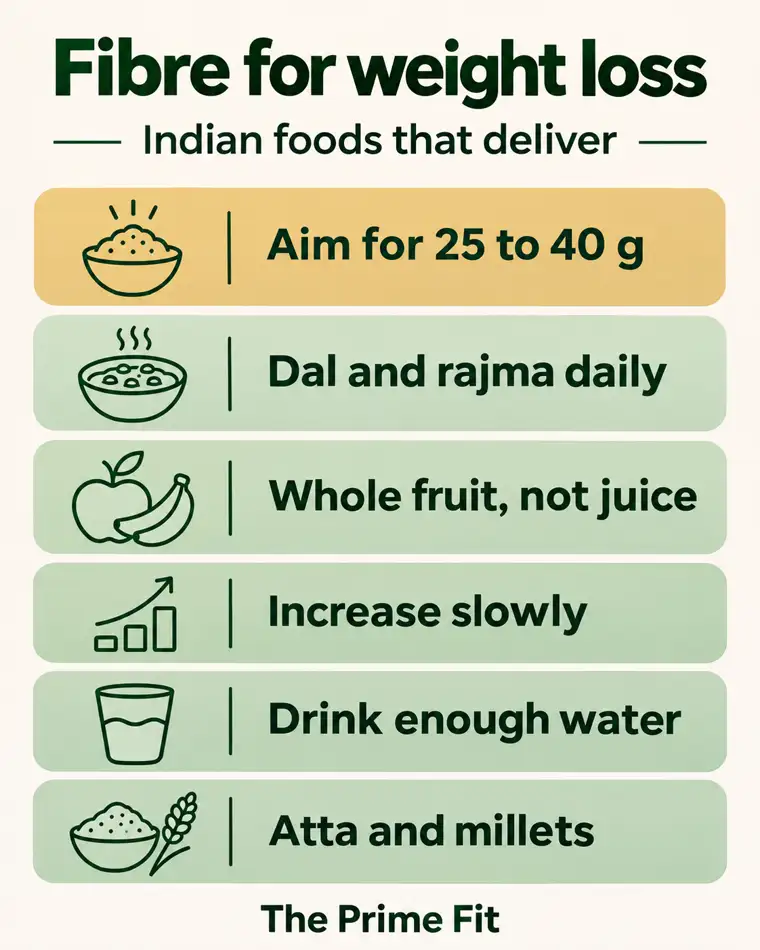
Fibermaxxing is the social media name for deliberately eating as much fibre as you can. Underneath the trend is a question worth answering properly: how much fibre do you need, and does fibre for weight loss actually work? Most adult guidance falls between about 25 and 40 grams a day. The World Health Organization advises at least 25 g from food, and Indian guidance is commonly quoted as about 30 g for a 2,000 kcal diet. Many urban Indian diets built on white rice, maida and packaged snacks fall short of this.
Fibre helps with weight in a modest, reliable way. It makes meals more filling for fewer calories, slows the rise in blood sugar after eating and supports regular bowel movements. It is not a fat burner, and more is not always better. Jumping from a low intake to very high amounts overnight mostly produces gas, bloating and discomfort.
This guide explains the types of fibre, the best Indian sources with approximate amounts, a sample day for vegetarians and non-vegetarians, and how to increase fibre comfortably. It is general information. If you have a bowel condition or take regular medicines, check with your healthcare provider first.
What is fibre?
Dietary fibre is the part of plant foods that the small intestine cannot digest. It passes to the large intestine, where some of it is fermented by gut bacteria and the rest adds bulk to stool. Fibre is found only in plant foods: grains, pulses, vegetables, fruit, nuts and seeds. Milk, curd, paneer, eggs, meat and fish contain none.
| Type | What it does | Indian sources |
|---|---|---|
| Soluble, gel-forming fibre | Forms a gel in the gut, slows digestion, helps lower LDL cholesterol and softens the rise in blood sugar after meals | Oats, barley (jau), isabgol, rajma, chana, dals, apple, guava, citrus, bhindi, flaxseed, chia |
| Insoluble fibre | Adds bulk and speeds movement through the bowel | Whole wheat atta, wheat bran, millets, vegetable skins and stalks, leafy greens, nuts |
| Fermentable fibre and resistant starch | Feeds gut bacteria, which produce short-chain fatty acids | Pulses, onion, garlic, slightly green banana, cooked and cooled rice or potato |
How much fibre do you need each day?
There is no single agreed figure, but the recommendations cluster together.
- World Health Organization: at least 25 g a day of naturally occurring fibre from food for adults.
- Indian guidance: commonly quoted as about 30 g a day for a 2,000 kcal diet, with older Indian recommendations set higher, at about 40 g.
- A practical rule used internationally: about 14 g for every 1,000 kcal eaten.
Using the last rule, an illustrative example: a woman eating 1,500 kcal a day for weight loss would aim for about 21 g (1.5 x 14), and a man eating 2,200 kcal would aim for about 31 g (2.2 x 14). Because people eating fewer calories still benefit from fullness and regular bowels, a target of at least 25 g is sensible for most adults, moving towards 30 to 35 g if it is comfortable.
Does fibre help weight loss?
Yes, modestly. In trials, people asked to eat more fibre, or given gel-forming fibre supplements, tend to lose a little more weight than comparison groups. The effect is small when fibre is the only change. It works best as part of an overall eating plan.
The reasons are straightforward:
- Lower energy density. A katori of rajma or a bowl of salad fills the stomach for fewer calories than the same volume of fried or refined food.
- Slower eating and digestion. High-fibre foods take longer to chew, and gel-forming fibre slows stomach emptying.
- Appetite hormones. When gut bacteria ferment fibre, the products appear to prompt the gut to release fullness hormones, including GLP-1. This natural effect is small and brief compared with GLP-1 medicines. Our article on how GLP-1 works explains the difference.
- Steadier blood sugar, which may reduce cravings between meals in some people.
Claims that a particular fibre drink matches a prescription medicine are not supported. We look at those in “Nature’s Ozempic”: do oats, chia and psyllium really work?
What are the other health benefits of fibre?
The broader evidence for fibre is stronger than the weight evidence. Large reviews of long-term studies have found that people who eat more fibre, in the range of about 25 to 29 g a day or higher, have lower rates of heart disease, type 2 diabetes and bowel cancer, and live longer on average, than people who eat little. These are mostly observational findings, so they show a link rather than proof of cause, but trials support the effects on cholesterol, blood sugar and blood pressure.
For Indians, who develop diabetes and heart disease at a lower body weight than many other populations, that matters. Fibre is also the first-line dietary measure for constipation.
Which Indian foods are highest in fibre?
The figures below are approximate. Fibre content varies with the variety, how much gravy or water is in the serving, and the size of the katori. Use them as a guide, not as exact values.
| Food and portion | Approximate fibre |
|---|---|
| 1 katori cooked rajma, chole or lobia (about 150 g) | 6 to 10 g |
| 1 katori cooked dal (from about 30 g raw dal) | 3 to 5 g |
| 30 g roasted chana with skin | 4 to 5 g |
| 1 medium whole wheat roti (about 30 g atta) | About 3 g |
| 1 bajra or jowar roti (about 35 g flour) | 3 to 4 g |
| 40 g dry oats (1 bowl cooked) | About 4 g |
| 1 katori cooked brown rice (about 150 g) | 2 to 3 g |
| 1 katori cooked white rice (about 150 g) | Under 1 g |
| 1 katori cooked vegetable sabzi such as bhindi, beans, gobhi or palak | 3 to 4 g |
| Half a katori green peas (about 75 g) | About 4 g |
| 1 plate salad of cucumber, carrot and tomato (about 150 g) | About 2 g |
| 1 medium guava (about 100 g) | 5 g or more |
| 1 medium apple or pear with skin | 4 to 5 g |
| 1 medium banana or orange | About 3 g |
| A small handful of almonds (about 15 g) | About 2 g |
| 1 tablespoon chia seeds (about 12 g) | About 4 g |
| 1 tablespoon ground flaxseed (about 8 g) | About 2 g |
| 1 teaspoon isabgol husk (about 5 g) | About 4 g |
Three points stand out. Pulses are the richest everyday source, so a daily katori of dal plus rajma, chole or sprouts a few times a week does most of the work. Whole wheat roti contributes far more than white rice or maida. And whole fruit beats juice, because juicing removes most of the fibre.
An Indian high-fibre day: vegetarian and non-vegetarian
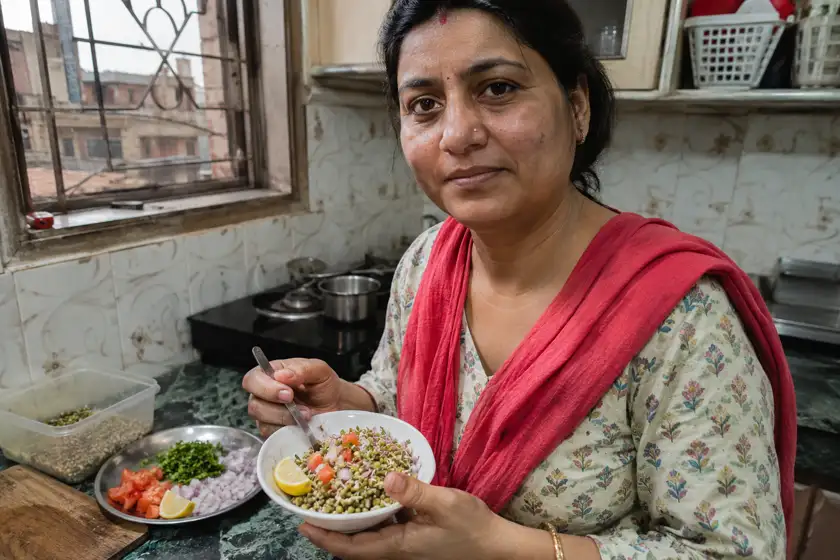
This is an illustrative example using the approximate figures above. Portions should be adjusted to your calorie needs.
| Meal | Vegetarian | Fibre | Non-vegetarian | Fibre |
|---|---|---|---|---|
| Breakfast | Vegetable oats upma (40 g oats with carrot, peas and beans), curd | 6 g | 2-egg omelette with onion, tomato and spinach, 2 slices whole wheat bread, 1 orange | 8 g |
| Lunch | 2 whole wheat rotis, 1 katori rajma, salad, chaas | 16 g | 1 katori brown rice, chicken curry, 1 katori dal, 1 katori beans sabzi, salad | 11 g |
| Evening | 1 guava | 5 g | 1 apple and a small handful of almonds | 6 g |
| Dinner | 1 roti, 1 small katori dal, 1 katori bhindi sabzi, curd | 9 g | 2 whole wheat rotis, grilled or curried fish, 1 katori mixed vegetable sabzi | 9 g |
| Total | About 36 g | About 34 g |
Neither day uses a supplement or an unusual food. Notice that the eggs, chicken and fish add protein but no fibre: the fibre in the non-vegetarian day comes entirely from the grains, dal, vegetables, fruit and nuts served with them. For more menus, see our Indian diabetes diet chart and the vegetarian high-protein meal plan.
Simple swaps that add fibre
- Atta instead of maida: roti in place of naan, kulcha or white bread. Do not sieve out the bran (chokar).
- Add a millet: a bajra, jowar or ragi roti a few times a week, especially in winter.
- Thicker dal, more often: include whole dals such as sabut moong, masoor and chana with their skins.
- Vegetables into staples: methi or palak in the dough, peas and carrots in poha and upma, lauki in dal.
- Fruit as the evening snack: guava, apple, pear, orange or papaya instead of biscuits.
- Roasted chana, makhana with peanuts, or sprouts chaat instead of namkeen.
- Keep edible skins on apple, pear, cucumber and potato after washing well.
- Seeds as a garnish: a spoon of ground flaxseed in atta or curd, or chia soaked in water or milk.
How to increase fibre without gas and bloating
Gut bacteria need time to adjust to more fibre. A sudden jump is the usual reason people give up.
- Go gradually. Add one extra fibre-rich serving every few days, over three to four weeks.
- Drink enough fluid. Fibre needs water to work. Aim for pale yellow urine through the day.
- Spread it across meals instead of one very large serving.
- Prepare pulses well. Soak rajma and chole overnight, discard the soaking water, and pressure cook until soft. Hing, ginger, jeera and ajwain in the tadka are traditional aids.
- Start with gentler options such as moong dal, oats, cooked vegetables and papaya before large amounts of raw salad, cabbage or rajma.
Some extra wind in the first weeks is normal and usually settles.
Can you have too much fibre? The risks of fibermaxxing
There is no official upper limit for fibre from food, and people on traditional diets eat well above 40 g without harm. Problems arise mainly when intake rises very fast, when fluid is low, or when large amounts come from powders, bars and fortified products.
- Bloating, cramps and gas, or worsening constipation if fluid intake is poor.
- Fullness that crowds out protein. This matters if your appetite is already small, for example on weight loss medicines or in older age.
- Slightly reduced absorption of iron, zinc and calcium at very high intakes of bran and unsoaked grains and pulses. Soaking, sprouting and fermenting reduce this.
- Interference with medicines. Fibre supplements taken at the same time can reduce absorption of some medicines, including thyroid tablets.
Who should get medical advice before raising fibre
Speak to your healthcare provider first if you have inflammatory bowel disease, a history of bowel obstruction or narrowing, previous bowel or bariatric surgery, gastroparesis, difficulty swallowing, or irritable bowel syndrome that flares with pulses, onion or wheat. You may need a tailored plan.
Fibre supplements: isabgol, powders and gummies
Food comes first, because it brings protein, vitamins and minerals along with fibre. Supplements can help when food alone is not enough, particularly for constipation.
Isabgol (psyllium husk) has the best evidence. It relieves constipation and modestly lowers LDL cholesterol and post-meal blood sugar. Start with 1 teaspoon a day, stirred into a full glass of water and drunk promptly, followed by more water. Taking it dry or with too little fluid can cause choking or a blockage. As a general rule, keep fibre supplements about 2 hours apart from other medicines, and ask your healthcare provider about thyroid tablets specifically. See our note on thyroid treatment and weight loss medicines.
Fibre gummies and “prebiotic” sodas usually contain small amounts, and some added fibres cause a lot of gas. They are not a substitute for dal and vegetables.
Fibre on GLP-1 medicines
Mounjaro, Wegovy and Ozempic slow stomach emptying and reduce appetite, and constipation is a common side effect. Fibre helps, but the approach needs care. Large, bulky, raw meals can worsen fullness and nausea, especially after a dose increase. Prefer cooked vegetables, moong dal, oats, papaya and small portions spread through the day, with enough fluid, and prioritise protein at each meal. Our guides to constipation on GLP-1 medicines and Mounjaro constipation, acidity and bloating give step-by-step fixes.
Common myths about fibre
| Myth | What is true |
|---|---|
| More fibre is always better | Benefits are clear up to about 25 to 40 g. Beyond that, extra gains are uncertain and discomfort is more likely. |
| Salad is the best source | Cucumber and tomato are mostly water. Pulses, whole grains, guava and cooked vegetables provide much more. |
| Brown bread is high in fibre | Many brown breads are coloured maida. Check that whole wheat is the first ingredient. |
| Juice counts as fruit | Juicing removes most of the fibre and concentrates the sugar. |
| Fibre burns belly fat | It helps you eat less and feel full. It does not burn fat. |
| Isabgol every day is harmful | It is generally safe long term when taken with enough water, but ongoing constipation should be assessed. |

When to see a healthcare professional
Constipation and bloating are usually harmless, but some symptoms need assessment and should not be treated with fibre alone. See a healthcare professional if you have a change in bowel habit lasting more than a few weeks, blood in the stool, black stools, unexplained weight loss, persistent abdominal pain, anaemia, or a family history of bowel cancer.
Seek urgent care
Go to an emergency department for severe abdominal pain with a swollen abdomen, repeated vomiting, inability to pass stool or wind, or heavy bleeding from the back passage. Stop fibre supplements until you have been assessed.
Questions to ask your healthcare provider
- How much fibre is right for me, given my calorie needs and health conditions?
- Is my constipation or bloating likely to be diet-related, or does it need tests?
- Should I use isabgol, and how should I time it with my medicines?
- I have IBS or acidity: which fibre-rich foods should I start with?
- Do I need to adjust fibre while my weight loss medicine dose is increasing?
- How do I get enough protein and fibre when my appetite is small?
How The Prime Fit helps
At The Prime Fit, nutrition advice is built around the food you already eat. After an assessment of your health, weight and routine, our clinical nutrition support helps you plan meals with enough protein and fibre for your needs, whether you are vegetarian, eat eggs, or eat meat and fish, and adapts the plan for fasting days, festivals and travel.
For people on medical treatment, follow-up includes managing digestive side effects such as constipation and fullness, so that eating well remains comfortable as doses change. Fibre is one part of a wider plan that also covers activity, sleep and, where appropriate, medicines.
Frequently asked questions
How much fibre should I eat per day?
Most adults should aim for at least 25 g a day, and about 30 g or a little more is a good target if it is comfortable. Needs vary with calorie intake and health conditions.
Does fibre help you lose weight?
Modestly. Fibre makes meals more filling for fewer calories and steadies blood sugar. It works as part of an overall eating plan, not as a fat burner.
What is fibermaxxing?
It is a social media term for deliberately eating a lot of fibre. Reaching recommended amounts is beneficial. Pushing far beyond them quickly tends to cause gas and bloating.
Which Indian foods have the most fibre?
Rajma, chole, lobia and whole dals, whole wheat and millet rotis, oats, guava, apple, pear, cooked vegetables such as bhindi and beans, roasted chana, and seeds such as chia and flaxseed.
Why do I get gas when I eat more fibre?
Gut bacteria ferment fibre and produce gas, especially when intake rises suddenly. Increase gradually over a few weeks, drink enough water and soak and cook pulses well.
Is isabgol good for weight loss?
It can add fullness and helps constipation, cholesterol and post-meal blood sugar a little, but its effect on weight is small. Always take it with a full glass of water.
Is roti or rice better for fibre?
Whole wheat roti has about 3 g of fibre each, while a katori of white rice has under 1 g. Brown rice and millets are in between or higher. Portion size still matters for weight.
Can I eat high-fibre foods on Mounjaro or Wegovy?
Yes, and fibre helps with constipation. Increase it slowly, prefer cooked vegetables and softer pulses, drink enough fluid and keep protein a priority, especially after dose increases.
This article is general information and is not a substitute for a consultation. Fibre values and study findings are approximate. Speak to your healthcare provider or dietitian before making major dietary changes or starting supplements, especially if you have a bowel condition, take regular medicines, or are pregnant.