In this article
- What GLP-1 is
- What natural GLP-1 does
- Why the body’s own GLP-1 is not enough
- How the medicines were made to last
- A short history
- How GLP-1 medicines cause weight loss
- What GIP is, and why Mounjaro is different
- What “agonist” means
- Effects on blood sugar
- Why the side effects make sense
- What these medicines cannot do
- What happens when the medicine is stopped
- Can you raise your own GLP-1 naturally?
- Who are GLP-1 medicines for?
- How they are taken
- A simple glossary
- What happens after a meal, step by step
- The other hormones in the story
- Common myths
- How The Prime Fit uses this science
- Frequently asked questions
“GLP-1” has gone from an obscure term in diabetes research to a household word in a few years. Most people know it has something to do with Ozempic and weight loss. Far fewer know that GLP-1 is not a drug at all. It is a hormone that your own body has been making after every meal since before you were born.
Understanding what this hormone does explains almost everything about the medicines built on it: why they reduce appetite, why they lower blood sugar without usually causing it to go too low, why nausea is the commonest side effect, why they are injected once a week, and why weight tends to return when they are stopped.
This guide explains the science in plain language. It is general information and not a substitute for advice from your healthcare provider about whether treatment is right for you.
What GLP-1 is
GLP-1 stands for glucagon-like peptide-1. It is a small protein, a chain of about thirty amino acids, made by specialised cells in the lining of the lower small intestine and the colon. These cells sense food arriving in the gut and release GLP-1 into the bloodstream within minutes of eating.
GLP-1 belongs to a family of gut hormones called incretins. The name comes from an observation made decades ago: when a person swallows glucose, the pancreas releases far more insulin than when the same amount of glucose is given directly into a vein. Something from the gut was boosting the insulin response. That “something” turned out to be mainly two hormones, GLP-1 and GIP. Together they account for a large share, roughly half or more, of the insulin released after a meal in a healthy person.
In one sentence
GLP-1 is the gut’s way of telling the rest of the body, “food has arrived: release insulin, slow down the stomach, and you can stop eating now.”
What natural GLP-1 does
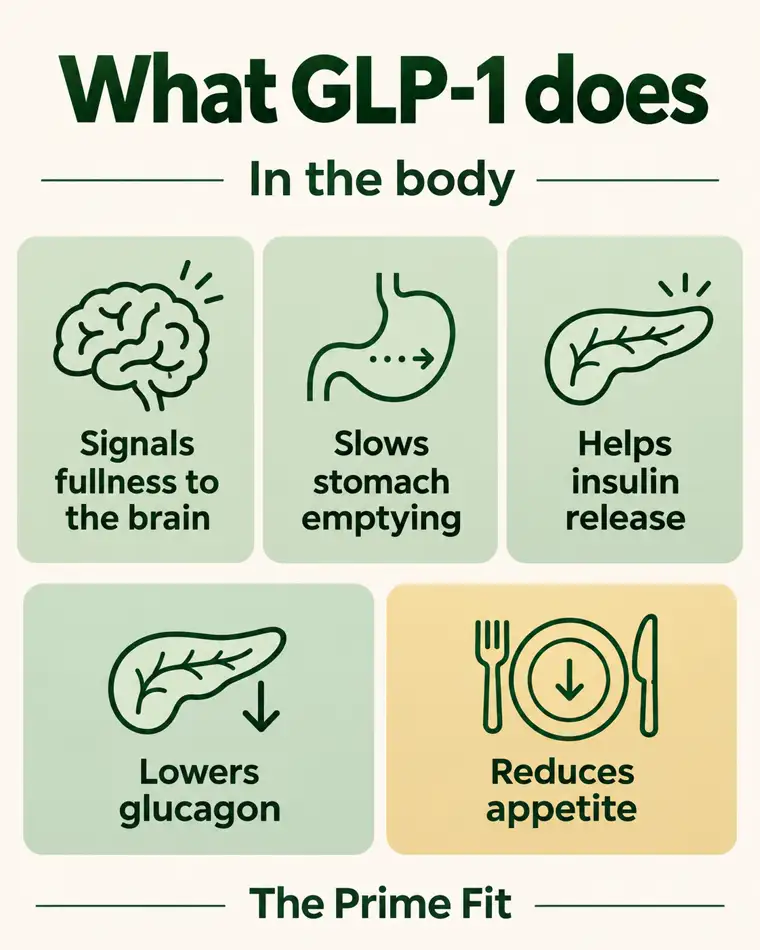
Receptors for GLP-1 are found in many organs. When the hormone attaches to them, it produces a coordinated set of effects.
| Where | What GLP-1 does | Result |
|---|---|---|
| Pancreas, beta cells | Increases insulin release, but only when blood sugar is raised | Blood sugar after meals is brought down without overshooting |
| Pancreas, alpha cells | Reduces release of glucagon, the hormone that tells the liver to put out sugar | Less sugar entering the blood from the liver |
| Stomach | Slows the rate at which food leaves the stomach | Slower rise in blood sugar; longer feeling of fullness |
| Brain, hunger centres in the hypothalamus and brainstem | Signals satiety | You feel satisfied and stop eating |
| Brain, reward circuits | Dampens the pull of highly palatable food | Fewer cravings |
| Heart and blood vessels | Several effects on vessel lining, inflammation and heart rate | Under study; thought to contribute to cardiovascular benefit |
| Kidneys | Promotes loss of sodium in the urine | Small reduction in blood pressure |
The most important detail is in the first row. GLP-1 boosts insulin only when glucose is high. When blood sugar returns to normal, the effect switches off. This “glucose-dependent” action is why medicines based on GLP-1 rarely cause low blood sugar by themselves, unlike insulin or sulfonylurea tablets.
Why the body’s own GLP-1 is not enough
Natural GLP-1 has a very short life. An enzyme in the blood called DPP-4 breaks it down almost immediately. Half of it is gone within about two minutes. It is designed to deliver a brief, local signal after a meal and then disappear.
In people with type 2 diabetes, the incretin effect is weakened: the same meal produces a smaller boost in insulin. In people with obesity, the fullness signals from the gut to the brain appear to be blunted, and the brain becomes less responsive to them. After weight loss by dieting, levels of fullness hormones fall further while hunger hormones rise, which is one reason lost weight returns.
Scientists reasoned that a stronger, longer-lasting GLP-1 signal might correct these problems. The challenge was the two-minute lifespan.

How the medicines were made to last
The first breakthrough came from an unexpected source. A hormone in the saliva of the Gila monster, a lizard from North America, turned out to resemble human GLP-1 and to resist breakdown by DPP-4. A synthetic version became the first GLP-1 medicine, approved for type 2 diabetes in 2005 and given by injection twice a day.
Later medicines were built on the human GLP-1 molecule itself, with deliberate changes:
- Altering an amino acid at the point where DPP-4 cuts the molecule, so that the enzyme can no longer break it down quickly.
- Attaching a fatty acid chain, which lets the molecule bind to albumin, a protein in the blood. Bound to albumin, it circulates for days, is released slowly, and is not filtered out by the kidneys.
The result is a molecule that behaves like GLP-1 at its receptor but lasts thousands of times longer.
| Substance | How long it lasts (half-life) | How often it is given |
|---|---|---|
| Natural GLP-1 | About 2 minutes | Released by the gut after each meal |
| Exenatide (the first GLP-1 medicine) | About 2.5 hours | Twice a day; a weekly form came later |
| Liraglutide | About 13 hours | Once a day |
| Dulaglutide | About 5 days | Once a week |
| Semaglutide (Ozempic, Wegovy) | About 7 days | Once a week; also a daily tablet |
| Tirzepatide (Mounjaro) | About 5 days | Once a week |
Because the medicine is present all the time, not just for a few minutes after meals, its effects on appetite are continuous and much stronger than those of the natural hormone.
A short history
| Period | Milestone |
|---|---|
| 1960s | The incretin effect is described: glucose taken by mouth produces more insulin than glucose given into a vein |
| 1980s | GLP-1 is identified and shown to stimulate insulin |
| 1990s | GLP-1 is found to reduce appetite and food intake; the lizard hormone is characterised |
| 2005 | First GLP-1 medicine approved for type 2 diabetes |
| 2010 onwards | Once-daily, then once-weekly medicines for diabetes |
| 2014 | A GLP-1 medicine is first approved specifically for weight management |
| 2017 to 2021 | Weekly semaglutide approved for diabetes, then at a higher dose for weight management; a tablet form approved for diabetes |
| 2022 to 2023 | Tirzepatide, acting on both GIP and GLP-1 receptors, approved for diabetes and then for weight management |
| 2023 onwards | Trials show reduced heart attacks and strokes, kidney protection and improvement in fatty liver and sleep apnoea; newer combinations and tablets in development |
Dates are those of first approvals internationally and are approximate. The key point is that this class of medicine has been in use for about two decades, first in diabetes.
How GLP-1 medicines cause weight loss
The medicines do not burn fat, speed up metabolism or block the absorption of food. They work by reducing how much you want to eat. Several mechanisms combine.
1. Stronger fullness signals
The medicines act on the hunger and satiety centres in the hypothalamus and brainstem. Meals become satisfying sooner, and the feeling lasts longer.
2. Less hunger between meals
The background drive to eat falls. Many people describe forgetting about food for hours, which they have never experienced before.
3. Reduced reward from food
GLP-1 receptors are present in brain areas involved in pleasure and motivation. Brain-imaging studies show less activation in these regions in response to pictures of tempting food. Cravings fall, and preferences shift away from very sweet and fatty foods. People often call this the quietening of “food noise”.
4. Slower stomach emptying
Food remains in the stomach for longer, which adds to fullness, particularly in the first months. This effect lessens somewhat with time.
5. Lower energy intake overall
In studies where participants ate freely from a buffet, those on semaglutide consumed roughly a quarter to a third fewer calories. Over months, that deficit produces weight loss.
Energy expenditure does not rise. In fact, as with any weight loss, the body uses slightly less energy as it becomes smaller. The medicines work on the intake side of the equation.
What GIP is, and why Mounjaro is different
GIP, glucose-dependent insulinotropic polypeptide, is the other main incretin. It is released from the upper small intestine after eating and, like GLP-1, increases insulin release when blood sugar is raised. It also acts on fat tissue and on the brain.
Tirzepatide is a single molecule designed to activate both the GIP receptor and the GLP-1 receptor. It is sometimes called a dual agonist or “twincretin”. In trials it has produced greater average weight loss and blood-sugar lowering than medicines acting on GLP-1 alone at the doses used.
Exactly how the GIP action contributes is still being worked out. It appears to enhance the effect on appetite, may reduce nausea, allowing higher effective doses, and influences how fat tissue stores and releases energy.
| Type of medicine | Receptors activated | Examples |
|---|---|---|
| GLP-1 receptor agonist | GLP-1 | Semaglutide, liraglutide, dulaglutide, exenatide |
| Dual agonist | GIP and GLP-1 | Tirzepatide |
| Other combinations in development | GLP-1 with glucagon, amylin or all three hormone receptors | In clinical trials |
| DPP-4 inhibitors | None directly; they slow the breakdown of the body’s own GLP-1 | Sitagliptin, vildagliptin, linagliptin |
DPP-4 inhibitors deserve a note. These diabetes tablets raise natural GLP-1 levels modestly by blocking the enzyme that destroys it. They lower blood sugar but do not cause meaningful weight loss, because the rise in GLP-1 is far smaller than that achieved by the injectable medicines.
What “agonist” means
A receptor is like a lock on the surface of a cell, and a hormone is the key. An agonist is a substance that fits the lock and turns it, producing the same response as the natural hormone. A GLP-1 receptor agonist is therefore a medicine that activates the GLP-1 receptor. The term is technical, but the idea is simple: the medicine imitates the hormone.
Effects on blood sugar
For people with type 2 diabetes, these medicines lower blood sugar through four routes: more insulin when glucose is high, less glucagon, slower absorption of food, and, over time, weight loss that improves the body’s sensitivity to insulin. HbA1c typically falls by one to two percentage points or more.
They are not insulin, and they do not replace insulin in people whose pancreas cannot make it. They are not used to treat type 1 diabetes.
Why the side effects make sense
| Side effect | Mechanism |
|---|---|
| Nausea, fullness, burping, reflux | Slower stomach emptying; direct action on brain centres that control nausea |
| Vomiting | Eating beyond the reduced capacity of a slow stomach |
| Constipation | Slower movement through the gut; less food and fluid |
| Diarrhoea | Changes in gut movement and secretion |
| Tiredness, dizziness | Lower intake of food and fluid; lower blood pressure |
| Low blood sugar, mainly with insulin or sulfonylureas | Additive glucose lowering with medicines that are not glucose-dependent |
| Gallstones | Rapid weight loss; reduced gallbladder emptying |
| Slightly faster pulse | Direct effect on the heart’s pacemaker |
| Hair shedding, loss of muscle | Consequences of rapid weight loss and low protein intake, not of the hormone itself |
Because the gut and brain adapt over a few weeks, treatment starts at a low dose and is increased step by step. This is the reason for the four-week dose steps used with all these medicines.
What these medicines cannot do
- They do not choose what you eat. A small appetite can be filled with nourishing food or with tea and biscuits. The quality of the diet remains your responsibility.
- They do not build or protect muscle. Protein and resistance exercise do that.
- They do not permanently reset appetite. When the medicine leaves the body, hunger signals return to what they were.
- They do not target fat in one area. Fat is lost from all over the body, with abdominal fat often responding early.
- They do not work for everyone. About one person in ten loses little.
- They do not replace treatment for blood pressure, cholesterol or other conditions.
What happens when the medicine is stopped
The medicine clears from the body over about five weeks. As it does, the amplified fullness signal fades, stomach emptying returns to normal, and appetite and cravings come back. In trials, people who stopped regained about two-thirds of their lost weight within a year, and improvements in blood pressure and blood sugar faded in parallel.
This is not a rebound caused by the medicine. It is the underlying biology of obesity reasserting itself once treatment is withdrawn, in the same way that blood pressure rises when blood pressure tablets are stopped. It is why these medicines are regarded as long-term treatment.
Can you raise your own GLP-1 naturally?
Yes, a little. Certain foods and habits increase the body’s own release of GLP-1 after meals.
| Food or habit | Effect on natural GLP-1 |
|---|---|
| Protein: dal, curd, paneer, eggs, fish, chicken | Stimulates release; also the most filling nutrient |
| Fibre: vegetables, whole pulses, oats, fruit | Gut bacteria ferment fibre into substances that stimulate GLP-1-producing cells |
| Healthy fats: nuts, seeds, mustard or olive oil | Modest stimulation |
| Eating vegetables and protein before carbohydrates | Larger GLP-1 response and a lower rise in blood sugar after the meal |
| Eating slowly | Allows time for gut hormones to signal fullness |
| Regular physical activity | May improve the response |
| Adequate sleep | Supports normal appetite hormones |
These are worthwhile habits, and they are the basis of sensible eating advice. But the effect is small and brief, because natural GLP-1 is destroyed within minutes. No food, tea, spice or supplement reproduces the effect of a medicine that keeps the receptor activated for a week. Products advertised as “natural Ozempic” or “GLP-1 boosters” do not have evidence of comparable weight loss.
Who are GLP-1 medicines for?
- Adults with type 2 diabetes, to improve blood sugar and, in those with heart or kidney disease, to reduce the risk of complications.
- Adults with obesity, a BMI of 30 or above, or with overweight, a BMI of 27 or above, and a weight-related condition, for long-term weight management alongside diet and activity. For Indians, health risks begin at lower BMI values, and healthcare professionals assess individually.
They are not suitable for anyone with a personal or family history of medullary thyroid carcinoma or MEN 2, or during pregnancy and breastfeeding, and they are used with caution after pancreatitis and in several other situations. They are prescription medicines and require a medical assessment.
How they are taken
| Medicine | Form | Main licensed uses |
|---|---|---|
| Semaglutide (Ozempic) | Weekly injection | Type 2 diabetes |
| Semaglutide (Wegovy) | Weekly injection, higher dose | Weight management |
| Semaglutide (Rybelsus) | Daily tablet | Type 2 diabetes |
| Tirzepatide (Mounjaro) | Weekly injection | Type 2 diabetes and weight management |
| Liraglutide | Daily injection | Type 2 diabetes; weight management at a higher dose |
| Dulaglutide | Weekly injection | Type 2 diabetes |
Brand names, strengths and licensed uses vary between countries. Most of these medicines are peptides, which would be digested if swallowed, which is why they are injected. The tablet form of semaglutide uses a special absorption enhancer and must be taken on an empty stomach.
A simple glossary
| Term | Meaning |
|---|---|
| GLP-1 | A gut hormone released after eating that increases insulin, slows the stomach and signals fullness |
| GIP | A second gut hormone with related effects |
| Incretin | A gut hormone that boosts insulin release after a meal |
| Receptor agonist | A medicine that activates a receptor in the same way as the natural hormone |
| DPP-4 | The enzyme that breaks down natural GLP-1 within minutes |
| Half-life | The time taken for the amount of a substance in the body to fall by half |
| Satiety | The feeling of having eaten enough |
| Gastric emptying | The movement of food from the stomach into the intestine |
| Titration | Increasing the dose step by step |
| HbA1c | A blood test reflecting average blood sugar over two to three months |

What happens after a meal, step by step
It helps to picture the natural sequence, because the medicines amplify exactly this.
- You eat. Food reaches the stomach and begins to pass into the small intestine.
- Gut cells sense nutrients. Protein, fat and carbohydrate trigger hormone-producing cells in the intestinal lining.
- GLP-1 and GIP are released into the blood within minutes, peaking over the next half hour to an hour.
- The pancreas responds. As blood sugar rises, insulin release is boosted and glucagon falls.
- The stomach slows. Food is released more gradually, smoothing the rise in blood sugar.
- The brain receives the message, through the bloodstream and through nerves from the gut. Fullness builds and the urge to keep eating fades.
- The signal ends. The hormones are broken down within minutes, and levels return to baseline until the next meal.
A GLP-1 medicine keeps step six switched on, at a higher level, around the clock. That is the whole idea in a sentence. It is also why eating slowly matters so much on treatment: the fullness signal is already strong, and giving it fifteen or twenty minutes to register is what stops you eating the extra few mouthfuls that cause nausea.
The other hormones in the story
GLP-1 is one voice in a larger conversation between the gut, fat tissue and the brain.
| Hormone | Made by | Main effect on appetite and weight |
|---|---|---|
| GLP-1 | Lower intestine | Fullness; more insulin; slower stomach emptying |
| GIP | Upper intestine | More insulin; effects on fat tissue and appetite |
| PYY | Lower intestine | Fullness after meals |
| Amylin | Pancreas, released with insulin | Fullness; slower stomach emptying |
| Ghrelin | Stomach | Hunger; rises before meals and after weight loss |
| Leptin | Fat tissue | Signals energy stores to the brain; falls with weight loss, increasing hunger |
| Insulin | Pancreas | Lowers blood sugar; promotes storage of energy |
| Glucagon | Pancreas | Raises blood sugar; increases energy use |
After weight loss, ghrelin rises and leptin, PYY and GLP-1 fall. That shift is the biological reason diets are hard to sustain, and it is the gap that these medicines fill. Newer medicines in development combine GLP-1 with amylin or glucagon action to draw on more of this system.
Common myths
“GLP-1 medicines are a type of insulin”
They are not. They help your own pancreas release insulin when blood sugar is high.
“They are steroids or stimulants”
They are neither. They are copies of a natural gut hormone and do not act like amphetamine-type appetite suppressants.
“They melt fat”
They reduce appetite. Fat is lost because you eat less.
“They speed up metabolism”
They do not increase energy expenditure.
“They wear out the pancreas”
There is no evidence that they exhaust insulin-producing cells. Their action on insulin is glucose-dependent.
“Certain foods work just as well”
Protein and fibre raise natural GLP-1 briefly, which helps with fullness, but the effect is far smaller.
“They are new and untested”
The class has been used in diabetes since 2005, and the newer medicines have been studied in very large trials.
How The Prime Fit uses this science
At The Prime Fit, treatment is built on how these medicines work. Because they reduce appetite without choosing your food, every patient has a dietitian who plans protein-rich Indian meals and reviews progress weekly. Because the body adapts gradually, doses are increased step by step by a healthcare professional. And because the effect lasts only while treatment continues, we plan maintenance with you from the beginning.
To find out whether treatment is suitable for you, book a consultation or read about our GLP-1 therapy programme.
Frequently asked questions
What does GLP-1 stand for?
Glucagon-like peptide-1. It is a hormone made in the gut and released after eating.
What does GLP-1 do in the body?
It increases insulin release when blood sugar is raised, reduces glucagon, slows stomach emptying and signals fullness to the brain.
How do GLP-1 medicines cause weight loss?
By reducing appetite, increasing fullness, dampening cravings and slowing the stomach, so that you eat less. They do not burn fat or raise metabolism.
Are Ozempic, Wegovy and Mounjaro all GLP-1 medicines?
Ozempic and Wegovy contain semaglutide, which acts on the GLP-1 receptor. Mounjaro contains tirzepatide, which acts on both the GIP and GLP-1 receptors.
Is a GLP-1 medicine the same as insulin?
No. It helps the pancreas release its own insulin when needed and is not a replacement for insulin.
Why are they injected once a week?
They are modified to resist breakdown and bind to a blood protein, so they last about a week. Being peptides, they would be digested if swallowed in ordinary form.
What is GIP?
Another gut hormone that boosts insulin after meals. Tirzepatide activates the receptors for both GIP and GLP-1.
Can I increase GLP-1 naturally?
Protein, fibre and eating slowly raise it modestly and briefly. No food or supplement matches the effect of the medicines.
Why does weight return after stopping?
The medicine’s effect on appetite lasts only while it is in the body. When it clears, hunger signals return to their previous level.
Are GLP-1 medicines safe?
They have been used for about two decades and studied in large trials. They have side effects and are not suitable for everyone, so a medical assessment is needed.
This article is general information and is not a substitute for a consultation. Dates and figures are approximate. Prescription medicines should be used only under a healthcare professional’s care.