In this article
- A short guide to the thyroid
- Why this question comes up so often in India
- Common thyroid conditions at a glance
- What the thyroid warning actually says
- What human studies have found
- Hypothyroidism and weight
- Do GLP-1 medicines affect thyroid function?
- Overlapping symptoms: is it the thyroid or the medicine?
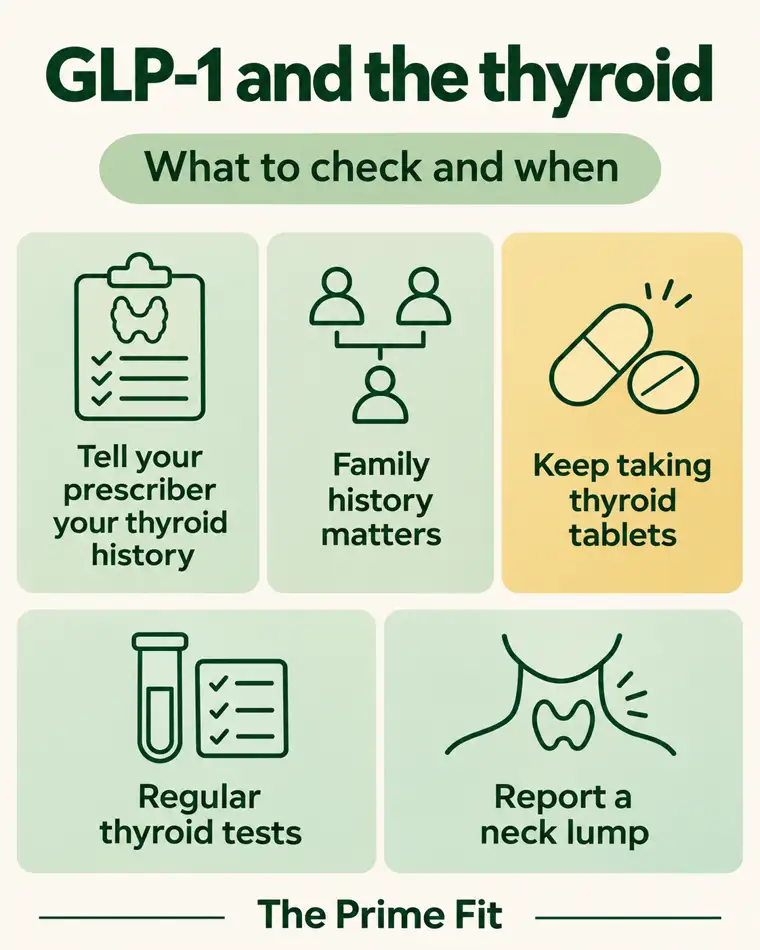
- Monitoring: what to check and when
- Thyroid nodules and goitre
- Previous thyroid cancer
- Hyperthyroidism
- Taking thyroid tablets correctly
- Eating well with a thyroid condition on GLP-1 treatment
- Women, thyroid disease and weight
- Three illustrative examples
- Questions to ask your healthcare provider
- Common myths
- How The Prime Fit manages thyroid conditions
- Frequently asked questions
Open the leaflet of any GLP-1 medicine, whether Mounjaro (tirzepatide), Wegovy or Ozempic (semaglutide), and you will find a warning about thyroid tumours. For the very large number of people in India who have a thyroid condition, that warning is alarming. Many assume it means they cannot take the medicine. Others are told so by well-meaning friends or even at a pharmacy counter.
In fact, the warning concerns one rare type of thyroid cancer and one rare inherited syndrome. It does not apply to hypothyroidism, Hashimoto’s thyroiditis or ordinary thyroid nodules, which account for nearly all thyroid problems. People with these conditions can generally be treated, and often benefit, because excess weight and an underactive thyroid frequently go together.
This guide explains what the warning means, which thyroid conditions matter, how treatment interacts with thyroid tablets, and what checks are sensible. It is general information. Decisions about your own treatment should be made with your healthcare provider, and with your endocrinologist if you have one.
A short guide to the thyroid
The thyroid is a small gland at the front of the neck. It makes thyroid hormones, T4 and T3, which set the pace of metabolism throughout the body. The pituitary gland in the brain controls it with thyroid-stimulating hormone (TSH). When thyroid hormone is low, TSH rises; when thyroid hormone is high, TSH falls. TSH is therefore the main screening test.
The thyroid contains two types of cell, and the distinction matters for understanding the warning:
- Follicular cells make thyroid hormone. They are involved in hypothyroidism, hyperthyroidism, Hashimoto’s disease, goitre, most nodules, and the common thyroid cancers, papillary and follicular.
- C-cells (parafollicular cells) make a different hormone, calcitonin. They are far fewer in number. A rare cancer called medullary thyroid carcinoma arises from them.
Why this question comes up so often in India
Thyroid disorders are among the most common hormonal conditions in the country. Surveys in Indian cities have found hypothyroidism in roughly one adult in ten, with women affected about three times as often as men, and many more have mildly raised TSH or thyroid antibodies without symptoms. Excess weight, PCOS and type 2 diabetes are also common, so the same person frequently has two or three of these conditions together. It is therefore usual, not exceptional, for someone seeking weight treatment to be on a thyroid tablet already. A clear understanding of what the thyroid warning does and does not mean prevents people who would benefit from being turned away unnecessarily.
Common thyroid conditions at a glance
| Condition | What it is | Can GLP-1 medicines usually be used? |
|---|---|---|
| Hypothyroidism | Underactive thyroid; treated with levothyroxine tablets | Yes. Thyroid levels should be monitored as weight falls |
| Hashimoto’s thyroiditis | Autoimmune inflammation, the commonest cause of hypothyroidism | Yes |
| Subclinical hypothyroidism | Mildly raised TSH with normal thyroid hormone | Yes. TSH may improve with weight loss |
| Hyperthyroidism, including Graves’ disease | Overactive thyroid | Usually after the thyroid is controlled; discuss with your endocrinologist |
| Goitre and benign thyroid nodules | Enlargement or lumps, very common and mostly harmless | Yes, once nodules have been appropriately assessed |
| Previous papillary or follicular thyroid cancer | The common, usually curable thyroid cancers | Not a listed contraindication; an individual decision with your specialist |
| Thyroid removed or treated with radioiodine | Lifelong levothyroxine | Yes, depending on the reason for treatment; dose monitoring needed |
| Medullary thyroid carcinoma, personal or family history | Rare cancer of the C-cells | No. Must not be used |
| Multiple endocrine neoplasia type 2 (MEN 2) | Rare inherited syndrome that includes medullary thyroid carcinoma | No. Must not be used |

What the thyroid warning actually says
During development, GLP-1 medicines were given to rats and mice for much of their lifespan. The animals developed tumours of the thyroid C-cells, including medullary thyroid carcinoma, in a dose- and duration-dependent way. Rodent C-cells carry many GLP-1 receptors and respond strongly to these medicines. Human C-cells carry very few, and studies in monkeys did not show the same effect.
Because the relevance to humans could not be ruled out, regulators required a warning, and as a precaution these medicines are contraindicated in:
- anyone who has had medullary thyroid carcinoma;
- anyone with a close blood relative who has had medullary thyroid carcinoma;
- anyone with multiple endocrine neoplasia syndrome type 2.
Medullary thyroid carcinoma accounts for only a few percent of thyroid cancers, and thyroid cancer itself is uncommon. Many people do not know the type of thyroid cancer a relative had. If there is thyroid cancer in your family, try to find out the type, or tell your healthcare provider so that it can be looked into.
The key distinction
The warning is about a rare cancer of the C-cells. Hypothyroidism, Hashimoto’s disease and common nodules involve different cells and are not what the warning refers to.
What human studies have found
Since these medicines have been used by millions of people for well over a decade, researchers have looked for any signal in humans.
| Type of evidence | Finding |
|---|---|
| Randomised trials | Thyroid cancers were rare and not clearly more frequent with GLP-1 medicines than with comparison treatments. Trials were not large or long enough to settle the question for a rare cancer |
| Calcitonin monitoring in trials | No meaningful rise in calcitonin, the marker of C-cell activity, in people treated for years |
| One large study of health records in France | Reported a somewhat higher rate of thyroid cancer diagnoses in people who had used GLP-1 medicines for one to three years |
| Large studies in Scandinavia and elsewhere | Found no substantial increase in thyroid cancer risk |
| Regulatory review in Europe | Concluded that the available evidence did not support a causal link |
One explanation for the mixed results is detection. People starting these medicines have more medical contact, examinations and scans, and small thyroid cancers that would otherwise have gone unnoticed are more likely to be found. Research continues. The current position of regulators is that a causal link in humans has not been established, and the precautionary contraindication for medullary thyroid carcinoma and MEN 2 remains.
Hypothyroidism and weight
Hypothyroidism is common, particularly in women, and it is routinely blamed for weight gain. The truth is more modest. An underactive thyroid slows metabolism and causes fluid retention, but the weight gained is usually in the range of 2 to 5 kg, much of it water. Once thyroid levels are corrected with levothyroxine, that part resolves. Larger amounts of excess weight have other causes and do not disappear with thyroid tablets.
This matters in two ways. First, taking more thyroid hormone than you need in the hope of losing weight is ineffective and dangerous: it can cause palpitations, bone loss and heart rhythm problems. Second, people with well-controlled hypothyroidism who still carry excess weight are entirely appropriate candidates for weight treatment, including GLP-1 medicines if they meet the criteria.
Does obesity affect thyroid tests?
Yes. TSH tends to run slightly higher in people with obesity, even when the thyroid is healthy, and it often falls towards normal as weight is lost. A mildly raised TSH in someone with excess weight does not always mean thyroid disease, and healthcare professionals interpret it alongside thyroid hormone levels, antibodies and symptoms before starting tablets.
Do GLP-1 medicines affect thyroid function?
These medicines do not damage the thyroid or alter its ability to make hormone. In trials, thyroid function tests did not change in any clinically important way. What does change is your body weight, and that affects how much thyroid hormone you need.
Your levothyroxine dose may need to come down
The dose of levothyroxine depends largely on body weight, particularly lean mass. As you lose 10, 15 or 20 kg, the dose that was right before may become too much. Signs of over-replacement include palpitations, tremor, feeling hot, sweating, anxiety, poor sleep and loose stools. On a blood test, TSH falls below the normal range.
For this reason, TSH should be rechecked during treatment, and the tablet dose adjusted by your healthcare provider. Do not change it yourself.
Absorption of thyroid tablets
Levothyroxine is absorbed in the upper intestine and is sensitive to food, tea, coffee, calcium, iron and antacids. GLP-1 medicines slow stomach emptying, which can alter the timing of absorption. With the weekly injections this has not been shown to cause important problems, but it is one more reason for periodic TSH testing.
The daily semaglutide tablet is a specific case. Studies show that it increases the amount of levothyroxine absorbed by about a third, and both tablets need an empty stomach. If you take oral semaglutide, your healthcare provider will advise on timing and monitor thyroid levels more closely.

Overlapping symptoms: is it the thyroid or the medicine?
Several symptoms occur both with thyroid imbalance and during GLP-1 treatment. Sorting them out needs a blood test, not guesswork.
| Symptom | Could be the thyroid if | Could be the treatment or weight loss if |
|---|---|---|
| Tiredness | TSH is high (underactive) or very low (over-replaced) | You are eating or drinking too little, or low in iron or B12 |
| Constipation | Underactive thyroid | Slower gut, low fibre and fluid |
| Hair shedding | Either under- or overactive thyroid | Rapid weight loss, low protein or iron |
| Palpitations, tremor, feeling hot | Too much thyroid hormone as weight falls | Dehydration; a small rise in pulse from the medicine |
| Feeling cold | Underactive thyroid | Loss of insulating fat; low intake |
| Loose stools | Too much thyroid hormone | A recognised side effect, especially after dose increases |
| Low mood | Underactive thyroid | Under-eating, poor sleep, other causes |
| Weight loss stalling | Thyroid levels have drifted | A normal plateau; intake creeping up |
Monitoring: what to check and when
| When | What | Why |
|---|---|---|
| Before starting | TSH, with free T4 if abnormal; a careful history including family history of thyroid cancer; examination of the neck | To find untreated thyroid disease and identify the rare contraindications |
| About 3 months in, and after each 5 to 10% of weight lost | TSH, in people on levothyroxine | To adjust the dose as weight falls |
| 6 to 8 weeks after any change in levothyroxine dose | TSH | It takes this long for levels to settle |
| Every 6 to 12 months on stable treatment | TSH | Routine monitoring |
| Any time | TSH and review if you have palpitations, tremor, marked fatigue, or a new lump in the neck | To detect over- or under-replacement, or a nodule |
Tests that are not needed routinely
Measuring calcitonin or performing thyroid ultrasound in everyone before or during GLP-1 treatment is not recommended. Calcitonin can be mildly raised for unrelated reasons, and ultrasound finds harmless nodules in a large proportion of adults, leading to anxiety and unnecessary biopsies. These tests are arranged when there is a reason, such as a lump that can be felt, a suspicious history or symptoms.
Thyroid nodules and goitre
Thyroid nodules are extremely common. Ultrasound finds them in a third to a half of adults, and well over nine in ten are benign. A known benign nodule or a simple goitre is not a reason to avoid GLP-1 treatment.
What matters is that nodules are assessed in the usual way. A nodule that is large, growing, hard, associated with a hoarse voice or swollen glands in the neck, or that looks suspicious on ultrasound should be evaluated, sometimes with a fine-needle biopsy, before treatment is started. If you notice a new lump in your neck, persistent hoarseness, difficulty swallowing or breathing while on treatment, tell your healthcare provider.
Previous thyroid cancer
The common thyroid cancers, papillary and follicular, arise from follicular cells, not C-cells. A history of these is not listed as a contraindication. Nevertheless, because of the uncertainty in human data, the decision is made individually. Your endocrinologist will consider the type and stage of the cancer, how long ago it was treated, whether you are in remission, and how much you stand to gain from weight treatment. Many such patients are treated; some specialists prefer to wait or to use other approaches.
A history of medullary thyroid carcinoma, in you or a close relative, is different. These medicines must not be used.
Hyperthyroidism
An overactive thyroid causes weight loss, a fast heart rate, tremor and anxiety. Weight often returns, sometimes with interest, once it is treated. GLP-1 medicines raise the resting pulse slightly and reduce food intake, so starting them while the thyroid is still overactive is generally unwise. Once thyroid levels are controlled and stable, treatment for excess weight can be considered with your endocrinologist. People who become hypothyroid after radioiodine or surgery are managed like others on levothyroxine.
Taking thyroid tablets correctly
Good absorption of levothyroxine matters more than ever when other things are changing.
- Take it at the same time every day, on an empty stomach, with plain water.
- Wait 30 to 60 minutes before tea, coffee, milk or breakfast. Alternatively, some people take it at bedtime, at least three hours after the last meal; ask your healthcare provider which suits you.
- Keep calcium, iron, antacids and multivitamins at least four hours apart from it.
- Soya products and very high-fibre meals close to the tablet can reduce absorption.
- Use the same brand consistently where possible, and tell your healthcare provider if it is changed.
- Do not skip doses, and do not double up to make up for a missed tablet without advice.
- If you also take the oral form of semaglutide, follow the specific timing your healthcare provider gives you.
- Tell your healthcare provider about biotin supplements, which can interfere with thyroid blood tests. Stop them for two to three days before testing if advised.
A simple morning routine with a weekly injection
| Time | What to do |
|---|---|
| On waking | Levothyroxine with a glass of plain water |
| Next 30 to 60 minutes | Bathe, get ready, walk or stretch. No tea, coffee or food |
| Breakfast | A protein-rich breakfast; tea or coffee if you like |
| Later in the day | Iron, calcium or multivitamin, at least four hours after the thyroid tablet |
| Once a week, any time | Your GLP-1 injection |
Eating well with a thyroid condition on GLP-1 treatment
There is no special “thyroid diet” that replaces medication, and most food restrictions circulated for hypothyroidism are unnecessary.
| Belief | What is actually true |
|---|---|
| Cabbage, cauliflower and broccoli must be avoided | Normal cooked portions are fine. Only very large raw quantities in someone short of iodine could matter |
| Soya is forbidden | Soya foods are acceptable and a good protein source. Keep them a few hours apart from the thyroid tablet |
| Gluten must be removed | Only for people with coeliac disease, which is somewhat more common in autoimmune thyroid disease and can be tested for |
| Extra iodine or kelp helps | Iodised salt provides enough for most people. Excess iodine can worsen thyroid problems |
| Selenium and other supplements fix the thyroid | Evidence is limited; do not take them without advice |
| Millets cause thyroid problems | Millets in normal amounts as part of a varied diet are fine |
What does matter is the same as for anyone on treatment: protein at every meal, vegetables and fibre, adequate fluids, and correction of iron, vitamin B12 and vitamin D deficiencies, which are common in people with thyroid disease and cause fatigue and hair shedding in their own right.
A sample day
| Meal | Vegetarian | Non-vegetarian |
|---|---|---|
| On waking | Thyroid tablet with water; wait 30 to 60 minutes | Thyroid tablet with water; wait 30 to 60 minutes |
| Breakfast | Moong chillas with paneer, curd | 2-egg vegetable omelette, 1 toast |
| Mid-morning | Fruit; a few nuts | Fruit; chaas |
| Lunch | 1 to 2 rotis, dal or chana, sabzi, salad, curd | Small katori of rice, fish curry, sabzi, salad |
| Evening | Roasted chana or sprouts | Boiled egg or roasted chana |
| Dinner | Paneer or tofu with vegetables, dal, 1 phulka | Chicken with vegetables, dal, 1 phulka |
Women, thyroid disease and weight
Thyroid disease is several times more common in women, and it often coexists with PCOS, with weight gain after pregnancy, and with the changes of menopause. Thyroid problems can also appear for the first time in the months after childbirth. A woman struggling with weight in any of these settings should have her thyroid checked. If she is planning a pregnancy, two things need coordinating: GLP-1 medicines are stopped in advance, and thyroid levels need to be well controlled before conception and monitored closely during pregnancy, when the levothyroxine dose usually needs to rise.

Three illustrative examples
These invented examples show typical situations. They are not advice for any individual.
Hypothyroidism on a stable dose
A 44-year-old woman has taken 100 micrograms of levothyroxine for eight years, with a normal TSH and a BMI of 33. She starts a weekly injection. After losing 11 kg in five months she notices palpitations and poor sleep. Her TSH is below the normal range. Her levothyroxine is reduced to 75 micrograms, and six weeks later her TSH and symptoms are normal. Her weight loss continues.
A family history of thyroid cancer
A 38-year-old man mentions that his aunt had thyroid surgery for cancer. Before prescribing, his healthcare provider asks him to find out the type. Hospital records show it was papillary carcinoma. With no other concerns, treatment goes ahead.
Medullary thyroid carcinoma in a parent
A 41-year-old woman’s father was treated for medullary thyroid carcinoma. GLP-1 medicines are not used. Her healthcare provider refers her for genetic counselling and plans weight management through a structured nutrition programme, with other options discussed.
Questions to ask your healthcare provider
- Is my thyroid condition one of those that rules out this medicine?
- Do you need to know what type of thyroid cancer my relative had?
- How often should my TSH be checked while I lose weight?
- How should I time my thyroid tablet, and my iron or calcium?
- Should my endocrinologist be involved in the decision?
- What symptoms would suggest my thyroid dose is now too high?
Common myths
“Anyone with a thyroid problem cannot take these injections”
Only a personal or family history of medullary thyroid carcinoma or MEN 2 rules them out. Hypothyroidism does not.
“These medicines cause thyroid cancer”
Tumours occurred in rodents. A causal link in humans has not been established, and regulators continue to monitor.
“My weight is all due to my thyroid”
Hypothyroidism accounts for a few kilograms at most once it is treated.
“A higher thyroid dose will help me lose weight”
It will not, and it is harmful.
“I need a neck scan before starting”
Not routinely. A history and examination guide whether a scan is needed.
“Once my thyroid dose is set, it never changes”
It often needs to be lowered as weight falls.
How The Prime Fit manages thyroid conditions
At The Prime Fit, every assessment includes thyroid function and a history of thyroid disease and thyroid cancer in the family. If you take levothyroxine, your TSH is rechecked as your weight falls, and dose changes are made with your healthcare provider or endocrinologist. Your dietitian plans your meals and the timing of your tablets and supplements, and we offer a dedicated thyroid weight loss diet programme for those who prefer a nutrition-led approach or for whom medication is not suitable.
To discuss treatment with a thyroid condition, book a consultation or read about our thyroid weight loss diet programme and GLP-1 therapy.
Frequently asked questions
Can I take Mounjaro, Wegovy or Ozempic if I have hypothyroidism?
Yes, in general. Hypothyroidism is not a contraindication. Your thyroid levels should be monitored, because your levothyroxine dose may need to be reduced as you lose weight.
Who must not take GLP-1 medicines because of the thyroid?
People with a personal or family history of medullary thyroid carcinoma, or with multiple endocrine neoplasia syndrome type 2.
Do these medicines cause thyroid cancer?
They caused C-cell tumours in rodents. Human studies have given mixed results and have not established a causal link. The contraindication is a precaution.
Can I take them with Hashimoto’s thyroiditis?
Yes. Hashimoto’s affects different cells from those named in the warning. Routine thyroid monitoring applies.
Will my thyroid tablet dose change?
Quite possibly. The dose depends on body weight, so it often needs to come down after significant weight loss. Your healthcare provider will adjust it based on TSH.
Do I need a thyroid ultrasound or calcitonin test first?
Not routinely. They are arranged if you have a lump, symptoms or a relevant family history.
Can I take them if I have thyroid nodules?
Benign nodules do not prevent treatment. Suspicious nodules should be evaluated first.
I had papillary thyroid cancer. Can I use these medicines?
It is not a listed contraindication, but the decision should be made with your endocrinologist, considering your cancer history and the expected benefit.
How should I take my thyroid tablet with a weekly injection?
As usual: on an empty stomach with water, 30 to 60 minutes before breakfast, and four hours apart from calcium or iron. The weekly injection can be taken at any time.
Why am I tired and losing hair: thyroid or the injection?
It could be either, or low iron, B12 or protein. A blood test including TSH will clarify, and the cause can then be treated.
This article is general information and is not a substitute for a consultation. Do not change the dose of thyroid medication or any prescription medicine without your healthcare provider’s advice.