In this article
- What are ultra-processed foods?
- Do ultra-processed foods cause weight gain?
- Why are ultra-processed foods so easy to overeat?
- How to spot ultra-processed foods on Indian shelves
- How to read the nutrition label
- Front-of-pack claims that mislead
- Is all packaged food bad?
- Everyday Indian swaps
- A sample day with minimal ultra-processed food
- Festivals, travel and children
- Ultra-processed foods if you are on a GLP-1 medicine
- Who should see a healthcare professional?
- Common myths about ultra-processed foods
- Questions to ask your healthcare provider
- How The Prime Fit helps
- Frequently asked questions
The link between ultra-processed foods and weight gain is one of the more consistent findings in recent nutrition research. In a carefully controlled trial, people ate noticeably more calories and gained weight on an ultra-processed diet compared with a minimally processed one, even though the two diets were matched for sugar, fat, fibre and salt on offer. Large population studies point in the same direction.
In practical terms, ultra-processed foods are factory-made products built largely from refined flours, sugars, oils and additives: biscuits, namkeen, instant noodles, sugary drinks, packaged cakes, sweetened breakfast cereals and many ready-to-eat snacks. They are not poison, and one packet does not undo a healthy diet. But when they make up a large part of what you eat, it becomes much harder to control weight.
This guide explains how to recognise them in an Indian shop, how to read the label and what to eat instead. No brands are named, because the label matters more than the name on the front.
What are ultra-processed foods?
The term comes from the NOVA classification, developed by researchers in Brazil, which groups foods by how much industrial processing they have undergone, not by their nutrients.
| NOVA group | What it means | Indian examples |
|---|---|---|
| 1. Unprocessed or minimally processed | Whole foods that are cleaned, cut, dried, frozen, pasteurised or milled | Vegetables, fruit, dal, rice, atta, eggs, fresh chicken and fish, milk, plain curd, frozen peas |
| 2. Processed culinary ingredients | Substances taken from foods and used in cooking | Oil, ghee, sugar, jaggery, salt |
| 3. Processed foods | Group 1 foods with added salt, sugar or oil, usually with few ingredients | Paneer, pickle, salted roasted peanuts, simple fresh bread, canned beans |
| 4. Ultra-processed foods | Industrial formulations of refined ingredients plus additives such as flavours, colours, emulsifiers and sweeteners | Biscuits, chips, packaged namkeen, instant noodles, soft drinks, packaged juices, sweetened cereals, ice cream, packaged cakes, processed meats |
NOVA is a useful guide, not a perfect rule. Some foods sit on the border, and a food being in group 4 does not make it equally harmful as every other food in that group. A fortified whole grain bread and a cream biscuit are both technically ultra-processed, but they are not the same.
Do ultra-processed foods cause weight gain?
The strongest direct evidence comes from a trial at the United States National Institutes of Health, published in 2019. Twenty adults lived in a research unit and ate an ultra-processed diet for two weeks and a minimally processed diet for two weeks, in random order. They could eat as much as they wanted. On the ultra-processed diet they ate about 500 kcal more per day and gained about 0.9 kg. On the minimally processed diet they lost about the same amount.
The trial was small and short, so it cannot tell us what happens over years. Larger observational studies, which follow many people over a long time, have linked higher intake of ultra-processed foods with obesity, type 2 diabetes and heart disease. These studies show association, not proof, because people who eat more packaged food often differ in other ways too. Taken together, though, the evidence is strong enough that India’s national dietary guidelines, updated in 2024, advise limiting ultra-processed foods and foods high in fat, sugar and salt.
Why are ultra-processed foods so easy to overeat?
Researchers are still working out the exact reasons. The likely ones are:
- High energy density. A lot of calories in a small, dry volume. A small packet of namkeen can match the calories of a full plate of dal, sabzi and roti.
- Speed. Soft, low-fibre textures need little chewing, so you eat quickly, before fullness signals arrive. In the trial above, people ate faster on the ultra-processed diet.
- Low protein and fibre. These are the two things that keep you full.
- Engineered taste. Combinations of fat with sugar, or fat with salt and refined starch, are rare in nature and very rewarding.
- Liquid calories. Sugary drinks and packaged juices add calories without reducing how much you eat afterwards.
- Convenience and marketing. Always available, cheap in small packs and heavily advertised.
If you find packaged snacks occupy your thoughts more than you would like, our article on food noise explains why this happens.
How to spot ultra-processed foods on Indian shelves
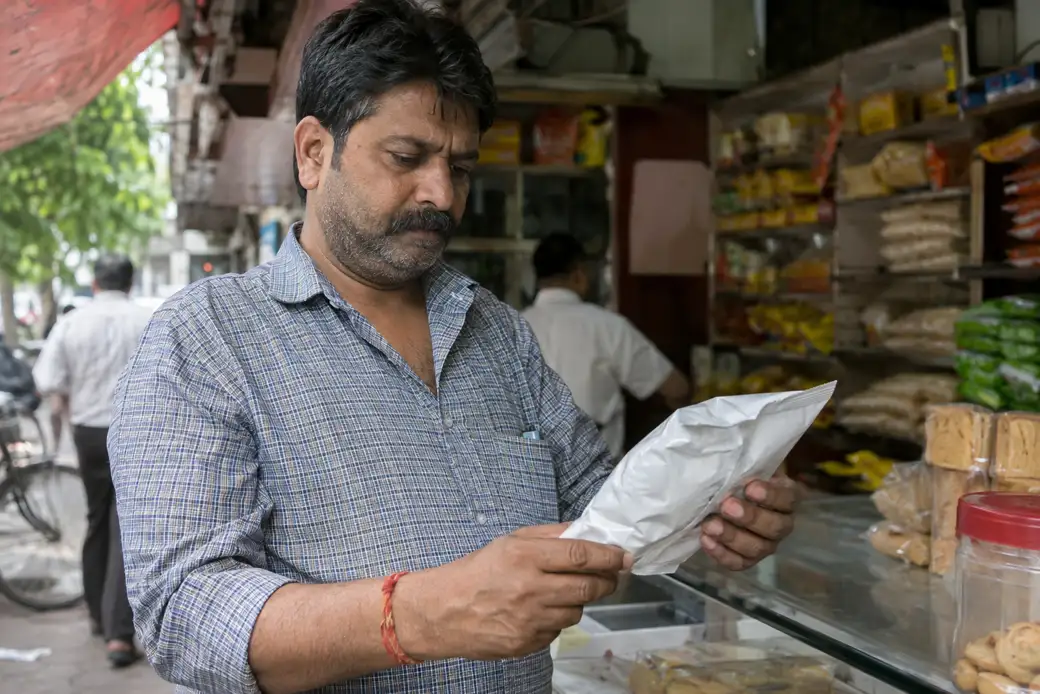
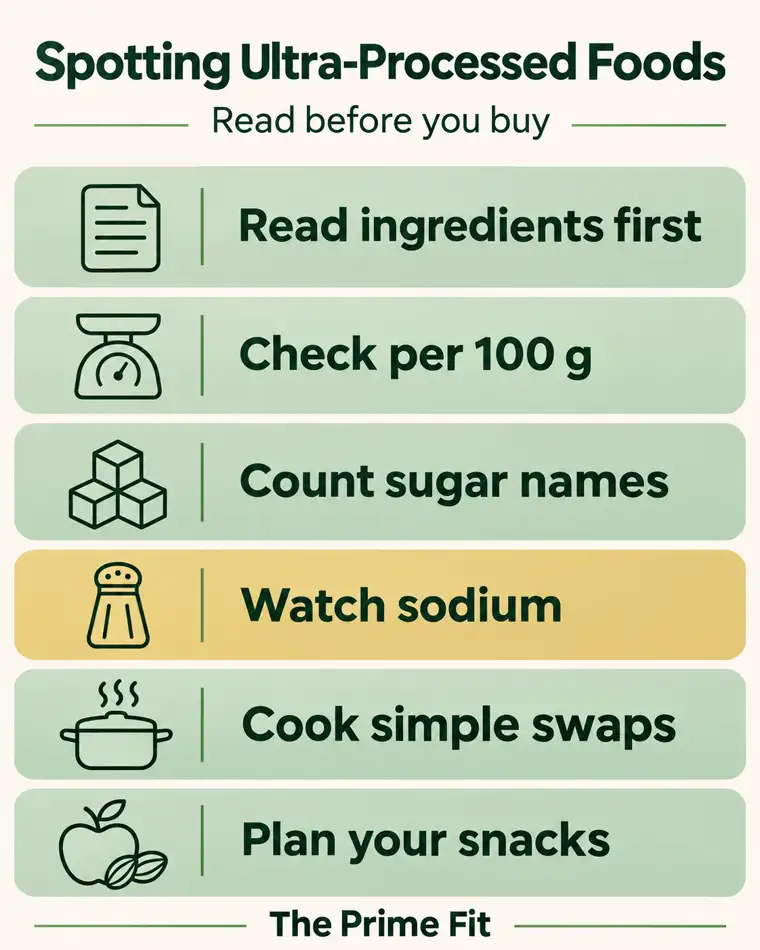
Turn the packet over. The front is advertising. The back is information.
- A long ingredient list, often more than five to eight items.
- Ingredients you would not keep at home: maltodextrin, liquid glucose, invert sugar syrup, hydrolysed vegetable protein, modified starch, interesterified fat, protein isolates.
- Additives listed by function and number: emulsifier, stabiliser, flavour enhancer, acidity regulator, colour, “nature identical flavouring substances”.
- Refined wheat flour (maida), sugar or refined palm oil among the first three ingredients.
Ingredients are listed in descending order by weight, so the first three tell you most of what the product is.
How to read the nutrition label
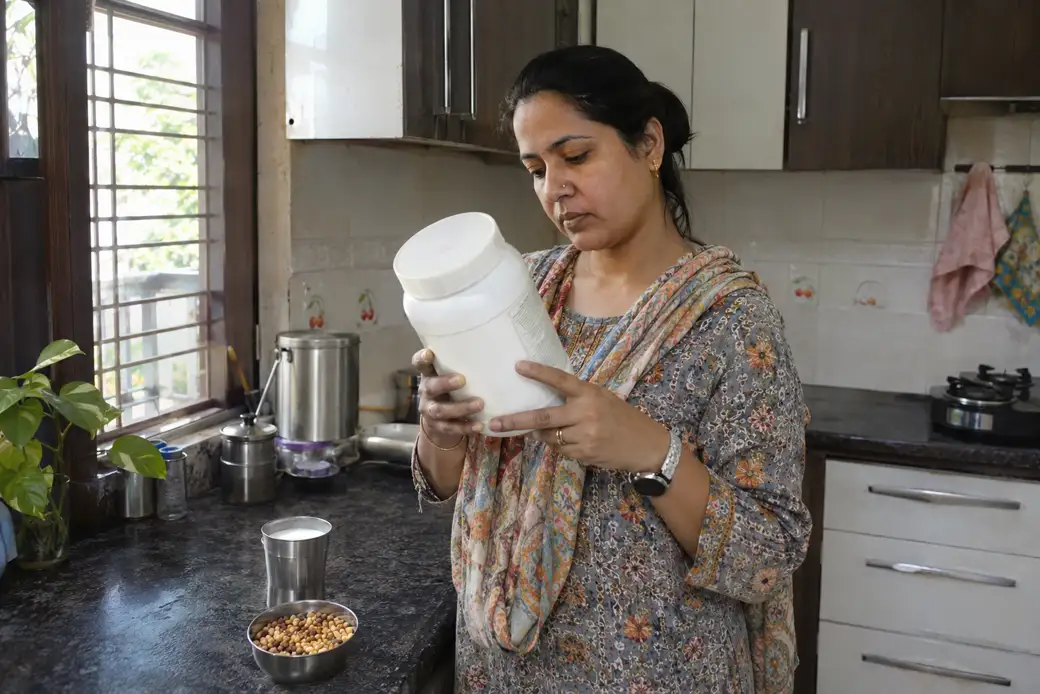
Indian labels give nutrition per 100 g or 100 ml, and often per serving. Always compare products per 100 g, because serving sizes are set by the manufacturer and are often smaller than what people really eat.
India does not yet have a mandatory front-of-pack warning label, although proposals have been under discussion for some time. Until then, the traffic light thresholds used in the United Kingdom are a handy rough benchmark for solid foods.
| Per 100 g of food | Low | High |
|---|---|---|
| Total sugars | 5 g or less | More than 22.5 g |
| Total fat | 3 g or less | More than 17.5 g |
| Saturated fat | 1.5 g or less | More than 5 g |
| Salt | 0.3 g or less | More than 1.5 g |
Indian labels usually show sodium, not salt. To convert, multiply sodium by 2.5. So 600 mg of sodium per 100 g equals 1.5 g of salt per 100 g, which is the “high” threshold. The World Health Organization advises less than 5 g of salt a day for adults, about one level teaspoon, from all sources.
Sugar: a worked calculation
One teaspoon of sugar is about 4 g. Illustrative example: a 250 ml carton of a sweetened drink lists 12 g of sugar per 100 ml. The carton therefore contains 30 g of sugar, about seven and a half teaspoons, and roughly 120 kcal from sugar alone. The World Health Organization advises keeping free sugars below 10% of daily energy, and ideally below 5%, which is roughly 25 g a day for many adults.
Sugar hides under many names: sucrose, glucose, dextrose, fructose, liquid glucose, corn syrup, invert syrup, malt extract, maltodextrin, honey, jaggery, fruit juice concentrate. If three or four of these appear in one list, the product is mostly sugar and starch whatever the front says.
Front-of-pack claims that mislead
| Claim | What to check |
|---|---|
| “Multigrain” or “with whole grains” | Whether maida is still the first ingredient, and what percentage the other grains make up |
| “No added sugar” | Total sugars per 100 g. Juice concentrates and dates are still sugar |
| “Baked, not fried” | Total fat, sodium and refined flour. Baked snacks can still be energy dense |
| “High protein” | Grams of protein per serving against sugar and calories per serving |
| “Diet” or “lite” | Calories per 100 g compared with the regular version. The difference is often small |
| “Made with real fruit” | The fruit percentage in the ingredient list, which may be very low |
| “Zero trans fat” or “zero cholesterol” | Saturated fat, total fat and calories, which matter more for weight |
| “Sugar free” | Refined flour, fat and calories. Sugar-free biscuits and sweets are rarely low in calories |
Is all packaged food bad?
No. Packaging and processing are not the problem in themselves. Many packaged foods are helpful for a busy household and support weight loss.
- Pasteurised milk, plain curd, paneer and unsweetened chaas
- Frozen peas, corn, mixed vegetables and frozen fish or chicken without coatings
- Whole dals, rajma, chana, plain oats, dalia, brown rice, millets and whole wheat atta
- Roasted chana, plain makhana, unsalted or lightly salted peanuts and nuts
- Eggs, tofu and plain soya chunks
- Canned chickpeas or beans, rinsed before use
The useful question is not “is it packaged?” but “what is it made of, and would I recognise the ingredients?”
Everyday Indian swaps
| Instead of | Vegetarian swap | Non-vegetarian swap |
|---|---|---|
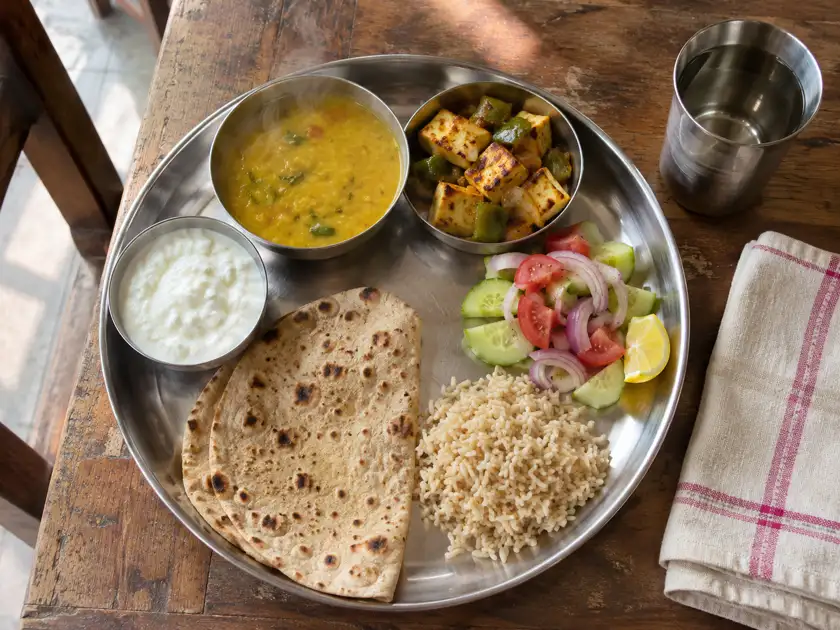
| Biscuits or rusk with chai | Roasted chana, a handful of peanuts or a small besan chilla | A boiled egg |
| Instant noodles | Vegetable dalia, poha with peanuts or moong dal chilla | Egg bhurji with one roti |
| Chips or packaged namkeen | Plain roasted makhana, bhuna chana chaat with onion and lemon | Grilled chicken tikka pieces |
| Soft drinks or packaged juice | Nimbu pani without sugar, chaas, plain soda with lemon, whole fruit | The same |
| Sweetened breakfast cereal | Plain oats with milk, nuts and fruit, or vegetable upma | Omelette with vegetables and one slice of whole wheat toast |
| Flavoured yoghurt or packaged lassi | Plain curd with fruit or roasted jeera | The same |
| Frozen fried snacks | Paneer tikka, sprouted moong salad | Tandoori fish or chicken |
A sample day with minimal ultra-processed food
This is an illustrative example, not a prescription. Portions depend on your needs.
| Meal | Vegetarian | Non-vegetarian |
|---|---|---|
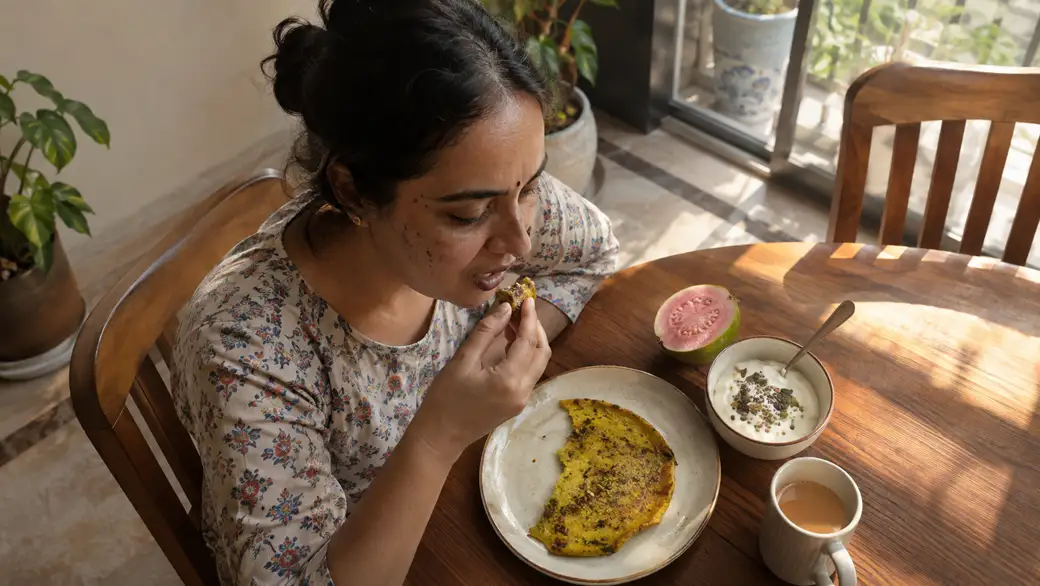
| Breakfast | 2 moong dal chillas with mint chutney and a bowl of curd | 2-egg omelette with vegetables and one roti |
| Mid-morning | One whole fruit | One whole fruit |
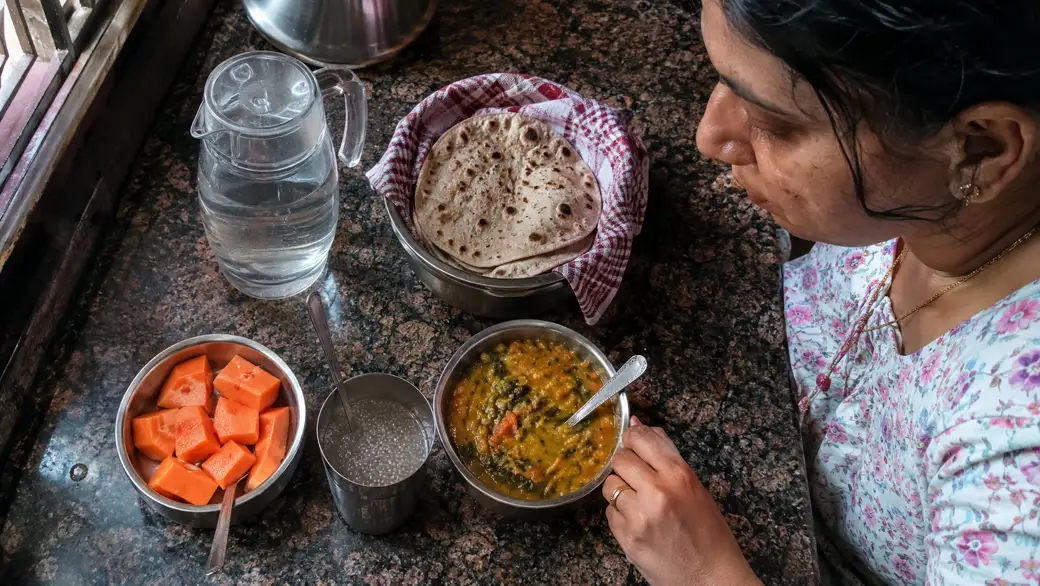
| Lunch | Dal, seasonal sabzi, 2 rotis, salad, curd | Chicken or fish curry, sabzi, 2 rotis, salad |
| Evening | Chai without sugar and roasted chana | Chai without sugar and a boiled egg |
| Dinner | Paneer bhurji or rajma, sabzi, one roti or a small portion of rice | Grilled fish or chicken, sabzi, dal, one roti |
For condition-specific menus, see our Indian diabetes diet chart and the GLP-1 diet plan for Indians.
Festivals, travel and children
Diwali gift boxes, wedding seasons and train journeys are when packaged sweets and snacks pile up. A few habits help:
- Keep gifted sweets and snacks out of sight, share them or pass them on. Food on the table gets eaten.
- Carry your own travel food: roasted chana, nuts, fruit, a paneer or egg roll made at home.
- During Navratri and other fasts, packaged “vrat” chips and fried mixtures are still ultra-processed snacks. Fruit, curd, makhana and sabudana cooked with little oil are better choices.
- Do not use packaged snacks as a daily tiffin item or a reward for children. Habits formed early tend to last.
Ultra-processed foods if you are on a GLP-1 medicine
Medicines such as Mounjaro, Wegovy and Ozempic reduce appetite, and many people find their interest in packaged snacks falls. That is helpful, but it brings a new risk: when you eat much less, every bite counts for more. If the small amount you eat is mostly biscuits, namkeen and sweet tea, you can lose weight while falling short on protein, fibre and vitamins, which costs muscle. Fried and very sweet foods also tend to worsen nausea and acidity during treatment.
Use the reduced appetite to rebuild your routine around real meals. More detail is in our guide to GLP-1 therapy.
Who should see a healthcare professional?
Food changes are safe for almost everyone, but some people should have a medical review alongside them.
Consider an assessment if
Your BMI is 23 or above, your waist is more than 90 cm (men) or 80 cm (women), you have diabetes, prediabetes, high blood pressure, fatty liver, PCOS or sleep apnoea, or you have tried repeatedly to lose weight without lasting success. You can check your BMI with our BMI calculator.
Seek help sooner
See a healthcare professional promptly if you have unexplained weight loss or gain, excessive thirst and urination, or episodes of eating large amounts with a feeling of loss of control, followed by distress, vomiting or purging. Chest pain, breathlessness or fainting need urgent care.
Common myths about ultra-processed foods
- “A calorie is a calorie, so processing does not matter.” Calories do determine weight change, but processing affects how many calories you end up eating before you feel full.
- “All packaged food is ultra-processed.” Milk, curd, dal, frozen vegetables and plain oats come in packets and are not.
- “Home-made is always healthy.” Deep-fried pakoras and home-made mithai are not ultra-processed, but they are still high in calories. Portion and frequency matter.
- “Diet, baked or multigrain versions are fine in any amount.” Most are still refined, salty and easy to overeat.
- “You must give them up completely.” Occasional use is realistic. The aim is to make them a small part of your diet, not the base of it.
- “Additives are the whole problem.” The research on individual additives is still developing. The clearer issue is the overall pattern: refined, energy dense, low in protein and fibre.
Questions to ask your healthcare provider
- How much of my current diet is ultra-processed, and what should I change first?
- What are sensible daily limits for sugar and salt given my blood pressure and blood sugar?
- Do I need blood tests for diabetes, cholesterol or fatty liver?
- How much protein and fibre should I aim for each day?
- Are my weight and waist in a range where medical treatment should be considered?
- How do I handle cravings in the evening or under stress?
How The Prime Fit helps
At The Prime Fit, an assessment looks at your weight, waist, medical history and relevant blood tests, and also at how you actually eat: your work hours, who cooks, what you snack on and what is realistic for your household. Nutrition support through our clinical nutrition service focuses on practical changes, such as label reading, planned snacks and simple home meals, for vegetarian and non-vegetarian diets alike. Follow-up visits track progress and adjust the plan. Where medical treatment is appropriate, it is discussed alongside food changes, not in place of them.
Frequently asked questions
What counts as an ultra-processed food?
Factory-made products built mainly from refined flour, sugar, oil and additives, such as biscuits, chips, packaged namkeen, instant noodles, soft drinks and sweetened cereals. A long ingredient list with items you would not use at home is the usual sign.
Do ultra-processed foods cause weight gain?
In a controlled trial, people ate about 500 kcal more a day and gained weight on an ultra-processed diet. Long-term population studies also link these foods with obesity, though they cannot prove cause on their own.
Is bread ultra-processed?
Most packaged bread technically is, because of added emulsifiers and preservatives. A whole wheat bread with a short ingredient list is a better choice than white bread, and far less of a concern than biscuits or cakes.
Are digestive or multigrain biscuits healthy?
They are still biscuits. Most contain refined flour, sugar and fat, with a small amount of whole grain or fibre. Check the ingredient list and the figures per 100 g.
Is packaged fruit juice better than a soft drink?
Not by much for weight. Both deliver sugar in liquid form without the fibre of whole fruit. Eat the fruit and drink water.
How do I convert sodium to salt on a label?
Multiply sodium by 2.5. For example, 400 mg of sodium equals 1 g of salt.
Can I eat packaged snacks while losing weight?
Occasionally, yes. Buy small packs, serve a portion in a bowl and do not eat from the packet. Daily use makes weight loss much harder.
Are protein bars and health drinks ultra-processed?
Most are. Some are useful in specific situations, but many contain as much sugar as a sweet. Read the label as you would for any other packaged food.
This article is general information and is not a substitute for a medical consultation. Figures from studies and food labels are approximate. Speak to your healthcare provider or dietitian before making major changes to your diet if you have diabetes, kidney disease or another medical condition.