In this article
- Wegovy vs Mounjaro health insurance coverage in India: the short answer
- Why most policies do not pay for weight loss injections
- When is insurance cover more likely?
- Does the reason for the prescription change things?
- Situation by situation: what is usually covered?
- Why is bariatric surgery treated differently?
- Wegovy vs Mounjaro comparison: what affects your out-of-pocket planning
- Cost of Wegovy vs Mounjaro in India: why insurance is only part of the picture
- How do I check my own policy, step by step?
- Which documents help a claim?
- Other ways to manage the cost safely
- What may change in the coming years?
- Common myths
- Questions to ask your healthcare provider
- How The Prime Fit helps
- Frequently asked questions
If you are comparing Wegovy vs Mounjaro health insurance coverage in India, the short answer is the same for both: most retail health insurance policies do not pay for either medicine when it is prescribed for weight loss. There are two reasons. Both are outpatient medicines, while most policies are built around hospitalisation, and many policies list obesity or weight-control treatment as an exclusion.
There is no meaningful difference between the two brands on this point. Whether a claim is paid depends on your policy and on the reason the medicine was prescribed, not on the name printed on the pen. Cover becomes more likely when a plan has outpatient or pharmacy benefits, when it is an employer group policy with wider terms, or when the medicine is prescribed for type 2 diabetes under a plan that pays for long-term medicines.
Insurance terms differ between insurers and policies, and they change. Treat this as general information for 2026 and confirm every point against your own policy wording.
Wegovy vs Mounjaro health insurance coverage in India: the short answer
If you do not have diabetes and are prescribed either medicine for weight management, plan as though the full cost will come from your own pocket. Partial cover is the exception.
- The expense type matters most. A weekly injection taken at home is an outpatient (OPD) pharmacy expense. Most indemnity policies pay for admission to hospital, not for medicines bought over the counter.
- The exclusion list matters next. Many policies exclude treatment for obesity or weight control, except for surgery that meets defined conditions.
- Diabetes changes the picture, a little. If the medicine is prescribed for type 2 diabetes and your plan has OPD or chronic-disease medicine cover, a claim is more plausible, subject to waiting periods and the insurer’s decision.
Why most policies do not pay for weight loss injections
They are outpatient medicines
A standard indemnity health policy pays when you are admitted to hospital, usually for 24 hours or more, or for a listed day-care procedure. Consultations, routine blood tests and medicines you buy from a pharmacy and take at home fall outside this, unless your plan has a specific OPD benefit. Both medicines are self-injected at home, so they sit on the outpatient side.
Obesity treatment is a common exclusion
Health policies in India use a set of standardised exclusions. One of them deals with obesity and weight control. In many policies it excludes treatment for obesity unless it is surgery that meets specified conditions. So even a plan with OPD cover may decline a medicine prescribed only for weight loss. The exact wording in your policy document decides the outcome.
OPD benefits have limits
Where OPD cover exists, it usually has an annual limit and sometimes a list of what counts. A long-term weekly medicine can use up a modest limit within months.

When is insurance cover more likely?
None of these is a guarantee. They are the situations in which it is worth asking.
- Policies or riders with OPD or pharmacy benefits. Some retail plans and add-ons reimburse prescribed medicines up to a limit. Check whether obesity treatment is still excluded within that benefit.
- Employer group policies. Group cover is negotiated by the employer and can be wider than retail cover, sometimes with OPD benefits or waived waiting periods. Ask your HR team or the insurance help desk for the policy wording.
- Type 2 diabetes with medicine cover. When the diagnosis on the prescription is type 2 diabetes and the plan pays for outpatient or chronic-disease medicines, the claim is assessed as diabetes treatment.
- Diabetes-specific plans. Some plans designed for people with diabetes include consultations, tests or medicines.
In every case, waiting periods for pre-existing disease, sub-limits, co-payments and the insurer’s own assessment apply.
Does the reason for the prescription change things?
Yes, and this is where the two medicines differ slightly. Mounjaro (tirzepatide) is approved in India for type 2 diabetes as well as for weight management, so the same brand can appear on a diabetes prescription. Semaglutide for diabetes is sold under different brand names, Ozempic as an injection and Rybelsus as a tablet, while Wegovy is the semaglutide brand for weight management.
A diabetes prescription for either ingredient may be claimable under a plan that covers diabetes medicines. A Wegovy prescription signals weight management, which is where the obesity exclusion tends to apply.
Never misstate a diagnosis
Do not ask a prescriber to write “diabetes” on a prescription when you do not have diabetes, and do not hide a known condition when buying a policy. Misrepresentation can lead to a rejected claim or a cancelled policy, and it puts a wrong diagnosis on your record.
Situation by situation: what is usually covered?
| Situation | Usually covered? | What to check |
|---|---|---|
| Wegovy or Mounjaro for weight loss, no diabetes | Usually not, under most retail policies | Obesity or weight-control exclusion; whether any OPD or pharmacy benefit applies to it |
| Medicine prescribed for type 2 diabetes, plan has OPD or chronic-medicine cover | Sometimes, within limits | OPD annual limit, list of eligible medicines, waiting period for pre-existing diabetes, co-payment |
| Hospital admission for a serious side effect, such as severe dehydration or pancreatitis | Often assessed like any other admission, but not certain | Whether complications of an excluded treatment are also excluded; pre-authorisation rules; ask your insurer in advance |
| Consultations and blood tests | Usually not, unless the plan has OPD or diagnostics cover | OPD limit, network requirements, whether a preventive health check-up benefit exists |
| Bariatric surgery | Often, when the policy’s conditions are met | BMI threshold, related conditions, waiting period, pre-authorisation, any sub-limit |
Why is bariatric surgery treated differently?
It surprises many people that an operation can be covered when a medicine is not. The standardised obesity exclusion is commonly cited as allowing cover for obesity surgery when all of the following are met:
- the surgery is carried out on medical advice and is supported by accepted medical protocols;
- the person is an adult, aged 18 or above;
- BMI is 40 or above, or 35 or above together with specified serious related conditions, such as severe sleep apnoea, uncontrolled type 2 diabetes or certain heart conditions, usually after less invasive methods have not worked.
Surgery is also a hospital admission, which indemnity policies are designed to pay for. Waiting periods, sub-limits and pre-authorisation still apply and policies differ, so verify the conditions with your insurer. These thresholds differ from the Asian Indian BMI cut-offs used in medical care, where overweight begins at 23 and obesity at 25. You can check your own figure with our BMI calculator and read about the options in weight loss injections versus bariatric surgery.
Wegovy vs Mounjaro comparison: what affects your out-of-pocket planning
Because most people pay for these medicines themselves, the practical differences matter more. This comparison leaves out prices, which change and vary by dose.
| Feature | Wegovy | Mounjaro |
|---|---|---|
| Active ingredient | Semaglutide | Tirzepatide |
| Approved uses | Long-term weight management, including in people with excess weight and established heart disease | Type 2 diabetes and long-term weight management |
| Dose steps | Five strengths: 0.25, 0.5, 1, 1.7 and 2.4 mg | Six strengths: 2.5, 5, 7.5, 10, 12.5 and 15 mg |
| How often | Once a week | Once a week |
| Pen type | Pre-filled injection pen; confirm the current presentation with your pharmacist | Pre-filled injection pen; confirm the current presentation with your pharmacist |
| Long-term use | Usually needed to maintain results | Usually needed to maintain results |
| More likely to be claimed under diabetes cover | Less likely, as it is the weight-management brand | More likely, when prescribed for type 2 diabetes |
For budgeting, remember that cost usually rises with the dose and that not everyone needs the highest strength. For the medical comparison, see Mounjaro vs Wegovy: which is better for weight loss.
Cost of Wegovy vs Mounjaro in India: why insurance is only part of the picture
People who search for the cost of Wegovy vs Mounjaro in India often hope that insurance will settle the choice. It rarely does. The better questions are which medicine suits your health profile, what dose you are likely to settle on, and whether you can sustain the cost for a year or more.
A medicine stopped after a few months because of cost is poor value, since weight commonly returns after stopping. Our article on how long to stay on weight loss injections covers what long-term treatment involves.
How do I check my own policy, step by step?
- Find the full policy wording. The brochure and the summary are not enough. Download the complete document from your insurer, or ask your HR team for the group policy wording.
- Read the exclusions list. Look for the heading on obesity or weight control, and note the exact words.
- Look for OPD or pharmacy benefits. Note the annual limit, whether medicines are included, and whether you must use network pharmacies.
- Check waiting periods. If you have diabetes, high blood pressure or another condition that existed before the policy began, find the pre-existing disease waiting period.
- Ask about pre-authorisation. Some benefits need approval before the expense, not after.
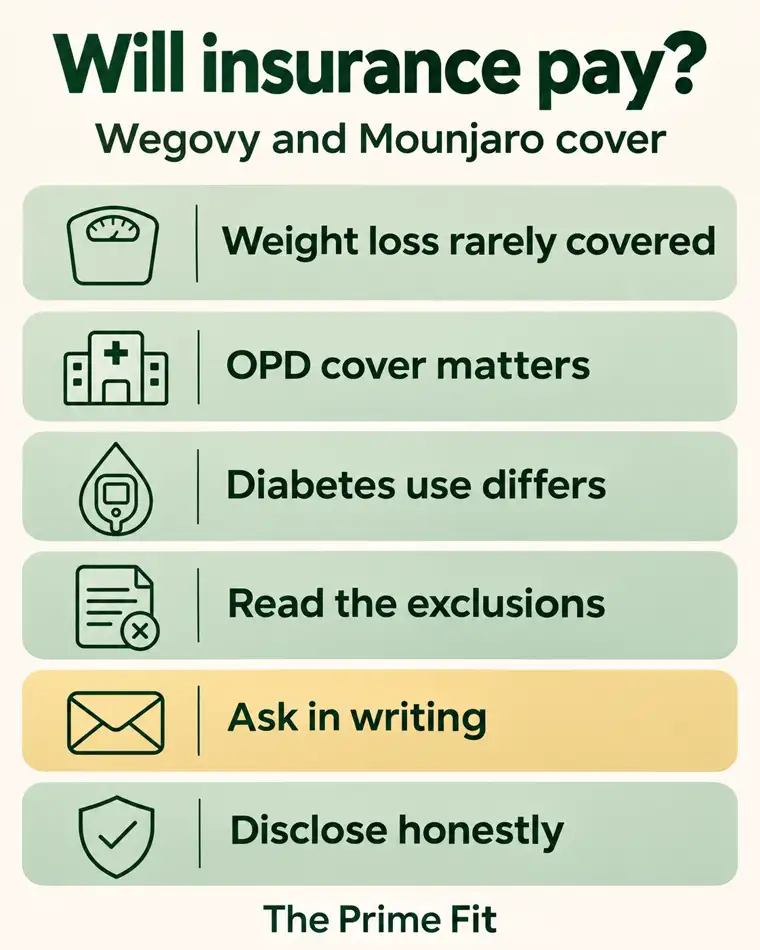
- Ask in writing. Email your insurer or the help desk with your policy number, the medicine name, the diagnosis and the question. Keep the reply.
Two illustrative examples
Illustrative example 1: Ritu, 38, in Noida has a family floater with no OPD benefit, a BMI of 31 and no diabetes. Her policy pays for hospitalisation only, so her injections, consultations and tests are self-funded. Illustrative example 2: Arvind, 46, in Gurugram has type 2 diabetes and an employer group policy with an OPD limit. His insurer confirms in writing that prescribed diabetes medicines are eligible, so his claim may be paid until the limit is used up.
Which documents help a claim?
If your plan has a benefit that might apply, complete and accurate paperwork gives the claim its best chance.
- A dated prescription that states the diagnosis, the medicine, the dose and the duration.
- Medical records that note your height, weight, BMI, waist measurement and any related conditions, such as type 2 diabetes, high blood pressure, sleep apnoea or fatty liver.
- Test reports, for example HbA1c, fasting glucose, lipids and liver function. See blood tests before starting GLP-1 treatment.
- Original pharmacy bills showing the pharmacy’s name, GST number, batch number, your name and the prescriber’s name.
Submit claims within your policy’s time limit. If a claim is declined, ask for the reason in writing. Insurers have a grievance process you can use.
Other ways to manage the cost safely
- Employer benefits. Some employers offer wellness allowances, flexible benefit plans or a health spending account in addition to insurance. Ask what applies to prescribed medicines.
- Know the tax position. Deductions exist under section 80D for health insurance premiums and preventive health check-ups, within limits. This does not mean your medicine costs are deductible. Confirm your own position with a tax adviser.
- Plan for the long term. Before starting, discuss the likely dose path and duration with your prescriber, and budget for at least a year, including consultations and tests.
- Protect the investment. Good nutrition, enough protein and strength training help you get more from each dose and hold on to results. Dal, paneer, curd and sprouts, or eggs, fish and chicken, with home-style roti and sabzi, cost little and support treatment well.
Shortcuts that are not worth it
Do not buy cheap, unverified pens from social media sellers or unknown websites. Counterfeit and badly stored products are a real risk, as explained in our guide to fake and unregulated GLP-1 pens. Do not stretch the gap between doses, split doses or count pen clicks to make a pen last longer unless your prescriber has specifically advised a change.
What may change in the coming years?
This area is moving. More medicines in this class are reaching India, and lower-cost versions of semaglutide have begun to appear, which may ease out-of-pocket costs over time.
There is also growing medical recognition of obesity as a long-term disease, and insurers in several countries are reviewing how they treat it. Whether and when insurers in India will widen cover is not known, so do not start treatment assuming cover will arrive later.
Common myths
- “Mounjaro is covered and Wegovy is not.” Not as a rule. Cover follows the diagnosis and the policy terms. Mounjaro is only more likely to be claimable when it is prescribed for type 2 diabetes under a plan that pays for diabetes medicines.
- “A prescription means the insurer must pay.” A prescription shows medical need. It does not override an exclusion or create an OPD benefit that the policy does not have.
- “Writing diabetes on the prescription is a harmless fix.” It is misrepresentation, and it can cost you the claim and the policy.
Questions to ask your healthcare provider
- What is the diagnosis you are treating, and how will it be written on my prescription?
- Which medicine suits my health profile, and why?
- What dose am I likely to settle on, and how long might treatment last?
- If cost becomes a problem, what is the safe way to pause, change or stop?
- Which warning signs mean I should seek urgent care?
Severe or persistent abdominal pain, repeated vomiting, signs of dehydration or an allergic reaction need prompt medical attention, whatever your insurance position.
How The Prime Fit helps
The Prime Fit does not arrange insurance and cannot tell you what your insurer will decide. Our team can make the medical side clear and well documented. That begins with an assessment of your weight, health history and blood tests. You receive a clear written prescription and records that state the diagnosis accurately.
Treatment is supported with nutrition guidance for Indian meals, vegetarian and non-vegetarian, and regular follow-up on progress, side effects and dose. We can also talk through the likely length of treatment, so you can budget honestly before you begin.
Frequently asked questions
Is Mounjaro covered by health insurance in India?
Usually not when it is prescribed for weight loss, because it is an outpatient medicine and many policies exclude obesity treatment. When Mounjaro is prescribed for type 2 diabetes and your plan has OPD or chronic-medicine cover, a claim may be possible within the plan’s limits and waiting periods. Check your policy wording.
Does insurance cover Wegovy for weight loss?
Most retail health policies in India do not. Wegovy is a weight-management medicine taken at home, so it falls under both the outpatient gap and, in many policies, the obesity exclusion. Some employer group plans or OPD benefits may contribute.
Is Ozempic covered for diabetes?
It can be, if your policy pays for outpatient or chronic-disease medicines and your diabetes is past any pre-existing disease waiting period. A hospitalisation-only policy will not usually reimburse pharmacy purchases.
Which is more likely to be covered, Wegovy or Mounjaro?
Neither brand has an advantage for weight loss. Mounjaro is more likely to be claimable only when prescribed for type 2 diabetes. Cover depends on the diagnosis and the policy, not the brand.
Does my employer’s group health insurance cover weight loss injections?
Some group policies are wider than retail plans and include OPD benefits, but many still exclude obesity treatment. Ask your HR team or the insurance help desk for the policy wording and a written answer about your specific medicine and diagnosis.
Is bariatric surgery covered by health insurance in India?
Often, when the policy’s conditions are met. These are commonly cited as surgery on medical advice in an adult with a BMI of 40 or above, or 35 or above with specified serious related conditions. Verify the conditions with your insurer.
Can I claim Wegovy or Mounjaro as a tax deduction?
Do not assume so. Section 80D provides deductions for health insurance premiums and preventive health check-ups within limits, which is different from the cost of medicines. Ask a tax adviser about your own situation.
Will insurance pay if I am hospitalised for a side effect of a weight loss injection?
Many admissions are assessed like any other hospitalisation, but some policies exclude complications arising from an excluded treatment. Ask your insurer before you start, and seek urgent care for serious symptoms regardless of cover.
This article is general information for education only. It is not medical, insurance, legal or tax advice. Insurance terms differ between insurers and policies and may change, so always rely on your own policy wording and written confirmation from your insurer. Decisions about medicines should be made with a qualified healthcare provider who knows your health history.