In this article
- Why excess weight harms the heart
- The landmark trial in people with obesity and heart disease
- What “20 percent lower” means in real numbers
- Is the benefit simply due to weight loss?
- Evidence in people with type 2 diabetes
- Heart failure
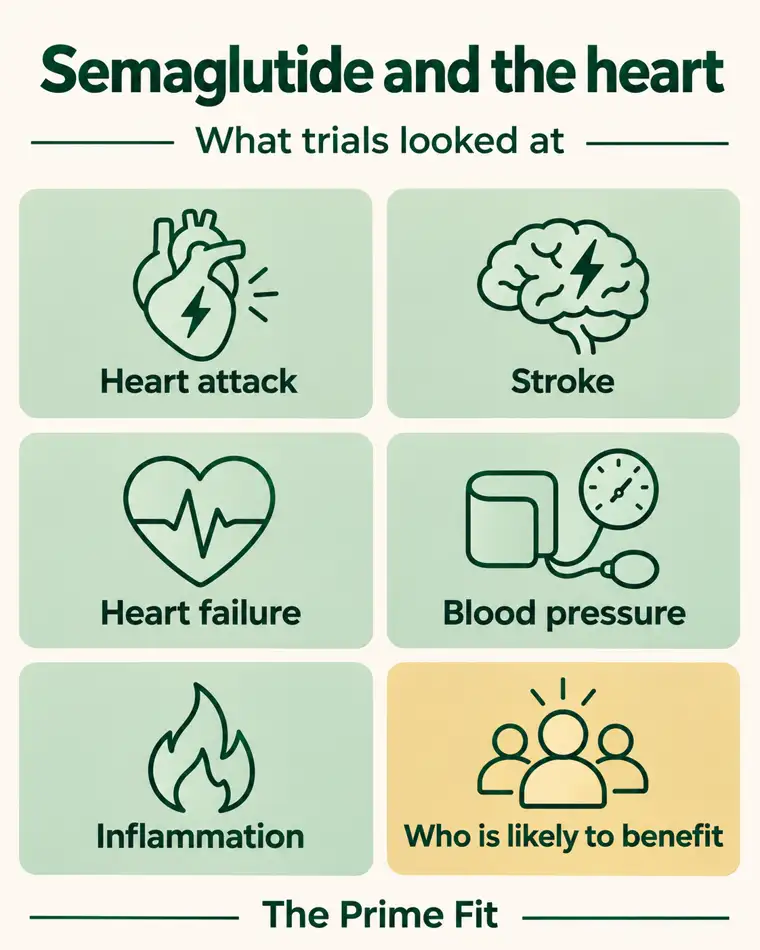
- Other cardiovascular findings
- What changes, and when
- Who is likely to benefit
- What is not yet known
- How it fits with your other heart medicines
- Practical points for people with heart disease
- Eating for your heart on treatment
- Semaglutide and tirzepatide for the heart
- Safety in people with heart disease
- Three illustrative examples
- Questions to ask your healthcare provider
- Common myths
- How The Prime Fit works with your heart care
- Frequently asked questions
For decades, healthcare professionals told people with heart disease to lose weight, on the reasonable assumption that it would protect them. What was missing was proof. No weight loss medicine had been shown in a large trial to reduce heart attacks, strokes or deaths, and some earlier ones had done the opposite and been withdrawn.
That changed in late 2023, when a trial of more than 17,000 people showed that semaglutide 2.4 mg, the dose sold as Wegovy, reduced major cardiovascular events by about a fifth in adults with overweight or obesity and established heart disease. Regulators have since added cardiovascular risk reduction to its licensed uses. It is one of the main reasons obesity is now treated as a medical condition with consequences beyond the scale.
This guide explains that evidence in plain language, along with results in diabetes, heart failure and kidney disease, and sets out honestly what is and is not yet known. It is general information. Decisions about your heart treatment should be made with your cardiologist and physician.
Why excess weight harms the heart
Excess body fat, particularly fat stored in the abdomen and around the organs, affects the cardiovascular system in several ways at once:
- Blood pressure rises, through effects on the kidneys, nervous system and blood volume.
- Blood fats worsen: triglycerides rise, protective HDL cholesterol falls, and LDL particles become smaller and more harmful.
- Insulin resistance and type 2 diabetes develop, damaging blood vessels.
- Chronic inflammation: fat tissue releases substances that promote the build-up and rupture of plaque in the arteries.
- The heart works harder and its walls thicken and stiffen, leading to heart failure.
- Fat around the heart itself affects the heart muscle and rhythm.
- Sleep apnoea strains the heart every night.
Indians are especially vulnerable. Heart attacks occur about a decade earlier on average than in Western populations, often at body weights that look unremarkable, because of a tendency to store fat in the abdomen and to develop diabetes early.
The landmark trial in people with obesity and heart disease
Who took part
The trial enrolled about 17,600 adults in 41 countries. All were aged 45 or over, had a BMI of 27 or above, and had established cardiovascular disease: a previous heart attack, a previous stroke, or symptomatic disease of the leg arteries. None had diabetes. Most were already taking standard heart medicines such as statins, antiplatelet drugs and blood pressure treatment.
What was tested
Participants were randomly assigned to a weekly injection of semaglutide, increased to 2.4 mg, or to placebo, in addition to their usual care. Neither they nor their healthcare professionals knew which they were receiving. They were followed for an average of a little over three years, some for nearly five.
What was found
| Outcome | Semaglutide | Placebo | Relative difference |
|---|---|---|---|
| Heart attack, stroke or cardiovascular death (the main outcome) | About 6.5 in 100 | About 8.0 in 100 | About 20% lower |
| Death from any cause | About 4.3 in 100 | About 5.2 in 100 | About 19% lower |
| Heart failure events or cardiovascular death | About 3.4 in 100 | About 4.1 in 100 | About 18% lower |
| Average weight change | About 9% lost | About 1% lost | |
| Stopped treatment because of side effects | About 17 in 100 | About 8 in 100 |
Only the main outcome was formally confirmed by the trial’s statistical plan; the other results point in the same direction but are considered supportive. Blood pressure, waist size, blood sugar, triglycerides and a blood marker of inflammation all improved. Far fewer people on semaglutide went on to develop diabetes.
What “20 percent lower” means in real numbers
Percentages can mislead, so it helps to see the absolute figures.
| Out of 1,000 people like those in the trial, over about three years | Number |
|---|---|
| Would have a heart attack, stroke or cardiovascular death on placebo | About 80 |
| Would have one on semaglutide | About 65 |
| Events prevented | About 15 |
| People who need to be treated for three years to prevent one event | About 67 |
That is a meaningful benefit for a group already receiving good standard care, and it is in the same range as other accepted heart-protective treatments. For any one person, it means a real but modest reduction in risk, not a guarantee. The benefit is larger for people at higher risk and smaller for those at lower risk.
Relative and absolute risk
“20 percent lower” is the relative reduction. The absolute reduction was about 1.5 percentage points over three years. Both figures are true; you need both to judge what the treatment offers you.
Is the benefit simply due to weight loss?
Probably not entirely. Three observations suggest that more is going on:
- The curves for the two groups began to separate within the first few months, before most of the weight had been lost.
- Further analyses found that the benefit was seen across the range of starting weights, and that the amount of weight an individual lost explained only part of it.
- Semaglutide had already reduced cardiovascular events in people with type 2 diabetes at lower doses, with much smaller weight loss.
The likely contributors are lower blood pressure, better blood fats and sugar, less inflammation, and direct effects of GLP-1 action on blood vessels and plaque. Researchers are still working out the relative importance of each.
Evidence in people with type 2 diabetes
The heart benefits of semaglutide were first seen in diabetes.
| Trial population | Form and dose | Main finding |
|---|---|---|
| Type 2 diabetes at high cardiovascular risk, about 3,300 people, two years | Weekly injection, 0.5 or 1 mg | About a quarter fewer heart attacks, strokes or cardiovascular deaths, driven mainly by fewer strokes |
| Type 2 diabetes at high cardiovascular risk, about 3,200 people | Daily tablet | Shown to be safe for the heart, with a trend towards fewer events |
| Type 2 diabetes with cardiovascular or kidney disease, about 9,600 people, four years | Daily tablet, 14 mg | About 14% fewer major cardiovascular events |
| Type 2 diabetes with chronic kidney disease, about 3,500 people | Weekly injection, 1 mg | About a quarter fewer major kidney events; fewer cardiovascular events and deaths |
On this basis, guidelines recommend a GLP-1 medicine with proven cardiovascular benefit for people with type 2 diabetes who have, or are at high risk of, cardiovascular disease, regardless of their HbA1c.
Heart failure
Heart failure with preserved ejection fraction, in which the heart pumps normally but is stiff and fills poorly, is closely linked with obesity. It causes breathlessness, swelling and fatigue, and has had few effective treatments.
In two year-long trials of people with this condition and obesity, with and without diabetes, semaglutide 2.4 mg improved symptoms and physical limitations clearly more than placebo, increased the distance participants could walk in six minutes, reduced body weight and lowered a marker of inflammation. Pooled analyses also suggest fewer episodes of worsening heart failure.
The evidence applies to this type of heart failure. For heart failure with reduced ejection fraction, where the pumping function is weak, data for GLP-1 medicines are limited and earlier trials with an older medicine in the class were not encouraging. Treatment decisions in that setting belong with a cardiologist.
Other cardiovascular findings
| Measure | Effect of semaglutide |
|---|---|
| Systolic blood pressure | Lower by about 3 to 7 mmHg, depending on dose and weight loss |
| Triglycerides | Lower, often by 15 to 20% |
| LDL cholesterol | Small reduction; not a substitute for a statin |
| C-reactive protein (inflammation) | Lower by roughly a third to 40% |
| Blood sugar and progression to diabetes | Substantially improved |
| Waist circumference | Reduced |
| Resting heart rate | Slightly higher, by about 1 to 4 beats per minute |
| Walking distance in people with diabetes and narrowed leg arteries | Improved in a dedicated trial |
| Kidney function in diabetes | Slower decline |
The small rise in heart rate is seen with all medicines in this class. It did not translate into harm in the outcome trials, but palpitations or a racing heart at rest should be reported.

What changes, and when
| Timeframe | What usually improves | What to check |
|---|---|---|
| First 3 months | Blood sugar after meals; appetite; early fall in weight and blood pressure | Home blood pressure; any dizziness; side effects during dose steps |
| 3 to 6 months | Triglycerides, waist size, markers of inflammation; HbA1c in those with raised sugar | Lipid profile, HbA1c; review of blood pressure tablets |
| 6 to 12 months | Most of the weight loss; stamina and breathlessness; sleep and snoring | Weight, waist, body composition; exercise capacity |
| 1 to 4 years | Fewer heart attacks and strokes in people with existing cardiovascular disease, as shown in the trial with continued treatment | Yearly review with your cardiologist; all standard heart medicines continued |
The early changes are the ones you can measure. The reduction in events is something you will never see directly, which is the nature of prevention. It is also why continuing treatment, and your other heart medicines, matters even when you feel well.
Who is likely to benefit
- Adults with a BMI of 27 or above and established cardiovascular disease: a previous heart attack, stroke, stent or bypass, or symptomatic disease of the leg arteries. This is the group in whom benefit has been proven.
- Adults with type 2 diabetes and cardiovascular disease or high cardiovascular risk.
- Adults with type 2 diabetes and chronic kidney disease.
- Adults with obesity and heart failure with preserved ejection fraction, for symptoms and function.
For Indian patients, in whom cardiovascular risk appears at lower BMI, healthcare professionals assess eligibility individually. If you have had a cardiac event and carry excess weight, particularly around the waist, it is reasonable to ask your cardiologist whether this treatment has a place for you.
What is not yet known
| Question | Current position |
|---|---|
| Does it prevent a first heart attack or stroke in people with obesity but no heart disease? | Not proven. Risk factors improve, so benefit is plausible, but the trial studied people with existing disease |
| Does it help people with a BMI below 27? | Not studied |
| How long does the benefit last, and what happens after stopping? | Shown for up to about four to five years on treatment. Weight and risk factors return towards baseline after stopping; the effect on events is unknown |
| Do other medicines in the class do the same? | Several GLP-1 medicines have shown benefit in diabetes. Tirzepatide was at least as good as an established GLP-1 medicine in a large trial in diabetes; its outcome trial in obesity is awaited |
| Is the tablet as protective as the injection? | The tablet has shown benefit in diabetes at its diabetes dose. It has not been tested in the obesity setting at equivalent doses for heart outcomes |
| Were Indian and South Asian patients well represented? | The trial was international and included Asian participants, but they were a minority. Results appeared consistent across groups |
How it fits with your other heart medicines
Semaglutide was tested on top of standard treatment, not in place of it. The people in the trial who benefited were, for the most part, already taking the medicines below.
| Treatment | What it does | Does semaglutide replace it? |
|---|---|---|
| Statins and other cholesterol-lowering medicines | Lower LDL cholesterol; the foundation of prevention | No |
| Aspirin or other antiplatelet medicines | Prevent clots in narrowed arteries | No |
| Blood pressure medicines | Protect the heart, brain and kidneys | No, though doses may need lowering as weight and pressure fall |
| Beta-blockers, ACE inhibitors and others after a heart attack | Protect the heart muscle | No |
| Diabetes medicines with heart and kidney benefit | For example SGLT2 inhibitors | No; often used together |
| Stopping smoking, activity, diet, cardiac rehabilitation | Reduce risk substantially | No |
Do not stop or reduce any heart medicine because you have started semaglutide. Tell your cardiologist about the injection, and tell your weight-management healthcare professional about your heart history and medicines.
Practical points for people with heart disease
- Blood pressure: check it at home weekly. If it falls, your tablets may need adjusting. Report dizziness or fainting.
- Fluids: vomiting or diarrhoea can cause dehydration, which matters more if you take diuretics or have kidney disease. If you have heart failure with a fluid limit, follow your cardiologist’s advice.
- Diuretics and potassium: prolonged vomiting or diarrhoea can disturb salts. Ask whether a blood test is needed.
- Blood thinners: a large change in diet, particularly in leafy vegetables, can affect warfarin. Have your INR checked as advised.
- Pulse: a small rise is expected. Report palpitations.
- Dose increases: go slowly. In the trial, about one in six people stopped because of side effects, mostly digestive.
- Muscle: protein and supervised strength exercise matter, especially in older adults and in heart failure.
- Procedures: tell the team before an angiogram, surgery or any sedation, because the stomach empties slowly.
- Exercise: start or resume activity under guidance, ideally through cardiac rehabilitation.
Call for emergency help if you have
Chest pain or tightness, pain spreading to the arm, jaw or back, sudden breathlessness, fainting, weakness or numbness on one side, drooping of the face, or difficulty speaking. Do not wait to see whether it passes.
Eating for your heart on treatment
The medicine reduces how much you eat. What you eat still shapes your blood fats, blood pressure and blood sugar.
| Eat more of | Cut down on |
|---|---|
| Vegetables and salad at every main meal | Deep-fried foods, namkeen, bakery items |
| Dals, chana, rajma, sprouts | Vanaspati, repeatedly heated oil, excess ghee and butter |
| Whole grains and millets in modest portions | Maida, white bread, sugary cereals |
| Fish twice a week, if you eat it; eggs; lean chicken | Processed and fatty red meat |
| Nuts and seeds, a small handful: walnuts, almonds, flaxseed | Sweets, sugary drinks, packaged juices |
| Mustard, groundnut, rice bran or olive oil, measured | Salt: pickles, papad, packaged snacks, added table salt |
| Whole fruit; low-fat curd and milk | Alcohol |
A sample day
| Meal | Vegetarian | Non-vegetarian |
|---|---|---|
| Breakfast | Vegetable oats with milk, a few walnuts | 2-egg-white and 1 whole egg omelette with vegetables, 1 whole wheat toast |
| Mid-morning | 1 fruit | 1 fruit; plain chaas |
| Lunch | Salad, 1 to 2 phulkas, dal or chana, sabzi cooked in little oil, low-fat curd | Salad, small katori of rice, fish curry, sabzi |
| Evening | Roasted chana or sprouts chaat | Roasted chana; unsweetened tea |
| Dinner | Tofu or low-fat paneer with vegetables, dal, 1 phulka | Grilled chicken or fish with vegetables, dal, 1 phulka |
Semaglutide and tirzepatide for the heart
Tirzepatide produces more weight loss on average than semaglutide and improves blood pressure, blood fats and blood sugar at least as much. In a large trial in people with type 2 diabetes and cardiovascular disease, it was compared with an established GLP-1 medicine known to protect the heart, and was at least as good, with somewhat fewer events. A dedicated trial of tirzepatide in people with obesity, measuring heart attacks, strokes and deaths, is in progress.
Until that reports, semaglutide is the medicine with direct proof of cardiovascular benefit in people with obesity and heart disease who do not have diabetes. For a patient in that position today, this is a legitimate reason for a healthcare professional to prefer it. The picture may change as new results arrive.
Safety in people with heart disease
The trial is reassuring. Serious adverse events were reported less often with semaglutide than with placebo, largely because there were fewer cardiac problems. The side effects that led people to stop were mainly nausea, vomiting and diarrhoea. Gallbladder problems were somewhat more frequent with semaglutide. There was no increase in pancreatitis. The usual precautions apply: the medicine is not for anyone with a personal or family history of medullary thyroid carcinoma or MEN 2, or during pregnancy, and people with diabetic eye disease need eye checks.

Three illustrative examples
These invented examples show how the evidence is applied. They are not recommendations for any individual.
A heart attack two years ago, BMI 31, no diabetes
A 58-year-old man takes a statin, aspirin, a beta-blocker and a blood pressure tablet. He matches the trial population closely. His cardiologist and physician add semaglutide. Over 18 months he loses 10 kg, his blood pressure tablet is reduced, and he completes a cardiac rehabilitation programme. All his other medicines continue.
Type 2 diabetes with a previous stent
A 63-year-old woman has an HbA1c of 8.1 percent on two tablets. Guidelines favour a GLP-1 medicine with proven cardiovascular benefit. Semaglutide is added, her sulfonylurea is stopped, and her HbA1c falls to 6.8 percent with a weight loss of 7 kg.
Obesity without heart disease
A 40-year-old woman with a BMI of 34, raised blood pressure and no cardiovascular disease asks whether the injection will prevent a heart attack. Her healthcare provider explains that this has not been proven for people like her, but that losing weight will improve her blood pressure, blood sugar and lipids. The choice of medicine is made on weight and other factors.
Questions to ask your healthcare provider
- Do I resemble the people in whom heart protection was shown?
- What is my own risk of a heart attack or stroke, and how much might treatment lower it?
- Which of my medicines might need adjusting as I lose weight?
- Should I monitor my blood pressure and pulse at home?
- Is semaglutide or another medicine the better choice for my heart?
- How long would I need to take it to keep the benefit?
- Is it safe for me to start exercising, and how?
Common myths
“Weight loss injections are bad for the heart”
Some older weight loss drugs were. Semaglutide has been shown to reduce cardiovascular events in a large trial.
“It protects everyone’s heart”
The proof is in people with existing cardiovascular disease, or with diabetes at high risk. Benefit in others has not been established.
“A 20 percent reduction means my risk falls by 20 points”
It is a relative reduction. In the trial, the absolute difference was about 1.5 in 100 over three years.
“I can stop my statin once I am on it”
It was tested in addition to statins and other treatments, not instead of them.
“The benefit is only from losing weight”
Weight loss contributes, but the benefit appeared early and was not explained by weight loss alone.
“All weight loss medicines have the same heart evidence”
Evidence differs between medicines. For tirzepatide in obesity, the outcome trial is awaited.
How The Prime Fit works with your heart care
At The Prime Fit, cardiovascular history, blood pressure, lipids and blood sugar are part of every assessment. If you have heart disease, we work with your cardiologist: the choice of medicine takes the heart evidence into account, your blood pressure and other medicines are reviewed as your weight falls, and your dietitian builds a heart-healthy Indian meal plan, low in salt and fried food and adequate in protein, with weekly follow-up.
To discuss treatment alongside your heart care, book a consultation or read about Wegovy and our GLP-1 therapy programme.
Frequently asked questions
Does Wegovy reduce the risk of heart attack and stroke?
In a trial of about 17,600 adults with overweight or obesity and existing cardiovascular disease, semaglutide 2.4 mg reduced heart attacks, strokes and cardiovascular deaths by about 20 percent over roughly three years.
Who is this heart benefit proven for?
Adults with a BMI of 27 or above who have already had a heart attack or stroke or have symptomatic artery disease, and people with type 2 diabetes at high cardiovascular risk.
Will it prevent heart disease if I have never had a heart problem?
That has not been proven. It improves blood pressure, blood sugar and blood fats, which is likely to help, but the trials studied people with existing disease.
Is the benefit due to weight loss?
Partly. The benefit appeared early and was not fully explained by the amount of weight lost, suggesting effects on blood pressure, inflammation and blood vessels as well.
Can I stop my statin or aspirin if I take semaglutide?
No. It adds to these treatments and does not replace them.
Does semaglutide help heart failure?
In people with obesity and heart failure with preserved ejection fraction, it improved symptoms, physical function and walking distance. Evidence in other types of heart failure is limited.
Does Ozempic also protect the heart?
Yes, in people with type 2 diabetes at high cardiovascular risk, semaglutide at diabetes doses reduced cardiovascular events.
Is Mounjaro as good for the heart?
Tirzepatide was at least as good as an established GLP-1 medicine in a large diabetes trial. Its outcome trial in obesity has not yet reported.
Does it raise the heart rate?
Slightly, by about 1 to 4 beats a minute on average. This did not cause harm in trials, but palpitations should be reported.
How long do I need to take it for heart protection?
The benefit was shown with continued treatment for three to five years. Weight and risk factors tend to return after stopping, so long-term use is usually planned.
This article is general information and is not a substitute for a consultation. Trial figures are approximate. Do not start, stop or change any heart medicine without your healthcare provider’s advice, and seek emergency care for chest pain or symptoms of stroke.