In this article
- What “generic” means
- How generics are approved
- Will a generic work as well?
- What may be different
- Diabetes doses and weight-management doses
- What to check before you use a generic
- Red flags
- What about generic tirzepatide?
- Switching from a brand to a generic
- Common mistakes when changing product
- The real benefit: staying on treatment
- What does not change with a generic
- How to compare products sensibly
- Reporting problems
- Generic injection or generic tablet?
- Three illustrative examples
- Questions to ask your healthcare provider and pharmacist
- Common myths
- How The Prime Fit approaches generics
- Frequently asked questions
For many people in India, the main barrier to GLP-1 treatment has been cost. These medicines are taken for years, and the monthly expense of an original brand puts long-term treatment out of reach for a large number of patients who would benefit. The arrival of generic versions of semaglutide, the active ingredient in Ozempic and Wegovy, changes that calculation.
It also raises questions. Is a generic the same medicine? Does it work as well? Why do the pens look different? Can I switch from the brand without starting again? And how do I tell a properly approved generic from the counterfeit and unregulated products that are also in circulation?
This guide answers those questions in general terms. The market is changing quickly, with new products, strengths and prices appearing, so this article does not name manufacturers or quote prices. Confirm current details with your healthcare provider and pharmacist. It is general information and not a recommendation of any particular product.
What “generic” means
When a company develops a new medicine, it holds patents that give it the exclusive right to sell that medicine for a number of years. When the patents expire, other manufacturers may produce and sell the same active ingredient, after satisfying the drug regulator that their product is of the required quality and performs like the original.
| Term | What it means |
|---|---|
| Originator or innovator brand | The product from the company that developed the medicine and ran the original clinical trials |
| Generic | A product containing the same active ingredient, in the same strength and form, made by another licensed manufacturer after patent expiry and approved by the regulator |
| Branded generic | A generic sold under the manufacturer’s own brand name. Most generics in India are sold this way |
| Second brand or co-marketed brand | The originator’s own product, sold under a different name by a partner company. It is the same product in a different carton |
| Biosimilar or similar biologic | A follow-on version of a medicine made in living cells. Because such medicines are complex, the regulator asks for additional comparison studies |
| Compounded product | A preparation mixed by a pharmacy, not approved as a finished product. Not the same as a generic |
| Counterfeit | A fake made to look like a real product. Illegal and dangerous |
Semaglutide is a peptide, a small protein. Follow-on versions may be made by chemical synthesis or in cells, and the regulator decides what evidence each manufacturer must provide. For patients, the practical point is the same: an approved product from a licensed manufacturer has been assessed for quality and comparability. A product that has not been approved has not.
Generic does not mean fake, weak or second-rate
An approved generic is a legitimate medicine. Most of the tablets taken in India every day, for blood pressure, diabetes, cholesterol and infections, are generics or branded generics.
How generics are approved
A manufacturer seeking approval for a generic must show the regulator, in broad terms, that:
- the active ingredient is the same substance, to defined standards of identity and purity;
- the strength in each dose is accurate and consistent from batch to batch;
- impurities are within strict limits, which matters especially for peptides;
- the product is sterile, since it is injected;
- it remains stable until its expiry date under the stated storage conditions;
- it is delivered to the bloodstream in a comparable way to the original, shown through studies in volunteers or patients;
- the device delivers the labelled dose reliably;
- it is made in a facility that meets good manufacturing practice.
Generic manufacturers do not usually repeat the large, multi-year trials that the originator carried out, because the active ingredient has already been shown to work. That is why generics cost less. The regulator may still require clinical studies comparing the generic with the original, particularly for complex injectable products.
Will a generic work as well?
An approved generic contains the same active ingredient at the same dose and is expected to have the same effect on appetite, weight and blood sugar, and the same side effects. In principle, the results seen in the semaglutide trials apply to the molecule, whoever makes it.
Three honest caveats are worth stating.
- The large outcome trials were done with the originator product. Generic versions rely on showing comparability, not on repeating those trials.
- Quality depends on the manufacturer. Peptides are more demanding to make than simple tablets. Established manufacturers with a track record in injectable and biological medicines, and products approved by the national regulator, give the most assurance.
- Real-world experience with newer generics is still accumulating. Reporting any unexpected lack of effect or side effect to your healthcare provider helps build that picture.
If you switch to a generic and notice a clear change, such as appetite returning at the same dose, tell your healthcare provider. Often the explanation is something else, such as a missed dose, a storage problem or a technique error with an unfamiliar pen, but it should be looked into.

What may be different
The active ingredient is the same. Several other things can differ, and these are where mistakes happen.
| Feature | How it can differ | Why it matters |
|---|---|---|
| Device | Single-dose pen, multi-dose dial pen, pre-filled syringe or vial; different buttons, dose windows and needle fittings | The steps for use are different. A demonstration is essential |
| Strengths available | Not every product offers every dose step | Your healthcare provider needs to prescribe a strength that exists for that product |
| Doses per pen | Some pens hold one dose, some four or more | Affects how long a pen lasts and when it must be discarded |
| Concentration | The amount of medicine per millilitre can differ | Critical with vials and syringes; volumes are not interchangeable between products |
| Inactive ingredients | Buffers and preservatives may differ | Rarely relevant, but matters if you have a known allergy |
| Needles | Supplied or bought separately; different lengths | Use the type recommended for the pen |
| Storage and in-use period | Time allowed out of the fridge, and how long a pen may be used after first use, can differ | Read the leaflet for the product you have |
| Licensed use | Some products are approved for type 2 diabetes, some for weight management, some for both | Your healthcare provider chooses a product appropriate to your condition |
| Brand name and packaging | Every manufacturer has its own | Know the generic name, semaglutide, and your dose in milligrams |
| Price | Varies considerably between products and strengths | Compare the monthly cost at the dose you will actually use |
Diabetes doses and weight-management doses
Semaglutide is used at lower doses for type 2 diabetes, typically 0.5 to 1 mg a week, and at higher doses for weight management, stepping up to 2.4 mg a week. Generic products may be available for either or both ranges, and their approved uses are stated on the pack and leaflet.
This matters because the weight loss shown in the major trials, about 15 percent on average, was achieved at 2.4 mg. A product that only goes up to 1 mg will produce good blood-sugar control and moderate weight loss, but not the same result. Your healthcare provider will prescribe a product and dose range that matches your goal. Do not try to reach a higher dose by taking extra injections of a lower-strength pen.
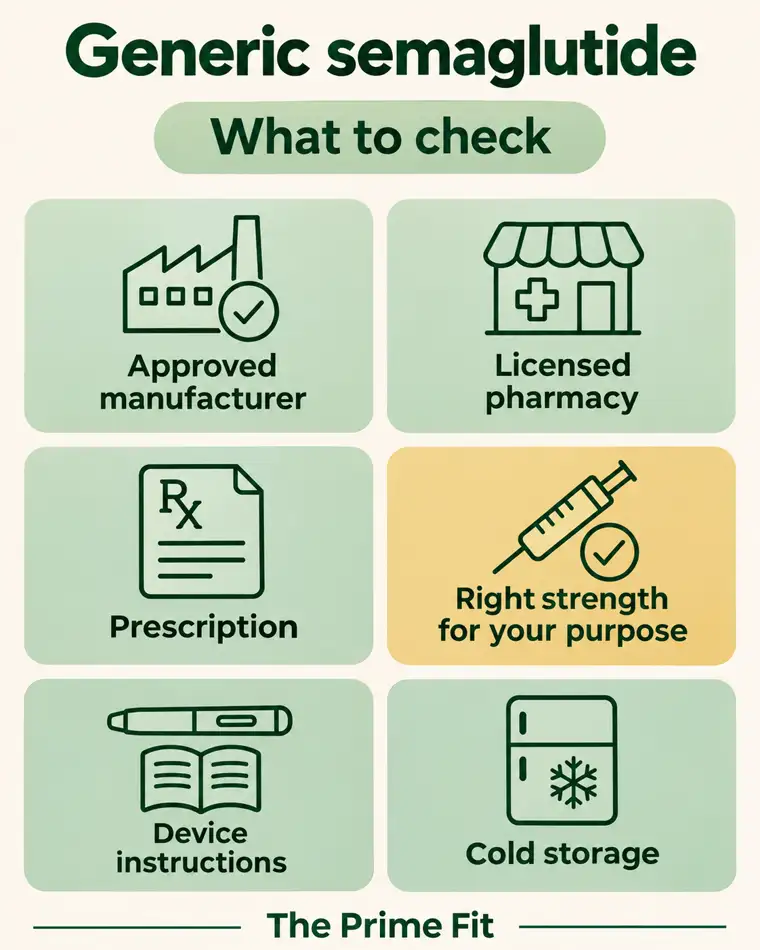
What to check before you use a generic
| # | Check | What you are looking for |
|---|---|---|
| 1 | Prescription | Your healthcare provider has prescribed semaglutide by name and dose, and knows which product you are using |
| 2 | Source | A licensed pharmacy, physical or an established online one, that asked for your prescription |
| 3 | Bill | Shows the pharmacy’s details and licence number, product name, batch number, expiry and price |
| 4 | Manufacturer | Name and address of a licensed manufacturer and marketer on the carton |
| 5 | Indian labelling | Maximum retail price, manufacturing licence number, batch number, manufacturing and expiry dates, and the prescription-medicine warning |
| 6 | Active ingredient and strength | “Semaglutide” with the strength in milligrams, matching your prescription |
| 7 | Seal and condition | Carton sealed and undamaged; printing sharp; no spelling errors |
| 8 | Cold chain | Taken from a refrigerator or delivered cold in insulated packaging |
| 9 | Leaflet | A printed patient leaflet with instructions for that specific device |
| 10 | The liquid | Clear and colourless, with no particles |
| 11 | Verification | Any QR code, serial number or helpline on the pack checked as directed |
| 12 | Demonstration | You have been shown how to use this particular pen |
If anything looks wrong, do not use the product. Take it back to the pharmacy and speak to your healthcare provider.
Red flags
- Sold without a prescription, or through social media, a gym, a salon or a slimming centre
- No bill, or cash only
- A price far below anything a pharmacy charges
- No manufacturer’s name and address, or no licence details
- Vials of powder or liquid labelled “peptide” or “for research use”
- Foreign packaging with no Indian label
- Delivered without cold packaging
- Claims such as “same as Ozempic” from a seller who cannot tell you who made it
- Products described as “generic Mounjaro” or “generic tirzepatide” from unofficial sources
What about generic tirzepatide?
Tirzepatide, the ingredient in Mounjaro, is a newer medicine, and its patents run for many more years. As a result, approved generic versions made by other manufacturers are not expected for some time. The originator may sell its own product under more than one brand name through a partner company, and those are genuine. But a product offered as cheap “generic tirzepatide” or “generic Mounjaro” by an unofficial seller should be treated with great suspicion. Ask your healthcare provider or a licensed pharmacist which tirzepatide products are approved.
Switching from a brand to a generic
Because the active ingredient is the same, your healthcare provider can usually move you across at the same weekly dose, without going back to the starting dose, provided you have not had a long gap.
- Tell your healthcare provider you are considering a switch, and why. Do not change product at the pharmacy counter without your healthcare provider knowing.
- Get a prescription for the specific product and strength. Check that it offers the dose you are on.
- Finish your current pen or stop it on your healthcare provider’s advice. Do not use both in the same week.
- Take the first dose of the new product on your usual injection day, one week after your last dose.
- Have the new device demonstrated. Pens differ, and the first week with a new one is when errors occur.
- Read the leaflet for storage, in-use period, priming and missed-dose instructions.
- Watch for changes in appetite, side effects or blood sugar over the next four to eight weeks, and report them.
- Keep the carton and bill until the pen is finished.
| Situation | Usual approach |
|---|---|
| Stable on a dose, switching with no gap | Continue at the same dose on the new product |
| A gap of two to three weeks | Ask your healthcare provider; a step down may be advised |
| A gap of a month or more | Usually restart at a low dose and build up |
| The new product does not come in your exact dose | Your healthcare provider chooses the nearest appropriate strength |
| Switching from a diabetes-dose product to a weight-management dose | Continue at the current dose, then step up as prescribed |
| Switching from tirzepatide to semaglutide | A different molecule: started low and increased step by step |
Switching between two generics
The same principles apply. Try to stay with one product once you are settled, so that you are familiar with the device and any change in how you feel can be interpreted. If your pharmacy gives you a different brand from the one prescribed, check with your healthcare provider before using it, particularly if the device is different.
Common mistakes when changing product
| Mistake | What can go wrong |
|---|---|
| Assuming the new pen works like the old one | Partial or missed dose; needle not attached; pen not primed |
| Carrying over “clicks” or volumes from another product | Under- or overdose, because concentrations and mechanisms differ |
| Using the old and new product in the same week | Double dose, with severe nausea and vomiting |
| Restarting at a high dose after a break during the switch | Strong side effects |
| Using a multi-dose pen beyond its in-use period to save money | Loss of potency; risk of contamination |
| Buying whichever is cheapest that week | Frequent device changes and no consistent record |
| Not telling the healthcare professional | Dose steps planned for a product you are no longer using |
The real benefit: staying on treatment
Obesity and type 2 diabetes are long-term conditions. Studies of everyday use show that a large proportion of people stop GLP-1 treatment within the first year, and cost is one of the main reasons. When treatment stops, appetite returns and weight is commonly regained.
A medicine that works slightly less well in theory but that you can afford to take for years will do far more for your health than one you take for four months. In that sense, an approved, affordable generic is not a compromise. For many patients it is what makes effective treatment possible at all.
Affordability also changes the conversation about maintenance. Instead of stopping abruptly at a target weight because of cost, it becomes realistic to continue at the lowest effective dose, with regular review.
What does not change with a generic
- Eligibility. A lower price does not widen the medical criteria. The medicine is for adults with obesity, overweight with a related condition, or type 2 diabetes, after assessment.
- The need for a prescription and follow-up.
- The dose schedule. Start low, increase every four weeks if tolerated.
- Side effects and precautions. Nausea, constipation and other digestive effects; rare gallbladder problems and pancreatitis; not for anyone with a personal or family history of medullary thyroid carcinoma or MEN 2; not in pregnancy or breastfeeding.
- The need for protein, strength training and a sensible diet to protect muscle.
- Storage in the refrigerator.
- Telling your surgeon or anaesthetist before any procedure.
Lower cost is not a reason to self-medicate
As prices fall, it becomes easier to obtain these medicines casually. The risks of using them without assessment, the wrong dose, the wrong patient, no monitoring, are the same whatever the price. Seek urgent help for severe abdominal pain, persistent vomiting, signs of low blood sugar or an allergic reaction.
How to compare products sensibly
| Question | Why it matters |
|---|---|
| Is it approved by the national drug regulator for my condition? | The basic assurance of quality and appropriate use |
| Who manufactures and markets it? | Experience with injectable and biological medicines counts |
| Does it come in all the dose steps I will need? | Avoids a forced switch halfway through |
| What device is it, and can I use it easily? | Eyesight, hand strength and confidence vary |
| What is the monthly cost at my likely maintenance dose? | The starting dose is not the dose you will pay for long term |
| Is supply reliable at my pharmacy? | Gaps in supply interrupt treatment |
| What are the storage and in-use rules? | Relevant to travel, climate and power cuts |
| Is there a patient helpline or verification system? | Useful for checking authenticity and reporting problems |
| Does my healthcare provider have experience with it? | Familiarity helps with dose planning and troubleshooting |
Price per pen can mislead. A cheaper pen that holds fewer doses, or that is only available at low strengths, may cost more per month at the dose you need.
Reporting problems
If you suspect a product is not genuine, or you have an unexpected reaction or lack of effect, keep the pen, carton and bill and tell your healthcare provider and pharmacist. Side effects can be reported through the national pharmacovigilance programme, and suspected fake or substandard medicines to the drug control authorities. Manufacturers also provide contact details on the pack. Reporting protects other patients, and it is how problems with any medicine, brand or generic, come to light.
Generic injection or generic tablet?
Semaglutide also exists as a daily tablet for type 2 diabetes, and follow-on versions of the tablet may become available as well. The tablet must be taken on an empty stomach with a sip of water, 30 minutes before food or other medicines, and at diabetes doses it produces less weight loss than the weight-management injection. A lower price does not change that comparison. Choose the form according to your goal and routine, with your healthcare provider’s advice.

Three illustrative examples
These invented examples show how a switch is typically handled. They are not recommendations for any individual or product.
A planned switch for cost
A 45-year-old woman has lost 12 kg over ten months on an originator pen and is stable on her maintenance dose, but is struggling with the expense. Her healthcare provider prescribes an approved generic that offers the same dose. She takes the first dose on her usual day, a week after her last one, after a demonstration of the new pen at the pharmacy. Her appetite and weight remain steady over the following three months, and she can now afford to continue.
A switch that went wrong, and was put right
A 52-year-old man changes product at the pharmacy without telling his healthcare provider. The new pen needs a needle attached and a flow check before first use, which his previous pen did not. For two weeks he receives little or no medicine, and his appetite returns. He assumes the generic is weak. A nurse watches him inject, corrects the technique, and the effect returns.
An offer to refuse
A 30-year-old woman is offered “generic Mounjaro” at a fraction of the usual price through a social media seller, with no prescription and no bill. Her healthcare provider explains that approved generic tirzepatide is not available and that the product cannot be verified. She does not buy it, and is assessed properly instead.
Questions to ask your healthcare provider and pharmacist
- Is an approved generic semaglutide suitable for my condition and dose?
- Which product do you recommend, and why?
- Can I switch at my current dose?
- Does this product come in all the strengths I may need?
- Can you show me how this pen works?
- How should it be stored, and how long can a pen be used once started?
- What should I do if I notice a difference after switching?
- What will it cost per month at my maintenance dose?
Common myths
“Generics are fake or low quality”
Approved generics from licensed manufacturers are legitimate medicines that have met the regulator’s standards.
“A generic is weaker, so I should take more”
The dose in milligrams is the same. Never increase it yourself.
“All pens work the same way”
Devices differ. Always have a new one demonstrated.
“If it is cheaper, I do not need a prescription or check-ups”
The medical requirements are unchanged.
“Any product called semaglutide is approved”
Unapproved, compounded and “research” products also use the name. Check the manufacturer, labelling and source.
“There are cheap generics of every weight loss injection”
Not of newer medicines still under patent. Be wary of anything sold as generic tirzepatide.
“Switching means starting from the lowest dose again”
Not if the ingredient is the same and there has been no long gap.
How The Prime Fit approaches generics
At The Prime Fit, cost is part of the treatment conversation from the start, because a plan you cannot sustain is not a plan. Your healthcare provider will tell you which approved products suit your condition and dose, prescribe by name and strength, and plan any switch so that there is no gap or overlap. We show you how to use the specific pen you receive, guide you to licensed pharmacies with proper cold storage, and review how you are doing after a change.
To discuss affordable long-term treatment, book a consultation or read about our GLP-1 therapy programme.
Frequently asked questions
Is generic semaglutide the same as Ozempic or Wegovy?
It contains the same active ingredient at the same dose. The manufacturer, brand name, device and sometimes the available strengths differ.
Is generic semaglutide safe?
A generic approved by the national drug regulator, made by a licensed manufacturer and dispensed by a licensed pharmacy on prescription is a legitimate medicine. Unapproved products sold informally are not.
Does it work as well as the brand?
It is expected to, since the active ingredient and dose are the same. Tell your healthcare provider if you notice a change after switching.
Why is it cheaper?
Generic manufacturers do not bear the cost of discovering the medicine and running the original large trials, and competition between manufacturers lowers prices.
Can I switch from Wegovy or Ozempic to a generic?
Usually yes, at the same weekly dose, with a prescription from your healthcare provider and a demonstration of the new pen. Take the first dose on your usual injection day.
Do I have to restart at the lowest dose?
Not if you switch without a long gap. After a break of several weeks, your healthcare provider may restart you lower.
Are the pens the same?
No. Devices vary between manufacturers. Read the leaflet and have the pen demonstrated before your first dose.
How can I tell a real generic from a fake?
Buy from a licensed pharmacy with a prescription and bill; check the manufacturer’s details, licence number, batch, expiry and price on the carton; make sure it arrived cold and sealed.
Is there a generic Mounjaro?
Tirzepatide is still under patent, so approved generics from other manufacturers are not expected for some years. Be very cautious of anything sold as generic tirzepatide.
Do I still need a prescription?
Yes. Semaglutide in any form is a prescription medicine that needs assessment and follow-up.
This article is general information and is not a substitute for a consultation. It does not recommend any specific product. Availability, approved uses, strengths and prices change; confirm current details with your healthcare provider and a licensed pharmacist.