In this article
- Why does weight loss affect bone?
- How much bone is lost with weight loss?
- Do GLP-1 medicines harm bones?
- Who is at higher risk of bone loss?
- How can you protect your bones while losing weight?
- Which exercise is best for bone health?
- How much calcium, vitamin D and protein do you need?
- Calcium-rich Indian foods
- A sample bone-friendly Indian day
- Do you need calcium or vitamin D supplements?
- Should you have a bone density scan?
- Warning signs: when to see a healthcare professional
- Common myths about bones and weight loss
- Questions to ask your healthcare provider
- How The Prime Fit helps
- Frequently asked questions
Bone health during weight loss and on GLP-1 medicines is a fair concern, and one that is often overlooked. When people lose a significant amount of weight, bone density tends to fall a little, particularly at the hip. This happens with dieting, with surgery and with medicines such as Mounjaro and Wegovy. For most people the change is small. For some, such as women after menopause or anyone who already has thin bones, it deserves a plan.
Current evidence does not show that GLP-1 medicines damage bone directly, and studies so far have not shown a clear rise in fractures. The effect on bone seems to come mainly from the weight loss itself, from eating less, and from losing muscle. Long-term fracture data for the newer weekly medicines at weight-loss doses are still limited, so honest advice has to include some uncertainty.
Why does weight loss affect bone?
Bone is living tissue that is constantly broken down and rebuilt. Several things change during weight loss that tilt this balance slightly towards loss.
- Less mechanical load. Bones adapt to the weight they carry. A lighter body places less load on the hips, spine and legs, and the skeleton adjusts.
- Less muscle. Muscles pull on bones, and that pull stimulates bone building. If muscle is lost along with fat, the stimulus falls.
- Lower intake. Eating less usually means less calcium, protein and vitamin D unless meals are planned carefully.
- Hormonal changes. Fat tissue produces some oestrogen and other hormones that influence bone. These shift as fat is lost.
- Speed. Rapid and large losses tend to affect bone more than slow, moderate ones.
It is worth keeping perspective. People with obesity often start with higher bone density than lighter people, and part of the fall is the skeleton adapting to a lower load. But obesity does not fully protect against fractures. Some fractures, such as those of the ankle and upper arm, are in fact more common at higher weights, and type 2 diabetes raises fracture risk even when bone density looks normal.
How much bone is lost with weight loss?
Studies of diet-induced weight loss generally show a small reduction in bone density at the hip, with less consistent change at the spine. The size of the effect depends on how much weight is lost, how fast, the person’s age and sex, and whether they exercise.
The clearest evidence of harm comes from bariatric surgery, especially procedures that bypass part of the intestine. These cause larger and longer-lasting bone loss and a higher fracture risk in later years, partly because they reduce absorption of calcium and vitamin D. This is why lifelong supplements and monitoring are standard after surgery.
Do GLP-1 medicines harm bones?
This is the main question for anyone considering Mounjaro Wegovy or Ozempic, and the answer has three parts.
What is reasonably well established. Large trials and pooled analyses of GLP-1 medicines, mostly in people with type 2 diabetes, have not shown a clear increase in fractures compared with placebo or other diabetes medicines.
What smaller studies suggest. In studies that measured bone density during GLP-1 treatment for weight loss, modest reductions at the hip and spine have been seen, in line with the amount of weight lost. In one randomised trial using an older daily GLP-1 medicine after an initial diet, people who took the medicine without exercising lost some bone density at the hip and spine, while those who combined the medicine with a supervised exercise programme preserved their bone density even though they lost the most weight. That finding is one of the strongest arguments for pairing treatment with exercise.
What is not yet known. The newer weekly medicines produce larger weight losses than older ones, and long-term fracture outcomes at these doses, particularly in older adults and postmenopausal women, have not been fully studied.
In short
The medicine does not appear to be the problem. Large, fast weight loss without exercise and adequate nutrition is. That is something you and your centre can do a great deal about.
Who is at higher risk of bone loss?
| Risk factor | Why it matters |
|---|---|
| Women after menopause, especially early menopause | Falling oestrogen speeds up bone loss |
| Older age, in men and women | Bone density and muscle decline with age; falls become more likely |
| A previous fracture after a minor fall | A strong predictor of future fractures |
| A parent who had a hip fracture | Inherited risk |
| Long-term steroid tablets | Reduce bone formation |
| Low vitamin D or low calcium intake | Very common in India, including in people who get little sun |
| Type 2 diabetes | Higher fracture risk despite normal or high bone density |
| Thyroid overactivity, or too high a dose of thyroid replacement | Increases bone turnover |
| Smoking and regular heavy alcohol use | Both weaken bone and raise fall risk |
| Very rapid or very large weight loss, or becoming underweight | Greater loss of muscle and bone |
Some other long-term medicines can also affect bone. Do not stop a prescribed medicine on your own: ask your healthcare provider.
How can you protect your bones while losing weight?
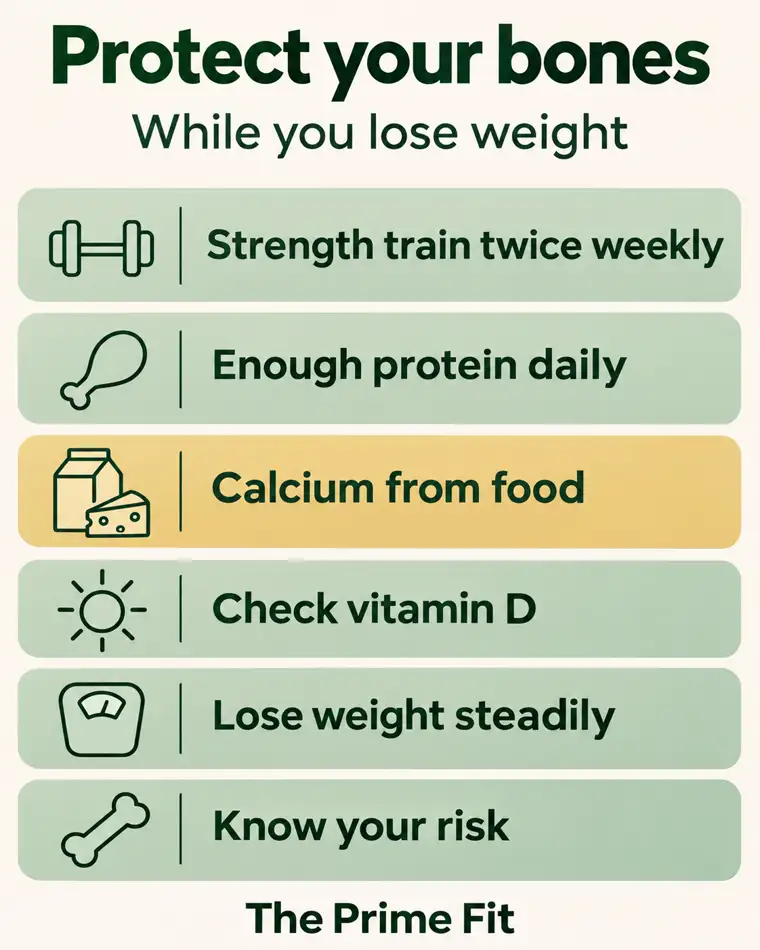
Five habits do most of the work.
- Do resistance exercise at least twice a week. This is the single most useful step.
- Eat enough protein at each meal, even when appetite is low.
- Get enough calcium, mainly from food.
- Correct low vitamin D under medical guidance.
- Lose weight at a steady pace and avoid crash diets or skipping meals for days.
Which exercise is best for bone health?
Bones respond to load and impact. Activities that make muscles work against resistance, or that involve the body landing on the ground, send the strongest signal.
- Resistance training: squats or sit-to-stand, step-ups, lunges, rows, presses and carries, using body weight, bands, dumbbells or machines. Two or three sessions a week, gradually getting harder.
- Weight-bearing activity: brisk walking, stair climbing, dancing, badminton and jogging if your joints allow.
- Balance work: standing on one leg near a support, heel-to-toe walking, yoga or tai chi. This reduces falls, which is how most fractures happen.
Swimming and cycling are excellent for the heart and kind to joints, but because the body is supported they do less for bone, so add some resistance work alongside. If you already have osteoporosis or have had a spinal fracture, ask your healthcare provider or physiotherapist which movements to avoid, such as deep forward bending with load, and start under supervision. Our beginner strength training plan is a practical place to begin.
How much calcium, vitamin D and protein do you need?
Calcium. Indian dietary recommendations are about 1,000 mg a day for most adults and about 1,200 mg a day for women after menopause. Your healthcare provider may set a different target for you. Food is the preferred source.
Vitamin D. Low vitamin D is very common in India despite the sunshine, because of indoor work, covered clothing, darker skin, air pollution and few dietary sources. Sensible sun exposure helps, but many people need a supplement, and the dose should be based on a blood test and your healthcare provider’s advice.
Protein. Bone is roughly half protein by volume, and protein also preserves the muscle that loads bone. Many centres advise about 1.2 to 1.6 g per kg of body weight a day during weight loss, adjusted for kidney function. As an illustrative example, a woman weighing 65 kg would aim for about 78 to 104 g a day (65 multiplied by 1.2 is 78; 65 multiplied by 1.6 is 104).
Calcium-rich Indian foods
The figures below are approximate. Calcium content varies with the type of milk, how paneer or tofu is made, and the variety of grain.
| Food and portion | Approximate calcium |
|---|---|
| Milk, 1 glass (250 ml) | About 300 mg |
| Curd, 1 katori (about 150 g) | About 180 mg |
| Ragi (finger millet) flour, 50 g, about 2 small rotis | About 170 mg |
| Sesame seeds (til), 1 tablespoon | About 90 mg |
| Paneer, 50 g | A good source; amount varies with how it is made |
| Tofu set with a calcium salt, 100 g | A good source; check the label |
| Small fish eaten with soft bones | A rich source |
| Green leafy vegetables such as methi, bathua, amaranth and drumstick leaves | Useful amounts; absorption from spinach is poor |
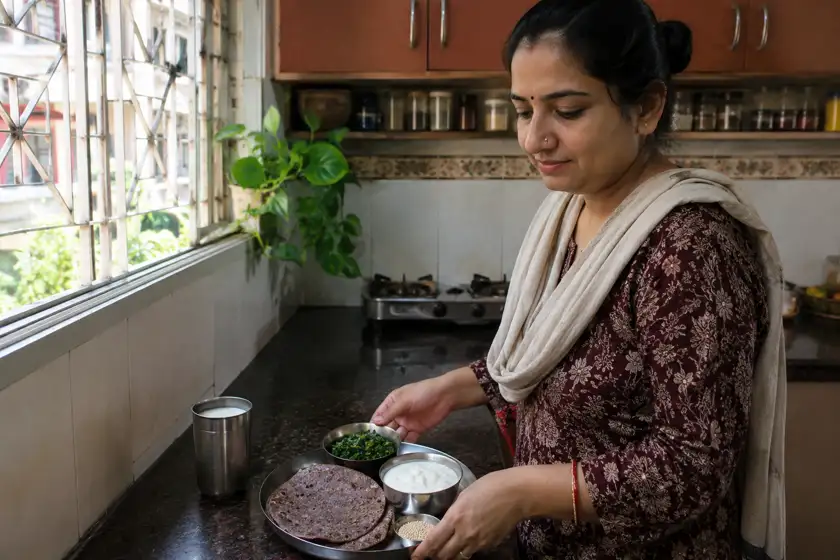
Illustrative example: one glass of milk (about 300 mg), one katori of curd (about 180 mg), two small ragi rotis (about 170 mg) and a tablespoon of sesame seeds (about 90 mg) together provide about 740 mg. Dals, vegetables and other foods through the day add to this.
A sample bone-friendly Indian day
This is an illustrative example of how calcium and protein can be spread across smaller meals, which suits the reduced appetite many people have on GLP-1 treatment. Portions should be set with your dietitian.
| Meal | Vegetarian | Non-vegetarian |
|---|---|---|
| Breakfast | Ragi dosa or ragi chilla with curd; or besan chilla with paneer filling | Two-egg omelette with a ragi roti and a small bowl of curd |
| Lunch | Rajma or chana, one or two rotis, methi or other green sabzi, curd, salad with til | Fish curry, preferably small fish with soft bones, with rice or roti, sabzi and curd |
| Evening | Roasted chana, or tofu or paneer tikka | Chicken tikka or grilled fish |
| Dinner | Moong dal, sauteed tofu or paneer with vegetables, one roti | Chicken curry with dal, vegetables and one roti |
If you avoid dairy, look for calcium-set tofu, ragi, sesame, pulses and fortified foods, and ask whether you need a supplement. More menus are in our vegetarian high-protein meal plan.
Do you need calcium or vitamin D supplements?
Not everyone does. If your diet regularly includes dairy, ragi, pulses and greens, you may meet your calcium needs from food. Supplements are useful when intake is clearly low, when appetite is very reduced, after bariatric surgery, or when your healthcare provider recommends them for osteoporosis.
- Calcium is absorbed better in smaller amounts, so if you are advised to take it, doses of about 500 mg at a time are usual.
- Calcium can interfere with the absorption of thyroid tablets and iron. Keep them several hours apart, as your healthcare provider or pharmacist advises.
- If you have had kidney stones or have kidney disease, ask before taking calcium.
- Take vitamin D only at the prescribed dose and for the prescribed period.
More is not better
Very high doses of vitamin D, or repeated injections and sachets taken without testing, can cause vitamin D toxicity with high blood calcium, vomiting, confusion and kidney damage. Excess calcium tablets can contribute to kidney stones and constipation, which is already common on GLP-1 medicines.
Should you have a bone density scan?
A DXA scan is a quick, low-radiation test that measures bone density at the hip and spine. Results are given as a T-score: minus 1.0 or above is normal, between minus 1.0 and minus 2.5 is low bone mass (osteopenia), and minus 2.5 or below is osteoporosis.
A scan is not needed for everyone starting weight loss treatment. It is generally recommended for women after menopause and for older men, and earlier for anyone with risk factors from the table above. If you are in one of these groups and planning a substantial weight loss, a baseline scan lets your healthcare provider compare later. A healthcare professional may also check vitamin D, calcium and related blood tests. Our guide to blood tests before starting GLP-1 treatment covers what is usually checked.
Warning signs: when to see a healthcare professional
Thinning bones cause no symptoms until a fracture occurs, which is why risk assessment matters. See your healthcare provider if you notice loss of height, a stooped posture developing, or a fracture after a minor fall or bump.
Seek urgent care for
Sudden severe back pain, especially after lifting, bending or a minor fall; a fall followed by hip or groin pain or being unable to put weight on the leg; a wrist or arm that is painful, swollen or deformed after a fall; or back pain with new weakness, numbness or loss of bladder or bowel control.
Also tell your centre if you are losing weight much faster than planned, feel weak or unsteady, or are struggling to eat enough because of nausea. Adjusting the dose or the meal plan is often the answer.

Common myths about bones and weight loss
- “GLP-1 injections cause osteoporosis.” There is no good evidence of this. Bone changes seen so far are in keeping with weight loss, and exercise appears to protect against them.
- “Being overweight protects my bones, so I should not lose weight.” Higher weight does not prevent all fractures, and the benefits of treating obesity for the heart, blood sugar, joints and mobility are substantial.
- “Walking is enough for bones.” Walking helps, but resistance training and some impact give a stronger signal.
- “Calcium tablets alone will protect me.” Without exercise, protein and adequate vitamin D, tablets do little.
- “I get plenty of sun in India, so my vitamin D must be fine.” Deficiency is widespread here.
Questions to ask your healthcare provider
- Based on my age, sex and history, am I at higher risk of bone loss?
- Should I have a DXA scan before or during treatment?
- Should my vitamin D and calcium levels be checked?
- Do I need supplements, at what dose and for how long?
- How much protein is right for me, given my kidney function?
- Which exercises are safe for me, and are there any I should avoid?
How The Prime Fit helps
At The Prime Fit, weight loss treatment starts with a medical assessment that looks at more than the number on the scale: your health history, medicines, life stage and risk factors, including those for bone. Where appropriate, relevant blood tests are reviewed before treatment begins, and a bone density scan may be suggested for people at higher risk.
Our clinical nutrition support helps you meet protein and calcium needs with Indian vegetarian or non-vegetarian food, even when appetite is low. For people on medicines, the GLP-1 support programme includes regular follow-up so that the pace of weight loss, side effects and activity can be reviewed together. We cannot promise particular outcomes, but we aim for weight loss that leaves you stronger, not frailer.
Frequently asked questions
Do Mounjaro, Wegovy or Ozempic weaken bones?
There is no clear evidence that these medicines damage bone directly or raise fracture rates. Bone density can fall modestly with significant weight loss by any method. Long-term data for the newer weekly medicines are still limited.
Does losing weight cause osteoporosis?
Weight loss can lower bone density a little, mainly at the hip, but it does not cause osteoporosis in most people. The risk is higher with rapid or very large losses and in people who already have thin bones.
What is the best exercise to protect bones during weight loss?
Resistance training two or three times a week, combined with weight-bearing activity such as brisk walking or stair climbing, and some balance work to prevent falls.
Should I take calcium tablets on GLP-1 medicines?
Only if your food intake is low or your healthcare provider advises it. Many people can meet their needs from milk, curd, ragi, pulses and greens. Ask your healthcare provider, especially if you have had kidney stones or take thyroid tablets.
Do I need a bone density scan before starting weight loss injections?
Not routinely. It is worth discussing if you are a woman after menopause, an older man, or have risk factors such as a previous fracture, long-term steroid use or early menopause.
Can I take GLP-1 medicines if I already have osteoporosis?
Often yes, but the decision is individual. Your experts should agree a plan that includes osteoporosis treatment, supervised exercise, nutrition and a gradual pace of weight loss.
Which Indian foods are best for bones?
Milk, curd, paneer, ragi, sesame seeds, calcium-set tofu, pulses, green leafy vegetables and small fish eaten with bones. Pair them with enough protein across the day.
Does bone density recover after weight loss stops?
This is not fully known. Bone tends to stabilise once weight is steady, but density lost may not fully return, which is why protecting it during weight loss with exercise and nutrition is the better approach.
This article is general information and is not a substitute for a medical consultation. Nutrient figures are approximate and research findings are described in general terms. Speak to your healthcare provider before starting supplements or a new exercise programme, particularly if you have osteoporosis, kidney disease, a previous fracture or take regular medicines.