In this article
- What “diet and exercise” achieves in trials
- What Wegovy adds
- In kilograms
- Why diets so often fail: it is biology
- What lifestyle change does that medicine cannot
- Regain: the decisive difference
- Health outcomes compared
- Side effects, effort and cost
- Who should try lifestyle change first
- Who is likely to need more than lifestyle change
- The best answer is both
- What a good lifestyle programme looks like
- Diet alone, exercise alone, or both?
- Do popular diets differ?
- Is taking medication “cheating”?
- A sensible way to decide
- Three illustrative examples
- Questions to ask your healthcare provider
- Common myths
- How The Prime Fit combines the two
- Frequently asked questions
“Have you tried diet and exercise?” Almost everyone living with excess weight has heard this question, usually many times, and usually from someone who assumes the answer is no. In reality, most people who seek medical help have tried repeatedly, lost weight, and regained it.
The arrival of Wegovy (semaglutide 2.4 mg) and similar medicines has sharpened an old debate. Are weight loss injections a shortcut for people who should simply try harder? Or are they a medical treatment for a condition that lifestyle advice alone has never managed well?
The evidence allows a clear answer, and it is not either-or. Lifestyle change improves health in ways no medicine can. For substantial, lasting weight loss, though, it is rarely sufficient by itself, and adding medication roughly triples the result. This guide sets out the comparison fairly. It is general information, and the right approach for you should be decided with your healthcare provider.
What “diet and exercise” achieves in trials
Lifestyle programmes have been studied for decades, some of them very intensive, with dietitians, exercise coaches and frequent group sessions.
| Type of programme | Average weight loss at one year | What happens later |
|---|---|---|
| Brief advice from a healthcare professional | 1 to 2% | Usually back to baseline |
| Self-directed dieting | 2 to 4% | Most is regained within one to two years |
| Structured programme with regular support | 5 to 8% | About half is regained by two to three years; a few percent remains long term with continued support |
| Very low-calorie diet or meal replacement programme | 10 to 15% in the short term | Substantial regain unless followed by intensive maintenance |
Two large, long-running trials are often quoted. In a diabetes prevention study, an intensive lifestyle programme produced about 7 percent weight loss at one year and cut the progression from prediabetes to diabetes by more than half, even though much of the weight returned over the following years. In a study of people with type 2 diabetes, an intensive programme achieved about 8 to 9 percent at one year and about 6 percent after eight to ten years, with frequent contact maintained throughout.
These are good results for health. They also show the ceiling. With the best available support, average long-term loss from lifestyle change settles at around 5 percent.
What Wegovy adds
In the trials of semaglutide 2.4 mg, both groups received lifestyle advice: a reduced-calorie diet and encouragement to be active. One group also received the medicine and the other a placebo injection. The trials therefore compare lifestyle alone with lifestyle plus semaglutide.
| Trial setting | Lifestyle plus placebo | Lifestyle plus semaglutide 2.4 mg |
|---|---|---|
| Standard lifestyle counselling, 68 weeks, no diabetes | About 2 to 3% | About 15% |
| Intensive behavioural therapy with an initial low-calorie diet, 68 weeks | About 6% | About 16% |
| Type 2 diabetes, 68 weeks | About 3% | About 10% |
| Two years of treatment | About 3% | About 15%, maintained |
| Proportion of people who lost at least | Lifestyle plus placebo | Lifestyle plus semaglutide |
|---|---|---|
| 5% | About 32 in 100 | About 86 in 100 |
| 10% | About 12 in 100 | About 69 in 100 |
| 15% | About 5 in 100 | About 50 in 100 |
| 20% | About 2 in 100 | About 32 in 100 |
The second row of the first table is revealing. Even when the lifestyle programme was made much more intensive, the placebo group lost about 6 percent, and the semaglutide group about 16 percent. Intensifying lifestyle support added little on top of the medicine, and the medicine added a great deal on top of lifestyle.
In kilograms
| Starting weight | Structured lifestyle programme (about 5 to 7%) | Lifestyle plus Wegovy (about 15%) |
|---|---|---|
| 80 kg | 4 to 5.6 kg | 12 kg |
| 90 kg | 4.5 to 6.3 kg | 13.5 kg |
| 100 kg | 5 to 7 kg | 15 kg |
| 120 kg | 6 to 8.4 kg | 18 kg |
For someone who needs to lose 5 kg to bring prediabetes under control, lifestyle change may be all that is required. For someone who needs to lose 15 kg to relieve sleep apnoea or avoid knee surgery, it is unlikely to be enough.

Why diets so often fail: it is biology
If weight were simply a matter of eating less and moving more, lifestyle programmes would work as well in the long term as in the first six months. They do not, for reasons that have been measured.
- Hunger hormones rise. After weight loss by dieting, the hunger hormone ghrelin increases, and hormones that signal fullness, including the body’s own GLP-1, fall. In one well-known study these changes were still present a year later.
- Energy use falls. A lighter body burns less, and after dieting it often burns a little less than expected for its new size.
- The brain’s response to food sharpens. Tempting food becomes more rewarding.
- The body defends its previous weight. These responses persist for years and act to restore lost fat.
- The environment is unchanged. Cheap, tasty, energy-dense food is everywhere, and daily life requires little movement.
Reviews of long-term studies find that, on average, more than half of the weight lost by dieting is regained within two years and most of it within five. This is not a failure of character. It is a predictable biological response, and it varies between people for genetic reasons.
What the medicine does differently
Semaglutide supplies a strong, continuous version of the fullness signal that falls after dieting. It works with the body’s regulation of weight instead of against it. That is why the loss is larger and why it is held for as long as treatment continues.
What lifestyle change does that medicine cannot
None of this makes diet and exercise optional. They deliver benefits that an injection does not.
| Benefit | Comes from |
|---|---|
| Cardiovascular fitness and stamina | Aerobic exercise |
| Muscle strength and preservation of muscle during weight loss | Resistance exercise and adequate protein |
| Bone strength | Weight-bearing and resistance exercise; calcium and vitamin D |
| Better insulin sensitivity independent of weight | Physical activity |
| Lower liver fat independent of weight | Exercise; less sugar and refined carbohydrate |
| Lower blood pressure and LDL cholesterol through diet quality | Less salt, more vegetables and pulses, better fats |
| Mood, sleep and cognitive function | Regular activity |
| Balance and independence in later life | Strength and balance training |
| Nutrient adequacy | A varied diet |
| Weight maintenance after treatment | High levels of activity and consistent eating habits |
A person who loses 15 percent of their weight on medication while eating poorly and remaining inactive ends up lighter, but weaker and less well nourished than they need be. A person who does both ends up lighter, stronger and with a far better chance of keeping the result.
Regain: the decisive difference
| Lifestyle alone | Lifestyle plus semaglutide | |
|---|---|---|
| While the approach continues | Weight tends to drift upward after the first six to twelve months, even with ongoing support | Weight loss is maintained for at least two to four years on treatment |
| After it stops | Regain is usual | About two-thirds of the lost weight is regained within a year |
| Why | Biological defence of body weight is unopposed | The appetite signal provided by the medicine is withdrawn |
Neither approach is a permanent fix that can be stopped. The difference is that continued medication holds the weight off, while continued dieting usually does not hold it fully. Both work best when the habits are kept for life.
Health outcomes compared
| Outcome | Intensive lifestyle programme | Semaglutide plus lifestyle |
|---|---|---|
| Progression from prediabetes to type 2 diabetes | Reduced by more than half in landmark trials; about 30% in an Indian trial | Most people with prediabetes returned to normal blood sugar |
| Blood pressure, blood sugar, triglycerides | Improved, in proportion to weight lost | Improved more, in proportion to the larger weight loss |
| Heart attack and stroke | A large trial in people with type 2 diabetes found no reduction overall, despite sustained weight loss of about 6% | Reduced by about 20% in people with obesity and existing heart disease |
| Sleep apnoea, mobility, quality of life | Improved | Improved |
| Knee osteoarthritis pain | Improved with weight loss and exercise | Clearly improved in a dedicated trial |
| Fitness and strength | Improved | Not improved by the medicine itself |
The comparison in the third row should be read carefully. The trials studied different people, and the lifestyle trial still showed many benefits, including less sleep apnoea, better mobility and fewer medicines. But it is a fair summary that a modest, lifestyle-induced weight loss has not been shown to prevent heart attacks, while semaglutide has, in a high-risk group.

Side effects, effort and cost
| Diet and exercise alone | Wegovy plus diet and exercise | |
|---|---|---|
| Medical risks | Very low. Injury from exercise; nutritional gaps or gallstones with crash diets | Digestive side effects are common; gallbladder problems uncommon; pancreatitis rare. Not suitable for everyone |
| Daily effort | High and continuous: resisting hunger and cravings every day | Lower: appetite is reduced, which makes the same habits far easier to keep |
| Hunger | Increases as weight falls | Decreases |
| Cost | Low; dietitian or gym fees optional | Recurring cost of the medicine, consultations and tests |
| Suitable in pregnancy and breastfeeding | Healthy eating and activity, yes; weight loss diets, with advice | No |
| Who can do it | Everyone | Adults who meet medical criteria and have no contraindications |
| Duration | Lifelong habits | Long-term treatment plus lifelong habits |
Who should try lifestyle change first
- People with a BMI below 27, or below the thresholds your healthcare provider uses for Indian patients, without weight-related disease
- Those who need to lose a modest amount, around 5 percent, to meet their health goal
- People who have never had structured support from a dietitian
- Women who are pregnant, breastfeeding or trying to conceive
- Anyone with a contraindication to GLP-1 medicines
- Those who prefer to avoid medication and are willing to commit to a programme
- People for whom the cost of long-term medication is not feasible
A fair trial means three to six months of a structured plan with regular follow-up, not a few weeks of trying alone.
Who is likely to need more than lifestyle change
- BMI of 30 or above, or 27 or above with a weight-related condition, particularly with repeated regain after previous attempts
- Those who need to lose 10 percent or more for their health: sleep apnoea, fatty liver with inflammation, knee osteoarthritis, hard-to-control diabetes
- People with established heart disease and excess weight
- Those whose hunger and food cravings make every diet a constant struggle
- People who have lost less than 5 percent after three to six months of a proper programme
- Those on medicines that promote weight gain which cannot be changed
Guidelines recommend considering medication when lifestyle measures alone have not produced enough weight loss in people who meet these criteria. There is no rule that a person must fail for years first.
The best answer is both
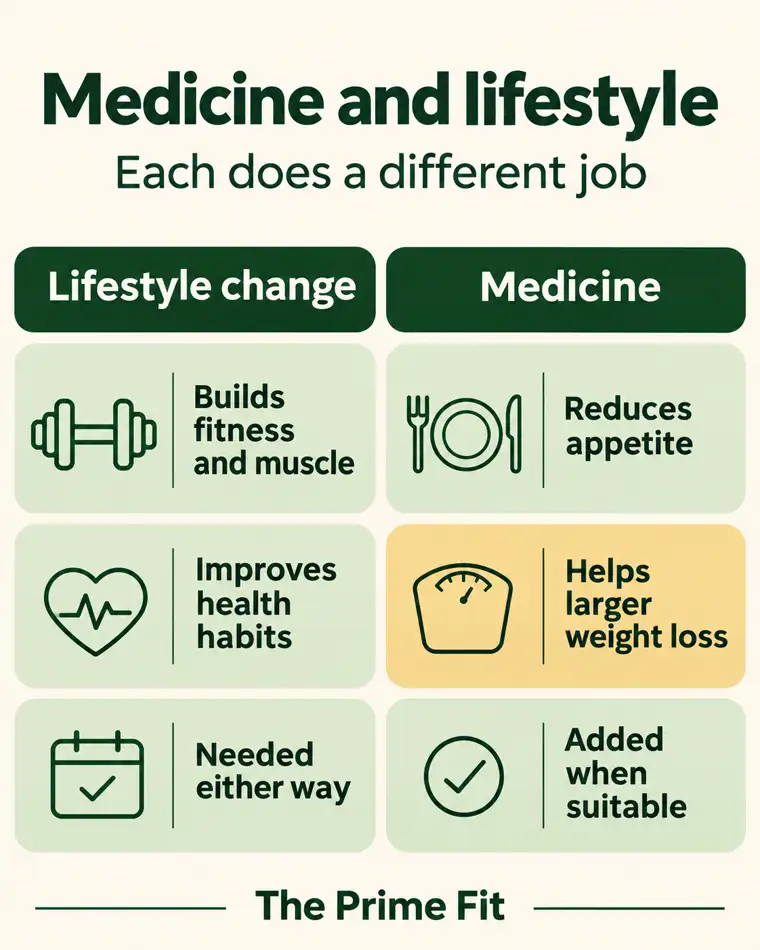
Medication without lifestyle change wastes much of its potential. Lifestyle change without medication is, for many people, a fight against biology. Together they complement each other.
| The medicine provides | You provide |
|---|---|
| Reduced hunger and cravings | Food quality: protein, vegetables, whole grains |
| Earlier fullness | Regular meals, eaten slowly |
| Sustained weight loss | Resistance exercise to keep muscle |
| Lower blood sugar | Daily activity, which improves insulin sensitivity further |
| Protection against regain while taken | Habits that limit regain if the dose is reduced or stopped |
Many people say the same thing after starting treatment: for the first time, the advice they had always been given became possible to follow.
What a good lifestyle programme looks like
Whether or not you take medication, these are the components with the best evidence.
- A modest calorie reduction, not a crash diet, built on food you already cook.
- Protein at every meal: dal, chana, rajma, paneer, curd, soya, eggs, fish, chicken.
- Vegetables at lunch and dinner; whole fruit once or twice a day.
- Whole grains and millets in measured portions.
- Very little sugar, sweetened drinks, refined flour and deep-fried food.
- At least 150 minutes a week of brisk activity, building towards 200 to 300 minutes for maintenance.
- Strength training two to three times a week.
- Seven to eight hours of sleep.
- Self-monitoring: weekly weight, a food record at intervals.
- Regular contact with a dietitian or programme, which is the single strongest predictor of success.
| Meal | Vegetarian | Non-vegetarian |
|---|---|---|
| Breakfast | 2 besan chillas with vegetables, curd | 2-egg vegetable omelette, 1 whole wheat toast |
| Mid-morning | 1 fruit; a few almonds | 1 fruit; chaas |
| Lunch | Salad, 2 phulkas, dal, sabzi, curd | Salad, small katori of rice, fish curry, sabzi |
| Evening | Roasted chana or sprouts chaat | Boiled egg or roasted chana |
| Dinner | Paneer or tofu with vegetables, 1 to 2 phulkas | Grilled chicken with vegetables, 1 to 2 phulkas |
Diet alone, exercise alone, or both?
People often ask which matters more.
- Diet alone produces most of the weight loss in any lifestyle programme. Reducing intake by a few hundred calories a day is far easier than burning the same amount.
- Exercise alone usually produces a small loss, typically 1 to 3 kg, because appetite rises to compensate and because an hour of brisk walking uses fewer calories than most people expect. Its value lies elsewhere: fitness, muscle, blood sugar, mood and, above all, keeping weight off.
- Both together give somewhat more weight loss than diet alone, better preservation of muscle, and much better maintenance.
The practical message: change your eating to lose weight, and exercise to stay healthy and keep it off. This holds whether or not you take medication. On semaglutide, the reduction in appetite does the work of the diet for you, which leaves your effort free for the part no injection can do: building strength and fitness, and choosing food that nourishes you.
Do popular diets differ?
| Approach | What trials show |
|---|---|
| Low-carbohydrate or keto | Faster loss in the first few months, partly water. By one to two years, results are similar to other diets. Hard to sustain with Indian vegetarian food |
| Low-fat | Similar long-term weight loss to low-carbohydrate diets |
| Intermittent fasting or time-restricted eating | Works by reducing intake; no better than ordinary calorie reduction when calories are matched |
| Mediterranean-style | Modest weight loss, with good evidence for heart health |
| High-protein | Better fullness and preservation of muscle; modest advantage for maintenance |
| Meal replacements and very low-calorie diets | Large short-term loss; regain is common without a structured maintenance phase |
| Detox, juice and crash diets | Rapid loss of water and muscle; quickly regained; not recommended |
Across comparisons, the best diet is the one a person can keep following. Adherence predicts results far better than the type of diet. For most Indian households, that means adjusting the proportions of familiar meals, more dal and sabzi, less rice and roti, less oil and sugar, instead of adopting an imported plan.
Is taking medication “cheating”?
This idea causes real harm, because it keeps people from effective treatment. Nobody says that a person with high blood pressure is cheating by taking tablets instead of relying on a low-salt diet alone, or that someone with an underactive thyroid should try harder. Obesity is a chronic condition with strong biological drivers. Using a medicine that corrects part of that biology, alongside diet and activity, is appropriate medical care.
It is equally unhelpful to dismiss lifestyle change as pointless. Both attitudes miss what the evidence shows: the two work best together.
A sensible way to decide
| Step | What to do |
|---|---|
| 1 | Have an assessment: BMI, waist, blood pressure, blood tests, medical history |
| 2 | Agree a health goal in percentage terms: how much weight loss would make a difference to your conditions? |
| 3 | If the goal is modest, or you do not meet criteria for medication, start a structured lifestyle programme with regular follow-up |
| 4 | Review at three months. A loss of 5% or more with improving health markers: continue |
| 5 | If progress is insufficient and you meet the criteria, discuss adding medication, without abandoning the programme |
| 6 | If your goal is large or your health risks are high from the start, discuss medication alongside lifestyle change at the outset |
| 7 | Whatever you choose, plan for maintenance |

Three illustrative examples
These invented examples show how the choice is made. They are not recommendations for any individual.
Lifestyle alone is enough
A 34-year-old woman with a BMI of 27.5 and borderline blood sugar has never had dietitian support. With a structured Indian meal plan, strength training and weekly follow-up, she loses 5 kg in four months, her blood sugar normalises and her waist falls by 6 cm. She does not need medication.
Lifestyle first, then medication added
A 46-year-old man with a BMI of 34 and sleep apnoea follows a good programme for six months and loses 4 kg, but his hunger is constant and his weight stalls. Semaglutide is added. Over the next year he loses a further 13 kg, and a repeat sleep study shows marked improvement. He says the diet finally feels manageable.
Both from the start
A 58-year-old woman with a BMI of 33 had a heart attack two years ago. Given the proven cardiovascular benefit in people like her, her healthcare professionals start semaglutide together with a heart-healthy diet and cardiac rehabilitation.
Questions to ask your healthcare provider
- How much weight do I need to lose to improve my health?
- Have I had a fair trial of a structured lifestyle programme?
- Do I meet the criteria for medication?
- What would medication add for me, and what are the risks?
- If I start with lifestyle alone, when should we review?
- Whatever I choose, what support will I have for diet and exercise?
Common myths
“If you just tried harder, diet and exercise would work”
Biology, not effort, explains why most diets end in regain.
“Injections mean you do not need to diet or exercise”
The trials combined medication with lifestyle advice, and muscle, fitness and long-term maintenance depend on it.
“Exercise alone will take the weight off”
Exercise is vital for health and for keeping weight off, but by itself it usually produces only a small loss.
“Lifestyle change is pointless now that medicines exist”
It prevents diabetes, improves fitness and mood, and is the only option for many people.
“Weight lost with medicine is fake weight loss”
Fat lost is fat lost, with the same health benefits, provided muscle is protected.
“You must fail at dieting for years before you qualify”
There is no fixed waiting period. What matters is that lifestyle measures alone have not been enough.
How The Prime Fit combines the two
At The Prime Fit, every plan starts with nutrition and activity, whether or not medication is used. After an assessment, your healthcare provider tells you honestly whether a dietitian-led programme is likely to meet your goal or whether medication would add meaningfully. If you start with lifestyle alone, we review at three months. If medication is prescribed, your dietitian still builds your Indian meal plan, sets protein targets and follows you weekly, because that is what makes the result healthy and lasting.
To find the right approach for you, book a consultation or read about our dietitian-led programmes and Wegovy treatment.
Frequently asked questions
Is Wegovy more effective than diet and exercise?
For weight loss, yes. In trials, lifestyle advice alone produced about 2 to 6 percent, while lifestyle plus semaglutide 2.4 mg produced about 15 to 16 percent.
Can I lose weight with diet and exercise alone?
Yes. Structured programmes produce about 5 to 8 percent in the first year, which brings real health benefits. Keeping it off is the challenge.
Why do I regain weight after dieting?
After weight loss, hunger hormones rise, fullness hormones fall and the body uses less energy. These changes persist and drive regain. It is biology, not weakness.
Do I still need to diet and exercise on Wegovy?
Yes. The medicine reduces appetite. Diet quality, protein and exercise protect muscle, improve fitness and help maintain the result.
Should I try diet and exercise before medication?
If your goal is modest or you have never had structured support, a three to six month programme is a sensible first step. If your health risks are high, your healthcare provider may recommend both from the start.
Is taking a weight loss injection cheating?
No. It is medical treatment for a chronic condition, used alongside lifestyle change, like treatment for blood pressure or diabetes.
Which is better for preventing diabetes?
Both work. Intensive lifestyle programmes cut progression from prediabetes by more than half in landmark trials. Semaglutide returned most people with prediabetes to normal blood sugar.
Which is better for the heart?
Semaglutide reduced heart attacks and strokes in people with obesity and existing heart disease. Lifestyle change improves risk factors and fitness but has not shown the same reduction in events in trials.
Will the weight stay off after I stop Wegovy?
Usually not fully. About two-thirds is regained within a year on average. Continued treatment and strong habits maintain it.
What if I cannot afford medication?
A structured, dietitian-led programme with strength training is effective and improves health. Ask your healthcare provider about more affordable approved options if medication is needed.
This article is general information and is not a substitute for a consultation. Trial figures are approximate averages from different studies and do not predict individual results.