In this article
- Why obesity is treated as a long-term condition
- What happens when treatment stops: the evidence
- What long-term treatment looks like in trials
- The phases of treatment
- Is there a minimum time to stay on treatment?
- Options for the maintenance phase
- Reasons people stop, and how each is handled
- If you decide to stop: how to do it well
- What the weeks after stopping usually feel like
- A sample day of eating during a taper
- The emotional side of the decision
- What makes maintenance more likely to succeed
- Restarting after a break
- Is long-term use safe?
- The yearly review: questions to settle together
- Thinking about cost over the long term
- Special situations
- Common myths
- A simple way to decide
- How The Prime Fit plans the long term
- Frequently asked questions
Once treatment with a GLP-1 medicine such as Mounjaro (tirzepatide), Wegovy or Ozempic (semaglutide) is working, a new question arrives: “How long do I have to take this?” Some people hope for a short course, like antibiotics. Others have heard that it is “for life” and feel uneasy. Cost, side effects, pregnancy plans and simple weariness with weekly injections all make the question practical, not theoretical.
The honest answer has two parts. The evidence shows that these medicines control weight while they are taken, and that most people regain weight after stopping. At the same time, long-term treatment does not have to mean the same dose forever. There are several ways to maintain a result, and for some people stopping is reasonable and can be done carefully.
This guide sets out what is known, the choices available, and how to think them through. It is general information. Decisions about continuing, reducing or stopping a prescription medicine must be made with your healthcare provider.
Why obesity is treated as a long-term condition
Body weight is regulated by the brain, using signals from fat tissue, the gut and the pancreas. When weight falls, by any method, the body responds as if to a threat: hunger hormones rise, fullness signals weaken and the body uses energy more sparingly. These changes can persist for years. They are the reason most diets end in regain, and they are not a failure of character.
GLP-1 medicines work by counteracting those signals. They do not permanently reset them. In this respect, treating obesity resembles treating high blood pressure or high cholesterol: the tablets control the condition while they are taken, and nobody is surprised when the numbers rise after stopping. Thinking of weight medication in the same way removes much of the anxiety and guilt around long-term use.
What happens when treatment stops: the evidence
Several trials have tested stopping directly.
| Study | What was done | What happened |
|---|---|---|
| Semaglutide, follow-up after the main trial | Participants stopped the medicine and lifestyle support after 68 weeks and were followed for a further year | They regained about two-thirds of the weight they had lost; improvements in blood pressure and blood sugar faded in parallel |
| Semaglutide, withdrawal trial | After 20 weeks on treatment, half continued and half were switched to placebo for 48 weeks | Those who continued lost about a further 8%; those switched to placebo regained about 7% |
| Tirzepatide, withdrawal trial | After 36 weeks on treatment and a loss of about 21%, half continued and half were switched to placebo for a year | Those who continued lost a further 5 to 6%; those on placebo regained about 14% |
Three lessons follow. Weight returns gradually, not overnight. Most people who stop regain a substantial part of what they lost, though usually not all of it within the first year. And a minority, perhaps one in six or so in these trials, maintain most of their loss after stopping, which shows it is possible but not typical.
Regain is biology
When the medicine is withdrawn, appetite and cravings return to their previous level. People who regain have not “failed”. The treatment that was controlling a chronic condition has been removed.
What long-term treatment looks like in trials
The longest data so far are encouraging.
- In a cardiovascular outcomes trial of semaglutide 2.4 mg, weight loss of about 10 percent was maintained for up to four years in people who continued treatment.
- In a three-year study of tirzepatide in people with obesity and prediabetes, substantial weight loss was sustained throughout, with a very large reduction in progression to diabetes.
- Medicines in this class have been used for type 2 diabetes for well over a decade, which provides reassurance about safety with prolonged use under medical supervision.
In other words, the medicines keep working. Weight does not usually creep back while treatment continues, although it levels off at a plateau after about a year or more.

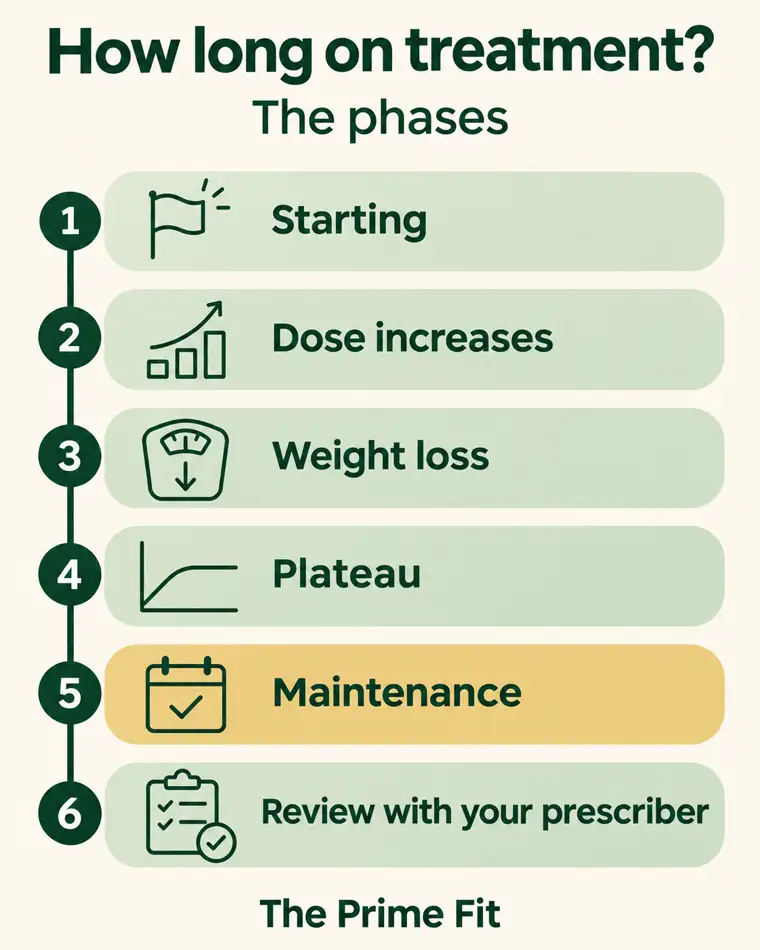
The phases of treatment
| Phase | Typical duration | Aim | What happens |
|---|---|---|---|
| 1. Starting and dose-finding | 3 to 6 months | Reach a tolerated, effective dose | Dose increases every four weeks or more; side effects managed; eating habits established |
| 2. Active weight loss | 6 to 18 months | Steady fat loss while protecting muscle | Most of the weight is lost; protein and strength training are central |
| 3. Plateau | Around 12 to 18 months | Recognise the new stable weight | Weight levels off; health targets are reviewed |
| 4. Maintenance | Long term | Hold the result with the least treatment needed | Lowest effective dose; less frequent reviews; habits sustained |
| 5. Review points | At least yearly | Decide whether to continue, reduce or stop | Weight, tests, side effects, life plans and cost are reassessed |
Most people do not move through these in a straight line. Dose holds, pauses for illness or travel, and restarts are common.
Is there a minimum time to stay on treatment?
There is no fixed minimum, but two practical points apply.
- Give it a fair trial. Response is usually assessed after about three to six months at a treatment dose. A loss of less than 5 percent by then suggests the medicine, at least in its current form, is not working well enough, and continuing unchanged is hard to justify.
- Allow time to reach the plateau. Weight loss continues for a year or more. Stopping at three or four months because of an early good result usually means stopping before the full benefit, and before new habits are established.
Options for the maintenance phase
Once you have reached a stable, healthier weight, there are several strategies. They differ in how much evidence supports them.
| Strategy | What it involves | Evidence and comments |
|---|---|---|
| Continue the same dose | Stay on the dose that produced the result | Best supported by trials; weight loss maintained for years |
| Step down to the lowest effective dose | Reduce gradually and watch weight and appetite | Common in practice; limited trial data, but sensible when a lower dose still controls appetite. Fewer side effects and lower cost |
| Switch to another medicine in the class | For example, a different molecule or an oral option, where suitable | May suit cost, availability or tolerability; dose needs re-titration |
| Extend the interval between injections | Injecting less often than weekly | Not an approved schedule and not well studied; the effect becomes less predictable. Only on a healthcare professional’s specific advice |
| Taper and stop, with intensive lifestyle support | Reduce the dose over months, then stop, with structured nutrition, exercise and follow-up | Early reports suggest tapering with coaching helps some people hold their weight for at least several months; long-term data are limited |
| Stop abruptly | End treatment without a plan | Associated with the most regain; not recommended unless medically necessary |
Your healthcare provider will weigh these with you. “Lowest effective dose” is the guiding principle: enough medicine to keep appetite manageable and weight stable, and no more.
Reasons people stop, and how each is handled
| Reason | How to approach it |
|---|---|
| Planning a pregnancy | Stop in advance as advised: usually at least one month before conception for tirzepatide and two months for semaglutide. Plan nutrition for the gap |
| Side effects | Often solved by a lower dose, slower increases or a different medicine before stopping is considered |
| Cost | Discuss openly: lowest effective dose, approved alternatives containing the same ingredient, or a planned taper with strong lifestyle support |
| Goal weight reached | Move to maintenance, not straight to stopping; the goal is to stay there |
| Surgery or a procedure | A temporary pause may be advised because of slowed stomach emptying; restart afterwards as directed |
| Illness, travel or supply problems | Short breaks happen; restart at an appropriate dose |
| Poor response | Review dose, adherence and other factors; consider a different medicine or another treatment such as a balloon or surgery |
| Not wanting long-term medication | A legitimate preference. Plan a gradual taper with the best possible support, and agree what you will do if weight returns |
| A new medical problem | For example pancreatitis or gallbladder disease: your healthcare provider will advise whether treatment must stop |

If you decide to stop: how to do it well
Nobody can guarantee that weight will stay off after stopping, but the following steps improve the odds.
- Choose your moment. Stop from a stable weight, not during active loss, and not just before festivals, travel or a stressful period.
- Taper, do not stop suddenly. Step down through the lower doses over several months, as your healthcare provider advises, watching appetite and weight at each step. If hunger and weight rise sharply at a particular dose, that dose may be your lowest effective one.
- Lock in your meal structure. Three regular meals with protein at each, vegetables at lunch and dinner, and planned snacks. Returning hunger is easier to manage with structure than with willpower.
- Keep lifting. Strength training two to three times a week protects the muscle that keeps your metabolism up.
- Walk daily. Higher levels of regular activity are consistently linked with successful weight maintenance.
- Weigh weekly and measure your waist monthly.
- Set an action threshold. Agree with your healthcare provider what you will do if you regain more than about 3 percent of your weight, roughly 2 to 3 kg for most people: for example, an early review, a dietitian visit or restarting treatment.
- Stay in follow-up for at least a year after stopping. This is when most regain occurs.
- Protect sleep and manage stress. Both strongly influence appetite.
- Do not treat restarting as failure. Going back on treatment early, at a small regain, is far easier than starting again after all the weight has returned.
What the weeks after stopping usually feel like
| Time after the last dose | What many people notice | What helps |
|---|---|---|
| Weeks 1 to 2 | Little change; the medicine is still active | Keep the meal routine exactly as it was |
| Weeks 3 to 5 | Hunger returns between meals; portions feel small; thoughts about food increase | Protein at every meal, high-fibre vegetables, planned snacks, plenty of water |
| Weeks 6 to 12 | Appetite close to its level before treatment; weight may begin to rise | Weekly weighing, strength training, walking after meals, early dietitian review |
| Months 3 to 12 | The period when most regain happens if nothing is in place | Follow-up visits; act at the agreed threshold; consider restarting at a low dose |
Any digestive side effects you had on treatment usually settle within a few weeks of stopping.
A sample day of eating during a taper
As the dose falls and hunger returns, meals need to be more filling without being much larger. Protein and fibre do that work.
| Meal | Vegetarian | Non-vegetarian |
|---|---|---|
| Breakfast | 2 besan or moong chillas with paneer filling and curd | 2-egg vegetable omelette, 1 whole wheat toast, fruit |
| Mid-morning | Fruit with a handful of nuts | Chaas and roasted chana |
| Lunch | Large salad, rajma or chana, sabzi, 1 to 2 rotis, curd | Large salad, chicken or fish curry, sabzi, 1 to 2 rotis |
| Evening | Sprouts chaat or roasted makhana with tea | Boiled egg or grilled chicken strips with tea |
| Dinner | Vegetable soup, paneer or tofu with vegetables, 1 roti | Vegetable soup, grilled fish with vegetables, small katori of rice |
The emotional side of the decision
Feelings about long-term medication are rarely only about medicine. Some people feel that needing treatment means they have not “done it themselves”. Others fear that stopping will undo everything, and feel trapped. Both reactions are understandable. It may help to separate the two questions: whether the condition needs ongoing treatment, which is a medical matter, and how you feel about it, which deserves its own conversation. People take long-term treatment for thyroid conditions, blood pressure and asthma without seeing it as a personal failing. If worry about regain, or about food and body image, is taking up a great deal of your thoughts, tell your healthcare provider. Psychological support is a normal and useful part of long-term weight care.
What makes maintenance more likely to succeed
- Regular physical activity, including resistance exercise
- A consistent eating pattern with adequate protein and fibre
- Self-monitoring of weight
- Good sleep
- Continued contact with a healthcare team
- Treating conditions that drive weight gain, such as hypothyroidism, sleep apnoea or depression
- Reviewing other medicines that promote weight gain
- A supportive home food environment
- Preserved muscle mass at the end of the weight-loss phase
None of these fully replaces the biological effect of the medicine, but together they narrow the gap.
Restarting after a break
If you have missed doses, the right restart depends on how long the gap has been. Tolerance to the digestive effects fades within a few weeks, so restarting at a high dose after a long break can cause severe nausea and vomiting.
| Gap since last dose | General approach |
|---|---|
| One missed weekly dose | Follow the missed-dose instructions for your medicine and continue as usual |
| Two to three weeks | Contact your healthcare provider; many will restart at the same or one step lower, depending on how you tolerated it before |
| A month or more | Usually restart at a low dose and increase again step by step |
These are general patterns, not instructions. Always check with your prescriber before restarting.
Is long-term use safe?
What is known is reassuring, with points that need monitoring.
- Experience. GLP-1 medicines have been prescribed for diabetes since the mid-2000s, and trials of the newer weight-management medicines now extend to three and four years, with no new safety concerns emerging over time.
- Digestive side effects are most common early and with dose increases, and usually settle on a stable dose.
- Gallbladder problems are somewhat more frequent, particularly with rapid weight loss.
- Pancreatitis is rare; severe persistent abdominal pain needs urgent assessment.
- Nutrition, muscle and bone need attention when appetite is low for long periods: protein, strength training, vitamin D, calcium, B12 and iron where indicated.
- Thyroid C-cell tumours were seen in rodent studies. The medicines are not used in people with a personal or family history of medullary thyroid carcinoma or MEN 2.
- Unknowns. Data beyond about four years for the newest medicines at weight-management doses are still accumulating, which is one reason for regular review.
Against these stand the benefits of sustained weight loss: lower risk of diabetes, cardiovascular events in those with heart disease, fatty liver progression and sleep apnoea. For people who meet the criteria for treatment, the long-term balance generally favours continuing.
The yearly review: questions to settle together
- Has my weight been stable, and is my waist holding?
- Are my blood pressure, blood sugar, lipids and liver tests where we want them?
- Is my muscle mass and strength preserved?
- Do I have any side effects, and could a lower dose control my appetite?
- Have my life plans changed: pregnancy, surgery, a move, finances?
- Are there newer or more suitable options for me now?
- What is our plan for the coming year: continue, step down or taper?
Thinking about cost over the long term
Long-term treatment is a financial commitment, and it is better planned than discovered. Points to discuss with your healthcare provider include the lowest dose that maintains your result, approved products containing the same active ingredient where available, and whether a period of treatment followed by a careful taper is a realistic plan for you. It also helps to weigh what treatment may save: fewer other medicines, fewer complications, and better capacity to work and stay active. Where long-term medication is not feasible, a gastric balloon or bariatric surgery may offer better value over several years for some people, and deserves an open conversation. Buying cheaper products from unverified sellers is never a safe solution.

Special situations
Type 2 diabetes
For people with diabetes, the medicine is also treating blood sugar and protecting the heart and kidneys. Stopping usually means another diabetes medicine is needed. Long-term use is standard.
Established heart disease
Where treatment has been started partly for cardiovascular protection, the benefit depends on continuing it.
Younger adults
Someone starting in their twenties or thirties faces decades of potential treatment. Regular reviews, attention to bone and muscle, pregnancy planning and the possibility of planned breaks all matter more.
Older adults
Preserving muscle and avoiding under-nutrition take priority. A lower maintenance dose with good protein intake and strength exercise is often preferred.
After bariatric surgery
Medicines are sometimes used for regain after surgery. Duration is decided by the surgical and medical team.
Common myths
“A three-month course will fix my weight”
Three months is roughly when the dose is still being established. The effect lasts only while treatment continues.
“If I have to take it long term, I must be addicted”
These medicines do not cause dependence or craving. Needing continued treatment for a chronic condition is not addiction, any more than taking blood pressure tablets is.
“My body will forget how to control weight on its own”
The medicine does not damage the body’s regulation. When it is stopped, appetite returns to what it was, not worse.
“Once I stop, I will regain everything within weeks”
Regain is gradual, over months, and varies between people. Early action limits it.
“If I eat perfectly, I will not need maintenance treatment”
Good habits help greatly, but they do not switch off the biological drive to regain. Some people manage without medication; many do better with a low maintenance dose.
A simple way to decide
| Your situation | Usually the best direction |
|---|---|
| Losing steadily, tolerating treatment, health improving | Continue; review at the plateau |
| At a stable weight, feeling well, on a higher dose | Discuss stepping down to the lowest effective dose |
| Diabetes or heart disease alongside excess weight | Long-term treatment, as for other chronic conditions |
| Troublesome side effects | Lower dose or alternative medicine before stopping |
| Planning pregnancy | Planned stop in advance, with a nutrition plan |
| Cost is unsustainable | Lowest effective dose, approved alternatives, or a supported taper; consider other treatments |
| Less than 5% loss after 3 to 6 months at a treatment dose | Reassess; change approach |
| Strong wish to stop, with good habits in place | Gradual taper, close follow-up and a clear plan if weight returns |
How The Prime Fit plans the long term
At The Prime Fit, the maintenance plan is discussed at the beginning, not sprung on you at the end. Your healthcare provider aims for the lowest dose that holds your result and reviews it regularly. Your dietitian builds the eating pattern and strength routine that will carry you through any reduction in dose, and continues weekly or monthly follow-up through the maintenance phase. If you choose to stop, we plan the taper with you and agree in advance what to do if weight begins to return.
To plan your treatment from start to maintenance, book a consultation or read about our GLP-1 therapy and GLP-1 support programme.
Frequently asked questions
Do I have to take weight loss injections for life?
Not necessarily, but most people need continued treatment to maintain their result, because weight usually returns after stopping. Many continue on the lowest effective dose, with regular reviews.
How long does it take to reach my goal weight?
Most weight is lost over the first 12 to 18 months, after which weight levels off. Your healthcare provider will set realistic targets based on percentage loss and health measures.
What happens if I stop suddenly?
Appetite and cravings return over a few weeks, and weight tends to rise over the following months. There are no dangerous withdrawal effects, but blood sugar may rise in people with diabetes. A planned taper is better.
Can I reduce my dose once I reach my target?
Often yes. Many healthcare professionals step down gradually to find the lowest dose that keeps appetite and weight stable. This should be done under supervision.
Can I take the injection every two weeks to maintain?
Longer intervals are not an approved schedule and have not been well studied. Do this only if your healthcare provider specifically advises it.
Will I regain all the weight if I stop?
In trials, people regained about two-thirds of their lost weight within a year of stopping on average, but results vary. Tapering, strength training, structured eating and early action on regain all help.
Is it safe to take these medicines for many years?
Trials lasting up to four years and long experience in diabetes are reassuring. Long-term use needs regular review, attention to nutrition and muscle, and monitoring for gallbladder problems.
Are GLP-1 medicines addictive?
No. They do not cause dependence. Weight returning after stopping reflects the underlying condition, not withdrawal.
Can I restart if the weight comes back?
Yes, after a review with your healthcare provider. After a long break the medicine is usually restarted at a low dose and increased again step by step.
What if I cannot afford long-term treatment?
Tell your healthcare provider. Options include the lowest effective dose, approved alternatives, a supported taper, or other treatments such as a gastric balloon or bariatric surgery. Do not buy from unverified sources.
This article is general information and is not a substitute for a consultation. Do not reduce, stop or restart a prescription medicine without your healthcare provider’s advice.