In this article
- Genuine, generic, compounded, counterfeit: what the words mean
- Why the unregulated market exists
- What can go wrong with a fake or unregulated injection
- Where to obtain your medicine safely
- The 12-point pack check
- Red flags when buying
- Buying online: how to do it safely
- Storage and the cold chain at home
- Unsafe practices to avoid, even with a genuine pen
- How fake or wrong-dose products show up in the body
- What to do if you suspect a product is not genuine
- Why a prescription and follow-up are part of the safety
- If cost is the reason you are looking elsewhere
- A one-minute checklist before every new pen
- Questions to ask your pharmacist or centre
- Common myths
- For family members: signs that someone may be using unregulated injections
- Disposing of pens and needles safely
- How The Prime Fit keeps treatment safe
- Frequently asked questions
GLP-1 medicines such as semaglutide (Wegovy, Ozempic) and tirzepatide (Mounjaro) are among the most sought-after medicines in the world. Wherever demand is high and prices are significant, a second market appears: counterfeit pens, unlabelled vials, products sold through social media, and “research peptides” that were never meant to be injected into people.
This is not a theoretical concern. Health authorities including the World Health Organization have issued alerts about falsified semaglutide pens found in several countries, and patients have been admitted to hospital after injecting fake products. In India, as in other countries, weight loss injections are prescription medicines, and anything sold outside the regulated supply chain carries real risk.
This guide explains what the different types of product are, why unregulated injections are dangerous, how to check that the medicine you receive is genuine, and what to do if you have doubts. It is general information. Regulations and available products change, so confirm current details with your healthcare provider or pharmacist.
Genuine, generic, compounded, counterfeit: what the words mean
These terms are often confused. The differences matter, because some of these products are legitimate and others are not.
| Type | What it is | Is it safe to use? |
|---|---|---|
| Original brand | The medicine made by the company that developed it, approved by the drug regulator | Yes, with a prescription, from a licensed pharmacy |
| Approved generic or branded generic | The same active ingredient made by another licensed manufacturer after approval by the drug regulator | Yes, with a prescription, from a licensed pharmacy. It is a legitimate medicine, not a fake |
| Compounded product | A preparation mixed by a pharmacy for individual patients, not individually reviewed or approved by the regulator as a finished product | Carries extra risk: strength, purity and sterility are not assured in the same way. Rules differ by country |
| Counterfeit or falsified product | A fake made to look like a real brand, with forged packaging. It may contain no active ingredient, the wrong dose or a different medicine altogether | No. Dangerous and illegal |
| “Research” peptide | Powder or liquid sold online, often labelled “for research use only” or “not for human consumption” | No. Not made to pharmaceutical standards and not intended for people |
| Diverted or grey-market product | A genuine product that has left the legal supply chain: smuggled, stolen, or imported without authorisation | Risky. Storage and handling are unknown, and there is no accountability |
Generic does not mean fake
An approved generic made by a licensed manufacturer and dispensed by a licensed pharmacy against a prescription is a proper medicine. The danger lies in products that are unapproved, counterfeit or sold outside the regulated system, whatever name is printed on the box.
Why the unregulated market exists
- Very high demand. Interest in weight loss injections has grown faster than awareness of how they should be prescribed.
- Cost. Treatment is long term, and some people look for cheaper sources.
- People who do not meet medical criteria. Those who would not be prescribed the medicine by a healthcare professional may try to buy it elsewhere.
- Convenience and privacy. Ordering through a social media message feels easier than a visits.
- Supply gaps. When a particular strength is hard to find, people are tempted by unofficial sellers.
- Misleading marketing. Phrases such as “same as Ozempic”, “generic Mounjaro imported” or “healthcare professional formulated” are used loosely by sellers with no accountability.
What can go wrong with a fake or unregulated injection
The wrong medicine
The most alarming cases have involved pens that looked like a GLP-1 medicine but contained insulin. People who injected them developed severe low blood sugar and needed emergency treatment. Others have contained no active ingredient at all, or unknown substances.
The wrong dose
Unapproved vials may be far stronger or weaker than the label states. Products supplied as powder to be mixed, or as multi-dose vials drawn up with insulin syringes, have led to tenfold dosing errors when units, millilitres and milligrams were confused. An overdose of a GLP-1 medicine causes severe, prolonged vomiting, dehydration and sometimes hospital admission, because the medicine remains active for days.
A different form of the ingredient
Some unapproved products use salt forms of the active ingredient, such as semaglutide sodium or acetate, which are not the form used in approved medicines and have not been shown to be safe or effective.
Contamination and loss of sterility
Injections must be sterile. Products made in unlicensed facilities can carry bacteria or impurities, leading to abscesses, serious infections or allergic reactions.
Broken cold chain
GLP-1 medicines are proteins that need refrigeration. A genuine pen that has spent days in a hot courier van or an unrefrigerated shop may no longer work properly, with no visible sign of damage.
No medical oversight
Even a genuine pen is unsafe if nobody has checked whether the medicine suits you, explained the dose steps, reviewed your other medicines or told you which symptoms need urgent attention.
No recourse
If something goes wrong with a product bought from an anonymous seller, there is no batch to trace, no pharmacist to ask and nobody responsible.
Where to obtain your medicine safely
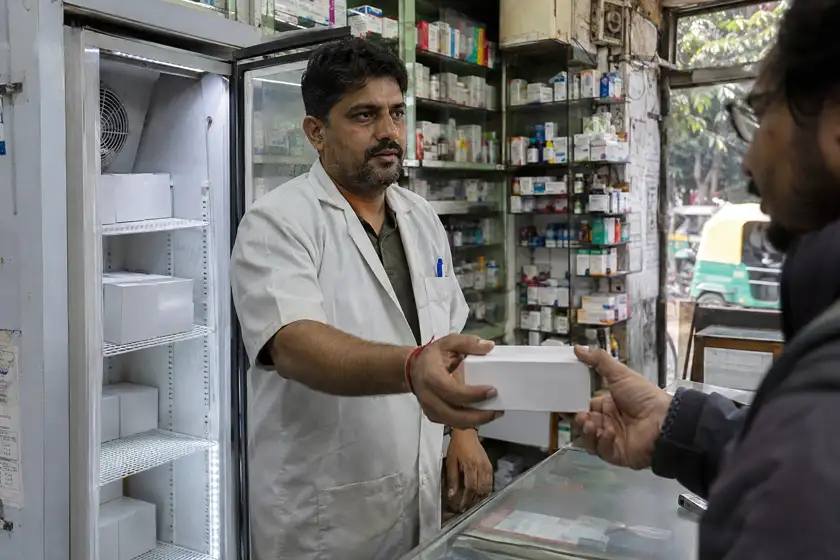
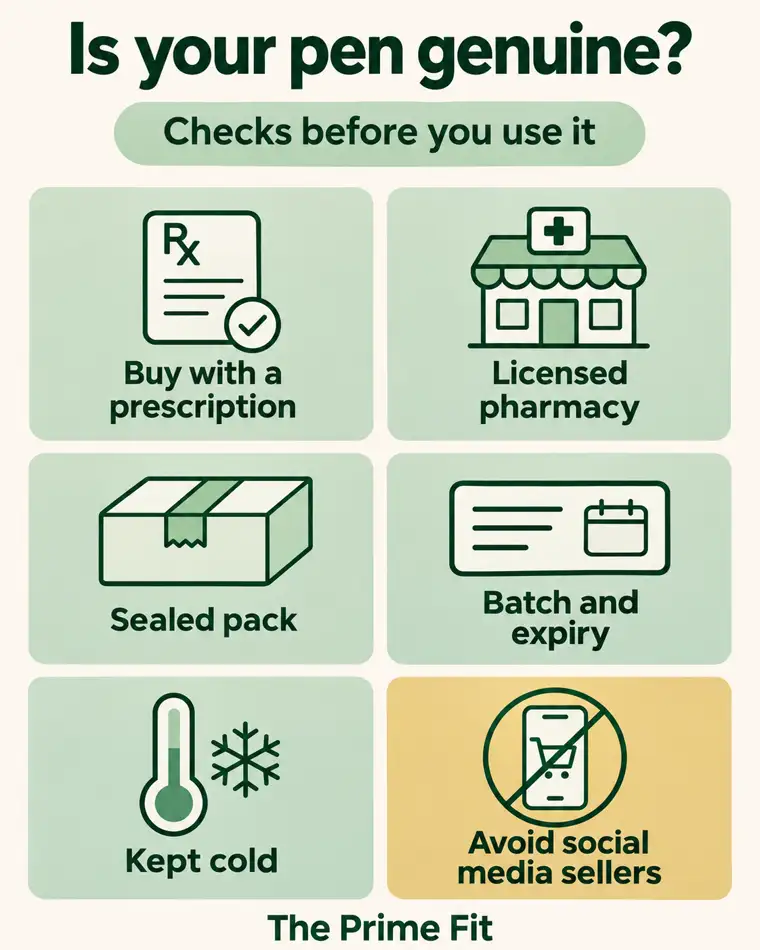
- Start with a healthcare professional’s assessment and a valid prescription. In India these are prescription-only medicines.
- Buy from a licensed pharmacy, either a physical chemist you know or an established, licensed online pharmacy that asks for your prescription.
- Ask for a proper bill showing the pharmacy’s name, address and licence number, the product name, batch number, expiry date and price.
- Receive the product cold. It should come from a refrigerator or arrive in an insulated pack with cool packs that are still cold.
- Keep the outer carton and the bill until the pen is finished.
If your centre supplies or arranges the medicine, ask where it is sourced and how it is stored. A good centre will be glad to tell you.
The 12-point pack check
Take two minutes to examine every new pack before the first injection. No single check proves a product is genuine, but several warning signs together should stop you from using it.
| # | Check | What to look for |
|---|---|---|
| 1 | Outer carton | Clean, sharp printing; no spelling mistakes, blurred logos, odd fonts or colours that differ from your previous pack |
| 2 | Seal | Tamper-evident seal intact; carton not opened, re-glued or re-taped |
| 3 | Product name and strength | Exactly what was prescribed, including the dose strength |
| 4 | Batch (lot) number and expiry date | Printed clearly on the carton and matching the label on the pen or vial inside |
| 5 | Manufacturer or importer details | Name and address of the manufacturer, and for imported products the importer and Indian marketing company |
| 6 | Indian labelling | Maximum retail price (MRP), licence details and a prescription-medicine warning, as required on medicines sold in India |
| 7 | Leaflet | A patient information leaflet in the pack, properly printed |
| 8 | Pen or vial appearance | Correct colour and design for the strength; label straight and firmly attached; dose counter or markings clear |
| 9 | The liquid | Clear and colourless to slightly yellow, with no particles, cloudiness or discolouration |
| 10 | Needles and parts | Any needles supplied are sealed and sterile; the pen clicks and dials as described in the leaflet |
| 11 | Temperature on receipt | Cold to the touch; cool packs not warm; no sign of having been frozen |
| 12 | Verification features | If the carton carries a QR code, serial number or scratch-off verification code, check it using the method printed on the pack or the manufacturer’s official website |
Compare each new pack with your previous one. If anything looks different, ask your pharmacist before using it. Packaging does change from time to time, and a pharmacist can confirm whether a change is genuine.
Red flags when buying
| Red flag | Why it matters |
|---|---|
| No prescription asked for | Licensed pharmacies must see one. A seller who does not ask is not following the law |
| Sold through Instagram, WhatsApp, Telegram, a salon, gym or slimming centre | These are not pharmacies and have no cold storage or accountability |
| Price far below the usual retail price | Genuine medicines have a narrow price range. Very cheap usually means fake, diverted or expired |
| No bill, or cash only | Nothing links the seller to the product |
| “Imported”, “export pack” or foreign-language packaging with no Indian label | May be diverted or counterfeit; storage in transit is unknown |
| Vials of powder or liquid with a syringe, labelled as peptide or “research use” | Not a medicine made for human use |
| Claims such as “herbal Ozempic”, “GLP-1 drops”, “patches” or “oral Mounjaro” | No such approved products deliver these medicines. Oral semaglutide exists only as a prescription tablet |
| Seller offers to send it by ordinary courier without cold packaging | The cold chain will be broken |
| Pressure to buy several months at once, or “limited stock” urgency | A sales tactic, not healthcare |
| Pre-filled syringes drawn up by someone else | You cannot know what is in them or how they were prepared |
Buying online: how to do it safely
Buying medicines online is not unsafe in itself. Established e-pharmacies operate with licensed pharmacists and require prescriptions. The risk comes from websites and social media sellers that imitate them.
- Use well-known pharmacy platforms or the online service of a pharmacy chain you recognise.
- Check that the site asks you to upload a valid prescription and shows its licence details and a physical address.
- Be wary of websites that advertise prescription medicines with “no prescription needed” or offer an instant online “approval” after a short questionnaire with no healthcare professional contact.
- Choose cold-chain delivery, and be at home to receive it. Do not let a refrigerated parcel sit with a security guard or neighbour for hours.
- Open the parcel on delivery and check the temperature and the pack before accepting it if possible.

Storage and the cold chain at home
A genuine medicine can still be spoiled by poor storage.
- Refrigerate at 2°C to 8°C, in the original carton, away from the freezer compartment and the door.
- Never freeze. Discard any pen or vial that has frozen, even if it has thawed.
- Protect from light and heat. Do not leave it in a car or near a window.
- If your product allows a period out of the refrigerator, the leaflet will state how long and at what temperature. This differs between products and presentations.
- During power cuts, keep the refrigerator closed. For long outages or travel, use an insulated medicine pouch with cool packs, without direct contact with ice.
- Check the expiry date, and for multi-dose pens note the date of first use and discard as instructed in the leaflet.
Unsafe practices to avoid, even with a genuine pen
- Sharing a pen with a family member or friend, even with a new needle. This can transmit infections, and their dose may not be right for you.
- Extracting medicine from a pen with a syringe to stretch doses or create in-between doses. Pens are not designed for this; it risks contamination and dose errors.
- “Microdosing” by clicking part-doses without medical guidance. The effect becomes unpredictable.
- Using leftover medicine beyond the in-use period stated in the leaflet.
- Using someone else’s prescription, or continuing after your own prescription and follow-up have lapsed.
- Buying abroad and carrying it home without a prescription, proper cold storage and an understanding of the dose.
How fake or wrong-dose products show up in the body
| What you notice | What it may mean | What to do |
|---|---|---|
| Shaking, sweating, intense hunger, confusion, palpitations soon after an injection | Low blood sugar; the product may contain insulin | Take sugar or glucose immediately and seek emergency care |
| Severe vomiting lasting days, inability to drink | Overdose or an incorrectly strong product | Urgent medical assessment; take the pack with you |
| No effect at all on appetite after several weeks at a treatment dose | Possibly inactive, spoiled or fake, although individual response also varies | Discuss with your healthcare provider and pharmacist before the next dose |
| Redness, swelling, heat, pus or a hard painful lump at the injection site, or fever | Infection from a non-sterile product | See a healthcare professional promptly |
| Rash, facial swelling, wheeze or difficulty breathing | Allergic reaction | Emergency care |
| Liquid looks cloudy, coloured or has particles | Spoiled or not genuine | Do not inject |
What to do if you suspect a product is not genuine
- Do not inject it. If you have already used it, do not take another dose.
- Keep everything: the carton, pen or vial, leaflet, bill and any messages from the seller. Photograph the batch number and expiry date.
- Contact your healthcare provider, describe any symptoms, and ask how to continue treatment safely.
- Take it back to the pharmacy if it came from one, and ask the pharmacist to check the batch with the distributor or manufacturer.
- Report it. Suspected fake medicines can be reported to your state drug control authority or the national drug regulator. Side effects from any medicine can be reported through the national pharmacovigilance programme, and manufacturers also have helplines for product verification printed on genuine packs.
- Seek urgent care for any of the serious symptoms in the table above.
Reporting helps protect other patients. You will not get into trouble for reporting a product you bought in good faith.
Why a prescription and follow-up are part of the safety
It is tempting to think of the pen as the treatment. In reality the treatment is the pen plus the assessment, dose plan, nutrition and monitoring that go with it. A healthcare professional’s involvement means that:
- conditions that make the medicine unsafe for you are identified first;
- the dose is increased at the right pace, and reduced if side effects appear;
- other medicines, such as those for diabetes or blood pressure, are adjusted as you lose weight;
- protein intake and muscle are protected with dietitian support;
- warning signs are explained, and someone is available if they occur.
People who obtain injections informally lose all of this, even when the product itself happens to be genuine.
If cost is the reason you are looking elsewhere
Cost is a genuine concern with long-term treatment, and it is better discussed openly than solved through an unsafe source. Options to raise with your healthcare provider include:
- Approved generic or alternative products containing the same active ingredient, where available, dispensed by a licensed pharmacy.
- A different medicine in the same class that may be priced differently.
- The lowest effective dose. Many people do well without reaching the highest strength.
- A structured nutrition programme first, or alongside a shorter course of medication, with a clear maintenance plan.
- Other treatments, such as a gastric balloon or surgery, where the overall cost over several years may compare differently.
A cheaper product from an unverified seller is never a saving if it is ineffective or harms you.
A one-minute checklist before every new pen
| Question | Answer should be |
|---|---|
| Did a healthcare professional prescribe this for me after an assessment? | Yes |
| Did it come from a licensed pharmacy with a bill? | Yes |
| Was it cold when I received it? | Yes |
| Is the seal intact, and do the batch number and expiry match on carton and pen? | Yes |
| Is the name and strength exactly what was prescribed? | Yes |
| Is the liquid clear, with no particles? | Yes |
| Does anything look different from my last pack? | No, or the pharmacist has confirmed the change |
Questions to ask your pharmacist or centre
- Is this product approved for sale in India, and who is the manufacturer or importer?
- Has it been kept refrigerated since it reached you, and how will it stay cold until I get home?
- Can you show me the batch number and expiry date on the carton and on the pen?
- Is this the same product and strength as my last pack? If the packaging has changed, why?
- How should I store it, and how long can it stay out of the fridge?
- Whom do I contact if the pen does not work properly?
A licensed pharmacist will answer these without hesitation. Reluctance to answer is itself a warning sign.
Common myths
“If the box looks real, the medicine is real”
Counterfeiters copy packaging well. That is why the source matters more than the appearance. A convincing box bought from a stranger online is still unsafe.
“A friend used it and was fine”
One good experience says nothing about the next vial from the same seller. Unregulated products vary from batch to batch.
“It is the same powder the companies use”
Approved medicines are made in inspected facilities, tested for identity, strength, purity and sterility, and filled into devices that deliver a precise dose. A powder labelled with the same name has had none of these checks.
“A lower dose of a doubtful product is safe”
If you do not know what is in the vial, you do not know what a “low dose” is.
“Centres and salons that sell injections directly must be authorised”
Not necessarily. Ask who is prescribing, whether a registered healthcare professional has assessed you, and where the product was purchased.
For family members: signs that someone may be using unregulated injections
Relatives are often the first to notice. Signs include unlabelled vials or syringes in the refrigerator, parcels arriving from unknown sellers, rapid weight loss with repeated vomiting or weakness, and reluctance to say where the medicine came from. Approach the subject without blame. The aim is to move the person into proper care, where the same goal can be pursued safely, not to shame them for wanting to lose weight.
Disposing of pens and needles safely
Used needles and pens should never go loose into household rubbish. Place needles in a puncture-proof container with a lid, such as a sharps box from a pharmacy or a thick plastic bottle, and ask your pharmacy or centre how to dispose of it locally. Remove or deface personal labels on cartons before discarding them. Safe disposal also prevents empty genuine pens from being collected and refilled by counterfeiters.
How The Prime Fit keeps treatment safe
At The Prime Fit, GLP-1 treatment begins with an expert-led assessment and a written prescription. We guide patients to obtain their medicine only through licensed pharmacies with proper cold-chain handling, and we show every patient how to check their pack, store it and inject correctly. Dose steps are reviewed regularly, a dietitian supports your nutrition every week, and the team is available if you have a question about a pen or a side effect.
If you are using, or thinking of using, weight loss injections and want to do it safely, book a consultation or read about our GLP-1 therapy programme.
Frequently asked questions
How can I tell if my Ozempic, Wegovy or Mounjaro pen is fake?
Check that it came from a licensed pharmacy against a prescription, that the seal is intact, the printing is sharp, the batch number and expiry match on the carton and pen, the Indian label details are present and the liquid is clear. Use any verification code on the pack, and ask your pharmacist if anything looks different.
Are generic semaglutide injections safe?
Generic versions approved by the drug regulator and made by licensed manufacturers are legitimate medicines when prescribed by a healthcare professional and dispensed by a licensed pharmacy. Unapproved products sold online or through social media are not the same thing.
Is it legal to buy weight loss injections without a prescription?
No. They are prescription-only medicines. A seller who supplies them without a prescription is not operating within the law, and the product cannot be trusted.
What are “research peptides”, and can I use them?
They are chemicals sold for laboratory use, often labelled “not for human consumption”. They are not made to pharmaceutical standards, their strength and purity are unknown, and they should never be injected.
What is compounded semaglutide or tirzepatide?
It is a preparation mixed by a pharmacy and not approved as a finished product by the regulator. Dosing errors and quality problems have been reported with such products in other countries. Approved pens and vials from licensed manufacturers are the safer choice.
Why is a very cheap pen a warning sign?
Genuine products are sold within a narrow price range. A price far below that usually means the product is counterfeit, expired, diverted from another market or stored improperly.
Can I buy from an online pharmacy?
Yes, if it is an established, licensed pharmacy that requires a prescription, issues a bill and delivers with cold-chain packaging. Avoid social media sellers and websites that do not ask for a prescription.
What should I do if I already injected a suspicious product?
Do not take another dose. Watch for low blood sugar, severe vomiting, signs of infection or allergy, and seek medical care if any occur. Keep the pack and inform your healthcare provider.
Can I share my pen with my spouse?
No. Pens are for one person only, even if the needle is changed, because of the risk of infection and because the dose is individual.
Do GLP-1 patches, drops or herbal versions work?
No approved patch, drop or herbal product contains or replaces these medicines. Such claims are marketing and should be ignored.
This article is general information and is not a substitute for a consultation. Rules and available products change; confirm current details with your healthcare provider or a licensed pharmacist.