In this article
- Why does Mounjaro cause nausea and vomiting?
- How common is Mounjaro nausea, and when does it start?
- What triggers nausea on Mounjaro?
- How to stop Mounjaro nausea: eating habits that work
- What should you drink, and when is oral rehydration needed?
- Do ginger, nimbu pani and cold foods help?
- Does the timing or site of the injection change nausea?
- What should you do on a day when you are vomiting?
- What can your prescriber do about nausea?
- When are nausea and vomiting a red flag?
- Why do people with diabetes or kidney disease need extra care?
- Common myths about Mounjaro nausea
- Questions to ask your healthcare provider
- How The Prime Fit helps
- Frequently asked questions
Mounjaro nausea is common, usually mild to moderate, and tends to appear in the first days after starting treatment or after a dose increase, then settle over days to weeks. To stop feeling sick, most people need three things: smaller and slower meals, steady sips of fluid, and a dose plan that moves no faster than their stomach can tolerate. Vomiting is less common than nausea, but it needs more care because of the risk of dehydration.
This guide explains why Mounjaro (tirzepatide) makes some people feel sick, what to eat on a rough day using everyday Indian foods, what your prescriber can change, and the warning signs that mean you should seek urgent medical help instead of waiting it out.
It is general information, not personal medical advice. Always follow the leaflet that comes with your pen and the instructions of your healthcare provider.
Why does Mounjaro cause nausea and vomiting?
Mounjaro acts on two gut hormone receptors, GIP and GLP-1. It strengthens the body’s normal signals after a meal. Two effects explain most of the sick feeling.
- Slower stomach emptying. Food stays in the stomach for longer, so a portion that felt normal before treatment can now feel heavy, and an overfull stomach triggers nausea, burping or reflux. This slowing is strongest early in treatment and after a dose step.
- Signals to the brain. The medicine acts on areas of the brain that control appetite and fullness. These sit close to the centres that produce nausea, so a strong “I am full” message can tip into “I feel sick”.
Neither effect means the medicine is harming your stomach. Read more in our guide to what GLP-1 is and how weight loss medicines work.
How common is Mounjaro nausea, and when does it start?
In the large trials of tirzepatide, nausea was among the most frequently reported side effects, along with diarrhoea, constipation and vomiting. Nausea was reported more often than vomiting. Most episodes were described as mild or moderate.
The timing follows a pattern:
- After the first dose. Treatment starts at 2.5 mg once a week, a low starting dose that is meant to help the body get used to the medicine.
- After each dose increase. The dose is usually raised in 2.5 mg steps, with at least four weeks on each step. The first one or two weeks on a new step are when nausea is most likely.
- In the first few days after an injection. Many people notice that the days just after the weekly dose are the hardest, and the later days are easier.
For most people the feeling fades over one to three weeks on a stable dose, and some have no nausea at all. If it is not clearly improving, or it stops you eating and drinking properly, speak to your prescriber instead of pushing through. Our Mounjaro dosage guide explains the steps in detail.
What triggers nausea on Mounjaro?
The medicine sets the stage, but daily habits often decide whether you feel sick. The table below lists the triggers people report most often and a practical swap for each.
| Trigger | Why it makes you feel sick | What to try instead |
|---|---|---|
| Large portions | The stomach empties slowly and overfills | Half your old portion on a small plate; add more only if still hungry after 15 minutes |
| Eating fast | Fullness signals arrive after you have already overeaten | Put the spoon down between bites; aim for 20 minutes per meal |
| Fried and greasy food (pakora, puri, samosa, butter-heavy gravies) | Fat slows stomach emptying further | Steamed, grilled, roasted or lightly tempered dishes |
| Very sweet food and drinks (mithai, sweet lassi, packaged juice) | Rich, sugary foods are poorly tolerated on a slow stomach | A small piece of fruit, or plain curd |
| Very spicy or sour food | Can worsen acidity and reflux, which feel like nausea | Milder seasoning: jeera, haldi, a little ginger |
| Large, late dinners | Lying down with a full stomach brings reflux and morning nausea | A light dinner two to three hours before bed |
| Long gaps without food | An empty, acidic stomach can feel as sick as an overfull one | Small meals or snacks at regular times |
How to stop Mounjaro nausea: eating habits that work
These habits are simple, and they are the first thing any care team will ask about. Most people who follow them find Mounjaro nausea becomes manageable.
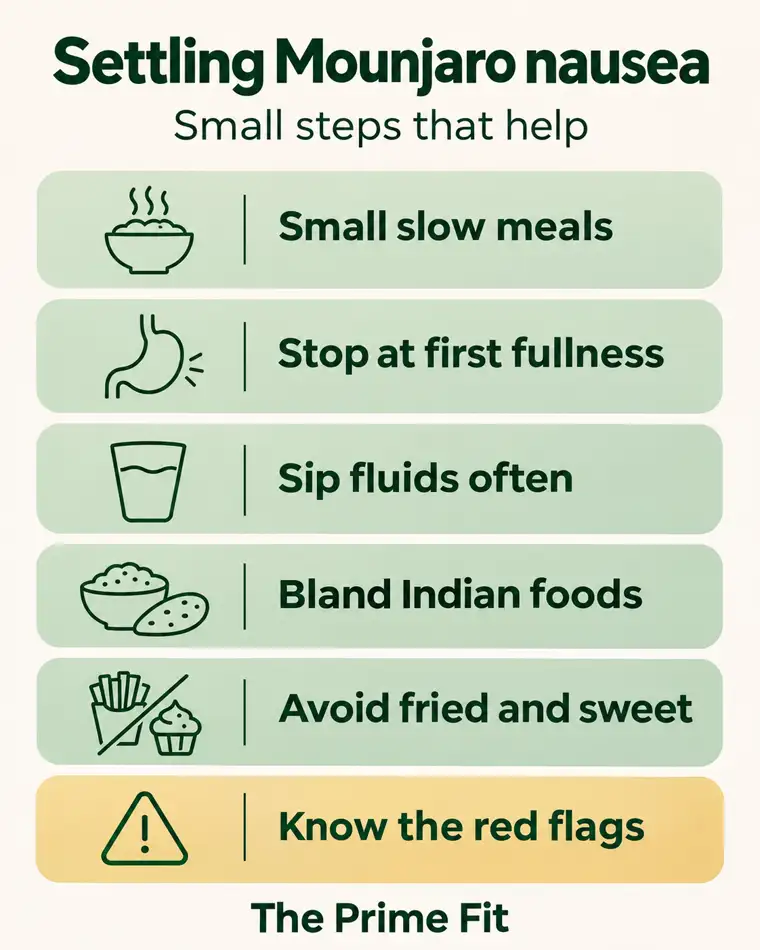
- Eat small portions. Think five or six small eating occasions, not three large meals. One idli with sambar may be enough where you used to eat three.
- Eat slowly and chew well. Give your stomach time to report back.
- Stop at the first sign of fullness. On this medicine the gap between “comfortable” and “too much” is narrow. A sigh, a burp or a sudden loss of interest in food is your signal. Leaving food on the plate is fine.
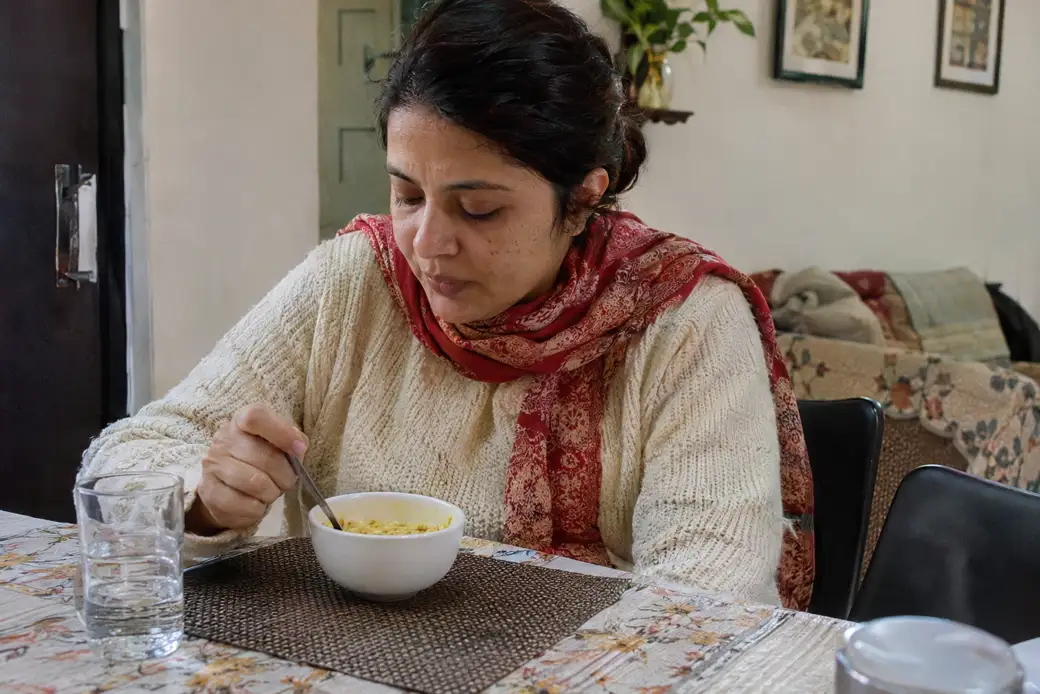
- Choose bland, low-fat foods on difficult days. Moong dal khichdi, curd rice, idli, plain toast, thin dal with soft rice, daliya, boiled potato, banana and plain crackers are gentle choices.
- Keep some protein in every small meal. Curd, dal, paneer, egg or soft chicken in small amounts helps protect muscle while your appetite is low.
- Stay upright after eating. Avoid lying down straight after a meal.
- Do not skip meals to avoid nausea. A long fast followed by a normal-sized meal is a common cause of vomiting.
For a fuller eating framework at each stage, see our GLP-1 diet plan for Indians.
What should you drink, and when is oral rehydration needed?
Fluids matter more than food on a sick day. Reduced appetite also reduces thirst, and dehydration itself causes nausea, headache and tiredness.
- Sip small amounts often through the day. A few sips every ten to fifteen minutes is easier than a full glass at once.
- Good options: water, thin chaas, coconut water, clear dal or vegetable soup, weak tea, and nimbu pani with a pinch of salt and little or no sugar.
- If you have vomited or have diarrhoea, use an oral rehydration solution (ORS) made exactly as the packet instructs. It replaces salts as well as water.
A simple check is your urine: pale yellow and regular means you are drinking enough. Dark, scanty urine means you need more fluid and, if it does not improve, medical advice.

Do ginger, nimbu pani and cold foods help?
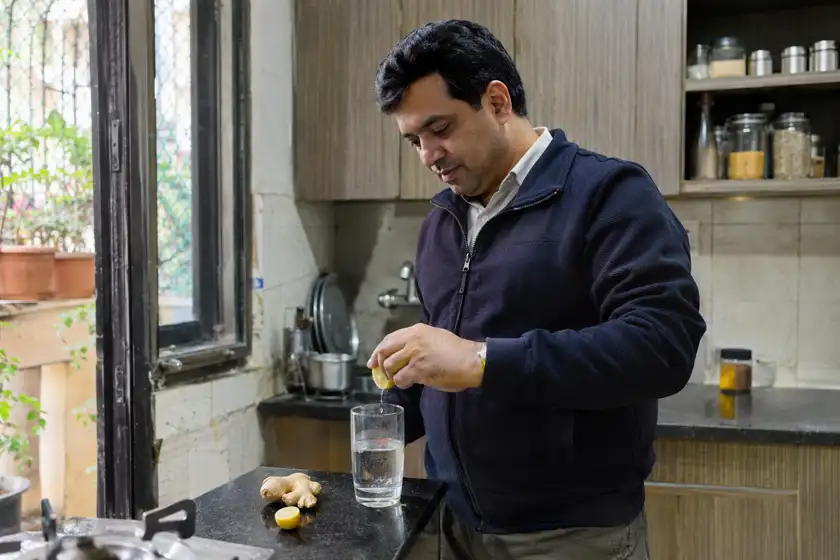
Ginger has a long history of use for nausea. It has not been tested specifically with tirzepatide, but it is safe as a food for most people and many find it soothing. Try ginger steeped in hot water or a thin slice of fresh adrak with a pinch of salt.
Nimbu pani helps mainly because it is fluid that is easy to sip, and the sour taste can cut through a queasy feeling. If you have acidity or reflux, lemon may make it worse, so go by how you feel.
Cold and room-temperature foods smell less than hot foods, which helps when smells set off nausea. Chilled curd, cold curd rice, a banana or a cool glass of chaas are often tolerated when a hot meal is not. None of these is a treatment, and none replaces fluids or medical advice when symptoms are severe.
Does the timing or site of the injection change nausea?
Mounjaro is taken once a week, on the same day each week, at any time of day, with or without food. There is no proven best time for avoiding nausea. Some people prefer to inject in the evening so that the first hours pass during sleep, or to choose a day that leaves the following two days quiet, for example Friday evening before a relaxed weekend. These are personal preferences, not rules.
The injection can be given under the skin of the abdomen, thigh or upper arm. There is no good evidence that one site causes less nausea than another, though you should rotate the site each week. Technique is covered in our guide on how to inject Mounjaro.
What should you do on a day when you are vomiting?
Vomiting once after an oversized meal is a signal to change portion size. Repeated vomiting needs a plan.
- Rest your stomach briefly. After vomiting, wait about half an hour, then begin with small sips of water or ORS.
- Fluids first. Keep sipping through the day even if you cannot eat. A teaspoon or a sip every few minutes is enough to start.
- Restart food gently. When fluids stay down for a few hours, try plain toast, a few spoons of khichdi or curd rice, or half a banana.
- Review your other medicines. If you take diabetes medicines, blood pressure medicines or water tablets, contact your prescriber for sick-day advice. If you vomit soon after taking an oral contraceptive pill or another important tablet, ask how to manage it.
- Do not take a further or extra dose of Mounjaro, and do not take your next dose while still vomiting without advice.
Gentle day menu (illustrative example)
A sample for a day when you feel sick. Portions are deliberately small. Adjust to your own tolerance.
| Time | Vegetarian | Non-vegetarian |
|---|---|---|
| On waking | Ginger water or plain water, sipped slowly; one plain rusk or toast | Same |
| Breakfast | One or two idlis with thin sambar, or a small bowl of daliya | One soft boiled or lightly scrambled egg with a slice of toast |
| Mid-morning | Half a banana, or a small glass of thin chaas | Same |
| Lunch | Small bowl of moong dal khichdi with a spoon of curd | Small bowl of soft rice with clear chicken soup and a few pieces of shredded chicken |
| Early evening | A small bowl of plain curd or a few cubes of soft paneer | A small bowl of plain curd, or one boiled egg white |
| Dinner (early and light) | Curd rice, or thin dal with a small phulka and lauki sabzi | Steamed or lightly grilled fish with soft rice, or thin dal with a small phulka |
Once you feel better, build protein back up. Our vegetarian high-protein meal plan for GLP-1 users gives ideas for the weeks that follow.
What can your prescriber do about nausea?
If food and fluid changes are not enough, the treatment plan itself can be adjusted. This is a normal part of care and not a sign of failure.
- Staying longer on the current dose. Four weeks is the minimum time on each step, not a deadline.
- Slower titration. Your prescriber may delay an increase, or decide that a lower dose is the right long-term dose for you if it is working.
- Anti-nausea medicine. A short course may be prescribed for difficult days. Take these only if prescribed for you, since they have their own side effects and interactions.
- Checking for other causes. Acidity, constipation, gallbladder problems, infections and other medicines can all cause nausea. Not every sick feeling is from the injection.
Never change or split doses without guidance. Constipation and acidity often travel with nausea: see Mounjaro constipation, acidity and bloating.
When are nausea and vomiting a red flag?
Seek urgent medical care if you have any of these
You cannot keep fluids down for a day. You have signs of dehydration: very little or very dark urine, a dry mouth, dizziness on standing, a racing heartbeat, confusion or unusual drowsiness. You have severe pain in the upper abdomen, especially pain that goes through to the back, with or without vomiting. There is blood in the vomit, or vomit that looks like coffee grounds, or black stools. You have a fever with pain under the right ribs, or yellowing of the eyes or skin.
Severe abdominal pain going to the back can be a sign of pancreatitis, a rare but serious condition listed in the prescribing information. Stop taking the medicine and get medical help straight away if this happens. Pain under the right ribs can point to a gallbladder problem. These risks are explained in our article on gallstones and pancreatitis with GLP-1 medicines.
Why do people with diabetes or kidney disease need extra care?
Diabetes on other glucose-lowering medicines. Mounjaro on its own has a low risk of low blood sugar. The risk rises when it is combined with insulin or sulfonylurea tablets. If you are eating very little or vomiting while taking these, your blood sugar can fall. Check your glucose more often on sick days, know the signs of a low (sweating, shaking, hunger, confusion, palpitations) and ask your prescriber in advance what to do with each of your medicines when you cannot eat. Do not stop insulin by yourself. More detail is in Mounjaro for type 2 diabetes versus weight loss.
Kidney disease. Dehydration from vomiting or diarrhoea can worsen kidney function, and the prescribing information specifically warns about this. If you have known kidney disease, or take water tablets or certain blood pressure medicines, have a low threshold for calling your prescriber when you cannot keep fluids down. Do not wait for a full day.

Common myths about Mounjaro nausea
- “Nausea means the medicine is working.” Not so. Weight loss does not depend on feeling sick, and many people lose weight well with no nausea at all.
- “The best fix is to stop eating.” Long gaps and very low intake make nausea, weakness and muscle loss worse.
- “You must reach the highest dose.” The right dose is the lowest one that works for you and that you can tolerate.
- “Any anti-sickness tablet from the chemist is fine.” These should be chosen by a prescriber who knows your other medicines.
Questions to ask your healthcare provider
- How long should I stay on my current dose before we consider increasing it?
- Is an anti-nausea medicine suitable for me, and when should I use it?
- What should I do with my diabetes, blood pressure or other medicines on a day I am vomiting?
- I take an oral contraceptive pill. Do I need additional precautions?
- Which symptoms should make me call you, and which should send me to an emergency department?
How The Prime Fit helps
At The Prime Fit, Mounjaro treatment begins with a medical assessment to confirm that the medicine is suitable for you. Dose changes are planned around how you are tolerating treatment. Our team offers nutrition support with practical Indian meal ideas, and follow-up so that side effects such as nausea are reviewed early. If you are struggling with side effects on treatment, you can get in touch with our team.
Frequently asked questions
How do I stop nausea on Mounjaro quickly?
Stop eating for a short while, sit upright, and sip water, ginger water or nimbu pani slowly. When you feel ready, have something small and bland such as toast, curd rice or a few spoons of khichdi.
How long does Mounjaro nausea last?
For most people it is worst in the first days after starting or after a dose increase and eases over days to a few weeks. If it is not improving on a stable dose, or it stops you eating and drinking, speak to your prescriber.
Is vomiting on Mounjaro normal?
Vomiting is a recognised side effect but is less common than nausea. Repeated vomiting, or being unable to keep fluids down, needs medical advice.
Should I skip my next dose if I feel sick?
Do not decide this alone. Mild nausea is not usually a reason to skip. If you are actively vomiting, dehydrated or unwell with another illness, contact your prescriber before the next injection.
What Indian foods are best when I feel nauseous?
Moong dal khichdi, curd rice, idli, plain toast, daliya, thin dal with soft rice, banana and plain curd are gentle choices. Keep portions small.
Can I take an anti-nausea tablet with Mounjaro?
Only if it has been prescribed for you. Anti-nausea medicines can have side effects and interact with other medicines.
Does nausea mean I will lose more weight?
No. Feeling sick is not a measure of how well the medicine is working. Many people lose weight steadily without any nausea.
When should I go to hospital for vomiting on Mounjaro?
Go urgently if you cannot keep fluids down for a day, pass very little urine, feel dizzy or confused, have severe abdominal pain that spreads to the back, or see blood in your vomit.
This article is for general education and does not replace advice from a qualified healthcare provider. Mounjaro is a prescription medicine. Follow the leaflet supplied with your pen and the instructions of your prescriber, and seek urgent medical care for any of the warning signs described above.