In this article
- At a glance
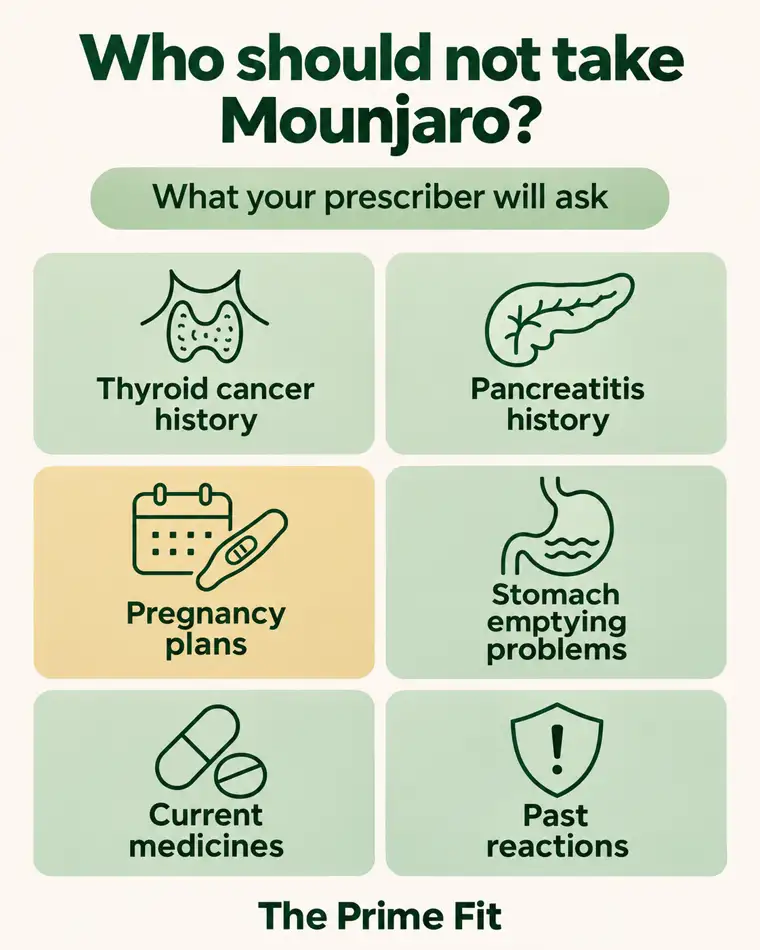
- Who must not take Mounjaro
- Who is generally advised against it
- Who needs extra caution
- Thyroid conditions: what does and does not matter
- Medicines that interact
- Women: three points to plan
- What your healthcare provider will ask before prescribing
- Tests that help decide
- A self-check before your consultation
- Conditions that do not, by themselves, rule it out
- If your circumstances change during treatment
- Older adults and people who are slim but unwell
- If Mounjaro is not suitable: the alternatives
- When to stop and seek help during treatment
- Why buying without an assessment is risky
- Three illustrative examples
- Questions to ask your healthcare provider
- Common myths
- How The Prime Fit checks suitability
- Frequently asked questions
Mounjaro (tirzepatide) has helped a great many people lose weight and control type 2 diabetes. Its popularity has also led to a belief that it suits anyone who wants to be slimmer. It does not. Like every prescription medicine, it has conditions in which it must not be used, others in which it needs caution, and a group of people for whom the benefits simply do not justify the risks.
Knowing where you stand before you start is the safest approach. Most people who are assessed properly turn out to be suitable. A few are not, and for them there are other effective options. And some need a precaution, a test or a change to another medicine first.
This guide explains each category. It is general information based on the prescribing information as generally published. Your own healthcare provider, who knows your history, must decide whether Mounjaro is right for you.
At a glance
| Category | Who |
|---|---|
| Must not take it | Personal or family history of medullary thyroid carcinoma; multiple endocrine neoplasia type 2; previous serious allergic reaction to tirzepatide or any ingredient; pregnancy |
| Not recommended | Breastfeeding; trying to conceive; type 1 diabetes; previous pancreatitis; severe stomach-emptying disorder or other severe gut disease; children and adolescents; people at a healthy weight without diabetes |
| Needs extra caution and monitoring | Taking insulin or a sulfonylurea; diabetic eye disease; kidney disease; gallbladder disease; using the oral contraceptive pill; older or frail adults; history of an eating disorder; history of depression; planned surgery; very high triglycerides; heavy alcohol use |
| Usually suitable | Adults with a BMI of 30 or above, or 27 or above with a weight-related condition, or with type 2 diabetes, who have none of the above or whose precautions have been addressed |
Who must not take Mounjaro
Medullary thyroid carcinoma, personal or family history
In long-term studies in rats, tirzepatide caused tumours of the thyroid C-cells, including a rare cancer called medullary thyroid carcinoma. It is not known whether this applies to humans, whose C-cells respond differently, but as a precaution the medicine is contraindicated in anyone who has had this cancer or has a close blood relative who has had it.
This is a specific, rare cancer. It is not the same as the common thyroid cancers, papillary and follicular, and it has nothing to do with hypothyroidism, Hashimoto’s disease or ordinary thyroid nodules. If a relative had “thyroid cancer” and you do not know the type, try to find out, and tell your healthcare provider.
Multiple endocrine neoplasia syndrome type 2 (MEN 2)
MEN 2 is a rare inherited condition that causes medullary thyroid carcinoma and tumours of other glands. People with MEN 2, or with a family history of it, must not use tirzepatide.
Serious allergy to tirzepatide or its ingredients
Anyone who has had a severe allergic reaction to tirzepatide, such as swelling of the face or throat, difficulty breathing or a widespread rash, must not take it again. Tell your healthcare provider if you have had a serious reaction to another medicine in the GLP-1 class, since caution is needed.
Pregnancy
Tirzepatide should not be used during pregnancy. Animal studies showed harm to the developing offspring, and pregnancy is not a time for weight loss. If you become pregnant while taking it, stop the injections and contact your healthcare provider and obstetrician.
Who is generally advised against it
Breastfeeding
It is not known how much of the medicine passes into breast milk or what effect it might have on a baby, and a breastfeeding mother needs adequate nutrition. Treatment is generally deferred until breastfeeding has ended.
Trying to conceive
Women planning a pregnancy are usually advised to stop tirzepatide at least one month beforehand, to allow it to clear from the body. Effective contraception should be used during treatment and until then.
Type 1 diabetes
Tirzepatide is not licensed for type 1 diabetes and cannot replace insulin. Reducing insulin in type 1 diabetes can cause a dangerous condition called ketoacidosis. Any use in this setting is a specialist decision.
Previous pancreatitis
Inflammation of the pancreas has been reported rarely in people taking medicines of this class. Tirzepatide was not studied in people with a history of pancreatitis, and most healthcare professionals avoid it in that situation and consider other approaches. If pancreatitis occurs during treatment, the medicine is stopped and not restarted.
Severe gastroparesis and other severe gut disease
Tirzepatide slows stomach emptying. In someone whose stomach already empties very slowly, a condition called gastroparesis, it can make symptoms much worse. It has not been studied in people with severe gastrointestinal disease, and is generally not recommended for them. Active inflammatory bowel disease and a history of bowel obstruction also call for specialist advice.
Children and adolescents
The criteria and safety data described here apply to adults. Treatment of anyone under 18 is a matter for specialists and depends on local approvals.
People at a healthy weight who do not have diabetes
The benefits shown in trials were in people with obesity, overweight with a related condition, or type 2 diabetes. In a person with a healthy BMI and no such condition, there is no proven benefit to set against the side effects and the risks of losing muscle and becoming under-nourished. Using it to lose a few kilograms for appearance is not appropriate.
Who needs extra caution
| Situation | The concern | What is usually done |
|---|---|---|
| Taking insulin or a sulfonylurea (glimepiride, gliclazide and others) | Low blood sugar | The dose of insulin or sulfonylurea is reduced when tirzepatide is started or increased; sugars are checked more often |
| Diabetic retinopathy | A rapid fall in blood sugar can temporarily worsen eye disease | Eye examination before or soon after starting; regular checks; prompt reporting of visual changes |
| Chronic kidney disease | Dehydration from vomiting or diarrhoea can worsen kidney function | No routine dose change, but slower dose increases, attention to fluids and kidney tests |
| Gallstones or previous gallbladder attacks | Weight loss and the medicine increase the risk of gallbladder problems | Steady pace of weight loss; regular meals with a little fat; assessment of symptoms; sometimes a surgical opinion first |
| Oral contraceptive pill | Absorption of the pill can be reduced after starting and after each dose increase | Barrier method as well for 4 weeks at those times, or a non-oral method |
| Other medicines that depend on precise absorption | Slower stomach emptying may alter their effect | Review of all medicines; monitoring where appropriate |
| Older or frail adults | Loss of muscle, falls, dehydration, low blood pressure | Lower doses, slower increases, protein and strength exercise, review of other medicines |
| History of an eating disorder | Appetite suppression can worsen restriction; vomiting is risky with bulimia | Specialist assessment before any treatment |
| History of depression or other mental illness | Mood should be monitored, although a causal link has not been shown | Start when stable; involve the treating psychiatrist; closer follow-up |
| Very high triglycerides | A risk factor for pancreatitis | Treat triglycerides first or alongside |
| Regular heavy drinking | Pancreatitis, low blood sugar, liver damage, worse side effects | Reduce or stop alcohol; honest discussion with the healthcare professional |
| Planned surgery, endoscopy or sedation | Food may remain in the stomach despite fasting | Tell the surgical team early; follow their instructions on pausing treatment and fasting |
| Heart failure or a fast heart rhythm | The medicine raises resting heart rate slightly | Discuss with the cardiologist; monitor |
| Liver disease | Generally no dose change; cirrhosis needs specialist care | Involve the liver specialist where disease is advanced |
Thyroid conditions: what does and does not matter
Because the leaflet mentions thyroid tumours, people with thyroid disease are often told, wrongly, that they cannot take Mounjaro.
| Thyroid condition | Can Mounjaro usually be used? |
|---|---|
| Hypothyroidism on levothyroxine | Yes. Thyroid levels are rechecked as weight falls, since the tablet dose may need reducing |
| Hashimoto’s thyroiditis | Yes |
| Benign thyroid nodules or goitre | Yes, once nodules have been appropriately assessed |
| Overactive thyroid | Usually after it has been controlled |
| Previous papillary or follicular thyroid cancer | Not a listed contraindication; decided individually with the specialist |
| Medullary thyroid carcinoma or MEN 2, personal or family history | No |
Medicines that interact
| Medicine | Interaction | Advice |
|---|---|---|
| Insulin | Additive lowering of blood sugar | Dose reduced and adjusted by your healthcare provider; never stop insulin abruptly |
| Sulfonylureas | Low blood sugar | Dose reduced or stopped |
| Other GLP-1 medicines (semaglutide, liraglutide, dulaglutide) | Same class | Never combined |
| DPP-4 inhibitors (sitagliptin and others) | Act on the same pathway; no added benefit | Usually stopped |
| Oral contraceptives | Reduced absorption around dose changes | Barrier or non-oral method as above |
| Oral hormone therapy | Absorption may be affected | Ask your healthcare provider; patches or gels avoid the issue |
| Warfarin and some other medicines with a narrow safety margin | Changes in absorption and diet may alter the effect | Closer monitoring when starting or changing dose |
| Levothyroxine | Dose requirement falls with weight loss | Recheck thyroid levels |
| Blood pressure medicines and diuretics | Blood pressure falls with weight loss; dehydration risk | Review doses; report dizziness |
| SGLT2 inhibitors | Risk of ketoacidosis with very low intake, vomiting or dehydration | Drink well; ask about pausing during illness or before surgery |
Give your healthcare provider a complete list of everything you take, including supplements, herbal products and medicines bought without a prescription.
Women: three points to plan
- Contraception: use a reliable method throughout treatment. Fertility can improve quickly with weight loss, even in women with PCOS and irregular periods.
- The pill: add a barrier method for four weeks after the first dose and after every dose increase, or choose a method that does not depend on absorption through the gut, such as an intrauterine device or implant.
- Pregnancy plans: tell your healthcare provider in advance. Tirzepatide is usually stopped at least a month before trying to conceive.

What your healthcare provider will ask before prescribing
- Your weight history, BMI and waist, and what you have tried before
- Whether you or any close relative has had thyroid cancer, and which type
- Any history of pancreatitis, gallstones or gallbladder surgery
- Stomach or bowel conditions, including severe reflux, gastroparesis and previous gut surgery
- Diabetes, how long you have had it, your medicines and any eye or kidney complications
- Kidney, liver and heart conditions
- All current medicines and supplements
- Pregnancy, breastfeeding, contraception and plans to conceive
- Alcohol intake
- Mental health, and any history of an eating disorder
- Previous allergic reactions to medicines
- Any surgery or procedure planned in the coming months
Answer fully, even where a question feels awkward. The purpose is to keep you safe, not to find a reason to refuse you.
Tests that help decide
| Test | What it can reveal |
|---|---|
| Fasting glucose and HbA1c | Diabetes or prediabetes; need to adjust other medicines |
| Kidney function | Reduced function needing closer monitoring |
| Liver enzymes | Fatty liver or other liver disease |
| Lipid profile | Very high triglycerides |
| Thyroid function | Untreated thyroid disease |
| Blood count, iron, vitamin B12, vitamin D | Deficiencies to correct before appetite falls |
| Pregnancy test, where relevant | Pregnancy |
| Eye examination, in diabetes | Retinopathy |
| Ultrasound, if indicated | Gallstones, fatty liver |
Routine calcitonin testing or thyroid scans are not needed unless there is a specific reason.
A self-check before your consultation
This list cannot tell you whether you are suitable, but it will help you prepare. A “yes” to any item should be discussed with your healthcare provider before treatment.
| Question | If yes |
|---|---|
| Have I, or has a close relative, had medullary thyroid cancer or MEN 2? | Mounjaro must not be used |
| Am I pregnant, breastfeeding or trying to conceive? | Not now; plan for later |
| Have I ever had pancreatitis? | Usually avoided; ask about alternatives |
| Do I have type 1 diabetes? | Not licensed; specialist decision |
| Do I have severe stomach or bowel disease? | Generally not recommended |
| Do I take insulin or a sulfonylurea? | Possible, with dose changes and monitoring |
| Do I have diabetic eye or kidney disease? | Possible, with checks |
| Do I have gallstones? | Possible, with care |
| Do I use the contraceptive pill? | Possible, with added precautions |
| Have I had an eating disorder or serious depression? | Needs assessment and support first |
| Is my BMI below 27, with no diabetes? | Not indicated |
| Do I have surgery planned? | Tell both teams; timing may change |
Conditions that do not, by themselves, rule it out
Many people rule themselves out unnecessarily. The following are not contraindications, although your healthcare provider should know about them.
| Condition | Position |
|---|---|
| High blood pressure | Suitable; blood pressure often improves, and tablets may need reducing |
| High cholesterol, on a statin | Suitable; the statin continues |
| Fatty liver | Suitable, and likely to benefit; advanced liver disease needs a specialist |
| PCOS | Suitable if weight criteria are met, with reliable contraception |
| Hypothyroidism | Suitable, with thyroid monitoring |
| Sleep apnoea | Suitable, and likely to benefit |
| Previous heart attack or stent | Usually suitable; coordinate with the cardiologist |
| Gallbladder removed | Suitable in general |
| Mild reflux or acidity | Suitable; symptoms may need managing |
| Age over 65 | Often suitable, with slower dosing and attention to muscle |
| Previous bariatric surgery or gastric balloon | Sometimes used for weight regain; a specialist decision |
| Taking metformin | Suitable; usually continued |
If your circumstances change during treatment
Suitability is not decided once and for all. Tell your healthcare provider promptly if any of the following happens while you are on Mounjaro: you become pregnant or decide to try for a baby; a relative is diagnosed with thyroid cancer; you are started on a new medicine, especially for diabetes, blood clotting, epilepsy or mental health; you are booked for surgery or an endoscopy; you develop gallbladder pain, jaundice or persistent vomiting; your mood changes; or your kidney function falls. In some of these situations treatment simply needs adjusting. In others it should be paused or stopped. Either way, the decision belongs with your healthcare provider, not with a guess made at home.
Older adults and people who are slim but unwell
In adults over 65, the balance of benefit and risk shifts. Loss of muscle and bone matters more, appetite is often small already, and dehydration and low blood pressure cause falls. Treatment can still be very worthwhile, for example before a joint replacement or in someone with diabetes and sleep apnoea, but it calls for lower doses, slower increases, a firm protein target and supervised strength exercise. In a frail older person, or anyone who is already losing weight unintentionally or eating poorly because of illness, an appetite-suppressing medicine is usually the wrong choice.
If Mounjaro is not suitable: the alternatives
Being unsuitable for one medicine does not leave you without options.
| Option | May suit | Points to know |
|---|---|---|
| Dietitian-led nutrition programme | Everyone, including those planning pregnancy or at lower BMI | The foundation of all weight care; no medicine-related risks |
| Condition-specific programmes | PCOS, diabetes, thyroid conditions, fatty liver, after pregnancy | Target the underlying condition |
| Semaglutide | People who do not tolerate tirzepatide, who rely on the oral pill, or who have established heart disease | Same class: the contraindications for thyroid cancer, MEN 2, pregnancy and pancreatitis also apply |
| Other weight-management medicines | Some people who cannot use GLP-1 medicines | Different mechanisms and precautions; availability varies; a healthcare professional’s decision |
| Metformin | Insulin resistance, prediabetes, PCOS | Modest weight effect; long experience |
| Swallowable gastric balloon | Those wanting a non-surgical, time-limited option without long-term medication | Has its own exclusions, such as previous stomach surgery |
| Bariatric surgery | Higher BMI, especially with diabetes; those needing a large, durable loss | An operation with lifelong follow-up |
Note that the main contraindications are shared across the GLP-1 class. If you cannot take tirzepatide because of medullary thyroid carcinoma, MEN 2, pregnancy or previous pancreatitis, the same applies to semaglutide.
When to stop and seek help during treatment
Stop the injection and seek urgent medical care if you have
Severe, persistent abdominal pain, with or without vomiting; swelling of the face, lips or throat, difficulty breathing or a widespread rash; repeated vomiting and inability to keep fluids down; yellowing of the eyes or skin; severe low blood sugar; or a sudden change in vision. If you discover you are pregnant, stop and contact your healthcare provider.
Also tell your healthcare provider about a lump in the neck, persistent hoarseness or difficulty swallowing; palpitations; persistent low mood; or any symptom that worries you.
Why buying without an assessment is risky
Every contraindication in this guide is identified by a conversation, an examination or a test. None of them is visible to a seller on social media, and none is checked when a pen is bought without a prescription. People who obtain the medicine informally may have a relative with medullary thyroid cancer, be in early pregnancy, take a sulfonylurea, or have gallstones, and not know that any of it matters. The assessment is not a formality. It is the part of treatment that prevents harm.

Three illustrative examples
These invented examples show how suitability is decided. They are not advice for any individual.
Suitable, with one precaution
A 36-year-old woman with a BMI of 33 and PCOS takes the combined pill. She has no thyroid cancer in the family and no history of pancreatitis. She is suitable. She adds condoms for four weeks after starting and after each dose increase, and plans to stop treatment before trying to conceive.
Suitable after changes
A 57-year-old man with type 2 diabetes takes glimepiride and has early retinopathy. His glimepiride is halved before the first dose, his eyes are examined, and he checks his sugars daily for the first weeks. Treatment proceeds safely.
Not suitable
A 44-year-old woman had an attack of pancreatitis three years ago, caused by gallstones, and has since had her gallbladder removed. Her healthcare provider explains that medicines of this class are generally avoided after pancreatitis and discusses a structured nutrition programme, with a gastric balloon or a surgical opinion as further options.
Questions to ask your healthcare provider
- Is there anything in my history that rules out Mounjaro?
- Which of my medicines will need to change?
- What should I do about contraception?
- Do I need an eye test, ultrasound or any other check first?
- Which symptoms should make me stop and call you?
- If Mounjaro is not right for me, what would you recommend instead?
Common myths
“Anyone with a thyroid problem cannot take Mounjaro”
Only medullary thyroid carcinoma or MEN 2, in you or a close relative, rules it out.
“It is safe for anyone who wants to lose weight”
It is for people who meet medical criteria and have no contraindications.
“If I have gallstones, I can never take it”
Not necessarily. It may be possible with care; your healthcare provider will advise.
“A small dose is fine in pregnancy”
No dose is recommended in pregnancy.
“If Mounjaro is ruled out, Wegovy will be fine”
The main contraindications apply to the whole class.
“The questions before prescribing are just paperwork”
They are how serious problems are prevented.
How The Prime Fit checks suitability
At The Prime Fit, no injection is prescribed without an expert-led assessment covering every point in this guide: your history and family history, medicines, contraception and pregnancy plans, and the blood tests you need. Where a precaution is required, we put it in place before the first dose. Where Mounjaro is not suitable, we tell you plainly and plan the alternative, whether a nutrition programme, another medicine, a gastric balloon or a surgical opinion.
To find out whether treatment is right for you, book a consultation or read about our Mounjaro programme and GLP-1 therapy.
Frequently asked questions
Who should not take Mounjaro?
Anyone with a personal or family history of medullary thyroid carcinoma or MEN 2, a previous serious allergy to tirzepatide, or who is pregnant. It is also not recommended when breastfeeding, trying to conceive, with type 1 diabetes, previous pancreatitis or severe stomach disease.
Can I take Mounjaro if I have hypothyroidism?
Yes, in general. Hypothyroidism is not a contraindication. Your thyroid levels should be monitored as you lose weight.
Can I take Mounjaro if I have had pancreatitis?
It is generally avoided after pancreatitis. Discuss alternatives with your healthcare provider.
Can I take it if I have gallstones?
Possibly, with a steady pace of weight loss and attention to symptoms. Your healthcare provider may suggest an assessment first.
Is Mounjaro safe in pregnancy or breastfeeding?
No. It should not be used in pregnancy and is not recommended while breastfeeding. Stop at least a month before trying to conceive.
Does Mounjaro interact with the contraceptive pill?
Yes. Use a barrier method as well for four weeks after starting and after each dose increase, or use a non-oral method.
Can people with type 1 diabetes use Mounjaro?
It is not licensed for type 1 diabetes and cannot replace insulin.
Can I take it with kidney disease?
Often yes, with slower dose increases, good hydration and monitoring of kidney function.
Can I take it if my BMI is normal?
It is not indicated for people at a healthy weight without diabetes.
If I cannot take Mounjaro, can I take Wegovy?
It depends on the reason. The main contraindications are shared across the class, but if the issue is side effects or the pill interaction, semaglutide may suit you.
This article is general information and is not a substitute for a consultation. Only a healthcare professional who has assessed you can decide whether a prescription medicine is suitable. Follow the leaflet supplied with your medicine.