In this article
- What the diet has to achieve
- Five rules that apply at every stage
- The three phases of eating
- The portion guide
- Breakfast options
- Lunch options
- Dinner options
- Snack options
- Three complete sample days
- Adapting your family’s meals
- Foods to keep small
- Solving common problems
- If you have diabetes
- Vegetarian, vegan and Jain notes
- A weekly kitchen routine
- Two more sample days
- Adjusting for the seasons
- Reading a food label in half a minute
- Eating out
- Supplements
- Common mistakes
- Common myths
- How The Prime Fit helps
- Frequently asked questions
Most diet charts fail for the same reason. They tell you to eat moong dal chilla on Monday and oats on Tuesday, and then Monday brings a guest, a power cut or a child who wants parathas. By Wednesday the chart is on the fridge door and nobody is following it.
Eating on a GLP-1 medicine, whether Mounjaro (tirzepatide), Wegovy or Ozempic (semaglutide), needs something more flexible. Your appetite will be small and will vary from day to day. Some days food will not appeal at all. What you need is a set of principles and a list of options, so that you can build a balanced plate from what is available, in any Indian kitchen, at any stage of treatment.
That is what this guide provides. It is general information. Your own plan should be adjusted by a dietitian, particularly if you have diabetes, kidney disease or another medical condition.
What the diet has to achieve
The medicine reduces how much you eat. The diet has four jobs that the medicine cannot do.
- Protect muscle, by supplying enough protein in a small volume.
- Keep you comfortable, by avoiding the foods and portions that trigger nausea, reflux and constipation.
- Keep you nourished, with enough iron, vitamin B12, calcium, fibre and fluid.
- Build habits that will hold your weight later.
Five rules that apply at every stage
- Protein first. Begin each meal with the dal, paneer, curd, egg, fish or chicken. Then vegetables. Roti or rice last.
- Three meals by the clock. Hunger is no longer a reliable signal.
- Small and slow. Use a quarter plate, take fifteen to twenty minutes, and stop at the first sign of fullness.
- Fluid between meals. Two to three litres a day, sipped, not gulped with food.
- Fibre daily. Vegetables twice a day, one or two fruits, whole dals.
The three phases of eating
| Phase | When | What your body is doing | How to eat |
|---|---|---|---|
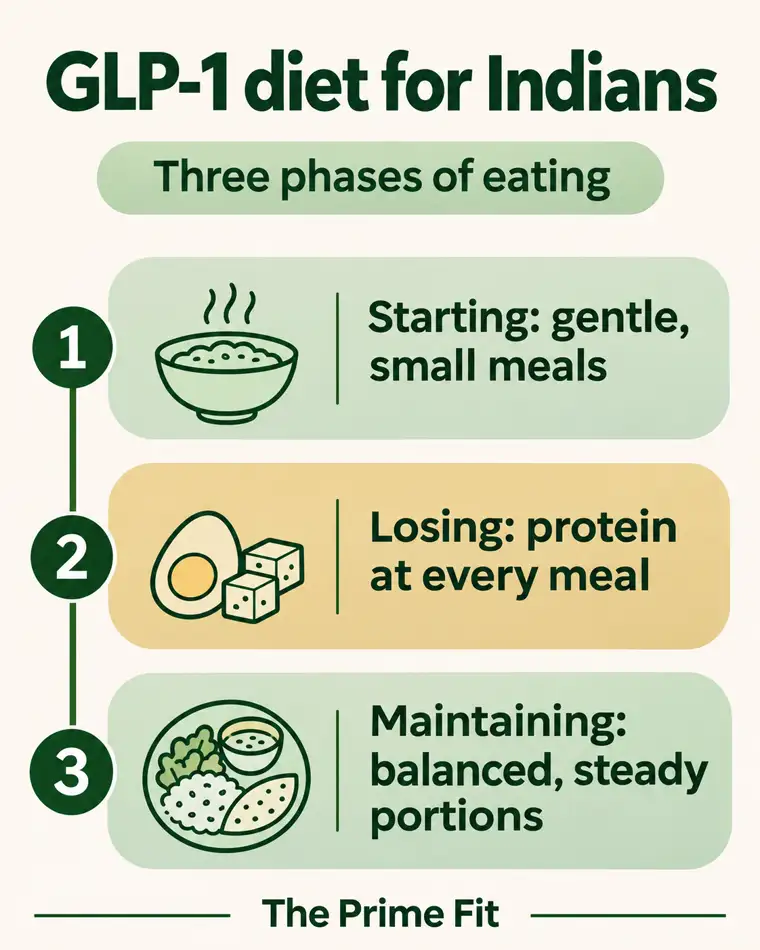
| Gentle | The first two weeks of treatment, and the first week after every dose increase | Adjusting to a new dose; nausea, fullness or loose stools are most likely | Light, soft, low-oil food in small amounts; fluids between meals; nothing fried or rich |
| Steady | Once you are settled on a dose | Appetite is reduced but comfortable; weight is falling | Balanced small meals; protein target met every day; fibre and fluid for the bowel; strength training |
| Maintenance | After weight has stabilised | Holding a new, lower weight | The same pattern with slightly larger portions of whole grains, fruit and healthy fats; planned treats |
You will move back and forth between the gentle and steady phases as your dose is stepped up. That is normal.
The portion guide
You do not need a weighing scale. These household measures are enough.
| Food group | One serving | Per meal on treatment |
|---|---|---|
| Protein | 1 katori thick dal or pulses; 50 to 75 g paneer or tofu (3 to 4 cubes); 1 katori curd; 2 eggs; a palm-sized piece of fish or chicken | 1 to 2 servings |
| Vegetables | 1 katori cooked sabzi, or 1 small plate of salad | 1 to 2 servings at lunch and dinner |
| Cereal | 1 phulka or small roti; half a katori of cooked rice; 1 idli; 1 small dosa; half a katori of poha or upma; 1 slice of bread | 1 to 2 servings |
| Fruit | 1 medium guava, apple, orange or pear; 1 cup papaya | 1 serving, once or twice a day |
| Fat | 1 teaspoon of oil or ghee; 5 to 6 almonds; 1 teaspoon of seeds | About 1 teaspoon of oil per meal in cooking |
| Dairy | 1 glass milk; 1 katori curd; 1 glass chaas | 2 to 3 servings a day, counted towards protein |
What a plate looks like
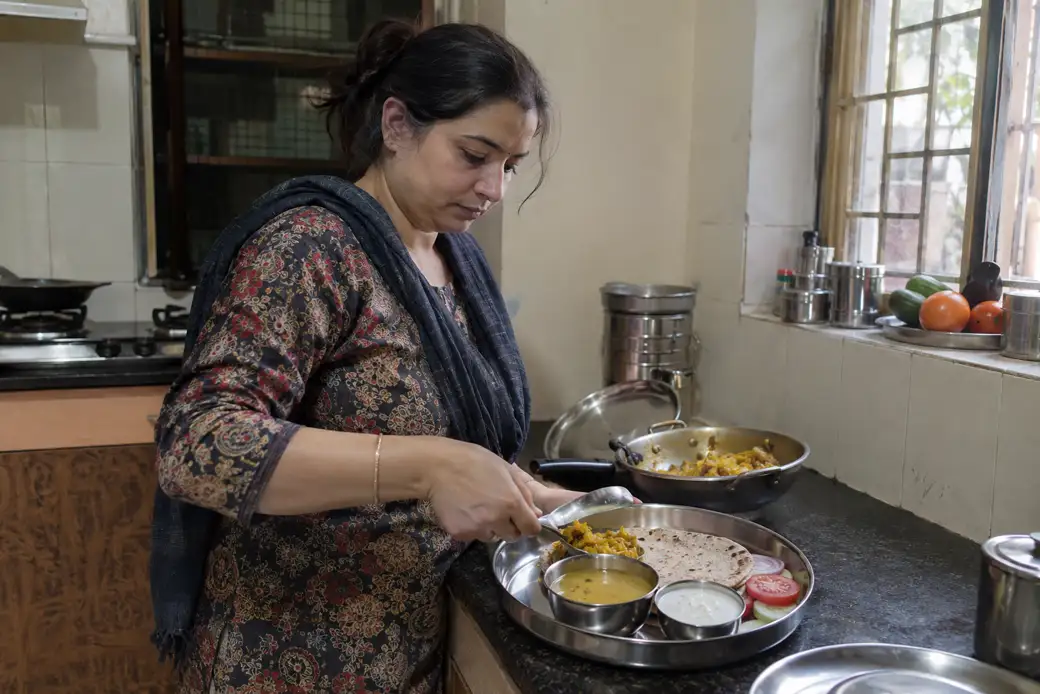
On a quarter plate or in a single bowl: half protein, a third vegetables, and the rest cereal. If you are full before the roti, leave the roti.
Daily protein
Many adults on treatment are advised about 1.0 to 1.5 grams of protein per kilogram of body weight a day, with a lower target for people with kidney disease. In practice, that means a protein food at every meal and at least one snack. If you fall short with food, your dietitian may suggest a protein supplement.

Breakfast options
Choose one. Each provides roughly 15 to 25 grams of protein in the portions shown.
| Region or style | Steady and maintenance phases | Gentle phase |
|---|---|---|
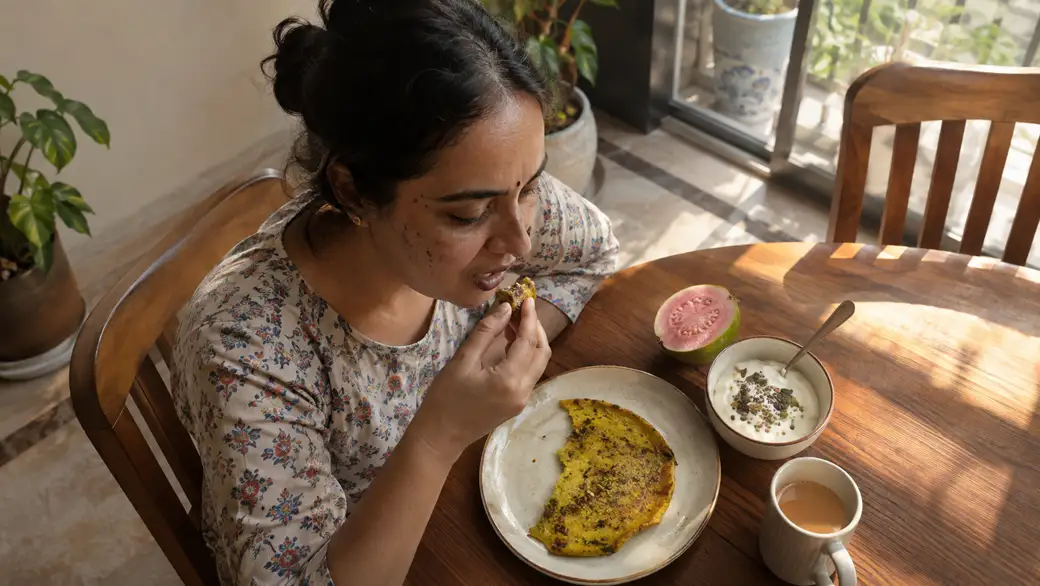
| North | 2 besan or moong chillas with paneer and curd; paneer-stuffed roti with curd; sprouts and vegetable poha with a glass of milk | 1 moong chilla with curd; dalia cooked in milk |
| South | 2 pesarattu with curd; 2 idlis with a large katori of sambar and a glass of milk; ragi dosa with sambar and peanut chutney | 2 idlis with sambar; curd rice in a small bowl |
| West | 4 pieces of dhokla with curd; thalipeeth with curd; sprouted usal with 1 small bhakri | 2 pieces of dhokla with chaas; soft moong dal khichdi |
| East | Chirer pulao or poha with peanuts and an egg or a glass of milk; chhena with fruit; moong dal cheela | Soft khichuri; muri with curd |
| Quick | Hung curd bowl with fruit, oats and seeds; vegetable oats in milk with almonds; protein shake blended with banana and milk | Plain curd with a ripe banana; milk with a slice of toast |
| With eggs | 2-egg vegetable omelette with 1 toast; egg bhurji with 1 phulka; 2 boiled eggs with fruit | 2 soft-scrambled or boiled eggs with toast |
Lunch options
Build lunch from one item in each column.
| Protein (choose 1 or 2) | Vegetable (choose 1 or 2) | Cereal (choose 1) | Side |
|---|---|---|---|
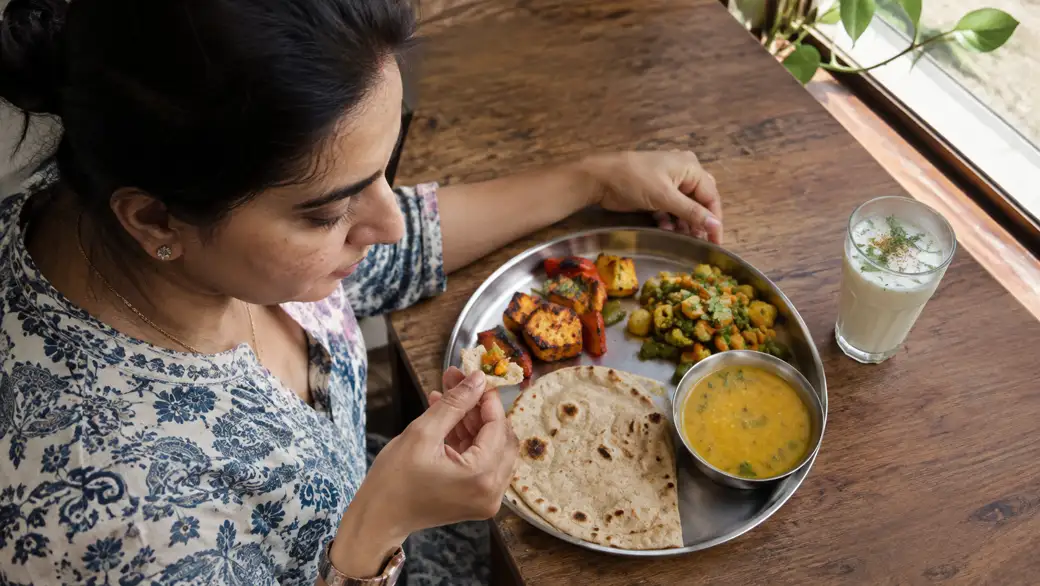
| Toor, moong or masoor dal, thick | Lauki, tori, tinda or parwal | 1 to 2 phulkas | Curd or chaas |
| Rajma, chole, lobia or kala chana | Bhindi, beans, cabbage or cauliflower | Half to 1 katori of rice | Cucumber or carrot salad with lemon |
| Sambar or kootu with plenty of dal | Poriyal or thoran | 1 bajra, jowar or ragi roti | Raita |
| Paneer, tofu or soya sabzi | Palak, methi or sarson | Half a katori of millet or dalia | A wedge of lemon; mint chutney |
| Kadhi with besan | Mixed vegetable sabzi | 1 small bhakri or thepla made with little oil | |
| Fish curry cooked in little oil | Pumpkin, brinjal or drumstick | ||
| Chicken curry or grilled chicken | Salad of tomato, onion and cucumber | ||
| Egg curry, 2 eggs |
Gentle-phase lunch: moong dal khichdi with lauki and curd; curd rice with a little dal; dal with soft phulka and boiled vegetables; a small portion of rice with thin fish or chicken stew.
Dinner options
Dinner should be the lightest meal and finished two to three hours before bed.
| Style | Steady and maintenance phases | Gentle phase |
|---|---|---|
| Vegetarian | Paneer or tofu with mixed vegetables, dal, 1 phulka; soya chunk curry with sautéed beans and 1 phulka; palak dal with a vegetable sabzi and curd | Vegetable dal soup with 1 soft phulka; moong dal khichdi with curd |
| South Indian | Vegetable kootu or sambar with 1 small dosa or ragi roti and curd; adai with avial | Rasam with a small portion of soft rice and curd |
| One-bowl meals | Thick dal and vegetable soup with paneer cubes; millet and dal khichdi with kadhi; dalia with vegetables and curd | Clear vegetable soup with a little dal |
| Non-vegetarian | Grilled or tandoori chicken or fish with sautéed vegetables and dal; fish stew with a small portion of rice; egg curry with 1 phulka and sabzi | Clear chicken and vegetable soup with 1 phulka |
Snack options
One or two a day, mid-morning and at about 5 pm. Choose snacks that add protein or fibre.
| Protein snacks | Fibre and fruit | Drinks that count | Gentle-phase snacks |
|---|---|---|---|
| Roasted chana, a handful | Guava, apple, pear, orange | Chaas | Plain toast or khakhra |
| Sprouts chaat with lemon | Papaya bowl | A glass of milk | Ripe banana |
| Hung curd with fruit | Carrot and cucumber sticks with hung-curd dip | Sattu drink with lemon and salt | Roasted makhana |
| Paneer cubes or tikka | Fruit with a spoon of chia or flaxseed | Thin dal soup | Curd |
| Boiled egg | Soaked figs or raisins, 2 to 4 | Coconut water | Ginger or jeera water |
| Peanuts or almonds, a small handful | Sundal | Protein shake | Clear soup |
Three complete sample days
North Indian vegetarian, steady phase
| Time | Meal |
|---|---|
| On waking | Warm water; tea with little or no sugar |
| Breakfast | 2 moong chillas with 50 g paneer filling, 1 katori curd |
| Mid-morning | 1 guava; water |
| Lunch | 1 katori rajma, lauki sabzi, 1 phulka, cucumber salad, 1 katori curd |
| 5 pm | Roasted chana and a glass of chaas |
| Dinner | Paneer and capsicum sabzi (75 g paneer), 1 katori dal, 1 phulka |
| After dinner | 10-minute walk |
South Indian vegetarian, steady phase
| Time | Meal |
|---|---|
| On waking | Warm water; filter coffee with little sugar |
| Breakfast | 2 pesarattu with a katori of curd and tomato chutney |
| Mid-morning | 1 orange; buttermilk |
| Lunch | Half a katori of rice, 1 large katori of sambar with vegetables, beans poriyal, half a katori of sundal, curd |
| 5 pm | A glass of milk and a handful of peanuts |
| Dinner | Vegetable kootu with moong dal, 1 ragi roti, curd |
| After dinner | 10-minute walk |
Non-vegetarian, gentle phase
| Time | Meal |
|---|---|
| On waking | Warm water or ginger tea |
| Breakfast | 2 soft-scrambled eggs with 1 slice of toast |
| Mid-morning | Coconut water or chaas |
| Lunch | A small portion of rice with thin fish or chicken stew and boiled vegetables |
| 5 pm | Curd, or a boiled egg; jeera water |
| Dinner, early | Clear chicken and vegetable soup with 1 soft phulka |
Adapting your family’s meals
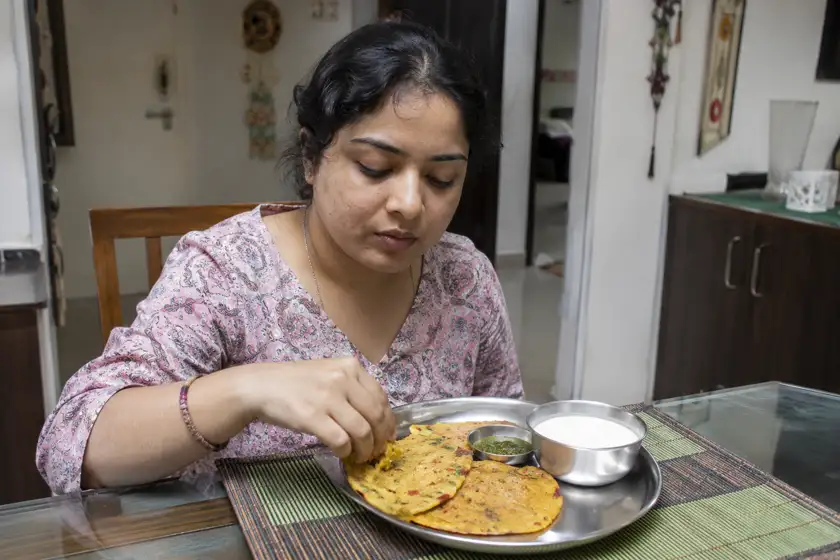
You do not need to cook separately. Small changes to the family meal are enough.
| The family is having | What you do |
|---|---|
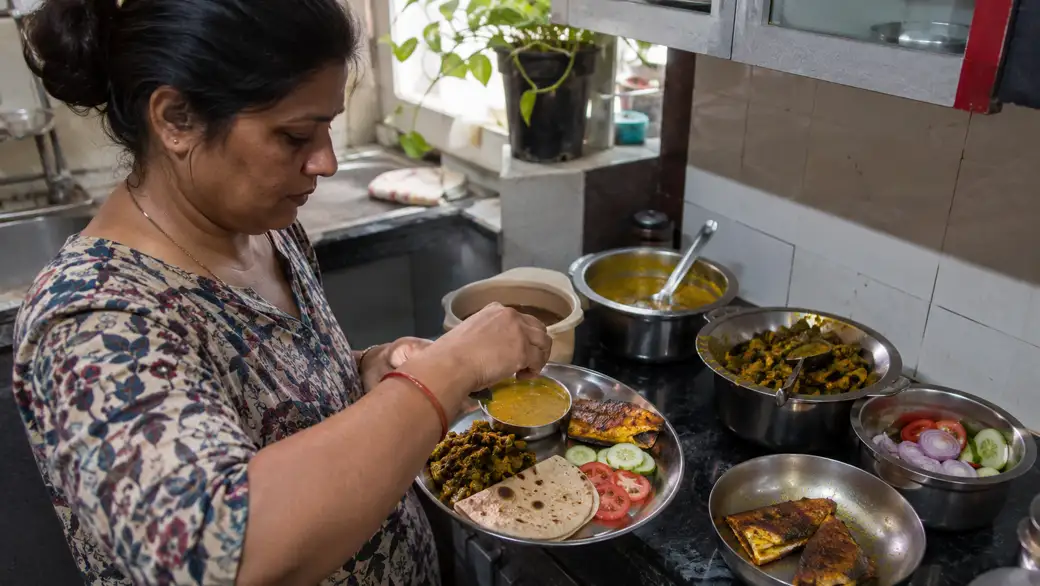
| Dal, sabzi, roti, rice | Take a full katori of dal and sabzi, curd, and 1 roti. Skip the rice or take 2 spoons |
| Rajma-chawal or chole-chawal | A large serving of rajma or chole, a small serving of rice, salad, curd |
| Parathas | 1 paratha made with little oil, with a large katori of curd and a boiled egg or paneer |
| Biryani or pulao | Take the meat or paneer and vegetables with a small serving of rice, with raita and salad |
| Sambar-rice | More sambar, less rice; add a poriyal and curd; a boiled egg or sundal if protein is low |
| Fish curry and rice | Two pieces of fish, vegetables, and half a katori of rice |
| Puri, pakora or other fried food | One piece to taste, after you have eaten protein and vegetables. Not in a gentle week |
| Sweets after dinner | A small portion, eaten slowly, on occasions. Or fruit |
Foods to keep small
| Food | Why | When it matters most |
|---|---|---|
| Deep-fried snacks, puri, pakora, vada, chips | Fat stays longest in a slowed stomach | Gentle phase; always in small amounts |
| Rich gravies with cream, butter or cashew paste | Heavy; trigger nausea and reflux | Gentle phase |
| Sweets, desserts, sugary drinks, juices | Take up room without nourishment; can cause loose stools | All phases |
| Maida: white bread, biscuits, naan, noodles | Low in fibre and protein | All phases |
| Large servings of rice, potato or roti | Crowd out protein | All phases |
| Fizzy drinks | Bloating and burping | Gentle phase |
| Very spicy food | Aggravates reflux in some people | If you have acidity |
| Alcohol | Worsens nausea, reflux and dehydration; empty calories | Especially around dose increases |
| Raw salads in large amounts | Can cause bloating when the gut is slow | Gentle phase; choose cooked vegetables |
Solving common problems
| Problem | What to change |
|---|---|
| Nausea | Halve the portion; choose khichdi, idli, curd rice, soup; ginger or jeera water; eat slowly; do not lie down after meals |
| Acidity and burping | Early, light dinner; no fried food or fizzy drinks; raise the head of the bed; avoid strong tea or coffee on an empty stomach |
| Constipation | More fluid; papaya, guava, vegetables, whole dals; soaked chia or isabgol with water; daily walk |
| Loose stools | ORS or chaas; curd rice, banana, khichdi; avoid oily, spicy and very sweet food for a day or two |
| Tiredness or dizziness | Do not skip meals; include some cereal with each meal; salted chaas; check iron and vitamin B12 |
| No appetite | Five small eating occasions; liquids such as milk, chaas, dal soup or a shake; tell your healthcare provider |
| Hair shedding | Count your protein; check iron, vitamin B12 and vitamin D; slow the pace of weight loss |
| Bored of the food | Rotate through the option tables; try another region’s dishes |
| Weight not moving | Check drinks, snacks, oil and portion creep with a three-day diary |
| Sweet cravings | Protein-rich breakfast; planned 5 pm snack; fruit with curd; earlier bedtime |
If you have diabetes
- Do not skip meals, especially if you take insulin or a sulfonylurea.
- Spread cereal evenly across three meals; do not remove it entirely.
- Choose whole wheat, millets, brown or hand-pounded rice and whole dals.
- Have fruit as whole fruit, one serving at a time.
- Check your blood sugar as advised and report low readings, since your medicines may need reducing.
- Walk for ten minutes after each meal.
Vegetarian, vegan and Jain notes
- Vegetarians: include dairy or soya at each meal alongside pulses. Have vitamin B12 checked.
- Vegans: rely on tofu, soya chunks, soya milk and pulses, and consider a plant protein powder and a B12 supplement.
- Jain and no-onion, no-garlic diets: all the protein foods here fit. Use gourds, beans, cabbage and leafy vegetables where roots are avoided, and move the evening snack earlier if you eat before sunset.
- Eggetarians: two eggs replace one vegetarian protein serving.
A weekly kitchen routine
- Soak and pressure-cook a batch of chana or rajma; refrigerate in portions.
- Keep chilla or dosa batter, hung curd, sprouts and boiled eggs ready.
- Set curd every night.
- Cut vegetables for two days at a time.
- Keep roasted chana, peanuts and makhana in jars, and biscuits and namkeen out of sight.
- Before a dose increase, stock moong dal, rice, idli batter, curd and ginger for a gentle week.
Two more sample days
Gujarati or Maharashtrian vegetarian, steady phase
| Time | Meal |
|---|---|
| Breakfast | 4 pieces of dhokla with a katori of curd, or sprouted matki usal with 1 small bhakri |
| Mid-morning | 1 fruit; chaas |
| Lunch | 1 jowar bhakri or phulka, 1 katori dal made without added sugar, tindora or bhindi shaak, kadhi, salad |
| 5 pm | Roasted chana or a handful of peanuts; tea with little sugar |
| Dinner | Moong dal khichdi with vegetables and a katori of curd, or pithla with 1 bhakri and a vegetable |
Bengali or Odia non-vegetarian, steady phase
| Time | Meal |
|---|---|
| Breakfast | 2 boiled eggs with 1 slice of toast, or chirer pulao with peanuts and a glass of milk |
| Mid-morning | 1 guava or orange |
| Lunch | Half a katori of rice, 2 pieces of fish in a light jhol, moong dal, a vegetable such as lau or pumpkin, salad |
| 5 pm | Chhena or curd; roasted chana |
| Dinner | 1 to 2 rotis, egg or chicken curry cooked in little oil, mixed vegetables |
Adjusting for the seasons
- Summer: thirst is reduced on treatment, and the heat increases losses. Carry water, and add chaas, nimbu pani with a pinch of salt and little sugar, and coconut water. Choose lighter meals: curd rice, dal with lauki, raita, cucumber. Mango is fine as one small serving in place of another fruit.
- Monsoon: stomach infections are common, and vomiting or diarrhoea is harder on someone already eating little. Eat freshly cooked food, avoid cut fruit and chaat from stalls, and keep ORS at home.
- Winter: appetite rises, and so does the supply of gajar halwa, pinnis, parathas and fried snacks. Use the season’s vegetables, sarson, methi, bathua, carrots and peas, in dals and sabzis. Have a small portion of a seasonal sweet after a meal, on occasion. Soups are an easy way to add protein and fluid.
Reading a food label in half a minute
Packaged foods marketed as healthy often are not. Four checks are enough.
| Look at | What to look for |
|---|---|
| Serving size | The figures may be for a quarter of the packet |
| Protein | A useful snack has at least 6 to 8 g per serving |
| Sugar | Prefer less than 5 g per serving. Sugar also appears as glucose syrup, maltodextrin, jaggery, honey and fruit concentrate |
| Ingredients list | Shorter is better. Maida, palm oil and sugar among the first three ingredients is a poor sign. “Sugar-free” products with sorbitol or maltitol can cause gas and loose stools |
“Diet” namkeen, digestive biscuits, flavoured yoghurts, breakfast cereals and many protein bars fail these checks. Roasted chana, plain curd, nuts and fruit need no label.
The same applies to products sold specifically to people on weight loss injections. You do not need special shakes, bars, teas or “GLP-1 support” supplements. If a protein supplement is useful for you, your dietitian will suggest a plain one, and everything else your body needs is in an ordinary kitchen: dal, curd, vegetables, fruit, whole grains, a little oil and enough water.
Eating out
- Order a starter portion, or share a main dish.
- Choose tandoori, grilled or steamed items, dal, one vegetable dish and one roti.
- Eat the protein first and stop early. Take the rest home.
- Have water or fresh lime soda without sugar.
- At a buffet, look at everything first, pick three or four dishes, and sit away from the counters.
- Avoid restaurant meals in the three days after a dose increase.
Supplements
Because intake is low, your healthcare provider may check iron, vitamin B12 and vitamin D and replace any that are low. A protein supplement is useful if you cannot meet your target with food. Isabgol helps constipation when taken with plenty of water. Do not start high-dose supplements without advice.
Common mistakes
- Living on tea, biscuits and one meal a day.
- Eating the roti first and having no room for the dal.
- Cutting out all oil and all cereal.
- Forgetting to drink.
- Celebrating a dose increase with a rich meal.
- Replacing meals with shakes for weeks.
- Returning to old portions when appetite comes back at the end of the week.
- Never checking protein intake.
Common myths
“On the injection, it does not matter what I eat”
The medicine reduces quantity. Quality decides whether you lose fat or muscle.
“Rice must be stopped completely”
A small portion, after protein and vegetables, is fine.
“Indian vegetarian food cannot provide enough protein”
It can, with dal, pulses, paneer, curd and soya at every meal.
“Eating less and less is better”
Too little food costs muscle, hair and energy.
“I need special imported diet foods”
Everything in this guide comes from an ordinary Indian kitchen.
How The Prime Fit helps
At The Prime Fit, every patient on a GLP-1 medicine has a dietitian who builds a plan from the food your household already cooks, in your region’s style. We set a protein target, give you option lists for each phase, prepare a gentle-week menu before every dose increase, and review your eating every week, adjusting as your appetite and dose change.
To get a plan made for your kitchen, book a consultation or read about our GLP-1 support programme.
Frequently asked questions
What should I eat on a GLP-1 medicine?
Small, regular meals built around protein such as dal, pulses, paneer, curd, eggs, fish or chicken, with vegetables and a modest portion of roti or rice, and 2 to 3 litres of fluid a day.
Is there a special Indian diet for Mounjaro, Wegovy or Ozempic?
No special foods are needed. Ordinary Indian meals work when you eat the protein first, keep cereal portions small and limit fried and sugary items.
How many meals should I eat?
Three small meals and one or two snacks. If meals feel too large, use five small eating occasions.
What should I eat after a dose increase?
For about a week, light, soft, low-oil food such as khichdi, idli with sambar, curd rice, dal with soft phulka and soups, with fluids between meals.
Can I eat rice and roti?
Yes, in small portions: 1 to 2 phulkas or half a katori of rice per meal, after the protein and vegetables.
How much protein do I need?
Many adults are advised about 1.0 to 1.5 grams per kilogram of body weight a day. Your dietitian will set your target.
Which foods cause nausea?
Deep-fried foods, rich gravies, very sweet foods, large portions, fizzy drinks and alcohol are the commonest triggers.
Can I eat fruit?
Yes. One or two servings of whole fruit a day. Papaya, guava, apple, pear and orange are good choices.
What if I have no appetite at all?
Eat by the clock, use liquids such as milk, chaas, dal soup or a protein shake, and tell your healthcare provider, since the dose may need adjusting.
Do I need to cook separate meals from my family?
No. Take more of the dal, sabzi and curd, less of the rice and roti, and skip or taste the fried items.
This article is general information and is not a substitute for a consultation. Meal plans should be adjusted to your health, medicines and blood tests by a qualified dietitian and healthcare professional.