In this article
- What creatine is
- What the research shows
- Does creatine help you lose weight?
- Creatine on GLP-1 medicines
- Creatine for women
- Creatine for vegetarians
- How to take it
- Side effects and safety
- Creatine does not work without training
- Creatine and protein together
- What to expect, week by week
- Cost and value
- Creatine after 50
- Creatine, creatinine and carnitine: not the same
- Other supplements marketed for muscle during weight loss
- Three illustrative examples
- Questions to ask your healthcare provider
- Common myths
- How The Prime Fit protects your muscle
- Frequently asked questions
Until recently, creatine was something young men bought in large tubs to build bigger muscles. Today it is recommended in women’s health podcasts, discussed by menopause specialists, and asked about in weight centres by people taking Mounjaro (tirzepatide) or Wegovy (semaglutide). The reason is a growing awareness that losing weight can mean losing muscle, and that muscle is worth protecting.
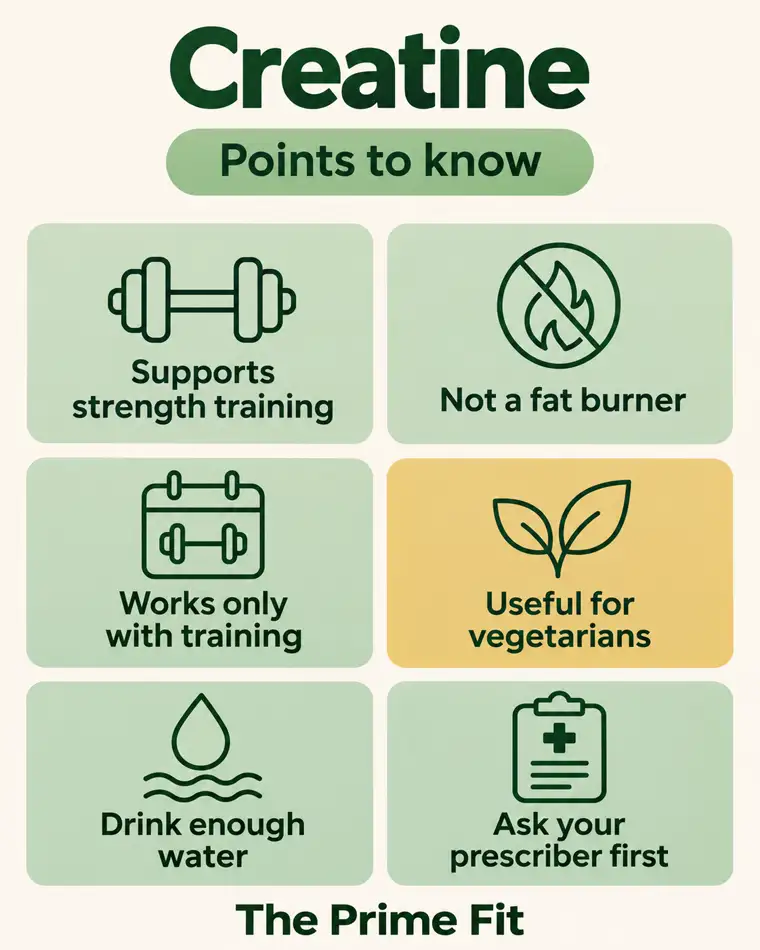
That awareness is well founded. The enthusiasm around creatine needs a little more care. It is a useful supplement with decades of research behind it, but it is not a fat burner, it does nothing without exercise, and it is not right for everyone.
This guide explains what creatine is and what it can and cannot do, with particular attention to people losing weight, women, vegetarians and those on GLP-1 medicines. It is general information. If you have kidney disease or another medical condition, or take regular medicines, speak to your healthcare provider before starting it.
What creatine is
Creatine is a natural compound made in the liver and kidneys from three amino acids. About 95 percent of it is stored in muscle, with a little in the brain. The body makes roughly one gram a day, and people who eat meat and fish take in about another gram from food. Vegetarians and vegans get almost none from their diet and have lower stores in their muscles.
What it does
Muscles run on a molecule called ATP. During short, intense efforts, such as lifting a weight, climbing stairs quickly or sprinting, ATP is used up within seconds. Creatine, stored in muscle as phosphocreatine, regenerates ATP rapidly. More stored creatine means a little more capacity for hard effort: one or two more repetitions, a slightly heavier load, a quicker recovery between sets.
That extra training, repeated over weeks, is what produces more strength and muscle. Creatine itself does not build muscle while you sit still.
What the research shows
| Outcome | What studies find | Strength of evidence |
|---|---|---|
| Strength, with resistance training | Greater gains than training alone, typically 5 to 10% more | Strong; hundreds of trials |
| Lean body mass, with resistance training | About 1 to 1.5 kg more than training alone over a few months; part of this is water held within muscle | Strong |
| High-intensity exercise performance | Improved | Strong |
| Muscle and strength in adults over 50, with training | Improved; may help function | Moderate to strong |
| Body fat | A very small reduction in body fat percentage when combined with training; no meaningful fat loss by itself | Moderate |
| Bone | Possible small benefit with resistance training in older adults; results mixed | Limited |
| Thinking and memory | Possible benefit under sleep deprivation or stress, and in vegetarians and older adults | Early and mixed |
| Mood and depression | Small studies suggest a benefit as an add-on to treatment | Early |
| Without any exercise | Little or no effect on muscle or strength | Consistent |
Does creatine help you lose weight?
No, not directly. It does not raise metabolism, suppress appetite or burn fat. In fact, the scale often goes up by one to two kilograms in the first few weeks, because creatine draws water into muscle cells.
Its value during weight loss is indirect.
- It supports strength training, which is the main way to keep muscle while losing fat.
- Preserved muscle keeps your energy needs higher, which helps with maintaining weight later.
- It can make workouts feel more productive when you are eating less and have less energy.
- Body composition improves: the proportion of fat falls a little more than with training alone.
Think of it as a tool for losing the right kind of weight, not for losing more weight.

Creatine on GLP-1 medicines
With semaglutide and tirzepatide, body-composition studies have found that roughly a quarter to a third of the weight lost is lean tissue. For most people, this is in proportion to the fat lost and leaves them healthier overall. But in older adults, in people who start with little muscle, and in those who lose weight very quickly, it can matter.
What is known
- There are, as yet, no large trials of creatine specifically in people taking GLP-1 medicines. Studies are under way.
- The recommendation rests on reasoning from other evidence: creatine with resistance training preserves lean mass during calorie restriction in several studies, and people on these medicines are in a sustained calorie deficit.
- Appetite is low on treatment, and meat intake often falls, so dietary creatine falls too.
The order of priorities
| Priority | Why it comes first |
|---|---|
| 1. Resistance exercise, two to three times a week | The signal that tells the body to keep muscle. Nothing replaces it |
| 2. Enough protein, about 1.0 to 1.5 g per kg of body weight daily for many adults | The raw material for muscle |
| 3. A sensible pace of weight loss, about 0.5 to 1 kg a week | Faster loss costs more muscle |
| 4. Enough total food and fluid | Severe under-eating cannot be fixed with supplements |
| 5. Creatine | A helpful addition once the first four are in place |
If you are not doing any strength training, creatine will do little for you. Start the training first.
Practical points on treatment
- Hydration: thirst is reduced on GLP-1 medicines, and creatine pulls water into muscle. Drink 2 to 3 litres a day unless you have been given a limit.
- Nausea: creatine occasionally causes stomach upset. Take it with food, split the dose, and do not start it in the week of a dose increase.
- The scale: expect a small rise or a pause in weight loss in the first weeks. It is water in muscle, not fat. Use your waist and body-composition readings to judge progress.
- Kidney tests: tell your healthcare provider you take creatine, since it can raise the creatinine reading slightly without harming the kidneys.
Creatine for women
Women have, on average, lower creatine stores than men and tend to eat less of the foods that supply it. Research in women, though less extensive, shows the same benefits for strength and lean mass with training.
| Life stage | What is known |
|---|---|
| Reproductive years | Improves strength and exercise performance with training. Does not cause a bulky appearance; women do not have the hormones for large muscle growth |
| Around periods | Hormonal changes affect creatine metabolism; some researchers suggest supplementation may help energy at certain phases, but evidence is limited |
| Pregnancy and breastfeeding | Not enough safety data in humans. Not recommended unless advised by your healthcare provider |
| Perimenopause and after menopause | Muscle and bone are lost more quickly. Creatine with resistance training improves strength and may help physical function; effects on bone are small and uncertain |
| PCOS | No specific trials. Strength training itself improves insulin sensitivity |
The fear of “bulking up” or “looking puffy” is common. The water creatine holds is inside muscle cells, not under the skin, so it does not cause a bloated face or swollen ankles.
Creatine for vegetarians
This is especially relevant in India. Because plant foods contain virtually no creatine, vegetarians have muscle creatine stores about 10 to 30 percent lower than meat eaters. Studies show that they respond to supplementation at least as well, and often better.
Creatine monohydrate sold as a supplement is made synthetically, not from animal sources, so it is suitable for vegetarians and vegans. If it comes in capsules, check that the capsule shell is not gelatin.
| Food | Approximate creatine |
|---|---|
| Red meat, 100 g raw | 0.4 to 0.5 g |
| Chicken, 100 g raw | 0.3 to 0.4 g |
| Fish, 100 g raw | 0.3 to 0.9 g, depending on the type |
| Milk, 1 glass | About 0.02 g |
| Eggs, dal, paneer, nuts, vegetables, grains | Negligible |
Reaching 3 grams a day from food would take more than half a kilogram of meat. A supplement is the only practical route.
How to take it
| Question | Answer |
|---|---|
| Which form? | Creatine monohydrate. It is the form used in almost all research, and the cheapest. Other forms have not been shown to be better |
| How much? | 3 to 5 g a day. About 3 g suits smaller adults; 5 g suits larger ones |
| Do I need a loading phase? | No. Loading with 20 g a day for a week fills muscle stores faster but causes more stomach upset and water gain. With 3 to 5 g daily, stores are full in about four weeks |
| When? | Any time. Consistency matters, not timing. Many people take it with a meal or after training |
| With what? | Stirred into water, milk, curd, a smoothie or a protein shake. It has little taste |
| Every day? | Yes, including rest days |
| Do I need to cycle on and off? | No |
| How long until it works? | Three to four weeks for stores to fill; strength differences emerge over 8 to 12 weeks of training |
| What if I miss a day? | Carry on the next day. Do not double up |
| What happens when I stop? | Stores return to baseline in four to six weeks. The water weight goes; muscle you have built stays if you keep training |
Choosing a product
- The ingredient list should say creatine monohydrate and nothing else.
- Prefer established brands with batch testing and, in India, a valid food-safety licence number on the label.
- Avoid “pre-workout” blends, in which creatine is mixed with stimulants and sweeteners.
- Avoid products making fat-burning or hormone-boosting claims.
- Micronised powder dissolves more easily; it is not more effective.
- Buy from a reliable seller. Counterfeit supplements exist.

Side effects and safety
At 3 to 5 grams a day, creatine monohydrate has been studied for years in healthy adults without evidence of harm.
| Concern | What the evidence says |
|---|---|
| Water weight | A gain of about 1 to 2 kg in the first weeks is common, from water held inside muscle. It is not fat and not bloating |
| Stomach upset | Uncommon at 3 to 5 g; more likely with large single doses. Take with food or split the dose |
| Kidneys | No harm shown in people with healthy kidneys. Creatine raises blood creatinine slightly because creatinine is its breakdown product, which can make a kidney test look worse without any real change in function |
| Hair loss | The idea comes from one small study in 2009 that found a rise in a hormone linked to male-pattern baldness. It measured the hormone, not hair. Later studies, including a trial that measured hair directly, have not confirmed an effect |
| Dehydration and cramps | Not supported by studies; if anything, fewer cramps. Drink adequately |
| Liver | No harm shown in healthy people |
| Blood pressure and heart | No adverse effect shown |
| Is it a steroid? | No. It is a compound the body makes itself, and it is not a banned substance in sport |
Who should avoid it, or ask first
- People with kidney disease, a single kidney, or a history of kidney problems
- Those with diabetes and kidney involvement, or uncontrolled high blood pressure
- People taking medicines that can affect the kidneys, such as regular anti-inflammatory painkillers or certain diuretics
- Women who are pregnant or breastfeeding
- Children and adolescents, unless advised by a healthcare professional
- People with bipolar disorder, in whom there have been isolated reports of mood elevation
- Anyone with liver disease
Stop and see a healthcare professional if you notice
Swelling of the face or ankles, a marked fall in urine output, dark urine, persistent nausea or vomiting, or severe muscle pain. These are not expected effects of creatine and need assessment.
Creatine and kidney blood tests
Kidney function is usually estimated from the level of creatinine in the blood. Creatine supplements can raise that level by a small amount, which makes the estimated filtration rate appear lower even though the kidneys are working normally. If you take creatine, tell your healthcare provider before a blood test. They may ask you to stop it for a week or two beforehand, or use a different test that is not affected.
Creatine does not work without training
This point is worth repeating, because it is where most disappointment arises. Creatine increases the capacity for hard muscular work. If that capacity is not used, nothing changes except a little water in the muscle.
A simple strength routine
| Exercise | Beginner version | Sets and repetitions |
|---|---|---|
| Squat | Sit-to-stand from a chair | 2 to 3 sets of 10 to 12 |
| Push | Wall or incline push-up | 2 to 3 sets of 8 to 12 |
| Pull | Resistance band row | 2 to 3 sets of 10 to 12 |
| Hip hinge | Glute bridge | 2 to 3 sets of 12 to 15 |
| Overhead | Shoulder press with water bottles or light dumbbells | 2 to 3 sets of 10 to 12 |
| Core | Plank on knees, or dead bug | 2 to 3 sets of 20 to 30 seconds |
| Carry | Walk holding two filled bags | 3 walks of 30 seconds |
Do this two or three times a week on non-consecutive days. When the last repetitions feel easy, add resistance. Creatine helps most when the effort is challenging.
Creatine and protein together
The two do different jobs and work well together. Protein supplies the building material for muscle. Creatine supplies energy for the training that stimulates it. Neither replaces the other.
| Meal | Vegetarian | Non-vegetarian |
|---|---|---|
| Breakfast | 2 moong chillas with paneer, curd; creatine stirred into a glass of water or milk | 2-egg vegetable omelette, 1 toast; creatine in water |
| Mid-morning | 1 fruit; a few almonds | 1 fruit; chaas |
| Lunch | Dal or chana, sabzi, salad, 1 roti, curd | Fish or chicken curry, sabzi, salad, small katori of rice |
| After training | A glass of milk with roasted chana, or a protein shake | Boiled eggs, or a protein shake |
| Dinner | Tofu or paneer with vegetables, dal, 1 phulka | Grilled chicken with vegetables, dal, 1 phulka |
What to expect, week by week
| Time | What happens |
|---|---|
| Week 1 | Usually nothing noticeable. Possibly mild stomach discomfort if taken without food |
| Weeks 2 to 4 | Muscle stores fill. The scale may rise by 0.5 to 2 kg from water in muscle. Muscles may feel slightly fuller |
| Weeks 4 to 8 | An extra repetition or two in training; slightly quicker recovery between sets |
| Weeks 8 to 12 | Measurable gains in strength if you have trained consistently and progressed the load |
| Beyond | Benefits continue as long as you keep training and taking it |
About one person in four or five responds little, usually because their stores were already high. Meat eaters with a high intake are the most likely non-responders; vegetarians the least.
Cost and value
Plain creatine monohydrate is one of the cheapest supplements available. At 3 to 5 grams a day, a modest tub lasts two to three months. Expensive branded forms, liquids, gummies and blends offer no proven advantage, and gummies have sometimes been found to contain far less creatine than claimed. If money is limited, spend it first on protein-rich food and a pair of resistance bands.
Creatine after 50
From midlife onwards, adults lose muscle and strength steadily, and the loss accelerates after 60. This matters more than appearance: weak legs mean difficulty with stairs, slower walking, falls and loss of independence. Pooled trials in older adults show that creatine combined with resistance training increases lean mass and strength more than training alone, with improvements in tasks such as rising from a chair. The effect on bone is small and uncertain. Because kidney function declines with age and many older people take several medicines, a healthcare professional’s advice and a kidney test beforehand are sensible. As at any age, the supplement is the smaller part. The training is what counts.
Creatine, creatinine and carnitine: not the same
| Name | What it is |
|---|---|
| Creatine | The compound stored in muscle that helps regenerate energy; taken as a supplement |
| Creatinine | The waste product formed when creatine breaks down; measured in blood tests to estimate kidney function |
| Creatine kinase (CK or CPK) | An enzyme in muscle; raised in blood after muscle injury or hard exercise |
| L-carnitine | A different compound involved in transporting fat into the cell’s energy units; marketed as a fat burner, with little effect on weight |
A raised creatinine on a blood test in someone taking creatine usually reflects the supplement, but it should always be shown to a healthcare professional, not assumed to be harmless.
Other supplements marketed for muscle during weight loss
| Supplement | Verdict |
|---|---|
| Protein powder (whey, soya, pea) | Useful if food alone does not meet your protein target |
| Creatine monohydrate | Useful alongside resistance training |
| Vitamin D | Correct a deficiency; important for muscle and bone |
| Omega-3 | Possible small benefit for muscle in older adults; evidence limited |
| HMB | May help in older or untrained people; little added benefit with adequate protein |
| BCAAs | Unnecessary if you eat enough protein |
| Collagen | Not a complete protein; does not replace dietary protein for muscle |
| Testosterone boosters, SARMs and “anabolic” products | Avoid. Ineffective or dangerous, and some are illegal |

Three illustrative examples
These invented examples show sensible and less sensible use. They are not advice for any individual.
Vegetarian woman on treatment
A 46-year-old vegetarian woman has lost 9 kg in five months on a weekly injection and is worried by a body-composition report showing a fall in muscle. She begins strength training three times a week, raises her protein with paneer, curd and soya, and adds 3 g of creatine daily after telling her healthcare provider. Over the next four months she loses a further 5 kg of fat while her muscle mass holds steady.
Creatine without training
A 38-year-old man takes creatine for three months, does no exercise, and concludes that it does not work. His weight has risen by a kilogram. Nothing was wrong with the product. It had no training to support.
A misleading kidney test
A 52-year-old man’s routine blood test shows a slightly raised creatinine. He has been taking 5 g of creatine a day and lifting weights. His healthcare provider repeats the test two weeks after stopping the supplement, and it is normal.
Questions to ask your healthcare provider
- Are my kidneys healthy enough for me to take creatine?
- Do any of my medicines make it unsuitable?
- Should I stop it before blood tests?
- Is my protein intake adequate?
- What strength exercises are safe for me?
- Can my muscle mass be measured, so that we can see whether it is being preserved?
Common myths
“Creatine burns fat”
It does not. It supports the training that preserves muscle.
“It is only for bodybuilders and men”
Women, older adults and vegetarians may benefit most.
“Creatine damages the kidneys”
Not in people with healthy kidneys at recommended doses. Those with kidney disease should avoid it unless advised.
“It causes hair loss”
That has not been shown.
“It makes you bloated and puffy”
The water is held inside muscle cells.
“You must load, cycle and time it precisely”
Three to five grams a day, at any time, is enough.
“It replaces protein”
It does a different job. You need both, and you need to train.
How The Prime Fit protects your muscle
At The Prime Fit, protecting muscle is part of every weight loss plan. We measure body composition at regular intervals, set a protein target with your dietitian, and guide you on resistance training suited to your fitness. If a supplement such as creatine or protein powder would help, we advise on the type and dose, check it against your kidney tests and medicines, and interpret your results accordingly.
To lose fat while keeping your strength, book a consultation or read about our GLP-1 support programme.
Frequently asked questions
Does creatine help with weight loss?
Not directly. It does not burn fat. It supports strength training, which helps you keep muscle while losing fat.
Should I take creatine on Mounjaro, Wegovy or Ozempic?
It can be a helpful addition if you are doing resistance training and eating enough protein, and your kidneys are healthy. There are no large trials in GLP-1 users yet. Ask your healthcare provider first.
Will creatine make me gain weight?
Many people gain about 1 to 2 kg in the first weeks from water held inside muscle. It is not fat.
How much creatine should I take?
3 to 5 grams of creatine monohydrate a day, every day. A loading phase is not necessary.
Is creatine safe for women?
Yes, for healthy women. It improves strength with training and does not cause a bulky appearance. It is not recommended in pregnancy or breastfeeding.
Is creatine vegetarian?
Creatine monohydrate supplements are made synthetically and are suitable for vegetarians and vegans. Check the capsule shell if it is not a powder.
Does creatine harm the kidneys?
Not in people with healthy kidneys at recommended doses. It can raise the creatinine reading on a blood test without affecting kidney function. People with kidney disease should avoid it.
Does creatine cause hair loss?
There is no good evidence that it does.
Do I need to exercise for creatine to work?
Yes. Without resistance training it has little effect.
When is the best time to take it?
Any time of day. Taking it daily matters more than timing.
This article is general information and is not a substitute for a consultation. Figures from studies are approximate. Speak to your healthcare provider before starting any supplement, especially if you have kidney disease, take regular medicines, or are pregnant or breastfeeding.