In this article
- The medicines in brief
- Why people switch
- The different kinds of switch
- Why doses cannot simply be converted
- How healthcare professionals usually approach a switch
- What to expect in the first weeks
- Will I lose more weight after switching?
- Managing side effects during a switch
- Safety points that are easy to miss
- Learning a new device
- Switching for cost: brands and approved generics
- Three illustrative scenarios
- Eating during the first month of a switch
- What not to do
- Monitoring after a switch
- When switching is not the answer
- Questions to ask your healthcare provider
- Common myths
- How The Prime Fit manages a switch
- Frequently asked questions
GLP-1 treatment is rarely a single, fixed prescription. Over months and years, many people change from one medicine to another: from Ozempic to Wegovy, from Wegovy to Mounjaro, from a daily injection to a weekly one, from a brand to an approved generic, or back again. Sometimes the reason is medical. Sometimes it is cost or supply.
Switching is common and usually goes smoothly, but it is not as simple as swapping one pen for another at the “same” strength. These medicines differ in their molecules, doses and devices, and the body’s tolerance to one does not transfer exactly to another. A poorly planned switch can bring back nausea and vomiting, or leave a gap in which appetite and weight rebound.
This guide explains why people switch, the different kinds of switch, how healthcare professionals typically handle them, what you are likely to feel, and the safety points to remember. It is general information. The dose and timing of any switch must be set by your prescriber.
The medicines in brief
| Medicine | Active ingredient | How it is taken | Main licensed use | Weekly dose steps |
|---|---|---|---|---|
| Ozempic | Semaglutide | Weekly injection | Type 2 diabetes | 0.25, 0.5, 1 mg (2 mg in some countries) |
| Wegovy | Semaglutide | Weekly injection | Weight management | 0.25, 0.5, 1, 1.7, 2.4 mg |
| Rybelsus | Semaglutide | Daily tablet | Type 2 diabetes | 3, 7, 14 mg daily |
| Mounjaro | Tirzepatide | Weekly injection | Type 2 diabetes and weight management | 2.5, 5, 7.5, 10, 12.5, 15 mg |
| Liraglutide (Victoza, Saxenda and others) | Liraglutide | Daily injection | Diabetes; weight management at the higher dose | 0.6 mg up to 1.8 mg or 3 mg daily |
| Approved generics | Same ingredient as the reference product | As for the reference product | As licensed | As for the reference product |
Semaglutide and liraglutide act on the GLP-1 receptor. Tirzepatide acts on both the GIP and GLP-1 receptors. Brand names, licensed uses and available strengths vary between countries and change over time.
Why people switch
| Reason | Typical situation |
|---|---|
| Not enough weight loss | Less than expected after several months at a full dose of the current medicine |
| Weight-loss plateau short of health goals | Good initial response, then a long stall with important targets unmet |
| Side effects | Persistent nausea, vomiting, constipation or reflux on one medicine |
| Blood sugar control | Diabetes not at target on the current medicine |
| Cost | A more affordable option becomes available, including approved generics |
| Availability | A particular strength or product is out of stock |
| Convenience | Moving from a daily injection or tablet to a weekly injection |
| Licensed indication | Moving from a diabetes product to the weight-management version of the same ingredient |
| Other health benefits | A healthcare professional prefers a medicine with evidence for a particular condition, such as heart disease or sleep apnoea |
| Device preference | Difficulty using a particular pen or vial |
Switching is not needed simply because another medicine is newer or more talked about. If your current treatment is working and you tolerate it, staying on it is usually the right choice.
The different kinds of switch
1. Same ingredient, different product
Examples are Ozempic to Wegovy, or a brand to an approved generic of the same molecule. Because the active ingredient is identical, the dose can usually be carried across to the nearest equivalent strength, and tolerance is preserved. What changes is the device, the strengths available and sometimes the licensed use.
2. Different ingredient
Examples are semaglutide to tirzepatide, or the reverse. These are different molecules. There is no established milligram-for-milligram conversion, and tolerance to one only partly predicts tolerance to the other. This kind of switch needs the most care.
3. Daily to weekly
Moving from daily liraglutide to weekly semaglutide or tirzepatide. Weekly medicines are generally more effective for weight loss. The new medicine is normally started at a low dose.
4. Tablet to injection, or the reverse
Oral semaglutide and injectable semaglutide share an ingredient but are absorbed very differently, so the doses look nothing alike. Your healthcare provider will choose the injection dose based on your tablet dose and how you tolerated it.

Why doses cannot simply be converted
It is natural to ask, “I am on 1 mg of Ozempic, so what is that in Mounjaro?” There is no official answer, for three reasons.
- Different molecules, different potency. A milligram of tirzepatide is not comparable with a milligram of semaglutide. The numbers on the pens are not on the same scale.
- Different actions. Tirzepatide acts on a second receptor, so the body’s response differs.
- Individual tolerance. Some people tolerate one medicine far better than the other, in ways that cannot be predicted.
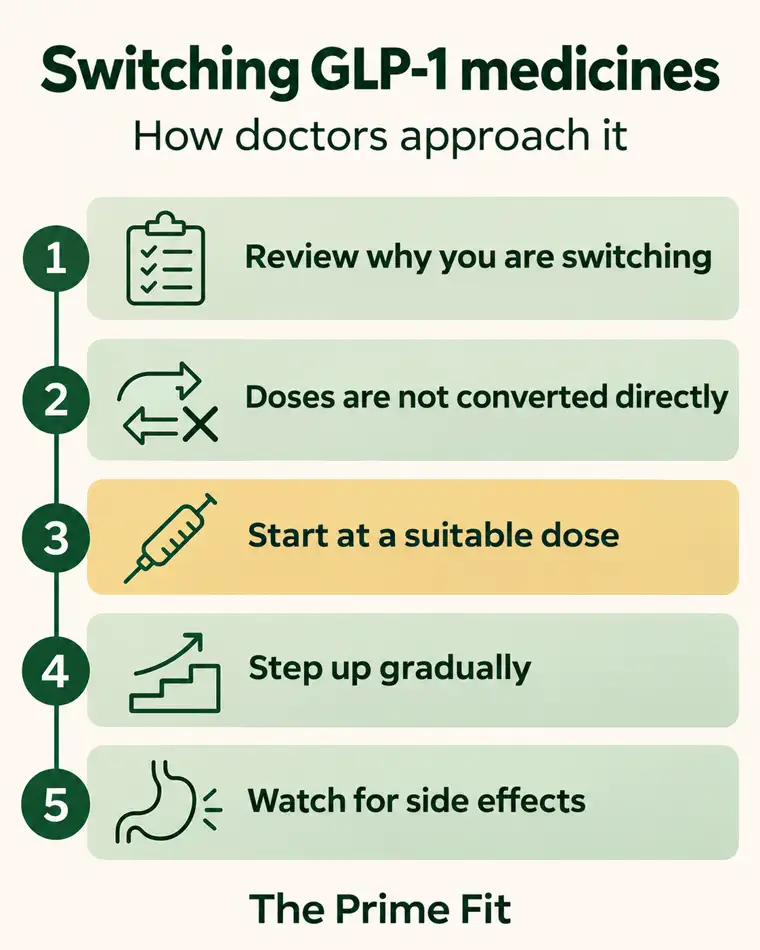
Regulators and manufacturers have not published equivalent doses. Tables that circulate online are informal estimates. Healthcare professionals therefore rely on a cautious principle: when changing molecule, start the new medicine low and increase step by step, adjusting to the person in front of them.
How healthcare professionals usually approach a switch
| Type of switch | General approach |
|---|---|
| Ozempic to Wegovy, or brand to approved generic (same ingredient) | Continue at the same or nearest dose on the usual injection day; learn the new device |
| Semaglutide to tirzepatide | Start tirzepatide at a low dose, commonly the 2.5 mg starting dose, then increase every four weeks or more as tolerated. Some healthcare professionals start one step higher in people who were on a high, well-tolerated dose of semaglutide |
| Tirzepatide to semaglutide | Start semaglutide at a low dose and increase stepwise. A healthcare professional may choose a starting step above the lowest for someone who tolerated a high dose of tirzepatide |
| Daily liraglutide to a weekly medicine | Give the first weekly dose the day after the last daily dose, starting low |
| Oral semaglutide to an injection | Start the injection shortly after the last tablet, at a dose chosen by the healthcare professional |
| Any switch after a break of several weeks | Treat as a new start: lowest dose, then build up |
These are general patterns from clinical practice, not instructions. Your healthcare provider may do something different for good reasons.
Timing the first dose
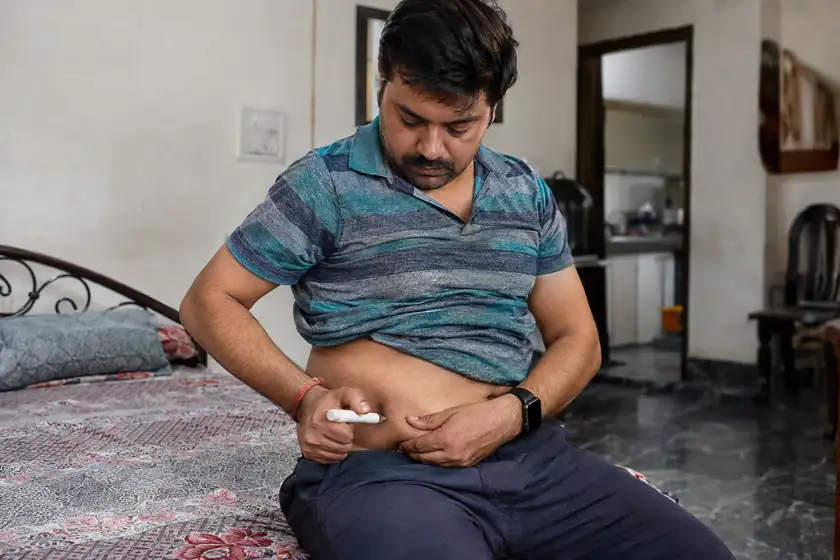
For weekly medicines, the first dose of the new medicine is usually taken on the day the next dose of the old one would have been due, that is, about a week after the last injection. This avoids both an overlap and a gap. Do not take both medicines in the same week, and never use two GLP-1 medicines together.
Why start low if I was on a high dose?
Starting low costs a few weeks of slower effect. Starting too high risks days of vomiting and dehydration, and sometimes puts people off treatment altogether. Because the old medicine lingers in the body for some weeks, you are not unprotected while the new one is built up.
What to expect in the first weeks
| Time | What many people notice | What helps |
|---|---|---|
| Week 1 | Little difference; the previous medicine is still active | Keep meals and routine the same |
| Weeks 2 to 4 | If the new starting dose is lower in effect, appetite may rise a little; or mild nausea as the body meets a new molecule | Protein at every meal, small portions, fluids; do not panic at a small change on the scale |
| Weeks 5 to 12 | Dose increases; appetite control strengthens; digestive effects may recur briefly after each step | “Gentle week” eating after each increase; report troublesome symptoms early |
| Months 3 to 6 | The effect of the new medicine becomes clear | Review weight, waist, blood tests and side effects with your healthcare provider |
A temporary pause in weight loss, or a kilogram or two of regain during the first weeks, is common and does not mean the switch has failed. Judge the new medicine after about three months at a treatment dose.
Will I lose more weight after switching?
It depends on what you are switching from and to.
- From semaglutide to tirzepatide: in a trial comparing the two directly in people starting treatment, tirzepatide produced more weight loss on average, about 20 percent against about 14 percent over 72 weeks. Many people who switch therefore do lose further weight. Evidence specifically in people who have already been treated with semaglutide is more limited, and individual responses vary.
- From tirzepatide to semaglutide: some people maintain their weight; some regain a little, since the average effect is smaller. For those who tolerate semaglutide better, or for whom it is more affordable or has particular evidence, such as cardiovascular protection, it can still be the right choice.
- From liraglutide to a weekly medicine: additional weight loss is usual.
- Same ingredient, different product: no change is expected at the same dose. Moving from the diabetes dose range to the higher weight-management doses of semaglutide can add further loss.
If you have reached a natural plateau after a large loss, switching may add less than you hope. A plateau reflects the body reaching a new balance, and no medicine removes that entirely.
Managing side effects during a switch
- Treat the first two weeks, and the week after every dose increase, as gentle weeks: small, low-fat meals such as khichdi, dal with soft roti, idli, curd rice and soups.
- Eat slowly and stop at the first sign of fullness.
- Drink 2 to 3 litres of fluid a day, sipped between meals.
- Keep fibre and movement going to prevent constipation.
- Avoid alcohol and fried or very sweet foods around the switch.
- Tell your healthcare provider promptly about vomiting, inability to drink, or severe abdominal pain.
Side-effect patterns can differ between medicines. Some people who had troublesome nausea on one do well on the other, and vice versa. That is one legitimate reason to try a switch.
Seek urgent medical help if
You have severe, persistent abdominal pain, repeated vomiting with inability to keep fluids down, signs of dehydration, yellowing of the eyes, or swelling of the face or throat or difficulty breathing.
Safety points that are easy to miss
Contraception when starting tirzepatide
Tirzepatide can reduce the absorption of oral contraceptive pills when it is started and after each dose increase. This applies when you switch to it from another medicine, even if you have been on GLP-1 treatment for a long time. Use a barrier method as well for four weeks after starting and after each increase, or change to a non-oral method.
Diabetes medicines
If you take insulin or a sulfonylurea, your blood sugar may run higher for a few weeks if the new medicine starts at a lower effective dose, and lower later as it is increased. Monitor more often during the switch, and let your healthcare provider adjust the other medicines. Do not stop a diabetes medicine yourself.
Planning a pregnancy
The advice on stopping before conception differs between medicines because they clear from the body at different rates. If you are planning a pregnancy, tell your healthcare provider before any switch.
Surgery or endoscopy
All of these medicines slow stomach emptying. Tell your surgeon and anaesthetist which one you are taking and when your last dose was.
Who should not switch to these medicines
The same cautions apply across the class: a personal or family history of medullary thyroid carcinoma or MEN 2, pregnancy and breastfeeding, and caution with previous pancreatitis or severe stomach or bowel disease. A problem such as pancreatitis on one GLP-1 medicine is generally a reason to avoid the others as well.
Learning a new device
Pens and vials differ more than people expect. Before your first dose of a new product, make sure you know:
- whether it is a single-dose pen, a multi-dose pen with a dial or clicks, or a vial with a syringe;
- how to select or check the dose, and what the dose window should show;
- whether a new needle is attached each time, and how to prime the pen if required;
- how long to hold the pen against the skin;
- how to store it, including how long it can be out of the refrigerator and how long a multi-dose pen can be used after first use;
- how to dispose of needles and pens safely.
Ask your healthcare provider, nurse or pharmacist for a demonstration, and read the leaflet in the pack. Dosing errors are most likely in the first week with a new device.
Switching for cost: brands and approved generics
Where approved generic versions of a medicine are available from licensed manufacturers, switching to one can make long-term treatment more affordable. Because the active ingredient is the same, your healthcare provider can usually move you across at the equivalent dose. Check that the product is prescribed, dispensed by a licensed pharmacy with a bill, and stored cold. The strengths and device may differ from the product you were using, so confirm the dose with your healthcare provider and pharmacist.
Unapproved, compounded or “research” products sold online are a different matter and are not safe substitutes.
Three illustrative scenarios
These examples show how the reasoning works. They are not prescriptions, and real decisions depend on the individual.
A plateau on semaglutide
A 41-year-old woman has lost 11 percent of her weight over a year on the full dose of semaglutide. Her weight has been flat for four months, she still has prediabetes and a BMI of 31. Her healthcare provider confirms that her diet, protein and activity are in order, then suggests tirzepatide. She takes the first, low dose on her usual injection day, a week after her last semaglutide, adds condoms because she uses the pill, and increases the dose every four weeks. Her appetite rises slightly for two weeks, then settles. Over the following six months she loses further weight, and her blood sugar returns to normal.
Side effects on tirzepatide
A 55-year-old man with type 2 diabetes has persistent nausea and reflux each time tirzepatide is increased beyond 7.5 mg, and his weight loss has stalled. After trying a slower schedule, his healthcare provider moves him to semaglutide, starting low. His sulfonylurea dose is reviewed and he checks his sugars more often for a month. He tolerates the new medicine better and continues to lose weight more slowly.
Cost
A 36-year-old woman is doing well but finds long-term treatment hard to afford. Her healthcare provider discusses an approved generic of the same ingredient from a licensed manufacturer. She moves across at the equivalent dose, is shown the new pen, and buys it from a licensed pharmacy with a bill. Nothing else changes.
Eating during the first month of a switch
Keep your food routine as steady as possible while the medicines change over. Eat three small meals at regular times with protein at each: dal, curd, paneer, eggs, fish or chicken. If hunger returns for a couple of weeks, add volume with vegetables and salad, and a planned afternoon snack such as roasted chana or sprouts, instead of larger portions of roti and rice. After each dose increase, return to light, low-fat meals for a few days. Keep up your fluids and your walks. Weigh once a week, on the same day, and look at the trend over a month.
What not to do
- Do not switch on your own using a friend’s leftover pens or an online conversion chart.
- Do not take two GLP-1 medicines together, or overlap them in the same week.
- Do not start the new medicine at a high dose because you were on a high dose of the old one, unless your healthcare provider has specifically advised it.
- Do not leave a long gap between medicines. If more than two or three weeks pass, speak to your healthcare provider about restarting low.
- Do not judge the switch in the first month.
- Do not abandon the basics. Protein, strength training, sleep and follow-up matter as much after a switch as before.
Monitoring after a switch
| What | How often at first | Why |
|---|---|---|
| Weight and waist | Weekly weight; monthly waist | To see the trend over two to three months |
| Side effects | Note daily for the first weeks | To guide the pace of dose increases |
| Blood sugar, if you have diabetes | More frequent checks for four to eight weeks | To adjust other diabetes medicines |
| Blood pressure | At each visit | May fall as weight falls |
| Review with your healthcare provider | About four weeks after switching, then at each dose step | To set the next dose |
| Blood tests | As scheduled, or sooner with symptoms | HbA1c, kidney function, liver tests, vitamins |

When switching is not the answer
Before changing medicine for poor results, it is worth checking the common, fixable causes:
- Has the dose of the current medicine been increased as far as planned and tolerated?
- Have doses been missed, or the pen stored or used incorrectly?
- Has intake drifted: liquid calories, alcohol, frequent snacks, larger portions?
- Is protein adequate, and is there any strength training?
- Has sleep worsened or stress risen?
- Has another medicine that promotes weight gain been started?
- Is thyroid function, or another condition, playing a part?
- Have you simply reached a healthy plateau after a 15 to 20 percent loss?
If these are in order and results remain inadequate, a switch is reasonable. If medicines in this class do not provide enough benefit, other options include a gastric balloon or bariatric surgery, which can be used with or after medication.
Questions to ask your healthcare provider
- Why do you recommend this switch for me, and what should I expect to gain?
- What dose will I start on, and how will it be increased?
- On which day do I take the first dose?
- Do my diabetes, blood pressure or contraceptive arrangements need to change?
- How does the new device work, and how do I store it?
- When will we decide whether the switch has worked?
- What do I do if side effects are worse than before?
Common myths
“Mounjaro is just a stronger Ozempic”
They are different molecules with different actions. One is not a higher dose of the other.
“There is an exact conversion chart”
No official dose equivalence exists. Online charts are estimates.
“Switching resets everything, and I will regain all my weight”
With a planned switch and no long gap, most people hold their weight and continue from where they were.
“If one GLP-1 medicine did not work, none will”
Responses differ between medicines. Some people who respond poorly to one do well on another.
“A generic is weaker than the brand”
An approved generic contains the same active ingredient at the stated strength. The source and storage are what need checking.
How The Prime Fit manages a switch
At The Prime Fit, a change of medicine is planned, not improvised. Your healthcare provider reviews why the current treatment is falling short, checks the fixable causes first, and, if a switch is right, sets the starting dose, the timing and the dose steps for you. You are shown how to use the new device, your other medicines and contraception are reviewed, and your dietitian adjusts your meal plan for the first weeks. We review you a month after the change and at each step.
If you are considering a switch, book a consultation or read about our GLP-1 therapy Mounjaro and Wegovy programmes.
Frequently asked questions
Can I switch from Ozempic or Wegovy to Mounjaro?
Yes, with your healthcare provider’s guidance. Because they are different molecules, Mounjaro is usually started at a low dose and increased step by step, even if you were on a high dose of semaglutide.
What dose of Mounjaro equals 1 mg of Ozempic?
There is no official equivalent. The medicines are not directly comparable milligram for milligram, so healthcare professionals start low and adjust to your response.
How long should I wait between the two medicines?
For weekly injections, the first dose of the new medicine is usually taken on the day your next dose of the old one would have been due, about a week after the last injection. Do not overlap them.
Will I lose more weight after switching to Mounjaro?
Many people do, since tirzepatide produced more weight loss than semaglutide on average in a direct comparison. Individual results vary, and gains are smaller if you have already reached a plateau after a large loss.
Can I switch from Mounjaro to Wegovy or Ozempic?
Yes. Reasons include side effects, cost, availability or specific health benefits. Your healthcare provider will choose the starting dose and build it up.
Is switching from Ozempic to Wegovy different?
They contain the same ingredient, so you can usually continue at the equivalent dose and then increase within the Wegovy range if needed.
Will side effects come back when I switch?
They may, briefly, especially when changing molecule. Starting low, eating small light meals and increasing slowly reduce them.
Can I take two GLP-1 medicines together?
No. They should not be combined or overlapped.
Do I need extra contraception when switching to Mounjaro?
If you use the oral contraceptive pill, yes: add a barrier method for four weeks after starting and after each dose increase, or use a non-oral method.
Can I switch to a generic version?
An approved generic with the same ingredient, prescribed by your healthcare provider and dispensed by a licensed pharmacy, can usually be used at the equivalent dose. Confirm the strength and device.
This article is general information and is not a substitute for a consultation. Doses and timing for switching prescription medicines must be decided by your healthcare provider. Product names, strengths and licensed uses vary by country.