In this article
- The stages, briefly
- What actually changes
- Why the belly, specifically
- Rule out other causes
- Hormone therapy and weight
- GLP-1 medicines in midlife women
- What works: the evidence-based plan
- What to eat: an Indian day
- What does not work
- A realistic timeline
- If hormone therapy is not for you
- When to see a healthcare professional
- A midlife health check
- Three illustrative examples
- Questions to ask your healthcare provider
- Common myths
- How The Prime Fit supports women in midlife
- Frequently asked questions
It often begins in the mid-forties. Clothes that fitted last year are tight at the waist. The weight has not changed much, or it has crept up by a few kilograms, but the shape is different. Sleep is broken. Energy dips. The eating and exercise habits that kept things steady for twenty years no longer seem to work.
Women are frequently told one of two unhelpful things: that it is “just hormones” and nothing can be done, or that they must simply eat less. Neither is accurate. The menopause transition does change where fat is stored and how much muscle is kept, and these changes are real. They are also manageable, with the right approach.
This guide explains what happens to weight and body shape around menopause, and what the evidence says about each solution, including hormone therapy and GLP-1 medicines. It is general information. Decisions about hormone therapy and prescription medicines should be made with your healthcare provider.
The stages, briefly
| Stage | What it means | Typical age |
|---|---|---|
| Perimenopause | The years of transition. Hormone levels fluctuate; periods become irregular; symptoms such as hot flushes, poor sleep and mood changes may begin | Often starts in the early to mid-forties; lasts about four to eight years |
| Menopause | The point twelve months after the last period | Around 46 to 47 on average in Indian women, a few years earlier than in Western countries |
| Postmenopause | The years after. Oestrogen remains low | The rest of life, often a third of it or more |
What actually changes
Total weight: mostly age
Studies that followed women through midlife found an average weight gain of about half a kilogram a year. Importantly, this is seen in men of the same age as well, and it tracks age more than menopause itself. It reflects a gradual loss of muscle, a slower metabolism and less physical activity.
Body shape: largely hormones
What menopause specifically changes is where fat goes. Before menopause, oestrogen directs fat towards the hips and thighs. As oestrogen falls, fat storage shifts to the abdomen, particularly to visceral fat around the internal organs. Studies using scans show that visceral fat begins to increase two to three years before the final period and continues afterwards, even in women whose weight is stable.
Muscle and bone
Muscle mass and strength decline faster during the transition. Bone density falls most rapidly in the years around the final period. Less muscle means lower energy needs, which makes weight gain easier.
| Change | Main driver | Why it matters |
|---|---|---|
| Gradual weight gain | Ageing: less muscle, less activity | Adds to cardiometabolic risk over time |
| More abdominal and visceral fat | Falling oestrogen | Raises the risk of diabetes, fatty liver and heart disease |
| Loss of muscle | Ageing and hormonal change | Lower metabolism, weakness, falls |
| Loss of bone | Falling oestrogen | Osteoporosis and fractures |
| Insulin resistance | Visceral fat; less muscle; poor sleep | Higher blood sugar; more hunger |
| Rise in LDL cholesterol and blood pressure | Loss of oestrogen’s protective effect | Heart disease risk catches up with men’s |
| Poor sleep | Hot flushes, night sweats, mood, sleep apnoea | Increases appetite and cravings |
Why the belly, specifically
- Oestrogen falls, and fat is redirected from under the skin of the hips to inside the abdomen.
- The balance of hormones shifts. With less oestrogen, the relative influence of androgens rises, which favours a central pattern.
- Sleep is disrupted. Short and broken sleep raises hunger hormones and cortisol, both of which promote abdominal fat.
- Muscle declines, so less glucose is used and more is stored.
- Activity often falls, through joint pain, fatigue or the pressures of midlife.
- Stress peaks. Work, teenagers, ageing parents and health worries converge.
- Alcohol and sugar may be used more for comfort.
For Indian women, who are already prone to abdominal fat and insulin resistance at lower body weights, and who reach menopause earlier, the effect can be marked. A waist of 80 cm or more, or more than half your height, signals increased risk.

Rule out other causes
Not everything in midlife is menopause. Ask your healthcare provider to check for conditions that are common at this age and cause weight gain or fatigue.
| Condition | Clues | Test |
|---|---|---|
| Underactive thyroid | Tiredness, feeling cold, constipation, dry skin, heavy periods | TSH |
| Prediabetes or diabetes | Often none; thirst, frequent urination, darkened skin on the neck | Fasting glucose, HbA1c |
| Sleep apnoea | Snoring, waking unrefreshed, daytime sleepiness | Sleep study |
| Depression or anxiety | Low mood, loss of interest, comfort eating | Clinical assessment |
| Medicines | Weight gain after starting certain antidepressants, steroids, diabetes or nerve-pain medicines | Medication review |
| Anaemia, vitamin D or B12 deficiency | Fatigue, breathlessness, aches | Blood count, ferritin, vitamin levels |
| Fluid retention | Swollen ankles, breathlessness | Medical review |
Hormone therapy and weight
Menopausal hormone therapy, often called HRT or MHT, replaces oestrogen, with a progestogen added for women who have a uterus. It is the most effective treatment for hot flushes and night sweats and protects bone.
Does it cause weight gain?
No. This is one of the most persistent myths. Randomised trials have not shown that hormone therapy causes weight gain. Some women notice mild fluid retention or breast tenderness when starting, which can be mistaken for weight gain and usually settles.
Does it cause weight loss?
Not in any meaningful way. It is not a weight loss treatment and should not be prescribed for that purpose.
What it does do
- Fat distribution: studies suggest that women on hormone therapy accumulate less abdominal fat and keep a little more lean mass than women who are not.
- Insulin sensitivity: modestly improved, with a lower rate of new diabetes in trials.
- Sleep: better, when hot flushes and night sweats are relieved, which indirectly helps appetite and energy.
- Bone: protected.
- Wellbeing: improved mood, energy and joint comfort make it easier to be active.
Who can take it?
For most healthy women under 60, or within ten years of menopause, who have troublesome symptoms, the benefits outweigh the risks. It is not suitable for everyone: for example, women with a history of breast cancer, certain clots, stroke, or unexplained vaginal bleeding. The type, dose and route are individualised. Oestrogen through the skin, as a patch or gel, carries a lower risk of clots than tablets and is often preferred in women with higher weight. This is a decision to make with a gynaecologist or menopause specialist.
GLP-1 medicines in midlife women
Medicines such as Wegovy (semaglutide) and Mounjaro (tirzepatide) are licensed for weight management in adults with a BMI of 30 or above, or 27 or above with a weight-related condition. They are not menopause treatments, but many of the women who qualify are in this age group.
Do they work after menopause?
Yes. Analyses of the large trials by age and menopausal status show that postmenopausal women lose a similar proportion of body weight to younger women: about 15 percent on average with semaglutide and about 20 percent with tirzepatide over 16 to 18 months. Abdominal fat falls substantially, and blood sugar, blood pressure and lipids improve.
With hormone therapy
An observational study of postmenopausal women taking semaglutide found that those also using hormone therapy lost more weight than those who were not. This was not a randomised trial, and women who take hormone therapy may differ in other ways, such as sleeping better and being more active. The finding is interesting, not proven. There is no known harmful interaction between the two. One practical point: tirzepatide can reduce the absorption of oral hormones around dose changes, so women taking oral hormone therapy with it should ask their healthcare provider whether a patch or gel would be preferable.
Extra care needed at this age
| Concern | Why it matters more after menopause | What to do |
|---|---|---|
| Muscle loss | Muscle is already declining | Protein at every meal; resistance training two to three times a week; body-composition checks |
| Bone loss | Weight loss reduces bone density, on top of menopausal loss | Calcium, vitamin D, weight-bearing and resistance exercise; a bone density scan if you have risk factors |
| Pace | Rapid loss costs more muscle and bone | Aim for about 0.5 kg a week; slower dose increases |
| Facial volume and skin | Collagen is falling; fat loss shows more | Do not chase a very low weight; sun protection; adequate protein |
| Hair shedding | Common in midlife already | Check ferritin, thyroid, vitamin D and B12 |
| Gallstones | More common in women of this age | Steady pace; report pain under the right ribs |
| Other medicines | Blood pressure, thyroid and diabetes doses may need lowering | Regular review |
For a woman with a BMI of 33, prediabetes and painful knees, a GLP-1 medicine can be transformative. For a woman at a healthy weight troubled by a change in shape, it is not the right tool. Strength training and nutrition are.
What works: the evidence-based plan
1. Lift weights
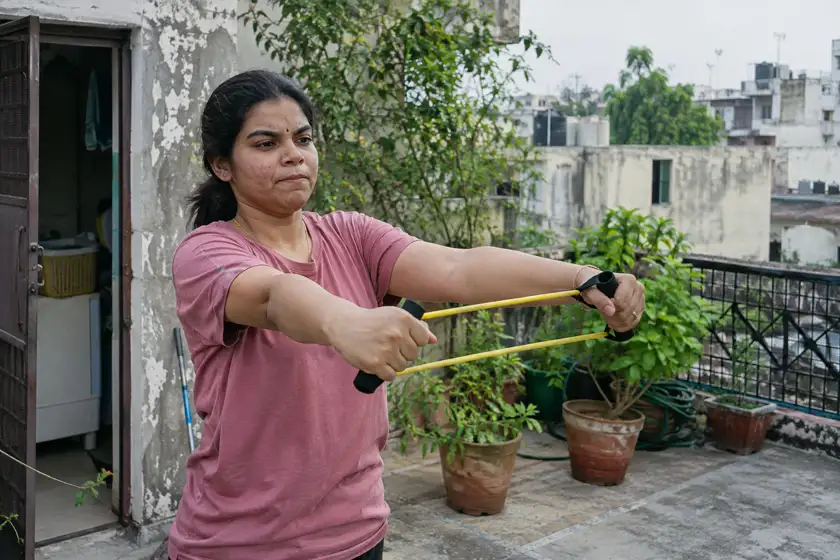
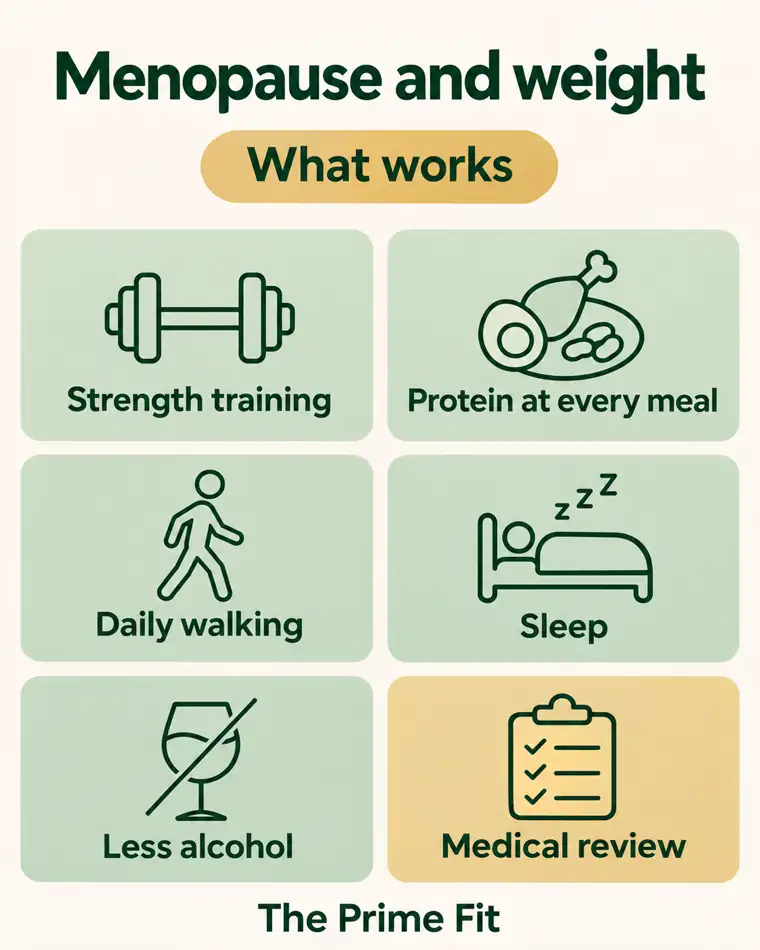
If there is one change to make in midlife, this is it. Resistance training preserves and builds muscle, raises energy needs, improves insulin sensitivity, reduces visceral fat even without weight loss, strengthens bone and improves mood. Two to three sessions a week, covering legs, hips, back, chest, shoulders and core, with loads that feel challenging by the last few repetitions.
| Exercise | Starting version | Progression |
|---|---|---|
| Squat | Sit-to-stand from a chair | Holding a weight at the chest |
| Hip hinge | Glute bridge | Deadlift with a kettlebell or dumbbells |
| Push | Wall push-up | Incline, then floor push-ups |
| Pull | Band row | Dumbbell row |
| Overhead | Press with water bottles | Dumbbell press |
| Carry | Walk with two shopping bags | Heavier loads, longer distance |
| Step-up | Low step, holding a rail | Higher step, with weights |
| Core | Dead bug, bird-dog | Plank |
2. Eat more protein than you used to
Muscle becomes less responsive to protein with age, so needs go up, not down. Many experts suggest about 1.0 to 1.2 grams per kilogram of body weight a day for midlife women, and more during weight loss, spread over three meals of 20 to 30 grams each. Most Indian women, especially vegetarians, eat well below this.
3. Reduce refined carbohydrate and sugar, not food groups
Insulin resistance rises at menopause. Smaller portions of rice, roti, bread and potatoes, eaten after protein and vegetables, and very little sugar and maida, make a visible difference to the waist. There is no need to eliminate carbohydrate.
4. Fibre and plants
Vegetables at lunch and dinner, whole pulses, fruit, nuts and seeds. A Mediterranean-style pattern has the best evidence for heart health after menopause and translates easily to Indian food.
5. Protect sleep
Seven to eight hours. A cool, dark room; a regular bedtime; no caffeine after midday; little or no alcohol; light bedding. If hot flushes and night sweats are waking you, see your healthcare provider. Treating them, with hormone therapy or other options, is one of the most effective things you can do for your weight.
6. Move every day
Walking, cycling, swimming or dancing for at least 150 minutes a week, plus everyday movement. Brief vigorous efforts, such as brisk uphill walking or intervals, help visceral fat and fitness.
7. Cut back alcohol
Alcohol worsens hot flushes and sleep, adds abdominal fat and raises breast cancer risk. Less is better.
8. Manage stress deliberately
Yoga, breathing exercises, time outdoors, social contact and saying no. Chronic stress drives comfort eating and poor sleep.
What to eat: an Indian day
| Meal | Vegetarian | Non-vegetarian |
|---|---|---|
| Breakfast | 2 besan chillas with paneer and curd; or vegetable oats in milk with almonds and a glass of milk | 2-egg vegetable omelette, 1 whole wheat toast, curd |
| Mid-morning | 1 fruit; a few walnuts | 1 fruit; chaas |
| Lunch | Salad, rajma or dal, palak or methi sabzi, 1 to 2 phulkas or a ragi roti, curd | Salad, fish curry, sabzi, small katori of rice, curd |
| Evening | Roasted chana or sprouts chaat; tea with little sugar | Boiled egg or roasted chana |
| Dinner, early | Tofu or paneer with vegetables, dal, 1 phulka | Grilled chicken or fish with vegetables, dal, 1 phulka |
| Bedtime, if needed | A small glass of milk | A small glass of milk |
Nutrients to watch
| Nutrient | Why | Indian sources |
|---|---|---|
| Protein | Muscle and bone | Dal, pulses, paneer, curd, milk, soya, eggs, fish, chicken |
| Calcium, about 1,000 to 1,200 mg a day | Bone | Milk, curd, paneer, ragi, sesame seeds, amaranth leaves |
| Vitamin D | Bone and muscle; deficiency is very common in India | Sunlight, fortified milk; supplement if low |
| Iron and vitamin B12 | Energy; often low, particularly in vegetarians | Greens, bajra, pulses with lemon; milk, curd, eggs; supplements if deficient |
| Omega-3 fats | Heart health | Fish, walnuts, flaxseed, chia |
| Fibre | Blood sugar, cholesterol, bowel | Vegetables, whole pulses, oats, fruit |
| Soya foods | Protein; contain plant oestrogens that may slightly ease hot flushes in some women | Tofu, soya milk, soya chunks, in normal amounts |
What does not work
| Approach | Why it disappoints |
|---|---|
| Eating very little | Accelerates loss of muscle and bone; slows metabolism; ends in rebound |
| Hours of cardio with no strength work | Burns some calories but does not protect muscle |
| Crunches and “belly fat exercises” | Strengthen muscle underneath but cannot remove the fat on top |
| “Hormone-balancing” teas, seed cycling and detoxes | No evidence |
| “Menopause supplements” for weight | No product has been shown to reduce menopausal weight gain |
| Compounded “bioidentical” hormone pellets and creams from unregulated sources | Doses are unpredictable and untested. Regulated body-identical hormones are available on prescription |
| Cutting out whole food groups | Hard to sustain; risks deficiencies |
| Hormone therapy taken for weight loss | It is not a weight loss treatment |
A realistic timeline
| Time | What to expect with consistent effort |
|---|---|
| Weeks 1 to 4 | Better energy and sleep; less bloating; strength exercises feel easier |
| Months 2 to 3 | Waist down by 2 to 4 cm; clothes looser; 2 to 4 kg lost if you have weight to lose |
| Months 4 to 6 | Visible change in shape; clear gains in strength; improved blood sugar and lipids |
| Months 6 to 12 | Further fat loss; muscle maintained or gained; a routine that feels normal |
Progress is slower than in your twenties. That is normal. The waist measurement and how you function are better guides than the scale, because gaining muscle while losing fat can leave weight unchanged.
If hormone therapy is not for you
Some women cannot take hormone therapy, and some prefer not to. Hot flushes and poor sleep can still be treated, which matters for weight as much as for comfort.
- Non-hormonal prescription medicines can reduce hot flushes. Your healthcare provider can advise which are suitable; some affect weight or interact with other medicines.
- Cognitive behavioural therapy adapted for menopause improves sleep and the distress caused by flushes.
- Practical measures: a cool bedroom, layered clothing, a fan, cutting back caffeine, alcohol and very spicy food if they trigger flushes.
- Regular exercise and weight loss themselves reduce the frequency and severity of hot flushes in women with excess weight.
- Vaginal oestrogen for local symptoms is a separate, low-dose treatment that many women who cannot take systemic hormones are able to use, on medical advice.
Herbal products sold for menopause have inconsistent evidence and are not risk-free. Tell your healthcare provider about anything you take.
When to see a healthcare professional
- Hot flushes, night sweats or poor sleep that affect daily life
- A waist of 80 cm or more, or a BMI above 23, with any related condition
- Weight gain of more than a few kilograms in a year without explanation
- Fatigue, hair loss or feeling cold, which may suggest thyroid problems
- Heavy or irregular bleeding, or any bleeding after menopause
- A family history of diabetes, heart disease or osteoporosis
- Low mood or anxiety
- Interest in hormone therapy or weight loss medication
See a healthcare professional promptly for
Any vaginal bleeding after menopause, a breast lump, chest pain or breathlessness on exertion, sudden swelling or pain in one leg, or severe low mood.
A midlife health check
| Check | Why |
|---|---|
| Weight, waist, blood pressure | Cardiometabolic risk |
| Fasting glucose and HbA1c | Prediabetes and diabetes |
| Lipid profile | LDL cholesterol often rises after menopause |
| Thyroid function | Common at this age |
| Liver enzymes; ultrasound if raised | Fatty liver |
| Blood count, ferritin, vitamin B12, vitamin D | Energy, hair, bone |
| Bone density scan | If you have risk factors, early menopause, or are over 65 |
| Breast and cervical screening | As recommended for your age |
| Body composition, where available | Muscle and fat, not just weight |

Three illustrative examples
These invented examples show different situations. They are not recommendations for any individual.
A change in shape at a healthy weight
A 48-year-old woman weighs the same as five years ago, 62 kg, but her waist has grown from 76 to 85 cm. Her tests are normal. She starts strength training three times a week, raises her protein and cuts sweet tea and evening snacks. In six months her weight is 61 kg, her waist 79 cm, and she is stronger than she was at forty.
Symptoms first
A 51-year-old woman sleeps four broken hours a night because of sweats, and eats biscuits at 3 am. After assessment, her gynaecologist starts hormone therapy through the skin. With sleep restored, she has the energy to exercise and her night-time eating stops. She loses 4 kg over the following months, not because of the hormones directly, but because of what they made possible.
Obesity with complications
A 56-year-old woman with a BMI of 34, prediabetes, high blood pressure and knee osteoarthritis has gained 12 kg since menopause. She starts a GLP-1 medicine with a slow dose schedule, a protein target, supervised strength training, calcium and vitamin D. Over 14 months she loses 15 kg, her blood sugar returns to normal, and a bone density scan is stable.
Questions to ask your healthcare provider
- Could my thyroid, blood sugar or medicines be contributing to my weight?
- Would hormone therapy be suitable for my symptoms, and in what form?
- Do I meet the criteria for weight loss medication, and would it be appropriate?
- Should I have a bone density scan?
- How much protein, calcium and vitamin D do I need?
- What strength training is safe for my joints?
Common myths
“Menopause makes weight gain inevitable”
It changes where fat is stored. Total weight gain is mostly about age and habits, and can be prevented.
“Hormone therapy makes you fat”
Trials do not show this. It may reduce abdominal fat gain.
“Hormone therapy is a weight loss treatment”
It is not.
“I just need to eat less”
Eating less without strength training costs muscle and bone.
“Lifting weights is risky at my age”
Properly taught, it is one of the safest and most beneficial things a midlife woman can do.
“Weight loss injections do not work after menopause”
They work as well as in younger women, with extra attention needed to muscle and bone.
How The Prime Fit supports women in midlife
At The Prime Fit, a midlife assessment looks beyond the scale: waist, body composition, blood sugar, lipids, thyroid, vitamins and, where indicated, bone health. Our dietitians design plans with enough protein, calcium and fibre for this stage of life, and guide you on strength training. If your weight and health call for medication, your healthcare provider prescribes it with a schedule that protects muscle and bone, and works with your gynaecologist on hormone therapy and other care.
To build a plan for this stage of life, book a consultation or read about our dietitian-led programmes.
Frequently asked questions
Why do I gain belly fat during menopause?
Falling oestrogen shifts fat storage from the hips and thighs to the abdomen, and muscle loss, poorer sleep and insulin resistance add to it.
Does menopause cause weight gain?
Midlife weight gain of about half a kilogram a year is mainly due to ageing and lifestyle. Menopause mainly changes where fat is stored.
Does HRT cause weight gain?
No. Trials have not shown weight gain with hormone therapy, and it may reduce the accumulation of abdominal fat.
Will HRT help me lose weight?
Not directly. It can improve sleep and wellbeing, which makes healthy habits easier, but it is not a weight loss treatment.
Do Wegovy and Mounjaro work after menopause?
Yes. Postmenopausal women lose a similar proportion of weight to younger women. Protein, strength training and bone health need extra attention.
Can I take a GLP-1 medicine with HRT?
Yes, there is no known harmful interaction. With tirzepatide, ask whether a patch or gel is preferable to oral hormones.
What is the best exercise for menopause belly fat?
Resistance training two to three times a week, combined with daily walking and some higher-intensity activity. Abdominal exercises alone do not remove belly fat.
How much protein do I need?
Many experts suggest about 1.0 to 1.2 grams per kilogram of body weight a day in midlife, and more during weight loss, spread across meals.
Do menopause supplements help with weight?
No supplement has been shown to reduce menopausal weight gain. Correct vitamin D, B12 or iron deficiency if present.
When should I see a healthcare professional?
If symptoms disturb your sleep or daily life, your waist is 80 cm or more, weight is rising without explanation, or you have any bleeding after menopause.
This article is general information and is not a substitute for a consultation. Hormone therapy and weight loss medicines are prescription treatments with benefits and risks that depend on your own health. Discuss them with your healthcare provider.