In this article
- How much weight does hypothyroidism really cause?
- Thyroid medicine timing: your healthcare provider decides
- The principles of a thyroid diet plan for weight loss
- Nutrients that matter with an underactive thyroid
- Goitrogens: do you need to avoid cabbage and cauliflower?
- Soy and hypothyroidism: what is actually known
- Millets, gluten and other foods people ask about
- 7-day Indian meal plan for hypothyroidism (veg and non-veg)
- Exercise, sleep and constipation
- Why am I not losing weight even though my TSH is normal?
- Common myths about thyroid and diet
- When to see a healthcare professional, and warning signs
- Questions to ask your healthcare provider
- How The Prime Fit helps
- Frequently asked questions
A thyroid diet plan for weight loss is, in truth, a sensible weight-loss diet with a few thyroid-specific adjustments. There is no food that “boosts” an underactive thyroid and no list of banned vegetables that explains the weight. If you have hypothyroidism, the plan that works has three parts: thyroid hormone levels brought into range with medicine prescribed by your healthcare provider, a modest calorie deficit built from ordinary Indian food, and enough protein and movement to protect muscle.
This guide sets out what hypothyroidism really does to weight, what to eat, a 7-day Indian meal plan with vegetarian and non-vegetarian options, and a careful look at the myths around goitrogens, soy, millets and iodine.
It is general information for adults with an underactive thyroid, and it cannot replace advice from the healthcare professional who knows your reports.
How much weight does hypothyroidism really cause?
Thyroid hormone sets the pace of the body’s energy use. When levels are low, metabolism slows, the body holds on to salt and water, and tiredness makes it harder to stay active. Weight goes up, but usually by less than people expect. Thyroid specialists generally describe the gain caused by the thyroid itself as a few kilograms, and much of that is fluid, not fat.
This matters for expectations. Once medicine brings your thyroid levels back into range, the fluid-related weight tends to settle, but larger amounts do not fall away by themselves. If you have gained 12 or 15 kg over some years, most of that has the same causes as in anyone else: food intake, activity, sleep, age and other hormones. The reassuring side is that, with a well-treated thyroid, you can lose weight in the same way as other people.
Check where you stand
For Asian Indians, overweight begins at a BMI of 23 and obesity at 25. A waist above 90 cm in men or 80 cm in women signals extra risk. Illustrative example: a woman who weighs 68 kg and is 1.60 m tall has a BMI of 68 divided by 2.56, which is about 26.6. You can check yours with our BMI calculator.
Thyroid medicine timing: your healthcare provider decides
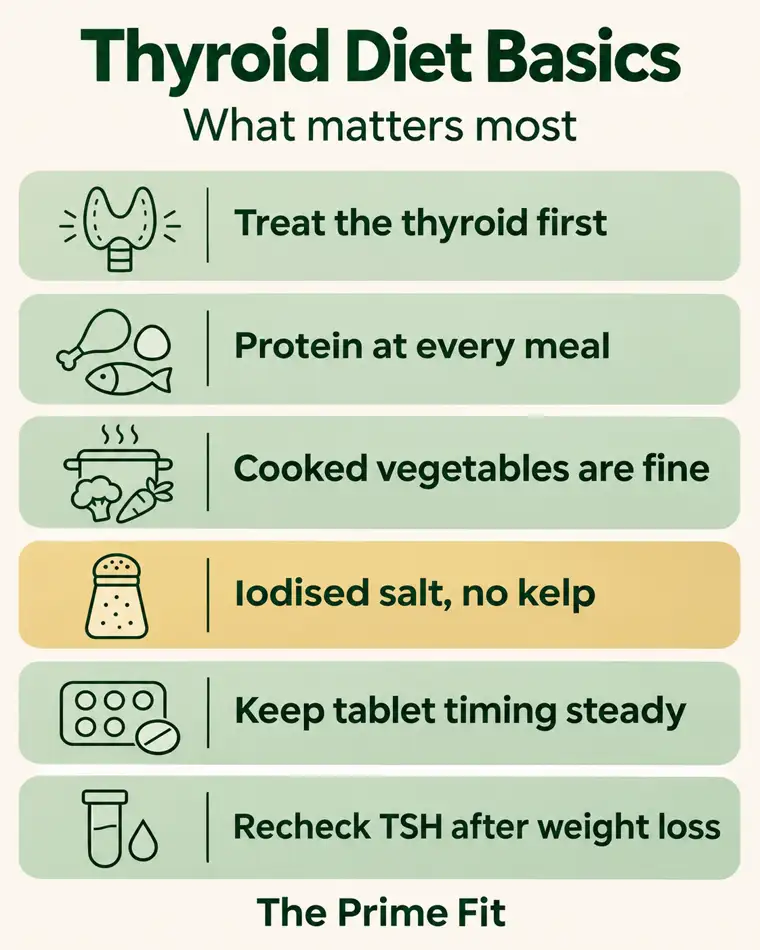
Hypothyroidism is treated with a daily thyroid hormone tablet, most often levothyroxine. Diet does not cure it, and stopping the tablet in favour of a “natural” plan allows the condition to return. What food can do is help you lose excess fat, correct common deficiencies and avoid interfering with the absorption of your tablet.
Your healthcare provider decides the dose and the timing of your thyroid medicine, based on your blood tests, weight, age, heart health and other medicines. Do not change either yourself, even if your weight is not moving.
The usual instructions are listed below so that you understand the reasoning. Follow what your own healthcare provider has told you if it differs.
- Take it the same way every day. Most people are told to take the tablet with plain water on an empty stomach, and to wait 30 to 60 minutes before tea, coffee or breakfast. Some are advised to take it at bedtime, a few hours after the last meal.
- Keep certain things apart from it. Calcium and iron supplements, and some antacids, can bind the medicine in the gut. Healthcare professionals usually advise a gap of about four hours.
- Be consistent with food habits. Coffee, milk, soy and very high-fibre meals taken close to the tablet can reduce absorption. They do not need to be given up, only kept away from tablet time.
- Tell your healthcare provider about every supplement. Biotin, common in hair and nail products, can distort thyroid blood test results. Ask how long to stop it before a test.
Do not raise your dose to lose weight
Taking more thyroid hormone than you need does not produce healthy fat loss. It can cause palpitations, an irregular heart rhythm, anxiety, poor sleep, muscle loss and thinning of the bones. Dose changes should follow blood tests, not the weighing scale.
The principles of a thyroid diet plan for weight loss
- A modest calorie deficit. Smaller portions of roti, rice and fried snacks, not starvation. Crash diets cost muscle and are hard to sustain.
- Protein at every meal. Many adults losing weight are advised about 1.0 to 1.2 g per kg of body weight a day, if the kidneys are healthy. Illustrative example: at 70 kg that is 70 to 84 g a day.
- Half the plate as vegetables, cooked or as salad, for fibre and fullness. Constipation is common in hypothyroidism, and fibre with enough water helps.
- Whole grains in measured amounts: phulka, brown or hand-pounded rice, oats, dalia, and millets in rotation.
- Less sugar, fried food and refined snacks: sweet tea several times a day, biscuits, namkeen, juices, pakoras, mithai and alcohol add up quickly.
- Iodised salt in normal cooking amounts, and no additional iodine products.
If you also have raised blood sugar, our Indian diabetes diet chart gives more detail.
Nutrients that matter with an underactive thyroid
| Nutrient | Why it matters | Indian food sources | Caution |
|---|---|---|---|
| Iodine | Needed to make thyroid hormone | Iodised salt, milk, curd, fish, eggs | Too much can worsen thyroid problems. Avoid kelp and iodine drops unless prescribed |
| Selenium | Involved in thyroid hormone metabolism | Eggs, fish, chicken, whole grains, sunflower seeds | Evidence for supplements is mixed, and excess is harmful. Food sources are enough for most people |
| Iron | Deficiency is common in Indian women and adds to tiredness and hair fall | Rajma, chana, masoor, green leafy vegetables, eggs, meat | Iron tablets should be kept about four hours from thyroid medicine |
| Vitamin B12 | Often low in vegetarians, and sometimes linked with autoimmune thyroid disease | Milk, curd, paneer, eggs, fish, chicken | Test before supplementing in high doses |
Ask for blood tests before taking supplements. Correcting a proven deficiency helps. Taking “thyroid support” products without testing rarely does.
Goitrogens: do you need to avoid cabbage and cauliflower?
Goitrogens are natural substances in some foods that can, in certain conditions, interfere with the way the thyroid uses iodine. They are found in the cabbage family: cabbage, cauliflower, broccoli, radish, turnip and mustard greens. This is the source of the widespread advice that thyroid patients must never eat gobhi or patta gobhi.
For most people, that advice is not supported. Problems have mainly been described when these vegetables are eaten raw in very large quantities, particularly where iodine intake is low. Cooking reduces goitrogen activity substantially. If you use iodised salt and eat normal portions of cooked sabzi, these vegetables are considered safe, and they are useful low-calorie, high-fibre foods.
The sensible limit is simple: avoid large daily amounts of raw cabbage-family juices, and enjoy cooked gobhi, broccoli, mooli and sarson ka saag in ordinary portions.
Soy and hypothyroidism: what is actually known
Soy is the second food most often removed from thyroid diets. In adults with enough iodine, studies have not shown that soy foods damage the thyroid or cause hypothyroidism in any meaningful way. The practical issue is different: soy can reduce the absorption of thyroid medicine when taken close to it.
So the answer is about timing and consistency, not avoidance. Soya chunks and tofu are valuable protein sources for vegetarians. Have them at lunch or dinner, several hours after a morning tablet. If you start eating soy daily, mention it to your healthcare provider so that your levels can be rechecked if needed.
Millets, gluten and other foods people ask about
| Food | The concern | A balanced view |
|---|---|---|
| Bajra and other millets | Bajra contains compounds with goitrogenic activity | Problems have been described where it is the main staple and iodine is lacking. Rotating bajra, jowar and ragi with wheat and rice, with iodised salt, is reasonable |
| Wheat and gluten | Claims that gluten “attacks” the thyroid | A gluten-free diet is necessary in coeliac disease, which is somewhat more common with autoimmune thyroid disease. Without coeliac disease, it has not been shown to treat hypothyroidism. |
| Ashwagandha and herbal mixes | Marketed for thyroid support | Some may alter thyroid hormone levels or affect the liver. Discuss with your healthcare provider before using them |
7-day Indian meal plan for hypothyroidism (veg and non-veg)
This sample menu assumes the thyroid tablet has been taken as your healthcare provider advised, with breakfast after the recommended gap. Portions depend on your size, activity and target, so treat this as a pattern, not a prescription.
| Day | Breakfast | Lunch | Evening | Dinner |
|---|---|---|---|---|
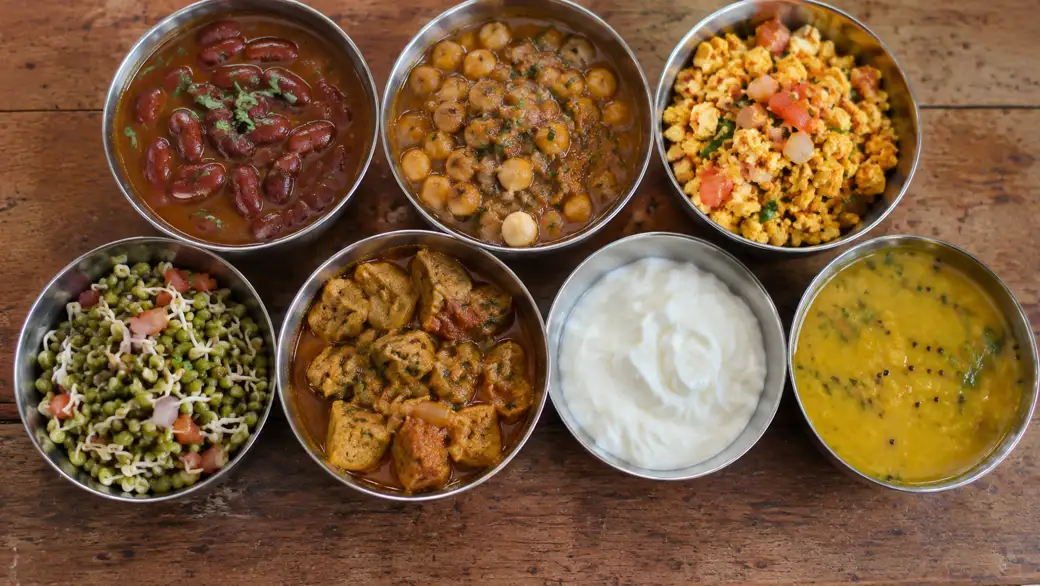
| Monday | 2 besan chillas with vegetables, curd. Non-veg: 2-egg omelette, 1 multigrain toast | 2 phulkas, moong dal, lauki sabzi, salad, curd | Roasted chana, chaas | Paneer bhurji, sautéed beans, 1 phulka. Non-veg: grilled fish, sautéed beans |
| Tuesday | Vegetable oats upma, a handful of peanuts | 1 katori brown rice, rajma, cooked cabbage sabzi, salad. Non-veg: chicken curry in place of rajma | Fruit (guava or apple), 5 almonds | Mixed dal, bhindi sabzi, 1 jowar roti |
| Wednesday | 2 moong dal idlis or regular idlis, sambar. Non-veg: add 1 boiled egg | 2 phulkas, chana masala, cauliflower and peas sabzi, curd | Sprouts chaat with lemon | Soya chunk curry, salad, 1 phulka. Non-veg: egg curry (2 eggs) |
| Thursday | Vegetable dalia, glass of milk without sugar | 1 bajra roti, palak paneer, cucumber raita. Non-veg: palak chicken | Makhana roasted in a little oil | Masoor dal, tinda or tori sabzi, small portion of rice |
| Friday | Poha with peas and peanuts, curd. Non-veg: 2 boiled eggs with poha | 2 phulkas, lobia, baingan bharta, salad | Chaas, 1 fruit | Tofu or paneer tikka, stir-fried broccoli and capsicum. Non-veg: chicken tikka |
| Saturday | Ragi dosa with sambar | Vegetable khichdi with extra moong dal, curd, salad. Non-veg: fish curry with 1 katori rice | Roasted peanuts, lemon water | Mixed vegetable soup, paneer and vegetable stir-fry. Non-veg: chicken soup with vegetables |
| Sunday | 1 stuffed paneer paratha made with little oil, curd. Non-veg: egg bhurji with 1 phulka | Small portion of rice or 2 phulkas, kadhi or dal, mooli or mixed sabzi, salad. Non-veg: home-style mutton or chicken curry, small portion | Fruit chaat without sugar | Light dinner: moong dal chilla or dal with sautéed vegetables |
Notice that cooked cabbage, cauliflower, broccoli, bajra and soya all appear. In ordinary portions they fit comfortably in a thyroid diet. For more ideas, see our vegetarian high-protein meal plan.
Exercise, sleep and constipation
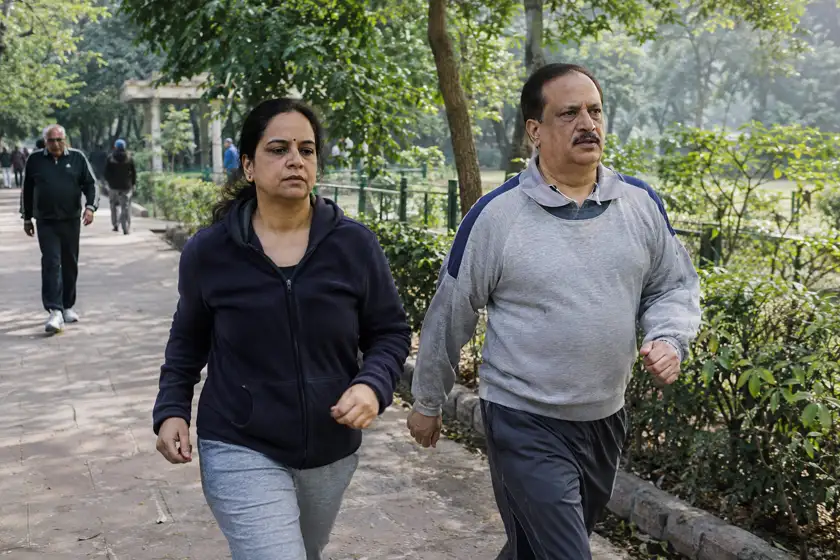
Movement matters as much as the menu. Aim to build towards about 150 minutes a week of brisk walking or similar activity, plus strength exercises on two days. Muscle is easily lost when weight comes down through diet alone. If tiredness is severe, start with 10-minute walks after meals and increase slowly. Our guide to walking for fat loss shows how to progress.
Seven to eight hours of sleep supports appetite control. For constipation, increase vegetables, whole pulses and fruit gradually and drink enough water. Isabgol is commonly used, but take it some hours away from your thyroid tablet.
Why am I not losing weight even though my TSH is normal?
A normal TSH means the thyroid is no longer holding you back. It does not, by itself, create a calorie deficit. Other causes are worth checking with your healthcare provider.
- Portions and liquid calories that are larger than they seem.
- Insulin resistance, prediabetes or PCOS.
- Menopause, poor sleep or untreated sleep apnoea.
- Medicines that promote weight gain, such as some steroids and some psychiatric medicines.
- Tablets taken irregularly or with food, so that levels drift.
When lifestyle measures have been tried properly and BMI and health risks are high enough, our team may discuss medical treatment for obesity. Well-controlled hypothyroidism does not usually prevent this, although certain rare thyroid cancers do. Our article on GLP-1 injections with thyroid problems explains the details, and who is eligible for weight loss injections covers the criteria.
One further point: the thyroid dose is partly related to body weight. After meaningful weight loss, some people need a lower dose. Ask for a repeat test instead of assuming the old dose still fits.
Common myths about thyroid and diet
| Myth | What is more accurate |
|---|---|
| “Thyroid patients cannot lose weight” | With hormone levels in range, weight loss follows the same rules as for anyone else |
| “Soy destroys the thyroid” | Not shown in people with adequate iodine. Keep soy away from tablet time |
| “A higher dose will speed up weight loss” | It risks the heart and bones and burns muscle as well as fat |
| “Once I diet properly I can stop the tablet” | Most adults with hypothyroidism need long-term treatment. Only your healthcare provider can decide otherwise |

When to see a healthcare professional, and warning signs
See your healthcare provider if you have ongoing tiredness, weight gain, constipation, feeling cold, hair fall, heavy periods or low mood despite treatment. Thyroid levels are usually rechecked about six to eight weeks after any change of dose.
- Planning pregnancy or newly pregnant: contact your healthcare provider promptly. The dose often needs to be adjusted early in pregnancy.
- Possible over-replacement: palpitations, tremor, sweating, anxiety, loose stools, poor sleep or unexplained weight loss.
- A lump in the neck, persistent hoarseness or difficulty swallowing.
Seek urgent care
Go to an emergency department for chest pain, a very fast or irregular heartbeat, fainting, severe breathlessness, or marked drowsiness, confusion, very slow pulse and feeling extremely cold in someone with untreated or poorly treated hypothyroidism.
Questions to ask your healthcare provider
- Is my TSH in the target range for my age and situation, and when should it be repeated?
- Exactly how and when should I take my tablet, and how long before tea or breakfast?
- Which of my other medicines or supplements need a gap from it?
- Should I be tested for iron, vitamin B12 and vitamin D levels?
- Will my dose need to change as I lose weight?
- Am I a candidate for medical weight-loss treatment, and is it safe with my thyroid condition?
How The Prime Fit helps
At The Prime Fit, weight management for people with thyroid conditions starts with a medical assessment: history, measurements, current medicines and a review of relevant blood tests. Where the thyroid is not yet well controlled, that comes first.
Our clinical nutrition support then builds a plan around the foods you already eat at home, with attention to protein, portion sizes and tablet timing. Follow-up visits track weight, waist and symptoms, and the plan is adjusted as you progress. If medical treatment for weight is appropriate, the options, benefits and risks are discussed openly.
Frequently asked questions
What is the best diet for thyroid patients to lose weight?
A balanced, portion-controlled Indian diet with protein at each meal, plenty of vegetables, measured whole grains and little sugar or fried food, alongside thyroid medicine taken as prescribed. There is no special food that treats the thyroid.
Can I eat cabbage, cauliflower and broccoli with hypothyroidism?
Yes, for most people. Cooked and eaten in normal portions, with iodised salt in the diet, they are considered safe. Avoid large amounts of raw cabbage-family juices.
Is soya bad for the thyroid?
Soy foods have not been shown to harm the thyroid in people with adequate iodine. They can reduce absorption of the tablet, so eat them several hours away from it and keep your intake fairly consistent.
How much weight will I lose once my thyroid is treated?
Usually only a few kilograms, much of it fluid. Further loss depends on diet, activity and other health factors, as it does for everyone.
When should I take my thyroid tablet?
Follow your healthcare provider’s instructions. Most people are told to take it with water on an empty stomach, 30 to 60 minutes before breakfast or tea, and to keep calcium and iron supplements about four hours away.
Should I use more iodised salt or take iodine supplements?
Use iodised salt in normal cooking amounts. Do not take iodine, kelp or seaweed supplements unless a healthcare professional prescribes them, because excess iodine can worsen thyroid problems.
Can I do intermittent fasting with hypothyroidism?
Many people with well-controlled hypothyroidism can, as long as the tablet is still taken consistently with water. Check with your healthcare provider first, especially if you have diabetes, are pregnant or take other medicines.
Can weight loss injections be used with hypothyroidism?
Well-controlled hypothyroidism does not usually rule them out, but they are not suitable for people with certain rare thyroid cancers or related family conditions. A healthcare professional must assess this individually.
This article is general information and is not a substitute for a consultation. Thyroid medicine dose and timing must be decided by your healthcare provider, based on your blood tests. Do not start, stop or change any medicine or supplement because of what you read here, and seek urgent care for the warning signs described above.