In this article
- What walking does for the body
- 7,000 steps: where the number comes from
- How much fat does walking burn?
- Japanese interval walking
- Weighted vests
- Walking after meals
- Pace, intensity and heart rate
- A 12-week plan
- Walking in Indian conditions
- Shoes, feet and technique
- Walking on weight loss treatment
- Walking is not enough by itself
- When to stop and seek advice
- Three illustrative examples
- Questions to ask your healthcare provider
- Common myths
- How The Prime Fit builds activity into your plan
- Frequently asked questions
Walking needs no equipment, no membership and no skill. It can be done at any age, almost anywhere, at any time of day. For people with excess weight, sore joints or little experience of exercise, it is usually the place to begin, and for many it remains the mainstay.
It has also become fashionable. Step counts are tracked on every phone. A large analysis in 2025 suggested that 7,000 steps a day, not the famous 10,000, delivers most of the benefit. A walking method developed in Japan nearly twenty years ago went viral as “Japanese walking”. And weighted vests appeared on morning walkers from California to Cubbon Park.
This guide looks at what the evidence supports, what walking does for weight and health, and how to use it well. It is general information. If you have heart disease, uncontrolled blood pressure, diabetes with complications, or joint problems, check with your healthcare provider before increasing your activity.
What walking does for the body
| Benefit | What studies show |
|---|---|
| Longer life | Higher daily step counts are consistently linked with a lower risk of early death, with the largest gains when moving from very low to moderate levels |
| Heart and blood vessels | Lower risk of heart disease and stroke; modest reduction in blood pressure |
| Blood sugar | Improves insulin sensitivity; a short walk after meals lowers the rise in blood sugar; lower risk of type 2 diabetes |
| Weight and waist | Modest fat loss; reduction in abdominal fat; important for keeping weight off |
| Mood and sleep | Lower risk of depression; better sleep quality |
| Brain | Lower risk of dementia in observational studies |
| Joints and bones | Maintains mobility; helps knee osteoarthritis symptoms; a mild stimulus for bone in the hips and legs |
| Digestion | Stimulates the bowel; helps constipation and reflux |
| Cancer | Lower risk of several cancers in observational studies |
7,000 steps: where the number comes from
The target of 10,000 steps did not come from research. It originated in a Japanese marketing campaign for a pedometer in the 1960s. It is a reasonable goal, but there was never evidence that it was a threshold.
In 2025, a large analysis pooling dozens of studies and more than 160,000 adults examined how daily steps relate to health outcomes. Compared with about 2,000 steps a day, taking about 7,000 was associated with:
| Outcome | Approximate lower risk at 7,000 steps compared with 2,000 |
|---|---|
| Death from any cause | About 47% |
| Cardiovascular disease | About 25% |
| Death from cardiovascular disease | About 47% |
| Type 2 diabetes | About 14% |
| Dementia | About 38% |
| Depressive symptoms | About 22% |
| Falls | About 28% |
How to read this
- The curve bends. Benefit rises steeply from very low step counts and begins to level off at around 5,000 to 7,000 for most outcomes. More steps still help a little, but each extra thousand adds less.
- Every increase counts. Going from 2,000 to 4,000 steps is linked with a meaningfully lower risk. You do not need to reach a target to benefit.
- These are associations. People who walk more may be healthier to begin with. The studies adjust for this as far as possible, and trials of walking support a real effect, but the exact percentages should not be taken literally.
- It is about health, not weight. The study did not ask how many steps are needed to lose fat.
- 10,000 is not wrong. For weight management and fitness, more is generally better, up to the point your time and joints allow.
| Daily steps | Category | Approximate distance | Approximate walking time |
|---|---|---|---|
| Under 5,000 | Sedentary | Under 3.5 km | Under 50 minutes in total |
| 5,000 to 7,499 | Low active | 3.5 to 5.5 km | 50 to 75 minutes |
| 7,500 to 9,999 | Somewhat active | 5.5 to 7.5 km | 75 to 100 minutes |
| 10,000 to 12,499 | Active | 7.5 to 9 km | 100 to 125 minutes |
| 12,500 and above | Highly active | Over 9 km | Over 125 minutes |
Distances assume a stride of about 70 to 75 cm and vary with height. The times include all the walking in a day, not one continuous session.
How much fat does walking burn?
This is where expectations need adjusting. Walking burns fewer calories than most people assume.
| Body weight | Calories per km, approximately | 30 minutes of brisk walking (about 2.5 to 3 km) | 10,000 steps (about 7.5 km) |
|---|---|---|---|
| 60 kg | 35 to 45 | 100 to 130 | 270 to 340 |
| 75 kg | 45 to 55 | 125 to 160 | 340 to 410 |
| 90 kg | 55 to 65 | 150 to 190 | 410 to 490 |
| 105 kg | 65 to 75 | 175 to 220 | 490 to 560 |
These are rough estimates; pace, slope and fitness change them. A samosa has about 250 calories, a glass of sweet lassi 250 to 300, and two rotis with ghee about 250. It takes five minutes to eat what forty-five minutes of walking burns.
That is why walking alone, without any change in eating, usually produces a small weight loss: typically 1 to 3 kg over several months in trials. It is also why the combination of diet and activity works better than either.
What walking is best at
- Keeping weight off. People who maintain a large weight loss for years typically walk about an hour a day.
- Reducing abdominal fat and improving blood sugar, even when the scale barely moves.
- Protecting health during weight loss, alongside strength training.
- Raising everyday energy use in a way that does not drive up hunger as much as intense exercise can.

Japanese interval walking
What it is
Researchers at a university in Japan developed and tested this method in the 2000s for middle-aged and older adults. It is simple:
- 3 minutes of fast walking, at a pace that makes talking in full sentences difficult; about 70 percent of your maximum effort.
- 3 minutes of slow walking, at an easy, comfortable pace.
- Repeat five times, for 30 minutes in total.
- At least four days a week.
What the research found
In the original trial, adults with an average age in the early sixties were assigned to interval walking, steady moderate walking of 8,000 or more steps a day, or no training, for five months. Those who did interval walking had greater improvements in thigh muscle strength and aerobic fitness, and a larger fall in blood pressure, than those who walked at a steady pace. Later studies by the same group, including in people with type 2 diabetes, reported benefits for blood sugar, body weight, and fitness.
Why it works
Fitness and strength improve when the body is asked to do more than it is used to. A steady stroll is too easy to provide that stimulus for many people. The fast intervals raise the heart rate and load the leg muscles; the slow intervals allow recovery, which makes the session manageable. It is a gentle form of interval training.
Limits of the evidence
- Most studies come from one research group and one country.
- A good number of participants found it hard to keep up over the long term.
- It has not been compared head to head with other forms of interval training.
- It is not magic. Brisk walking for 30 to 45 minutes also works. The principle is that some of your walking should be hard enough to leave you slightly breathless.
How to start
| Week | Session |
|---|---|
| 1 to 2 | 5 minutes easy, then 3 rounds of 2 minutes fast and 3 minutes slow, then 5 minutes easy. Three days a week |
| 3 to 4 | 5 minutes easy, 4 rounds of 3 minutes fast and 3 minutes slow, 5 minutes easy. Four days a week |
| 5 onwards | 5 rounds of 3 minutes fast and 3 minutes slow, with a short warm-up and cool-down. Four or more days a week |
“Fast” means fast for you. For a beginner it may be a purposeful walk; for a fit person, close to a jog. Use a timer or a phone app. On fast intervals, stand tall, take quicker steps, and swing your arms.
Weighted vests
The idea
A weighted vest adds load to the body, typically 5 to 10 percent of body weight, during walking. The claims are that it burns more calories, builds strength and protects bone, particularly for women after menopause and people losing weight.
What the evidence shows
| Claim | Evidence |
|---|---|
| Burns more calories | True, modestly. Carrying an extra 10% of body weight raises the energy cost of walking by roughly 5 to 15%, a few dozen calories per session |
| Improves fitness | Likely, by making the same walk harder |
| Builds leg strength | Small effect compared with resistance training |
| Protects bone | Not established. In a year-long trial of older adults losing weight, wearing a weighted vest for several hours a day did not prevent the loss of bone at the hip. Jumping, resistance training and adequate nutrition have better support |
| Preserves muscle during weight loss | Uncertain; small studies give mixed results |
| Speeds up fat loss | No good evidence of a meaningful effect |
In short, a vest makes walking a little harder, which is not a bad thing. It is not a substitute for strength training, and it will not transform results.
Who might use one
Someone who already walks regularly, has no joint or back problems, and wants more challenge without walking faster or longer.
Who should not
- Beginners. Start by walking more, then faster, then on slopes.
- People with significant excess weight. You are already carrying extra load.
- Anyone with back, neck, hip, knee or foot pain, or osteoporosis with previous fractures, unless advised by a physiotherapist.
- People with balance problems, heart disease or uncontrolled blood pressure.
- Pregnant women.
If you do use one
- Start at about 5 percent of body weight: 3 to 4 kg for most people. Do not exceed 10 percent.
- Choose a vest that fits snugly and spreads the weight over the trunk. A backpack is a reasonable substitute if it sits high and close.
- Begin with 10 to 15 minutes and build up.
- Keep your posture upright. Stop if you feel pain in the back, shoulders or knees.
- Do not wear it for running or jumping at first.
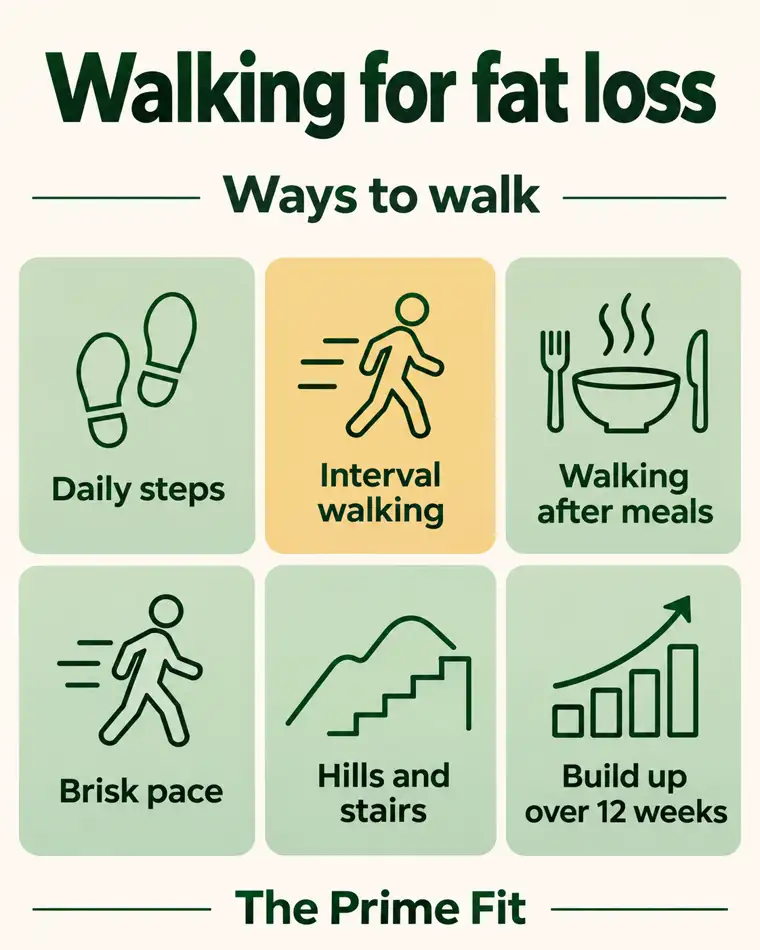
Cheaper ways to make walking harder include picking up the pace, choosing a route with slopes or stairs, and adding intervals.
Walking after meals
A short walk soon after eating is one of the simplest ways to improve blood sugar. Working muscles take up glucose directly, which blunts the rise after a meal. Studies show that even two to five minutes of light walking after eating lowers post-meal glucose, and ten to fifteen minutes does more. For people with prediabetes or diabetes, three ten-minute walks after meals can be as effective for blood sugar as one thirty-minute walk, or more so.
After dinner is the most valuable, since it is usually the largest meal and is followed by sitting or sleep. A post-meal walk also helps reflux and digestion. Keep the pace easy.

Pace, intensity and heart rate
| Intensity | How it feels | Steps per minute, roughly | Use |
|---|---|---|---|
| Light | Can sing | Under 100 | After meals; recovery; beginners |
| Moderate (brisk) | Can talk but not sing | 100 to 119 | The basis of most walking; counts towards the 150 minutes a week advised for health |
| Vigorous | Can say only a few words | 120 to 130 and above | Fast intervals; hills |
The “talk test” is a reliable guide. A cadence of about 100 steps a minute marks the lower edge of moderate intensity for most adults; count your steps for 15 seconds and multiply by four.
A 12-week plan
Start from where you are. Check your current average on your phone for a week first.
| Weeks | Daily steps target | Structured walks | Extras |
|---|---|---|---|
| 1 to 2 | Your baseline plus 1,000 | 15 to 20 minutes brisk, 5 days a week | 5 to 10 minutes after dinner |
| 3 to 4 | Baseline plus 2,000 | 25 to 30 minutes brisk, 5 days a week | 10 minutes after two meals |
| 5 to 6 | 6,000 to 7,000 | 30 minutes, with interval walking on 2 days | 10 minutes after each main meal |
| 7 to 8 | 7,000 to 8,000 | 30 to 40 minutes; intervals on 3 days | Add a route with a slope or stairs once a week |
| 9 to 10 | 8,000 to 9,000 | 40 minutes; intervals on 3 to 4 days | One longer walk of 60 minutes at the weekend |
| 11 to 12 | 8,000 to 10,000 | 40 to 45 minutes; intervals on 4 days | Maintain; add or continue strength training twice a week |
Increase by no more than about 1,000 steps a day each week. If a week feels hard, repeat it.
Ways to find more steps
- Walk while on phone calls.
- Take the stairs for up to three floors.
- Get off the bus or metro a stop early, or park further away.
- Walk to the market for small purchases.
- Set an alarm to stand and walk for two to three minutes every hour at work.
- Walk with a family member or friend after dinner.
- Pace during television advertisements or while waiting.
- Walk children to school or the bus stop.
Walking in Indian conditions
| Challenge | What to do |
|---|---|
| Summer heat | Walk before 7 am or after sunset. Carry water. Wear light cotton and a cap. Avoid the hours between 11 am and 4 pm |
| Air pollution | Check the air quality index. On poor days, walk indoors: at home, in a mall, on a treadmill or up and down stairs. Avoid busy roads |
| Monsoon | Indoor walking, stair climbing, marching on the spot, or an indoor walking video |
| Uneven pavements and traffic | Use parks, residential lanes, housing society compounds, terraces and stadium tracks |
| Safety, especially for women | Walk in groups, in daylight or well-lit areas, and tell someone your route |
| No time | Three ten-minute walks count as much as one of thirty |
| Stray dogs | Choose enclosed parks; walk at busier times |
Shoes, feet and technique
- Wear cushioned walking or running shoes that fit well, with socks. Avoid walking long distances in flat sandals or chappals.
- Replace shoes when the cushioning has flattened, usually after 600 to 800 km.
- People with diabetes should check their feet daily for blisters and cuts, and never walk barefoot.
- Stand tall, look ahead, relax the shoulders, bend the elbows and swing the arms.
- Land on the heel and roll through to the toes. Take quicker steps to go faster, not longer strides.
- Start and finish with five minutes at an easy pace.
Walking on weight loss treatment
For people taking a GLP-1 medicine such as Mounjaro or Wegovy, walking does several useful things: it helps constipation and reflux, improves blood sugar, protects fitness as weight falls, and builds the habit that will hold the result later. A few points apply.
- Eat a small snack with some protein and carbohydrate an hour or two before a long or brisk walk, since you may be eating less than you realise.
- Drink before and after, and carry water. Thirst is reduced on treatment.
- If you feel dizzy or weak, stop, sit, drink and eat.
- If you have diabetes and take insulin or a sulfonylurea, carry glucose tablets.
- Walking does not protect muscle by itself. Add resistance training two to three times a week.
Walking is not enough by itself
For all its benefits, walking does little for the muscles of the upper body, and provides only a mild stimulus for the legs and bones. Health guidelines recommend muscle-strengthening activity on at least two days a week in addition to aerobic activity. This matters most during weight loss, after menopause and in older age.
| Component | Weekly target | Examples |
|---|---|---|
| Aerobic activity | 150 to 300 minutes of moderate intensity, or 75 to 150 of vigorous | Brisk walking, interval walking, cycling, swimming |
| Strength | 2 or more days | Squats, push-ups, rows, bridges, with body weight, bands or weights |
| Balance and flexibility | 2 to 3 days, especially over 60 | Yoga, single-leg stands, heel-to-toe walking |
| Less sitting | Break up every hour | Stand, stretch, walk for two to three minutes |
When to stop and seek advice
Stop walking and get medical help if you have
Chest pain or tightness, pain spreading to the arm or jaw, unusual breathlessness, palpitations, dizziness or fainting, or calf pain that comes on with walking and eases with rest. See a healthcare professional before starting if you have heart disease, uncontrolled blood pressure or diabetes with complications.
Joint pain that lasts more than a day or two after walking means you have done too much. Cut back, check your shoes, and see a physiotherapist if it persists.

Three illustrative examples
These invented examples show how walking fits different situations. They are not advice for any individual.
From 2,500 steps to 7,500
A 54-year-old office worker with prediabetes averages 2,500 steps. He adds a ten-minute walk after each meal and a twenty-minute walk in the evening, reaching 7,500 steps within two months. With smaller portions of rice and no sweet drinks, he loses 4 kg and his fasting sugar returns to normal.
Interval walking for a plateau in fitness
A 47-year-old woman has walked 45 minutes at the same gentle pace for years. She switches to interval walking four days a week and adds strength training twice a week. After three months she climbs stairs without breathlessness, her resting pulse is lower, and her waist is 4 cm smaller, with no change in the time she spends exercising.
A weighted vest too soon
A 39-year-old man with a BMI of 35 buys a 12 kg vest to speed up fat loss. After two weeks his knees and lower back ache, and he stops walking altogether. His physiotherapist advises him to put the vest away, build up his steps, and begin simple strength exercises.
Questions to ask your healthcare provider
- Is it safe for me to start brisk or interval walking?
- Do I need a heart check first?
- How should I adjust my diabetes or blood pressure medicines as I become more active?
- Are my joints suitable for hills, stairs or a weighted vest?
- What step count should I aim for?
- What strength exercises should I add?
Common myths
“You must reach 10,000 steps or it does not count”
Most health benefits are seen by about 7,000, and every increase helps.
“Walking burns a lot of fat”
It burns a modest amount. Its greatest value is for health and for keeping weight off.
“Slow walking is as good as brisk walking”
Any walking helps, but intensity adds benefit for fitness, blood pressure and blood sugar.
“A weighted vest protects your bones”
This has not been shown. Resistance training has better evidence.
“Walking is all the exercise I need”
Add strength training at least twice a week.
“If I walk, I can eat what I like”
An hour of walking is undone by one fried snack and a sweet drink.
How The Prime Fit builds activity into your plan
At The Prime Fit, physical activity is prescribed as carefully as food. We start from your current step count and fitness, set realistic weekly targets, and add interval walking and strength training in stages that suit your joints and your schedule. Your dietitian aligns your meals and snacks with your activity, and for those on medication, we make sure exercise protects muscle as the weight comes off.
To get a plan that fits your day, book a consultation or read about our dietitian-led programmes.
Frequently asked questions
Is 7,000 steps a day enough?
For most health benefits, yes. A large 2025 analysis found that about 7,000 steps a day was linked with substantially lower risks of early death, heart disease and other conditions. More steps add a little more, especially for weight control.
How many steps do I need to lose weight?
There is no single number. Walking 8,000 to 10,000 steps a day helps, but meaningful weight loss needs a change in eating as well.
What is Japanese walking?
Interval walking: 3 minutes fast, 3 minutes slow, repeated five times for 30 minutes, at least four days a week. Studies found greater gains in fitness, leg strength and blood pressure than steady walking.
Is interval walking better than normal walking?
It gives more benefit in the same time by adding intensity. Any brisk walking is still valuable.
Do weighted vests help with weight loss?
They increase the calories burned slightly. There is no good evidence of meaningful extra fat loss, and they have not been shown to protect bone.
How many calories does walking burn?
Roughly 45 to 55 calories per kilometre for a 75 kg person, so about 340 to 410 for 10,000 steps.
Is walking after meals useful?
Yes. Even 5 to 10 minutes of easy walking after eating lowers the rise in blood sugar and helps digestion.
How fast should I walk?
Brisk enough that you can talk but not sing, about 100 or more steps a minute.
Can walking reduce belly fat?
Regular brisk walking reduces abdominal fat modestly, more so when combined with dietary change and strength training.
Is walking enough exercise?
It covers aerobic activity. Add muscle-strengthening exercise at least twice a week.
This article is general information and is not a substitute for a consultation. Study figures and calorie estimates are approximate. Check with your healthcare provider before increasing activity if you have a medical condition.