
In this article
- The short answer
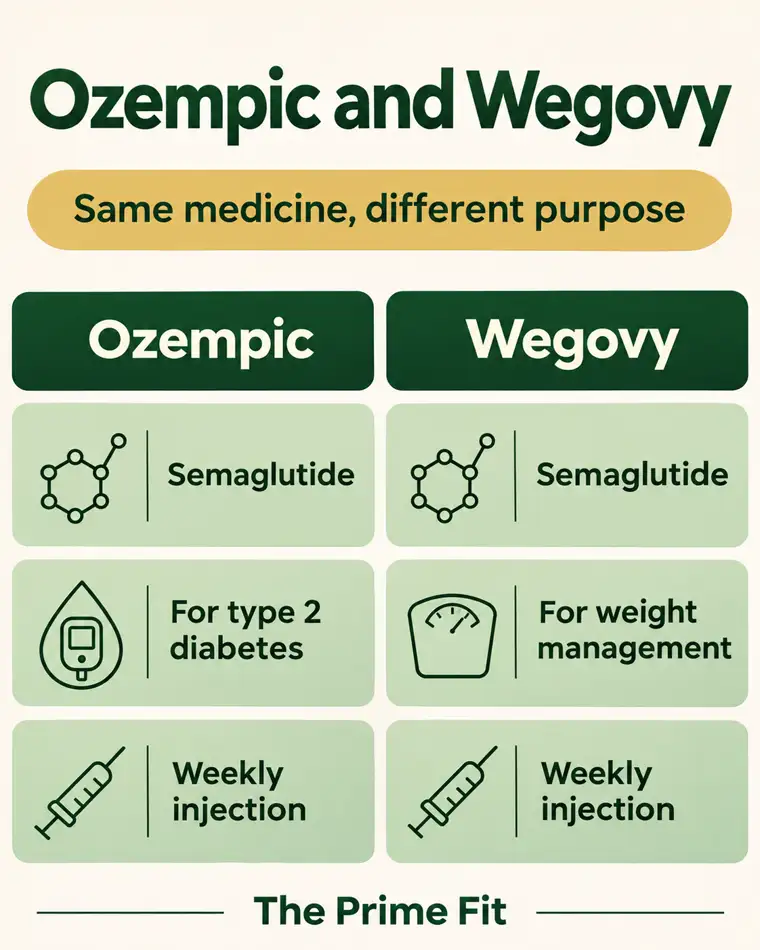
- Ozempic and Wegovy side by side
- Why are there two brands of the same medicine?
- How semaglutide leads to weight loss
- How much weight is lost at Ozempic doses?
- What does “off-label” mean?
- Which one is right for whom?
- Can you switch between Ozempic and Wegovy?
- Where do the tablets fit in?
- Side effects: are they different?
- “Ozempic face” and other headlines
- How semaglutide compares with tirzepatide
- Cost, availability and generics
- If you have diabetes and are already on Ozempic
- If you do not have diabetes and are considering treatment
- What results to expect, realistically
- Why everyone says “Ozempic”
- Benefits both products share
- What to expect over time on semaglutide
- Getting the most from semaglutide, whichever product you use
- Common myths
- Questions to ask your healthcare provider
- How The Prime Fit helps
- Frequently asked questions
“Ozempic” has become the everyday word for weight loss injections, used in headlines and conversations around the world. Yet Ozempic is, strictly speaking, a diabetes medicine. Its sister product, Wegovy, is the one licensed for weight management. Both contain semaglutide. The confusion is understandable, and it matters, because the two differ in dose, purpose and expected results.
This guide explains exactly how Ozempic and Wegovy relate to each other, how much weight loss each produces, what “off-label” use means, where the tablet form fits in, and how healthcare professionals decide which product suits which patient. It is general information. Brand names, strengths, approvals and availability vary by country and change over time, so confirm current details with your healthcare provider.
The short answer
- Same ingredient: both are semaglutide, a once-weekly GLP-1 medicine made by the same company.
- Different licensed uses: Ozempic is approved for type 2 diabetes. Wegovy is approved for chronic weight management.
- Different doses: Ozempic is usually used at 0.5 to 1 mg a week, with 2 mg in some countries. Wegovy goes up to 2.4 mg.
- Different results: more weight is lost at the higher Wegovy dose.
- Same side effects and precautions.
- Not a do-it-yourself swap: the pens deliver different doses, and one should not be substituted for the other without a healthcare professional’s instruction.
Ozempic and Wegovy side by side
| Ozempic | Wegovy | |
|---|---|---|
| Active ingredient | Semaglutide | Semaglutide |
| Licensed for | Type 2 diabetes, with diet and exercise; reducing cardiovascular risk in people with diabetes and heart disease | Chronic weight management in adults with obesity, or overweight with a weight-related condition; reducing cardiovascular risk in people with overweight or obesity and heart disease |
| How it is taken | Weekly injection under the skin | Weekly injection under the skin |
| Dose steps | 0.25 mg, 0.5 mg, 1 mg (2 mg in some countries) | 0.25 mg, 0.5 mg, 1 mg, 1.7 mg, 2.4 mg |
| Usual maintenance dose | 0.5 to 1 mg, sometimes 2 mg | 2.4 mg, or 1.7 mg if the full dose is not tolerated |
| Main goal of treatment | Lower blood sugar (HbA1c) | Reduce body weight and weight-related risk |
| Typical weight loss in trials | About 4 to 7 kg in people with type 2 diabetes | About 15% of body weight in people without diabetes; about 10% with diabetes |
| Side effects | Mainly nausea, diarrhoea, constipation, vomiting | The same, somewhat more frequent at the higher dose |
Why are there two brands of the same medicine?
Semaglutide was first developed and tested for type 2 diabetes. In those trials, researchers noticed that participants lost weight as well as improving their blood sugar. The company then ran a separate programme of trials in people with obesity, using a higher dose and measuring weight as the main outcome. Regulators assess each use on its own evidence, so the higher-dose product for weight management was approved under a different name, with its own dose range, pen and prescribing information.
The same pattern exists for other medicines. Liraglutide is sold at lower doses for diabetes and at a higher dose for weight management. Separate brands make clear which dose and purpose has been studied and approved.
How semaglutide leads to weight loss
Semaglutide mimics GLP-1, a hormone released from the gut after eating. It has several effects:
- It acts on appetite centres in the brain, reducing hunger and the pull of tempting foods.
- It increases the feeling of fullness, so smaller portions are satisfying.
- It slows the emptying of the stomach, prolonging fullness after meals.
- It increases insulin release and reduces glucagon when blood sugar is high, which lowers blood glucose.
The blood-sugar effect is already strong at lower doses, which is why Ozempic works well for diabetes at 0.5 to 1 mg. The effect on appetite and weight continues to increase with dose, which is why the weight-management product goes higher.

How much weight is lost at Ozempic doses?
In the diabetes trials, where participants had type 2 diabetes and were not specifically aiming to lose weight, average weight loss over 30 to 56 weeks was approximately:
| Weekly semaglutide dose | Average weight loss in people with type 2 diabetes |
|---|---|
| 0.5 mg | About 3.5 to 4.5 kg |
| 1 mg | About 4.5 to 6.5 kg |
| 2 mg (where available) | About 7 kg |
| 2.4 mg (Wegovy), with lifestyle programme | About 10% of body weight, roughly 9 to 10 kg |
In a trial in people with type 2 diabetes that compared the two doses directly, alongside lifestyle support, those on 2.4 mg lost about 10 percent of their body weight and those on 1 mg about 7 percent over 68 weeks.
In people without diabetes, the 2.4 mg dose produced about 15 percent weight loss on average over 68 weeks. People without diabetes generally lose more weight on semaglutide than those with diabetes at the same dose.
What this means
Ozempic does cause weight loss, and for many people with type 2 diabetes it is a valuable part of the benefit. For weight management as the primary aim, the higher dose in Wegovy has been shown to work better, and it is the dose that was tested for that purpose.
What does “off-label” mean?
A medicine is used “off-label” when a healthcare professional prescribes it for a purpose, dose or group of patients not covered by its official licence. This is legal and common in medicine when a healthcare professional judges it to be in the patient’s interest, but it carries extra responsibilities: the evidence for that use may be thinner, and the healthcare professional must explain this to the patient.
Prescribing Ozempic purely for weight loss in someone without diabetes is off-label. During periods when demand for Ozempic outstripped supply in several countries, regulators and professional bodies asked healthcare professionals to reserve it for people with diabetes, who depended on it for blood-sugar control, and to use the licensed weight-management product for weight loss. Where the weight-management product is available, it is generally the appropriate choice for that purpose.
This is a decision for a healthcare professional, not something to arrange yourself. Buying Ozempic without a prescription, or from an unverified seller, is unsafe.
Which one is right for whom?
| Your situation | Usually considered | Why |
|---|---|---|
| Type 2 diabetes; main aim is blood-sugar control; modest weight loss welcome | Ozempic, or another diabetes-licensed GLP-1 medicine | Licensed and dosed for diabetes; strong HbA1c reduction |
| Type 2 diabetes and obesity; substantial weight loss is an important goal | The weight-management dose of semaglutide, or tirzepatide, which is licensed for both conditions | Greater weight loss with good glucose control |
| Obesity or overweight with a related condition; no diabetes | Wegovy, or tirzepatide | Licensed and studied for weight management |
| Obesity or overweight with established heart disease; no diabetes | Wegovy | Shown to reduce heart attacks and strokes in this group |
| Healthy weight; wants to lose a few kilos | Neither | Not indicated; risks outweigh benefits |
Your healthcare provider will also consider your other medicines, kidney and eye health, cost, availability and how you tolerate treatment.
Can you switch between Ozempic and Wegovy?
Because the active ingredient is the same, a healthcare professional can move a patient from one to the other at the equivalent dose without restarting from the beginning, provided there has not been a long gap. For example, someone stable on 1 mg of Ozempic who needs more weight loss might be moved to the Wegovy range and stepped up through 1.7 mg to 2.4 mg, four weeks at a time.
Three cautions apply:
- The pens are different. Each delivers specific doses. Do not try to obtain a Wegovy dose by using an Ozempic pen differently, for example by counting clicks, or the reverse. Dosing errors have occurred this way.
- Do not use both. They are the same medicine, and taking both would be a double dose.
- If you have missed more than two weeks, speak to your healthcare provider before restarting; a lower dose may be needed.
Where do the tablets fit in?
Semaglutide is also available as a daily tablet, known as Rybelsus, licensed for type 2 diabetes at doses of 3, 7 and 14 mg. Only a small fraction of the tablet is absorbed, so the milligram amounts are far higher than for the injection and cannot be compared with it. The tablet must be taken on an empty stomach with a small sip of water, at least 30 minutes before food, drink or other medicines.
Weight loss with the diabetes doses of the tablet is modest, typically 3 to 4 kg. Higher-dose oral semaglutide has produced weight loss similar to the injection in trials and has been approved for weight management in some countries. Your healthcare provider can tell you what is currently available where you live.
| Ozempic | Wegovy | Rybelsus | |
|---|---|---|---|
| Form | Weekly injection | Weekly injection | Daily tablet |
| Licensed for | Type 2 diabetes | Weight management | Type 2 diabetes |
| Top dose | 1 mg (2 mg in some countries) | 2.4 mg | 14 mg daily |
| Typical weight effect | Moderate | Largest | Modest at diabetes doses |
Side effects: are they different?
The side effects are those of semaglutide and are the same for both products: nausea, diarrhoea, vomiting, constipation, abdominal discomfort, reflux, headache and tiredness. They are mostly mild to moderate, occur mainly when starting and after dose increases, and settle with time. Because Wegovy reaches a higher dose, digestive side effects are reported somewhat more often.
The same precautions apply to both:
- Not for people with a personal or family history of medullary thyroid carcinoma or MEN 2.
- Not recommended in pregnancy or breastfeeding; usually stopped at least two months before a planned pregnancy.
- Caution with a history of pancreatitis, gallbladder disease or severe stomach or bowel disease.
- In people with diabetic retinopathy, a rapid fall in blood sugar can temporarily worsen eye disease, so eye checks are advised.
- Risk of low blood sugar when combined with insulin or sulfonylureas, whose doses may need reducing.
- Tell your surgeon or anaesthetist before any procedure, because stomach emptying is slowed.
Seek urgent medical help if
You have severe, persistent abdominal pain, repeated vomiting and cannot keep fluids down, yellowing of the eyes, signs of dehydration, or swelling of the face or throat or difficulty breathing.
“Ozempic face” and other headlines
Terms such as “Ozempic face” describe the loss of facial fat that makes some people look gaunt after substantial weight loss. It is not a specific effect of the medicine. It occurs after significant weight loss by any means, including surgery and dieting, and is more noticeable with rapid loss and in older adults. A steadier pace, adequate protein, hydration, strength training and sun protection help. Temporary hair shedding a few months into treatment has the same explanation.
Loss of muscle is a more important concern than appearance. Protein at every meal and resistance exercise two to three times a week protect it.
How semaglutide compares with tirzepatide
Mounjaro (tirzepatide) is a different molecule that acts on the GIP receptor as well as the GLP-1 receptor. It is licensed for both type 2 diabetes and weight management. In a trial comparing the two directly in people with obesity, tirzepatide produced more weight loss on average, about 20 percent against about 14 percent over 72 weeks. Semaglutide has the advantage of a large trial showing fewer heart attacks and strokes in people with obesity and existing heart disease. Both are effective, and the choice depends on your health, response, tolerance, availability and cost.
Cost, availability and generics
Prices and supply differ between countries and change frequently, so this guide does not quote figures. A few general points help:
- Because the pens contain different amounts of medicine, the monthly cost of the two products differs.
- Where approved generic versions of semaglutide from licensed manufacturers are available, they contain the same active ingredient and can be a legitimate, more affordable option when prescribed and dispensed properly.
- Choosing a product only because it is cheaper per pen, and then using it at a dose it was not designed for, is not a safe saving.
- Products sold online without a prescription, including “research” semaglutide, are unsafe.
If you have diabetes and are already on Ozempic
You are already receiving a medicine that helps with weight as well as sugar. If your weight remains a concern:
- Ask whether your current dose is the highest appropriate one for you.
- Review medicines that promote weight gain, such as some sulfonylureas, insulin regimens or pioglitazone, with your healthcare provider.
- Work with a dietitian on protein, portion sizes and meal timing.
- Add resistance exercise and daily walking.
- Discuss whether a higher weight-management dose of semaglutide, or tirzepatide, would be appropriate.
Do not increase the dose yourself or add another GLP-1 medicine.
If you do not have diabetes and are considering treatment
The first step is an assessment to see whether you meet the criteria for weight-management treatment: a BMI of 30 or above, or 27 or above with a weight-related condition, with individual judgement for Indian patients, in whom risk begins at lower BMI. If you qualify, your healthcare provider will recommend a medicine licensed and dosed for weight management, together with a nutrition and activity plan. If you do not qualify, a dietitian-led programme is the safe and effective route.
What results to expect, realistically
| Person | Medicine and dose | An average result over about 16 months |
|---|---|---|
| Type 2 diabetes, 92 kg | Ozempic 1 mg | About 5 to 6 kg lost; HbA1c down by about 1.5 percentage points |
| Type 2 diabetes, 92 kg | Semaglutide 2.4 mg with lifestyle programme | About 9 kg lost |
| No diabetes, 92 kg | Wegovy 2.4 mg with lifestyle programme | About 13 to 14 kg lost |
These are illustrations based on trial averages. Individual results vary, and they depend on continuing treatment, diet and activity. The comparison makes one point clear: the same molecule gives quite different results depending on the dose and on whether the person has diabetes, which is why the product and dose should be matched to the goal of treatment and not chosen by name.
Why everyone says “Ozempic”
Ozempic reached the market several years before Wegovy, and it was the product in short supply when public interest in weight loss injections surged. The name became shorthand for the whole class, in the same way that a brand name sometimes stands for all photocopiers or all adhesive tape. When a friend, a news story or a social media post says “Ozempic”, it may in fact refer to Wegovy, to tirzepatide, or to GLP-1 medicines in general. It is worth asking which medicine and dose is actually meant before comparing someone else’s results with what you might expect.
Benefits both products share
Because the ingredient is the same, the wider health effects of semaglutide apply across its forms, in proportion to the dose and the weight lost:
- Lower blood sugar and HbA1c, with a low risk of hypoglycaemia when used without insulin or sulfonylureas
- Modest reductions in blood pressure and triglycerides
- Fewer major cardiovascular events in people with type 2 diabetes and heart disease, and in people with overweight or obesity and heart disease
- Slower decline in kidney function in people with type 2 diabetes and kidney disease
- Reduction in liver fat and inflammation in fatty liver disease, at the higher dose
- Less knee pain and better physical function with weight loss
What to expect over time on semaglutide
| Period | On the diabetes doses | On the weight-management dose |
|---|---|---|
| Weeks 1 to 4 | 0.25 mg: body adjusts; little change in sugar or weight | 0.25 mg: the same starting step |
| Weeks 5 to 12 | 0.5 mg, then 1 mg if needed: blood sugar improves; appetite falls | 0.5 mg, then 1 mg: appetite falls; weight starts to move |
| Months 4 to 6 | Stable dose; HbA1c reviewed; a few kilograms lost | 1.7 mg, then 2.4 mg: steady weight loss |
| Months 6 to 12 | Weight stabilises a few kilograms lower | Most of the weight loss occurs |
| Beyond a year | Long-term diabetes treatment | Plateau around 12 to 16 months; maintenance |
Getting the most from semaglutide, whichever product you use
The medicine reduces appetite. What you do with that reduced appetite decides the quality of the result.
| Habit | Why it matters | Indian examples |
|---|---|---|
| Protein at every meal | Protects muscle as weight falls | Dal, chana, paneer, curd, eggs, fish, chicken, soya |
| Vegetables and fibre | Fullness, bowel regularity, steadier sugar | Sabzi and salad at lunch and dinner; whole dals; fruit |
| Small, low-fat meals around dose increases | Reduces nausea and reflux | Khichdi, idli with sambar, curd rice, soups |
| Fluids | Prevents dehydration and constipation | Water, chaas, nimbu pani, coconut water |
| Strength training twice a week | Keeps muscle and metabolic rate | Sit-to-stands, wall push-ups, resistance bands |
| Daily walking | Blood sugar, mood, weight maintenance | 10 minutes after meals; 30 minutes a day |
| Regular reviews | Dose adjustment and monitoring | Weight, waist, HbA1c, kidney function, vitamins |
Common myths
“Ozempic and Wegovy are completely different medicines”
They contain the same active ingredient. The differences are in dose, device and licensed use.
“Ozempic is just as good as Wegovy for weight loss”
At its usual doses, Ozempic produces less weight loss than the 2.4 mg dose of Wegovy.
“I can make an Ozempic pen deliver a Wegovy dose”
Pens are designed for specific doses. Improvising risks under- or overdosing.
“Ozempic is for anyone who wants to slim down”
It is a prescription diabetes medicine. Semaglutide for weight management is for people who meet medical criteria.
“The weight stays off after a short course”
Weight usually returns after stopping. Treatment is intended to be long term, with regular review.
“Tablets are a weaker version, so they are safer”
The tablets contain the same medicine with the same precautions. The dose and absorption differ.
Questions to ask your healthcare provider
- Which semaglutide product is appropriate for my condition, and why?
- What dose am I aiming for, and how will we get there?
- How much weight loss and improvement in blood sugar should I expect?
- Would another medicine, such as tirzepatide, suit me better?
- Do my other medicines need to change?
- How long will I need treatment, and what is the plan for maintenance?
How The Prime Fit helps
At The Prime Fit, the choice of medicine follows an expert-led assessment of your weight, blood tests, medical history and goals. If you have diabetes, treatment is chosen for both blood sugar and weight. If you do not, we use medicines licensed for weight management, at doses that have been properly studied. Whichever medicine is prescribed, a dietitian builds your Indian meal plan and reviews you every week, and your healthcare provider adjusts the dose step by step.
To find out which treatment suits you, book a consultation or read about Ozempic Wegovy and our GLP-1 therapy programme.
Frequently asked questions
Is Ozempic the same as Wegovy?
They contain the same active ingredient, semaglutide. Ozempic is licensed for type 2 diabetes at lower doses. Wegovy is licensed for weight management and goes up to 2.4 mg a week.
Can Ozempic be used for weight loss?
Ozempic causes weight loss, but it is licensed for type 2 diabetes. Using it only for weight loss is off-label. The product studied and licensed for weight management is the higher-dose Wegovy.
Which causes more weight loss?
Wegovy, because of its higher dose. In trials, 2.4 mg produced about 15 percent weight loss in people without diabetes, compared with a few kilograms at the usual diabetes doses.
Why can I not just use Ozempic at a higher dose?
Ozempic pens deliver set doses up to their maximum. Trying to obtain other doses by improvising with the pen risks dosing errors. If you need the higher dose, your healthcare provider will prescribe the appropriate product.
Can I switch from Ozempic to Wegovy?
Yes, with a prescription. Because the ingredient is the same, you can usually continue at the equivalent dose and then step up.
Are the side effects the same?
Yes. Nausea, diarrhoea, constipation and vomiting are the most common, and they are somewhat more frequent at the higher dose.
Is Rybelsus the same as Ozempic?
Rybelsus is semaglutide in a daily tablet for type 2 diabetes. It is the same medicine, absorbed differently, and its weight effect at diabetes doses is modest.
I have diabetes. Should I take Ozempic or Wegovy?
It depends on your goals. If blood-sugar control is the main aim, Ozempic is appropriate. If substantial weight loss is also needed, your healthcare provider may consider the higher dose of semaglutide or tirzepatide.
Is Mounjaro better than Ozempic or Wegovy?
Tirzepatide produced more weight loss on average in a direct comparison with semaglutide. Semaglutide has strong evidence for heart protection. The right choice is individual.
Will I regain weight if I stop?
Usually, at least in part. In trials, people regained about two-thirds of their lost weight within a year of stopping semaglutide.
This article is general information and is not a substitute for a consultation. Product names, strengths, licensed uses and availability vary by country and change over time. Prescription medicines should be used only under a healthcare professional’s care.