In this article
- The headline numbers
- What the percentages mean in kilograms
- Averages hide a wide range
- How fast does the weight come off?
- Why the plateau happens
- Results in people with type 2 diabetes
- Fat or muscle: what are you actually losing?
- Why results differ between people
- What if you are not losing as expected?
- What weight loss does for your health
- What happens when you stop?
- Tracking progress beyond the scale
- Eight ways to get the best result from treatment
- Realistic expectations: three examples
- How far does a 15 or 20 percent loss take your BMI?
- Trial results and real life
- Changes in appearance as you lose weight
- Results in older adults and after menopause
- What a good second year looks like
- Common myths about results
- How The Prime Fit helps you get results that last
- Frequently asked questions
“How much weight will I lose?” is the first question almost everyone asks before starting a GLP-1 medicine such as Wegovy or Ozempic (semaglutide) or Mounjaro (tirzepatide). Social media is full of dramatic before-and-after photos, and equally full of people who say the injections did nothing. Both exist, and neither tells you what is typical.
The most reliable answers come from large clinical trials, in which thousands of people were followed for more than a year. This guide translates those results into plain language: the average loss, the range around it, how fast it happens, what proportion is fat, why some people lose more than others, and what happens when treatment stops. It also shows what the percentages mean in kilograms for different starting weights.
It is general information. Trial averages are not a promise for any individual, and your healthcare provider is the right person to set expectations for your own case.
The headline numbers
The table summarises the main weight-management trials in adults with obesity or overweight who did not have diabetes. In every trial, participants also received advice on diet and physical activity.
| Medicine and weekly dose | Trial length | Average weight loss | Placebo group |
|---|---|---|---|
| Semaglutide 2.4 mg (Wegovy) | 68 weeks | About 15% | About 2 to 3% |
| Tirzepatide 5 mg (Mounjaro) | 72 weeks | About 15% | About 3% |
| Tirzepatide 10 mg | 72 weeks | About 19 to 20% | About 3% |
| Tirzepatide 15 mg | 72 weeks | About 21% | About 3% |
| Liraglutide 3 mg (daily injection) | 56 weeks | About 8% | About 3% |
In a trial that compared the two newer medicines directly over 72 weeks, people taking tirzepatide lost about 20 percent of their body weight on average, and those taking semaglutide lost about 14 percent.
How to read these figures
They are averages across everyone who took part, including people who stopped early. Roughly half of participants lost more than the average and half lost less. The percentages are of starting body weight, not of excess weight.
What the percentages mean in kilograms
A percentage is hard to picture. The table converts typical results into kilograms for different starting weights.
| Starting weight | 5% loss | 10% loss | 15% loss | 20% loss |
|---|---|---|---|---|
| 70 kg | 3.5 kg | 7 kg | 10.5 kg | 14 kg |
| 80 kg | 4 kg | 8 kg | 12 kg | 16 kg |
| 90 kg | 4.5 kg | 9 kg | 13.5 kg | 18 kg |
| 100 kg | 5 kg | 10 kg | 15 kg | 20 kg |
| 110 kg | 5.5 kg | 11 kg | 16.5 kg | 22 kg |
| 120 kg | 6 kg | 12 kg | 18 kg | 24 kg |
So a person who starts at 90 kg and achieves an average result on semaglutide would reach about 76 to 77 kg after roughly 16 months. On a higher dose of tirzepatide, an average result would be about 71 to 72 kg after about 17 months.
Averages hide a wide range
The spread of results matters as much as the average. In the main trials, the proportion of participants reaching each milestone was approximately as follows.
| Weight loss reached | Semaglutide 2.4 mg | Tirzepatide 10 to 15 mg | Placebo |
|---|---|---|---|
| 5% or more | About 85 in 100 | About 90 in 100 | About 30 to 35 in 100 |
| 10% or more | About 70 in 100 | About 80 in 100 | About 12 to 19 in 100 |
| 15% or more | About 50 in 100 | About 65 to 70 in 100 | About 5 to 9 in 100 |
| 20% or more | About 30 in 100 | About 50 to 57 in 100 | About 2 to 3 in 100 |
Two things follow. First, most people respond: around 85 to 90 percent lose at least 5 percent. Second, a minority, roughly one in ten, lose less than 5 percent despite taking the medicine. Nobody can tell in advance which group you will be in, which is why progress is reviewed after the first few months.
How fast does the weight come off?
Weight loss on GLP-1 treatment is gradual. The dose is increased step by step over several months, and most of the loss happens during the first year.
| Period | What is happening | Typical loss so far (approximate) |
|---|---|---|
| Month 1 | Starting dose; body adapting; appetite begins to fall | 1 to 3% |
| Months 2 to 3 | Dose stepping up; steady loss begins | 4 to 7% |
| Months 4 to 6 | Reaching a treatment dose; fastest phase for many | 8 to 12% |
| Months 7 to 12 | Loss continues at a slower pace | 12 to 18% |
| Months 12 to 18 | Gradual levelling off; plateau | About 15% (semaglutide) to about 20% (tirzepatide) on average |
| Beyond 18 months | Maintenance with continued treatment | Weight broadly stable |
These figures are indicative, drawn from the shape of the weight curves in trials. In practice the path is uneven, with weeks of little change followed by a drop.
What is a healthy rate?
About 0.5 to 1 kg a week is generally considered a safe pace, and somewhat more in the first few weeks is common. Consistently faster loss increases the chance of muscle loss, hair shedding, gallstones, fatigue and loose skin. If you are losing much more than 1 kg a week over several weeks, your healthcare provider may hold or reduce the dose and your dietitian will review your intake.
The first month is not a test
The starting dose is designed for tolerance, not for results. Some people lose 2 or 3 kg in the first month, and others lose nothing. Neither predicts the final outcome reliably. Judge the treatment after about three months at a proper treatment dose.
Why the plateau happens
Almost everyone reaches a point where the weight stops falling, usually after about 12 to 18 months. This is not the medicine “wearing off”. As body weight falls, the body needs fewer calories, hunger hormones rise, and energy use becomes more efficient. Eventually the reduced intake produced by the medicine matches the reduced needs of a smaller body, and weight stabilises at a new, lower level.
A plateau after a 15 to 20 percent loss is the expected and successful result of treatment. The task then changes from losing weight to keeping it off.
Results in people with type 2 diabetes
People with type 2 diabetes generally lose less weight on the same medicines than people without diabetes. In trials of the weight-management doses in adults with diabetes, average losses were about 10 percent with semaglutide 2.4 mg and about 13 to 15 percent with tirzepatide 10 to 15 mg. The reasons are not fully understood, but insulin resistance, some diabetes medicines that promote weight gain, and the body retaining less sugar in the urine as control improves may all play a part.
The benefits for people with diabetes extend well beyond the scale: lower HbA1c, less need for other medicines, and improvements in blood pressure and liver fat.
Fat or muscle: what are you actually losing?
Whenever weight is lost by any method, some of it is lean tissue, which includes muscle, water and organ mass. In body-composition studies within the main trials, roughly two-thirds to three-quarters of the weight lost on these medicines was fat, and roughly a quarter to a third was lean mass. The proportion of body fat fell, so body composition improved overall.
The lean component still matters. Muscle keeps you strong, supports your metabolic rate and helps control blood sugar. The share of muscle lost is not fixed. It is strongly influenced by two things you control:
- Protein intake: for many adults in treatment, about 1.0 to 1.5 grams per kilogram of body weight a day, adjusted for kidney health, spread across meals.
- Resistance exercise: two to three sessions a week using weights, bands or body weight.
This is the main reason a structured nutrition and exercise plan should accompany the injection. Two people can lose the same 15 kg and end up with very different strength, shape and long-term results.
Why results differ between people
| Factor | Effect on results |
|---|---|
| Medicine and dose | Tirzepatide tends to produce more loss than semaglutide; higher doses more than lower ones |
| Reaching and staying on a treatment dose | Stopping early or staying on the starting dose gives smaller results |
| Consistency | Missed doses and long gaps reduce the effect and bring back side effects on restarting |
| Type 2 diabetes | Associated with somewhat smaller weight loss |
| Sex | Women lost more on average than men in several trials |
| Starting weight | Heavier people lose more kilograms; the percentage is often similar |
| Diet quality and protein | Affects how much is lost, and whether it is fat or muscle |
| Physical activity | Supports fat loss, muscle retention and maintenance |
| Sleep and stress | Poor sleep and chronic stress raise hunger and slow loss |
| Other medicines | Some, including certain diabetes, psychiatric and steroid medicines, promote weight gain |
| Other conditions | Untreated hypothyroidism, PCOS with marked insulin resistance, sleep apnoea |
| Alcohol and liquid calories | Add calories that bypass the medicine’s effect on fullness |
| Biology | Genetic and hormonal differences mean some people respond more than others for reasons outside their control |

What if you are not losing as expected?
Healthcare professionals usually review response after about three to six months at a treatment dose. A loss of less than 5 percent by then suggests the medicine is not working well enough for you in its current form. Before concluding that, your team will check:
- whether the dose has been increased as planned, or should be;
- whether doses have been missed, or the product stored or injected incorrectly;
- what and how much you are eating and drinking, including sugary drinks, alcohol and frequent snacks;
- protein, activity and sleep;
- other medicines and medical conditions, with blood tests where needed.
Options then include a higher dose, switching to another medicine in the class, intensifying the nutrition programme, or considering a different treatment such as a gastric balloon or bariatric surgery. A poor response to one medicine does not rule out a good response to another.
What weight loss does for your health
The purpose of treatment is better health, not a number. Benefits build as the percentage rises.
| Weight loss | Typical health improvements |
|---|---|
| About 5% | Lower blood pressure and blood sugar; improved triglycerides; reduced risk of developing diabetes |
| About 10% | Meaningful improvement in fatty liver, sleep apnoea, knee pain and mobility; more regular cycles in PCOS |
| About 15% or more | Greater chance of type 2 diabetes remission when treated early; further improvement in liver inflammation, blood pressure and cholesterol |
In a large trial of people with overweight or obesity and existing heart disease but no diabetes, semaglutide 2.4 mg reduced the risk of heart attack, stroke and cardiovascular death by about 20 percent over roughly three years. Benefits of this kind are a major reason these medicines are regarded as treatments for a chronic disease, not cosmetic aids.
What happens when you stop?
This is the part of the evidence that surprises many people. When the medicine is stopped, appetite and food cravings return, and weight tends to come back.
- In a follow-up of the main semaglutide trial, participants who stopped regained about two-thirds of the weight they had lost within a year.
- In a tirzepatide trial, people who had lost about 21 percent over nine months were then given either continued treatment or placebo. Those who continued lost a further 5 to 6 percent over the next year. Those switched to placebo regained about 14 percent.
Regain is not a personal failure. It reflects the biology of obesity, which behaves like other long-term conditions: treatment works while it is taken. For this reason, maintenance is usually planned as continued treatment at the lowest effective dose, combined with the eating and activity habits built during the first year. Any plan to stop should be made with your healthcare provider and supported by a clear nutrition and exercise programme.
Tracking progress beyond the scale
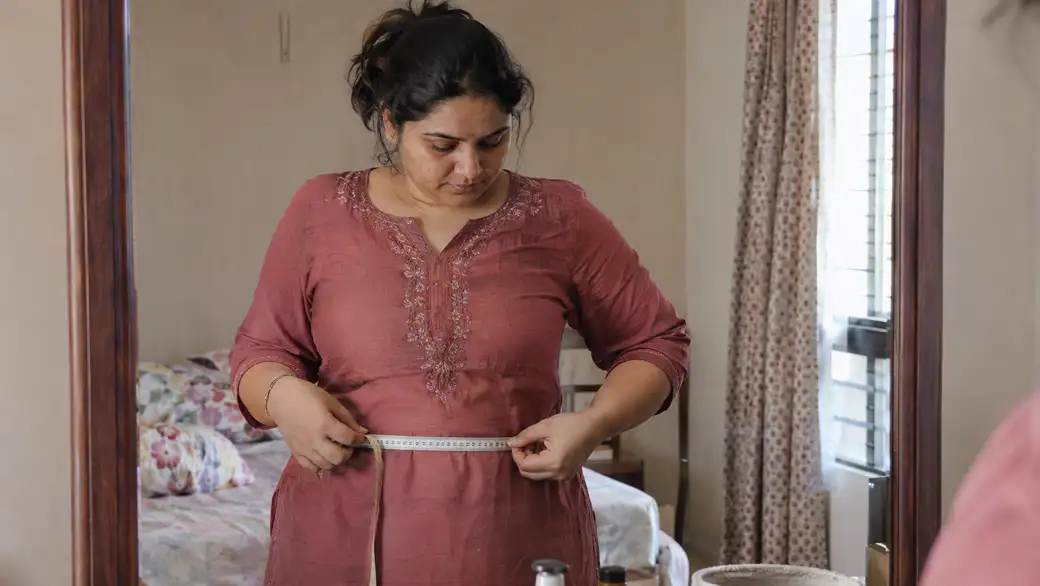
Body weight fluctuates daily with fluid, salt, hormones and bowel habits. Use several measures to see the real trend.
- Weekly weight, same day, same time, same scale, and look at the four-week trend.
- Waist circumference once a month. Abdominal fat often falls before the scale reflects it.
- Body composition, where available, every two to three months, to confirm that fat is falling and muscle is being preserved.
- Blood tests: HbA1c, lipids, liver enzymes, as advised.
- Blood pressure.
- How you feel and function: energy, sleep, breathlessness on stairs, joint pain, clothes size.
- Photographs every month in the same light and clothing.

Eight ways to get the best result from treatment
- Follow the dose plan, and tell your healthcare provider early about side effects so the dose can be adjusted instead of abandoned.
- Do not miss doses. Set a weekly reminder.
- Eat protein at every meal, even when you are not hungry: dal, curd, paneer, eggs, fish, chicken, soya.
- Lift something twice a week. Resistance exercise is the best protection for muscle.
- Walk daily, and after meals when you can.
- Drink enough water, and limit liquid calories and alcohol.
- Protect your sleep. Aim for seven to eight hours.
- Keep your reviews. Regular follow-up is associated with better and safer outcomes.
Realistic expectations: three examples
These illustrations are based on average trial results. They are not predictions for any individual.
| Example | Starting point | An average response might look like |
|---|---|---|
| Woman, 38, PCOS, no diabetes | 82 kg, BMI 32 | About 12 kg lost on semaglutide, or 14 to 16 kg on tirzepatide, over 16 to 18 months; more regular cycles |
| Man, 50, type 2 diabetes and high blood pressure | 98 kg, BMI 33 | About 10 kg on semaglutide, or 13 to 15 kg on tirzepatide; lower HbA1c and fewer medicines |
| Woman, 45, fatty liver and knee pain | 105 kg, BMI 39 | About 16 kg on semaglutide, or 20 kg or more on tirzepatide; less knee pain and improved liver tests |
In each case, the result could be several kilograms higher or lower, and it depends on continued treatment and lifestyle support.
How far does a 15 or 20 percent loss take your BMI?
Many people hope to reach a “normal” BMI. The table shows what average results do to BMI for three starting points. For most people the realistic outcome is a much healthier weight, not necessarily a textbook one, and that is where most of the health benefit lies.
| Height and starting weight | Starting BMI | After 15% loss | After 20% loss |
|---|---|---|---|
| 160 cm, 82 kg | 32.0 | 69.7 kg, BMI 27.2 | 65.6 kg, BMI 25.6 |
| 170 cm, 98 kg | 33.9 | 83.3 kg, BMI 28.8 | 78.4 kg, BMI 27.1 |
| 165 cm, 105 kg | 38.6 | 89.2 kg, BMI 32.8 | 84.0 kg, BMI 30.9 |
At higher starting BMI values, medication alone may leave the BMI in the obesity range even after an excellent response. This is not failure. It is also the situation in which healthcare professionals may discuss combining approaches or considering bariatric surgery.
Trial results and real life
Results outside trials are often somewhat smaller than the headline figures. Trial participants were selected, received their medicine without interruption, had regular contact with dietitians and were followed closely. In everyday practice, people stop for cost or side effects, stay on low doses, miss injections or have little lifestyle support. Analyses of real-world prescription data consistently show that many patients discontinue within the first year, and that those who continue and reach treatment doses achieve results much closer to the trials.
The lesson is practical. The factors that separate trial-level results from disappointing ones are largely within reach: staying on treatment, reaching an effective dose, structured nutrition and regular follow-up.
Changes in appearance as you lose weight
Significant weight loss changes more than the number on the scale. Facial fullness reduces, which some people welcome and others find ageing. Skin on the abdomen, arms and thighs may loosen, particularly after rapid or large losses and in older adults. Temporary hair shedding can occur a few months into treatment. These changes are linked to weight loss by any method, not to the medicine specifically. A steady rate of loss, adequate protein, hydration, strength training and sun protection all help the skin and hair adapt. Most hair shedding recovers once weight stabilises.

Results in older adults and after menopause
Older adults lose weight on these medicines too, but the balance of priorities shifts. Muscle and bone are harder to rebuild later in life, so protein intake, resistance exercise, vitamin D and calcium deserve particular attention, and doses are often increased more slowly. Women after menopause frequently carry more abdominal fat and may notice that waist size improves substantially even when total loss is moderate. For both groups, strength, balance and mobility are better measures of success than weight alone.
What a good second year looks like
By the second year, the goal is stability. Weight stays within a kilogram or two of your new baseline, waist size holds, blood tests remain improved, and you are stronger than when you started. The dose is the lowest that maintains this. Meals are regular and protein-rich without feeling like a diet, and exercise is a habit. Reviews are less frequent but continue. If weight starts to drift upward by more than about 3 percent, it is easier to correct early with a dietary review or dose adjustment than after a large regain.
Common myths about results
“Everyone loses 20 kg”
No. Results depend on starting weight, medicine, dose and the individual. Percentages are a better guide than kilograms.
“If I do not lose weight in the first month, it is not working”
The first month uses a low starting dose. Assess after about three months at a treatment dose.
“Faster is better”
Very rapid loss costs more muscle and increases side effects. Steady loss gives better body composition and is easier to maintain.
“The medicine does all the work”
The medicine reduces appetite. What you eat, whether you exercise and how you sleep decide how much of the loss is fat and how well it lasts.
“Once I reach my goal, I can stop and the weight will stay off”
Trials show that most people regain weight after stopping. Plan for maintenance from the start.
How The Prime Fit helps you get results that last
At The Prime Fit, results are planned and measured, not left to chance. Treatment begins with an expert-led assessment and realistic targets for your own starting point. Your dose is adjusted step by step, a dietitian builds your Indian meal plan with protein targets and reviews you weekly, and your body composition is tracked so that the weight you lose is mainly fat. When you reach a plateau, we plan maintenance with you.
To find out what you can expect, book a consultation or read about our GLP-1 therapy and GLP-1 support programme.
Frequently asked questions
How much weight can I lose on GLP-1 injections?
In trials, average loss was about 15 percent of body weight with semaglutide 2.4 mg and about 20 percent with higher doses of tirzepatide over 16 to 18 months, with diet and activity support. Individual results vary widely.
How much weight will I lose in the first month?
Commonly 1 to 3 percent of body weight, though some people lose more and some none, because the first month uses a low starting dose. It does not predict your final result.
Which gives more weight loss, Mounjaro or Wegovy?
On average, tirzepatide produced more weight loss than semaglutide, including in a trial that compared them directly. Both are effective, and the right choice depends on your health and your healthcare provider’s advice.
How long does it take to see results?
Most people notice reduced appetite within the first few weeks and clear weight loss by two to three months. The largest changes occur over the first six to twelve months.
When does weight loss stop?
Weight usually levels off after about 12 to 18 months of treatment. This plateau is expected and reflects the body reaching a new balance.
Will I lose muscle?
Some lean mass is lost with any weight loss. In trials, roughly a quarter to a third of the loss was lean mass. Adequate protein and resistance exercise reduce this.
Why am I losing less than other people?
Response varies with dose, consistency, diabetes, other medicines, sleep, diet and individual biology. Your healthcare provider can review these and adjust your plan.
Do people with diabetes lose less weight?
On average, yes. Losses of about 10 to 15 percent were seen in trials in people with type 2 diabetes, with important improvements in blood sugar.
Will the weight come back if I stop?
Usually, at least in part. Trials show that most people regain much of the lost weight within a year of stopping. Long-term treatment at the lowest effective dose, with lifestyle support, is the usual approach.
Is losing more than 1 kg a week safe?
It is common in the first few weeks. If it continues, tell your healthcare provider, because very rapid loss raises the risk of muscle loss, hair shedding and gallstones.
This article is general information and is not a substitute for a consultation. Trial results are averages and do not predict individual outcomes. Prescription medicines should be used only under the care of a qualified healthcare professional.