In this article
- What the trials show
- Why weight returns
- What happens in your body, week by week
- Reasons for stopping, and what to consider first
- If you have type 2 diabetes
- How to stop: taper if you can
- Preparing before the last dose
- Eating after stopping
- Exercise after stopping
- Monitoring: catch it early
- Restarting
- Stopping for pregnancy
- The alternatives to stopping completely
- A calendar for the year after stopping
- Who is more likely to keep the weight off?
- The emotional side
- Three illustrative examples
- Questions to ask your healthcare provider
- Common myths
- How The Prime Fit helps you stop safely, or stay well
- Frequently asked questions
People stop Wegovy (semaglutide 2.4 mg) for many reasons. Some have reached the weight they wanted. Some are planning a pregnancy. For others it is cost, side effects, a supply problem, or simply not wanting to inject every week indefinitely. Whatever the reason, the question is the same: what will happen to my weight?
The evidence is clear on the average and encouraging on the exceptions. Most people regain a substantial part of the weight they lost, because the medicine’s effect on appetite lasts only while it is in the body. A minority keep most of it off. What separates the two groups is partly biology and partly preparation.
This guide sets out what the trials found, what you are likely to feel week by week, how to taper, and a practical plan for the year after stopping. It is general information. Stopping or changing a prescription medicine should be planned with your healthcare provider, particularly if you have type 2 diabetes.
What the trials show
Two studies of semaglutide 2.4 mg tested stopping directly.
| Study | What was done | What happened |
|---|---|---|
| Follow-up after the main trial | After 68 weeks of treatment, participants stopped the medicine and the lifestyle programme and were followed for a further year | On treatment they had lost about 17% of their weight. A year after stopping, they had regained about two-thirds of that loss and remained about 5 to 6% below their starting weight |
| Withdrawal trial | After 20 weeks on semaglutide, half continued and half were switched to placebo for 48 weeks, all with lifestyle support | Those who continued lost about a further 8%. Those switched to placebo regained about 7% |
In the follow-up study, the improvements in blood pressure, blood sugar, blood fats and inflammation that had come with weight loss also moved back towards where they started. Some benefit remained in line with the weight that was kept off.
In kilograms
| Starting weight | Weight after 68 weeks on treatment (about 17% lost) | Weight a year after stopping, on average (about 5.5% below start) | Regained |
|---|---|---|---|
| 80 kg | 66.4 kg | 75.6 kg | About 9 kg |
| 90 kg | 74.7 kg | 85.1 kg | About 10.5 kg |
| 100 kg | 83 kg | 94.5 kg | About 11.5 kg |
| 120 kg | 99.6 kg | 113.4 kg | About 14 kg |
These figures describe the average of a group who stopped abruptly, without a taper and without continued lifestyle support. They are a warning about what happens when nothing is put in place, not a forecast for someone who prepares.
Three things the trials tell us
Regain is gradual, over months, not sudden. On average it is substantial but not complete within the first year. And individuals vary: some regained nearly everything, and some held most of their loss.
Why weight returns
Semaglutide works by supplying a strong, continuous version of the body’s own fullness signal. It does not permanently change the systems that regulate weight. When it is withdrawn:
- Appetite and cravings return to their previous level, and sometimes feel stronger by contrast.
- The stomach empties at its normal speed again, so meals are less filling.
- The body is still defending its old weight. After weight loss, hunger hormones are higher and energy use is lower than before, and this persists.
- Portions drift upward without any conscious decision.
This is not a rebound caused by the medicine, and it is not a failure of willpower. It is what happens when an effective treatment for a chronic condition is stopped, in the same way that blood pressure rises when blood pressure tablets are withdrawn.
What happens in your body, week by week
Semaglutide has a half-life of about one week. After the last injection, the level in your blood halves each week, and it takes about five weeks to clear almost completely.
| Time after last dose | Medicine remaining | What many people notice |
|---|---|---|
| Week 1 | About half | Little change |
| Week 2 | About a quarter | Slightly more interest in food; meals a little less filling |
| Weeks 3 to 4 | About a tenth, falling | Hunger between meals returns; portions feel small; thoughts about food increase |
| Weeks 5 to 6 | Almost none | Appetite close to where it was before treatment |
| Weeks 6 to 12 | None | Weight may begin to rise by about half a kilogram to a kilogram a month, or faster without a plan |
| Months 3 to 12 | None | The period in which most regain occurs |
Any digestive side effects you had, such as nausea or constipation, usually settle within the same few weeks. There are no withdrawal symptoms in the usual sense. In people with type 2 diabetes, blood sugar rises as the medicine clears.
Reasons for stopping, and what to consider first
| Reason | Before you stop, consider |
|---|---|
| I have reached my goal | The goal is to stay there. Discuss maintenance at the lowest effective dose instead of stopping outright |
| Cost | A lower maintenance dose; an approved generic of the same ingredient; a different medicine. Tell your healthcare provider that cost is the issue |
| Side effects | A lower dose, slower increases, dietary changes or supportive treatment often solve the problem. Another medicine may suit you better |
| Planning a pregnancy | A planned stop at least two months before trying to conceive, with a nutrition plan for the gap |
| Not losing any more weight | A plateau after 15% loss is the expected result, and the medicine is what is holding it |
| Tired of injections | A daily tablet form of semaglutide exists for diabetes, and higher-strength tablets for weight in some countries. Ask what is available |
| Worry about long-term safety | Trial data extend to about four years without new concerns. Discuss your specific worries |
| Surgery or a procedure | A temporary pause, not a permanent stop. Restart as advised |
| A new medical problem, such as pancreatitis | Stopping may be necessary. Your healthcare provider will advise on alternatives |
| I want to manage without medication | A legitimate choice. Prepare thoroughly, taper, and agree a plan for regain |
If you have type 2 diabetes
Semaglutide is treating your blood sugar as well as your weight, and it may be protecting your heart and kidneys. Stopping it without a replacement usually leads to a rise in HbA1c within weeks. Do not stop because your readings are normal; they are normal because of the treatment. If it must be stopped, your healthcare provider will arrange another medicine and ask you to monitor your sugars more closely during the change.
How to stop: taper if you can
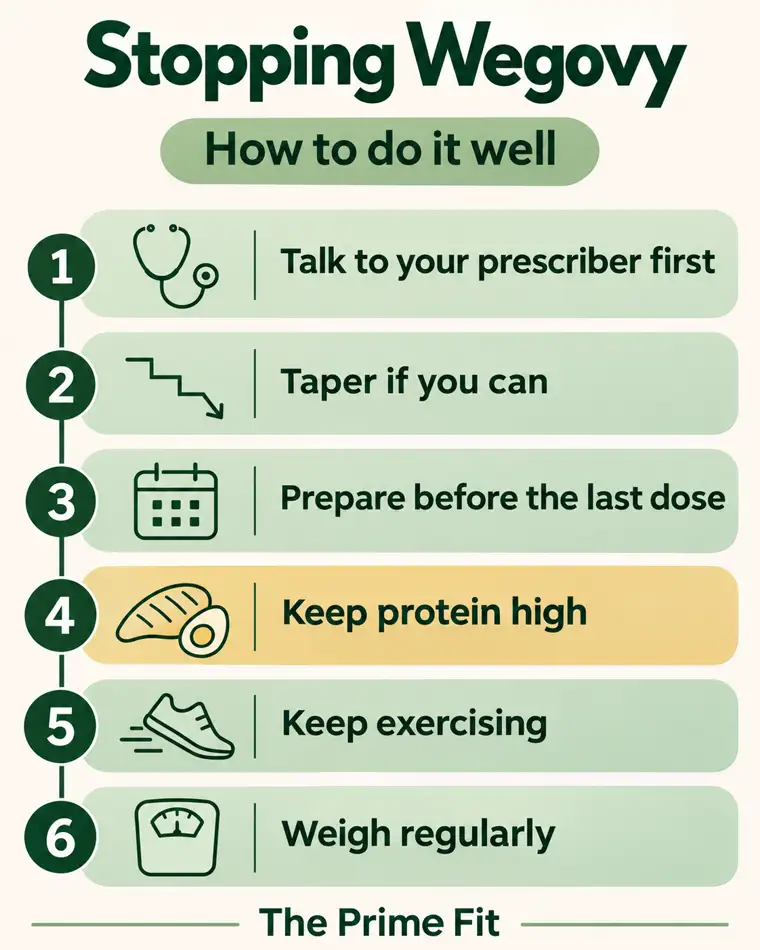
The prescribing information does not require a taper, and stopping abruptly is not dangerous. But the trials that showed large regain involved abrupt stopping. Stepping down gradually gives your appetite, your habits and your healthcare provider time to adjust, and early studies of tapering with coaching suggest that it helps some people hold their weight for at least several months. Long-term evidence is still limited.
| Stage | Weekly dose | Duration | What to watch |
|---|---|---|---|
| Current maintenance | 2.4 mg | Stable weight for at least 3 months | Habits firmly in place |
| Step 1 | 1.7 mg | 4 to 8 weeks | Weekly weight; appetite |
| Step 2 | 1 mg | 4 to 8 weeks | As above |
| Step 3 | 0.5 mg | 4 to 8 weeks | As above |
| Step 4 | 0.25 mg, or stop | 4 weeks | As above |
| Off treatment | None | Follow-up for at least a year | Weekly weight; monthly review at first |
This is an example of the kind of schedule healthcare professionals use, not a prescription. Yours should be set by your healthcare provider.
The taper is also a test
If your weight holds steady at 1.7 mg and at 1 mg but hunger surges and weight climbs at 0.5 mg, you have learned something useful: your lowest effective dose is probably 1 mg. Many people decide at that point to stay on a low dose instead of stopping completely. That is a good outcome, with fewer side effects and lower cost than the full dose.
Preparing before the last dose
- Stop from stability, not while you are still losing, and not just before festivals, travel or a stressful period.
- Fix your meal structure: three meals at set times, protein at each, vegetables at lunch and dinner.
- Know your protein target at your new weight, about 1.0 to 1.5 grams per kilogram for many adults, and how to reach it.
- Be training already: strength exercise two to three times a week and daily walking, established for at least two months.
- Record your baseline: weight, waist, a photograph, recent blood tests.
- Set your thresholds: agree with your healthcare provider the weight at which you will act and what you will do.
- Clear the kitchen of the snacks that used to tempt you.
- Book follow-up for one, two and three months after stopping.
- Review your other medicines, especially for diabetes and blood pressure.
- Tell someone at home what to expect and how they can help.

Eating after stopping
As hunger returns, meals need to be more filling without being much larger. Protein and fibre do that work. So does structure: a returning appetite is far easier to manage with a plan than with willpower.
| Principle | How |
|---|---|
| Protein at every meal and snack | Dal, chana, rajma, paneer, curd, soya, eggs, fish, chicken. Eat it first |
| Volume from vegetables | Start lunch and dinner with salad or a vegetable soup; fill half the plate with sabzi |
| Fibre | Whole dals, whole grains in measured portions, fruit instead of juice |
| Planned snacks | Mid-morning and at about 5 pm: fruit with nuts, sprouts, roasted chana, curd |
| Few liquid calories | Water, plain chaas, unsweetened tea and coffee |
| Slow eating | Fifteen to twenty minutes a meal; pause before taking more |
| Early dinner; kitchen closed afterwards | Evenings are when returning appetite is strongest |
| Limited sugar, refined flour and fried snacks | They are the least filling per calorie |
| Little or no alcohol | It adds calories and loosens restraint |
A sample day
| Meal | Vegetarian | Non-vegetarian |
|---|---|---|
| Breakfast | 2 besan or moong chillas with paneer, curd | 2-egg vegetable omelette, 1 whole wheat toast |
| Mid-morning | 1 fruit; a handful of almonds | 1 fruit; chaas |
| Lunch | Large salad, rajma or chana, sabzi, 1 to 2 rotis, curd | Large salad, chicken or fish curry, sabzi, 1 to 2 rotis |
| 5 pm | Sprouts chaat or roasted chana with tea | Boiled egg or grilled chicken strips with tea |
| Dinner, early | Vegetable soup, paneer or tofu with vegetables, 1 phulka | Vegetable soup, grilled fish with vegetables, small katori of rice |
| After dinner | 10-minute walk; herbal tea if you want something | 10-minute walk; herbal tea if you want something |
Exercise after stopping
Physical activity is the habit most consistently linked with keeping weight off. A trial that compared people after an initial weight loss found that those assigned to a supervised exercise programme maintained their loss far better than those given placebo, and that exercise combined with a GLP-1 medicine did best of all. Those who had been exercising also held their weight better after treatment ended.
| Type | Target |
|---|---|
| Brisk walking or other aerobic activity | 200 to 300 minutes a week, building up gradually |
| Strength training | 2 to 3 sessions a week, progressing over time |
| Daily steps | 7,000 to 10,000 |
| Walks after meals | 10 minutes each |
Strength training matters especially, because muscle lost during weight loss lowers your energy needs. Rebuilding it raises them.
Monitoring: catch it early
| Zone | Weight compared with the day you stopped | Action |
|---|---|---|
| Green | Within 2% | Continue; weigh weekly |
| Amber | 2 to 3% higher for two weeks | Two-week reset: food diary, no liquid calories or unplanned snacks, protein at every meal, extra walking, early nights. Contact your dietitian |
| Red | More than 3% higher, or rising steadily for a month | See your healthcare provider. Discuss restarting, possibly at a low dose, or other options |
For someone who stopped at 75 kg, amber begins at 76.5 kg and red at about 77.3 kg. Acting at two kilograms is far easier than acting at ten.
- Weigh once a week, same day and time.
- Measure your waist monthly.
- Recheck blood pressure, and blood sugar if it was raised before, at three and six months.
- Keep a brief note of hunger and mood.
Restarting
Going back on treatment is a medical decision, not a defeat. If weight is returning despite a real effort, restarting early, at a small regain, is much simpler than waiting until everything has come back.
| Time since last dose | General approach |
|---|---|
| Up to 2 weeks | Usually resume at the same dose, following the missed-dose instructions |
| More than 2 weeks | Speak to your healthcare provider. Depending on the gap and how you tolerated the medicine, you may resume at a lower dose |
| A month or more | Usually restart at a low dose and step up again every four weeks |
Tolerance to the digestive effects fades within a few weeks. Restarting at 2.4 mg after a long break can cause severe nausea and vomiting. Never do this on your own initiative.
Studies suggest that people who restart respond again, though not always to exactly the same degree. Repeated cycles of stopping and starting mean more time on low doses and more exposure to side effects, so a steady low dose is usually preferable to an on-off pattern.
Stopping for pregnancy
Semaglutide is not used in pregnancy. Because it clears slowly, the usual advice is to stop at least two months before trying to conceive, and to continue contraception during that time.
- Tell your healthcare provider three to six months ahead.
- Start folic acid as advised.
- Review all other medicines for safety in pregnancy.
- Check blood sugar, thyroid function, haemoglobin, vitamin D and vitamin B12.
- Follow a structured eating plan during the gap; some regain is common and is not a failure.
- If you become pregnant while still on treatment, stop and contact your healthcare provider and obstetrician.
- Treatment can be reconsidered after breastfeeding has ended.
The alternatives to stopping completely
| Option | What it offers |
|---|---|
| Lowest effective dose | Maintenance with fewer side effects and lower cost; found by stepping down |
| Approved generic semaglutide | The same ingredient at lower cost, where available, from a licensed pharmacy |
| A different medicine | For example tirzepatide, if side effects or response are the issue; started low |
| Tablet form | For those who dislike injections, where a suitable strength is available |
| Planned pause | For surgery, illness or travel, with a restart date |
| Other treatments | A gastric balloon or bariatric surgery for those who cannot continue medication and need durable weight loss |
Extending the gap between injections is sometimes suggested as a way to make a pen last. It has not been well studied and is not an approved schedule. A lower weekly dose is the better-supported choice.
A calendar for the year after stopping
| When | What to do |
|---|---|
| Week of the last dose | Record weight, waist and a photograph. Confirm your thresholds and follow-up dates |
| Weeks 1 to 4 | Change nothing in your routine. Weigh weekly |
| Weeks 5 to 8 | Expect hunger to return. Add the 5 pm protein snack and a vegetable starter at meals. First review with your dietitian |
| Month 3 | Healthcare professional’s review: weight, blood pressure, blood sugar if relevant. Adjust other medicines |
| Months 4 to 6 | Progress strength training. Keep weekly weighing. Use the two-week reset if you enter the amber zone |
| Month 6 | Review: blood tests, waist, body composition if available. Decide whether the plan is holding |
| Months 7 to 12 | Monthly check-ins. Plan for festivals and travel. Restart discussion if you reach the red zone |
| Month 12 | Full review. If weight is within range, move to yearly follow-up with continued self-monitoring |
Who is more likely to keep the weight off?
- People who are physically active for about an hour a day
- Those who do regular strength training and have preserved their muscle
- People with a consistent eating pattern on weekdays and weekends
- Those who weigh themselves weekly and act on small gains
- People who taper instead of stopping abruptly
- Those who stay in contact with a healthcare professional or dietitian
- People who sleep well and have ways of handling stress that are not food
- Those whose other weight-promoting medicines and conditions have been addressed
None of these guarantees success. Biology differs between people, and some will regain despite doing everything right. That is a reason to restart treatment, not a reason for blame.
The emotional side
Stopping can bring anxiety about regain, and regain can bring shame, particularly after months of compliments. It helps to decide in advance how you will think about it. A rise on the scale after stopping an appetite-regulating medicine is a physiological response. It tells you something about what your body needs. It says nothing about your character. If worry about weight begins to dominate your days, or you find yourself restricting severely to hold the line, tell your healthcare provider.

Three illustrative examples
These invented examples show different outcomes. They are not predictions.
Abrupt stop, no plan
A 44-year-old man stops at 82 kg when his prescription runs out, having lost 15 kg. He has no follow-up and returns to his old routine. Hunger returns within a month. A year later he weighs 92 kg. He restarts at a low dose with a dietitian’s support.
Taper to a low maintenance dose
A 39-year-old woman steps down from 2.4 mg after five stable months. Her weight holds at 1.7 mg and 1 mg. At 0.5 mg she gains 2 kg in six weeks and feels constantly hungry. She returns to 1 mg and remains stable there for the following year, at lower cost.
Stopping successfully
A 36-year-old woman tapers over five months before trying to conceive. She strength trains three times a week, walks daily and sees her dietitian fortnightly. Six months after her last dose she has regained 3 kg of the 13 kg she lost.
Questions to ask your healthcare provider
- Is stopping the best option for me, or would a lower dose meet my needs?
- How should I taper, and over how long?
- What weight should prompt me to contact you?
- If I regain, would you restart treatment, and at what dose?
- What will happen to my blood sugar and blood pressure, and do my other medicines need to change?
- What follow-up will I have in the first year?
- When should I stop if I am planning a pregnancy?
Common myths
“Once I reach my goal I can stop and the weight will stay off”
For most people it does not, without continued treatment or a great deal of support.
“I will regain everything within a few weeks”
Regain is gradual, over months, and on average is partial in the first year.
“The weight comes back worse than before”
Trials show weight returning towards, not beyond, the starting point on average.
“Stopping causes withdrawal”
There are no withdrawal symptoms. Appetite simply returns.
“Regaining means I did something wrong”
It reflects biology. It is a reason to review the plan.
“If I restart, it will not work again”
Most people respond again, after stepping the dose back up.
How The Prime Fit helps you stop safely, or stay well
At The Prime Fit, we talk about what happens after weight loss at the start of treatment, not at the end. If you are thinking of stopping, your healthcare provider will discuss whether a lower maintenance dose would serve you better, plan a taper if you wish to stop, and agree with you in advance what to do if weight returns. Your dietitian prepares your eating plan for the months after, sets your thresholds, and stays in close contact through the first year.
To plan your next step, book a consultation or read about our GLP-1 support programme and Wegovy treatment.
Frequently asked questions
What happens when you stop taking Wegovy?
The medicine clears over about five weeks, appetite and cravings return, and weight tends to rise gradually over the following months.
How much weight will I regain?
In a trial follow-up, people regained about two-thirds of the weight they had lost within a year of stopping, on average. Individual results vary, and preparation helps.
How soon does hunger come back?
Usually within three to five weeks of the last dose, as the level of semaglutide falls.
Do I need to taper off Wegovy?
It is not required for safety, but stepping down gradually is sensible. It gives time to adjust and may reveal a lower dose that maintains your weight.
Are there withdrawal symptoms?
No. Side effects fade, and appetite returns. People with diabetes will see their blood sugar rise.
Can I stop once I reach my goal weight?
You can, but most people regain. Staying on the lowest effective dose is the better-supported way to hold your result.
How can I keep the weight off after stopping?
Taper, eat structured protein-rich meals, be active for about an hour a day with strength training, weigh weekly, act on small gains and stay in follow-up.
Can I restart Wegovy if I regain?
Yes, with your healthcare provider. After a gap of more than two weeks, the dose may need to be lowered and stepped up again.
How long before pregnancy should I stop?
At least two months before trying to conceive, as your healthcare provider advises, using contraception until then.
Is it harmful to stop and start repeatedly?
It is not dangerous, but it means repeated side effects and more time on low doses. A steady low dose is usually better.
This article is general information and is not a substitute for a consultation. Trial figures are averages and do not predict individual results. Do not stop, taper or restart a prescription medicine without your healthcare provider’s advice.