In this article
- What is food noise?
- Hunger, appetite and food noise are different things
- Why do some people have more food noise?
- How loud is yours? A simple self-check
- How GLP-1 medicines quiet food noise
- The other side: when appetite becomes too quiet
- Using the quiet well
- Does food noise come back when treatment stops?
- Turning down food noise without medication, or alongside it
- Common Indian triggers and what to do
- A day designed to keep food noise low
- How family members can help
- If food noise returns while you are on treatment
- Food noise and emotional health
- Common myths
- How The Prime Fit helps
- Frequently asked questions
“For the first time in my life, I am not thinking about food all day.” Healthcare professionals hear some version of this sentence again and again from patients a few weeks into treatment with a GLP-1 medicine such as Mounjaro (tirzepatide), Wegovy or Ozempic (semaglutide). The experience has acquired a name: the quietening of “food noise”.
Food noise is not a medical diagnosis, and you will not find it in a textbook index. It is a useful everyday term for something very real: persistent, intrusive thoughts about food that are hard to switch off, even when the body does not need to eat. For people who live with it, the term brings relief. It explains why managing weight has felt like a full-time mental job, and why it was never simply a matter of willpower.
This guide explains what food noise is and is not, what drives it, how GLP-1 medicines appear to reduce it, the pitfalls of a very quiet appetite, and practical ways to turn the volume down with or without medication. It is general information and does not replace individual medical or psychological advice.
What is food noise?
Food noise describes frequent, unwanted thoughts about food and eating that occupy attention and are difficult to dismiss. Researchers have described it as heightened and persistent reactivity to food cues. In daily life it sounds like this:
- Thinking about lunch while still eating breakfast.
- Planning what to eat next, what is in the fridge, or what to order, many times a day.
- Being unable to concentrate when a box of sweets is on the table until it has been eaten.
- Bargaining with yourself: “just one more”, “I will start again on Monday”.
- Feeling pulled towards food by a smell, an advertisement or a delivery-app notification, even after a full meal.
- Feeling guilty after eating, followed almost immediately by thoughts of the next thing to eat.
Everyone thinks about food. It becomes “noise” when the thoughts are constant, feel out of your control, cause distress, or steer your eating against your own intentions.
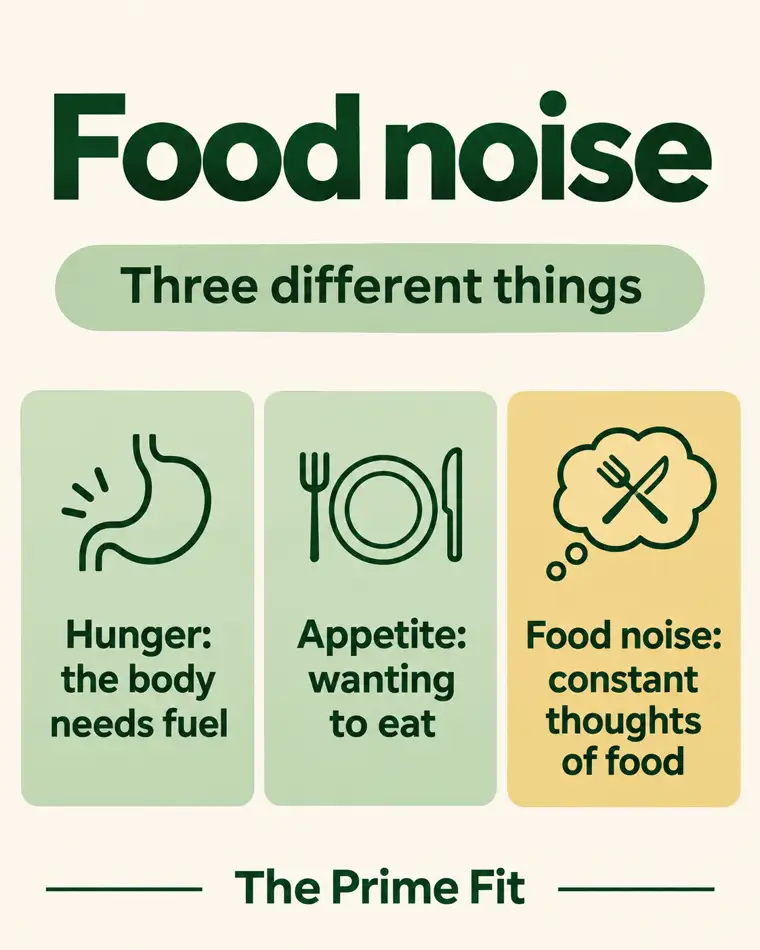
Hunger, appetite and food noise are different things
The body has two overlapping systems that influence eating. The first, sometimes called homeostatic hunger, is about energy needs: when the stomach is empty and fuel is low, hormones signal the brain to eat. The second, hedonic or reward-driven eating, is about pleasure and anticipation: the brain’s reward circuits respond to the sight, smell and thought of tasty food, regardless of need. Food noise belongs mainly to the second system.
| Physical hunger | Food noise | Emotional eating | Binge eating disorder | |
|---|---|---|---|---|
| What drives it | The body needs energy | Brain reward and food cues | Feelings: stress, boredom, sadness, loneliness | A recognised eating disorder with psychological and biological causes |
| How it starts | Gradually, hours after a meal | Any time, often soon after eating | After an emotional trigger | Episodes, often planned or in secret |
| What satisfies it | Almost any food | Usually specific tasty foods; often not satisfied for long | Comfort foods; relief is brief | Large amounts eaten rapidly with a sense of loss of control |
| After eating | Satisfaction | Thoughts move to the next food | Guilt or regret is common | Marked distress, shame |
| What helps | A balanced meal | Medical treatment, structured eating, environment and sleep | Addressing the emotion; coping skills | Specialist assessment and treatment |
These can overlap. Someone may have strong food noise and also eat in response to stress. The distinctions matter because the solutions differ.

Why do some people have more food noise?
The intensity of food noise varies greatly between people, and much of the difference is biological.
Genetics and brain wiring
Many of the genes linked with body weight act in the brain, influencing hunger, fullness and reward. Some people’s brains respond more strongly to food cues from childhood. This is not a character flaw. It is variation, like height.
Hormones of hunger and fullness
Ghrelin from the stomach increases hunger. Leptin from fat tissue, and gut hormones such as GLP-1 and PYY released after meals, signal fullness. In obesity, the brain can become less responsive to these fullness signals.
The effect of dieting
After weight loss by dieting, ghrelin rises and fullness hormones fall, and these changes can persist for a year or more. The brain interprets weight loss as a threat and turns up thoughts of food. This is why food noise often becomes louder precisely when you are trying hardest, and why regain is so common.
Sleep and stress
Short sleep increases ghrelin, lowers leptin and makes the brain’s reward centres more responsive to high-calorie food. Chronic stress raises cortisol, which drives cravings for sweet and fatty foods.
The food environment
Modern foods are engineered to be hard to stop eating, and they are everywhere: packets within reach, advertisements, and delivery apps that bring anything to the door in minutes. Constant cues keep the reward system switched on.
Insulin resistance and blood-sugar swings
Meals high in refined carbohydrate cause a rapid rise and fall in blood sugar, and the fall can trigger renewed hunger and cravings a few hours later. This pattern is common in PCOS and prediabetes.
Restriction
Strictly forbidding foods often makes them more prominent in the mind. Long gaps without eating and very low-calorie days have the same effect.
How loud is yours? A simple self-check
There is no standard clinical test in routine use, but these questions capture the experience. The more you answer “often”, the more food noise is likely to be affecting you.
- Do you think about food when you are not physically hungry?
- Do thoughts about food interrupt your work, conversations or sleep?
- Do you find it hard to stop eating a food you enjoy once you have started?
- Do you feel drawn to eat when you see, smell or hear about food, even after a meal?
- Do you spend a lot of mental energy resisting food?
- Do you feel that your eating is not fully under your control?
If these thoughts come with episodes of eating very large amounts with a sense of loss of control, eating in secret, or making yourself sick, please speak to a healthcare professional. These are signs of an eating disorder, which is treatable and needs specialist care.
How GLP-1 medicines quiet food noise
GLP-1 is a hormone released from the gut after eating. Its receptors are found not only in the pancreas and stomach but also in the brain: in the brainstem and hypothalamus, which regulate hunger and fullness, and in areas involved in reward and motivation. GLP-1 medicines act on these receptors for a full week after each dose. Tirzepatide also acts on receptors for a second gut hormone, GIP.
The effects on eating are several:
- Stronger fullness signals, so smaller meals feel sufficient.
- Slower stomach emptying, which prolongs the feeling of fullness.
- Reduced reward response to food. Brain-imaging studies show less activation in reward areas in response to pictures of tasty food. Patients describe food as simply less interesting.
- Fewer cravings and a shift in preference away from very sweet and fatty foods, reported in trials using food-craving questionnaires.
- Greater sense of control over eating, also measured in trials.
In surveys of people taking these medicines, a majority report that constant thoughts about food reduce substantially. Formal research on “food noise” as a defined concept is still young, so most of the evidence comes from related measures such as cravings and control of eating.
What patients describe
- “I can have biscuits in the house and forget they are there.”
- “I stop when I am full. I never used to notice being full.”
- “My mind has space for other things.”
- “I do not need to argue with myself all evening.”
When does it start, and does everyone feel it?
Some people notice a change within days of the first dose. For others it emerges gradually as the dose is increased over the first two to three months. Not everyone experiences it. A minority feel little change in appetite, and some find the effect is strongest in the days after the injection and fades towards the end of the week. If the noise returns before the next dose, tell your healthcare provider; a dose adjustment may help.
The other side: when appetite becomes too quiet
A quieter mind around food is welcome. A missing appetite is a risk.
| Problem | Why it matters | What to do |
|---|---|---|
| Forgetting to eat or skipping meals | Fatigue, dizziness, headaches, constipation | Eat three small meals by the clock, not by hunger |
| Too little protein | Loss of muscle, hair shedding, weakness | Protein first at every meal; track your intake for a week |
| Too little fluid | Dehydration, constipation, kidney strain | Drink to a plan: 2 to 3 litres a day unless advised otherwise |
| Loss of pleasure in food | Meals become a chore; social eating suffers | Choose foods you enjoy in small portions; discuss the dose with your healthcare provider |
| Very rapid weight loss | More muscle loss, gallstones, loose skin | Ask whether the dose should be held or reduced |
| Low mood or loss of interest in other things | Uncommon, but important | Tell your healthcare provider promptly |
The aim of treatment is a calm, manageable appetite, not its absence. The right dose is the one that turns the volume down while you still eat well.

Using the quiet well
The period when food noise is low is an opportunity. Habits that were nearly impossible to build against a constant craving become achievable.
- Establish a meal rhythm: three balanced meals and one or two planned snacks.
- Learn your fullness signals. Eat slowly and stop at “comfortable”.
- Rebuild your plate: protein, vegetables, then whole grains.
- Start strength training, while energy is not being spent on resisting food.
- Change your surroundings: clear the snack shelf, restock with foods that serve you.
- Notice your triggers. With the urge reduced, it is easier to see which situations used to set it off.
- Find other sources of comfort and reward: a walk, music, calling a friend, a hobby.
These habits are what protect you if the dose is lowered or treatment stops.
Does food noise come back when treatment stops?
For most people, yes. When the medicine leaves the body over several weeks, appetite, cravings and thoughts about food return, often to their previous level. In trials, people who stopped treatment regained much of their lost weight within a year, largely because the biology of hunger reasserted itself. This is not a sign of weakness. It is what happens when an effective treatment for a long-term condition is withdrawn.
It is one of the reasons healthcare professionals usually plan long-term treatment at the lowest effective dose. If you and your healthcare provider do decide to stop, a gradual reduction, a structured eating plan, regular activity and follow-up give you the best chance of holding your progress.
Turning down food noise without medication, or alongside it
Lifestyle measures rarely silence strong food noise completely, but they lower the volume meaningfully, and they make medication work better.
1. Eat enough protein and fibre
Protein is the most filling nutrient, and fibre slows digestion. A breakfast of besan or moong chilla with curd, eggs with vegetables, or sprouts keeps thoughts of food quieter through the morning than tea and biscuits or a sweet cereal.
2. Keep a regular meal pattern
Long gaps and skipped meals make the brain more reactive to food. Eat at roughly the same times each day.
3. Steady your blood sugar
Pair carbohydrates with protein and vegetables, choose whole grains over maida, and avoid sugary drinks. Fewer sugar swings mean fewer cravings.
4. Protect your sleep
Seven to eight hours of sleep is one of the most effective appetite regulators. A short night reliably increases cravings the next day.
5. Manage stress in ways that do not involve food
Breathing exercises, yoga, a walk outdoors, prayer or meditation, and talking to someone you trust all lower the drive to eat for comfort.
6. Reshape your environment
What you see, you want. Keep tempting foods out of the house or out of sight, and keep fruit, roasted chana and nuts visible. Turn off food-delivery notifications, and do not scroll food videos late at night.
7. Allow, do not forbid
Plan small portions of foods you love, eaten slowly and without guilt, preferably after a meal. A planned piece of mithai is less powerful than a forbidden box.
8. Ride the urge
Cravings rise, peak and fall like a wave, usually within 15 to 20 minutes. When one arrives, delay: drink water, change rooms, do a small task, and see whether it passes.
9. Move
Regular activity, including a short walk after meals, improves mood and insulin sensitivity and reduces cravings in many people.
10. Reduce ultra-processed foods
Packaged snacks, sweets and fast foods are designed to override fullness. The less often they are eaten, the less the brain expects them.
Common Indian triggers and what to do
| Trigger | Why it is powerful | A practical response |
|---|---|---|
| Chai with biscuits or namkeen, several times a day | Habit plus refined carbohydrate | Keep the chai; pair it with roasted chana, makhana or nuts, or have it plain |
| Mithai boxes during festivals and after functions | Constant visibility; social meaning | Take one piece on a plate, sit down and enjoy it; pass the box on or share it |
| “Thoda aur lo”: being urged to take more | Hospitality and respect | Serve yourself a small portion first so you can accept a little more; praise the food and decline kindly |
| Office snacks, birthday cake, client lunches | Frequent, unplanned | Eat a protein-rich breakfast and carry your own snack; decide in advance what you will have |
| Evening hunger on returning home | Long gap since lunch; tiredness | A planned 5 pm snack: fruit with nuts, sprouts, curd or a boiled egg |
| Late-night food delivery apps | Fatigue, boredom, instant access | Remove saved cards, mute notifications, set an app curfew, go to bed earlier |
| Eating while watching television or scrolling | Attention is elsewhere; fullness is missed | Plate your food, sit at the table, and finish before screens |
| Weddings and buffets | Variety drives overeating | Survey first, choose three or four dishes, fill half the plate with salad and protein, sit away from the counters |
| Children’s leftovers and cooking tastes | Small bites add up unnoticed | Pack leftovers away immediately; taste with a teaspoon, once |
A day designed to keep food noise low
| Time | What to do | Why it helps |
|---|---|---|
| Morning | Protein-rich breakfast within two hours of waking: moong chilla with curd, eggs with vegetables, or paneer paratha with little oil | Sets up steadier appetite for the day |
| Mid-morning | Water; fruit if hungry | Prevents a long gap before lunch |
| Lunch | Vegetables and dal or protein first, then roti or rice; 10-minute walk afterwards | Gentler rise in blood sugar; fewer afternoon cravings |
| 5 pm | Planned snack: roasted chana, sprouts, curd or nuts with tea | Heads off the evening rush of hunger |
| Evening | Movement or a non-food break after work: walk, shower, music, a call | Replaces the habit of eating to unwind |
| Dinner | Early, balanced, at the table without screens | Fullness is noticed; less late-night eating |
| Night | Kitchen closed; phone notifications off; in bed on time | Removes cues at the most vulnerable hour and protects sleep |
How family members can help
Food noise is invisible to others, and well-meant comments can make it worse. If someone at home is working on this, a few changes help more than advice does. Keep tempting snacks out of sight or out of the house for a while. Avoid pressing food on them, and accept “no, thank you” the first time. Do not comment on what or how much they eat, and never use sweets as reward or comfort. Cook and eat the same balanced meals together so that nobody is singled out. Suggest a walk after dinner. Most importantly, understand that this is biology and not a lack of discipline. Support and a calmer food environment make a real difference.
If food noise returns while you are on treatment
It is common for the effect to feel less dramatic after some months. Possible reasons, and what to do:
- The dose is no longer sufficient. Your healthcare provider may consider an increase, if you are not at the maximum and have tolerated the current dose.
- The body has adapted to a lower weight. Hunger hormones rise as weight falls. This is expected at a plateau.
- Doses have been missed or delayed.
- Sleep has worsened or stress has risen.
- Meals have become irregular or low in protein.
- More alcohol or ultra-processed food has crept in.
- A change in other medicines. Some medicines increase appetite.
Keep a simple diary for a week, noting meals, sleep, stress and when the thoughts are loudest, and take it to your review. The pattern usually points to the solution.

Food noise and emotional health
For many people, food has been a companion through stress, loneliness and celebration. When the pull of food fades, feelings that food used to soothe can surface. Some people feel a sense of loss, or do not know what to do with evenings that once revolved around eating. This is normal, and it is worth acknowledging. Building other sources of comfort and connection is part of treatment. If low mood, anxiety or distress about eating or body image persist, speak to your healthcare provider about psychological support. Counselling, particularly approaches that address eating behaviour, works well alongside medical treatment.
Common myths
“Food noise is just a lack of willpower”
It reflects biology: genes, hormones and brain reward pathways, amplified by the food environment. Willpower is a limited tool against a constant signal.
“Thin people do not have it”
People of any size can experience it, including those who control their weight through great effort.
“The medicine removes hunger completely, and that is the goal”
The goal is a manageable appetite with adequate nutrition. No appetite at all is a reason to review the dose.
“Once it is gone, it is gone for good”
It usually returns if treatment stops, which is why habits and a maintenance plan matter.
“If I still think about food on the injection, it is not working”
Responses vary. Weight, waist, blood tests and your sense of control over eating are better measures than complete silence.
How The Prime Fit helps
At The Prime Fit, we treat appetite as a medical and behavioural matter, not a moral one. Your healthcare provider adjusts your dose to keep appetite manageable without suppressing it completely. Your dietitian builds a meal rhythm with enough protein, plans for your personal triggers, from office snacks to festival sweets, and reviews you every week. If emotional eating or signs of an eating disorder emerge, we help you find the right support.
If food noise has made weight management a daily struggle, book a consultation or read about our GLP-1 therapy and GLP-1 support programme.
Frequently asked questions
What is food noise?
It is an everyday term for persistent, intrusive thoughts about food that are hard to switch off, even when you are not physically hungry. It is not a formal diagnosis.
Is food noise the same as hunger?
No. Hunger is the body’s signal that it needs energy and is satisfied by a meal. Food noise is driven by the brain’s reward system and food cues, and often continues after eating.
How do GLP-1 medicines reduce food noise?
They act on receptors in brain areas that control fullness and reward, strengthen fullness signals and reduce the brain’s response to tempting food. Many people report fewer cravings and a greater sense of control.
How quickly does food noise go away on treatment?
Some people notice a change within days; for others it develops over two to three months as the dose increases. A minority notice little change.
Why does food noise come back before my next injection?
The effect can fade towards the end of the week in some people. Tell your healthcare provider; a dose adjustment may help. Regular meals with protein also steady appetite.
Will food noise return if I stop the medicine?
Usually, yes, over the weeks after stopping. This is why long-term treatment and strong eating habits are planned from the start.
Can I reduce food noise without medicine?
You can lower it with protein- and fibre-rich meals, regular eating, good sleep, stress management, fewer ultra-processed foods and a home environment with fewer cues. Strong food noise may still need medical treatment.
I have no appetite at all on the injection. Is that good?
Not entirely. You still need protein, fluids and nutrients. Eat by the clock, and discuss the dose with your healthcare provider if you are struggling to eat.
Is food noise an eating disorder?
No, but it can occur alongside one. Eating very large amounts with loss of control, eating in secret or purging are signs to seek specialist help.
Do these medicines reduce cravings for alcohol or smoking too?
Some people report this, and early research is exploring it. They are not approved for these uses.
This article is general information and is not a substitute for a consultation. If thoughts about food or eating are causing you distress, please speak to a healthcare professional.