In this article
- What maintenance means
- Why keeping weight off is harder than losing it
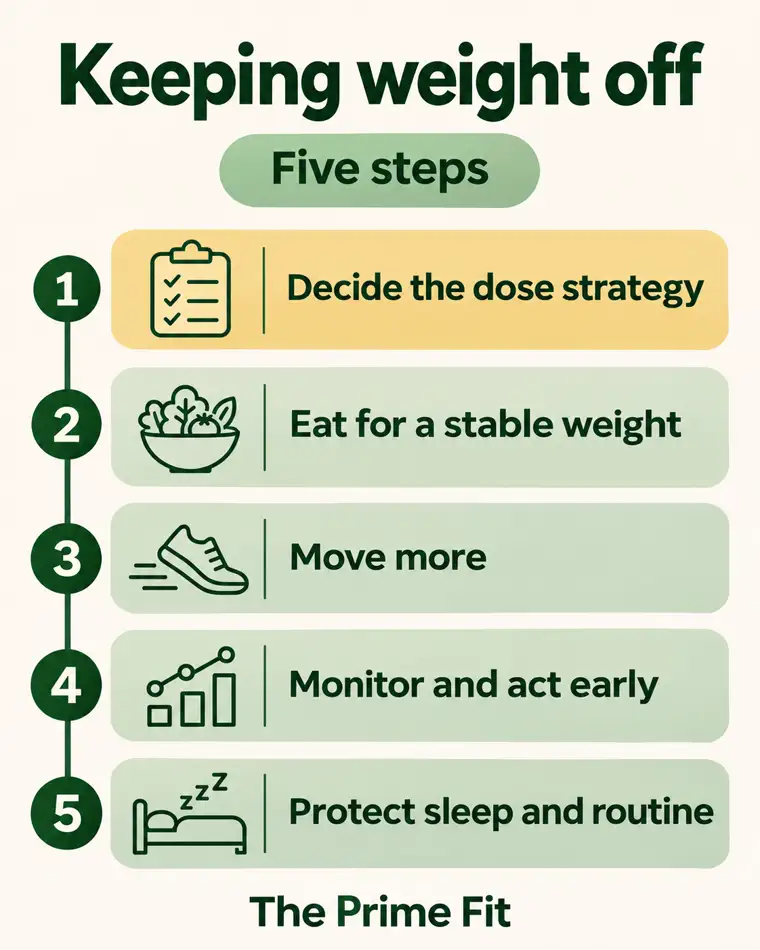
- Step 1: Decide the dose strategy with your healthcare provider
- Step 2: Eat for a stable weight
- Step 3: Move more than you did while losing
- Step 4: Monitor, and act early
- Step 5: Protect the foundations
- Handling the difficult moments
- A weekly routine that works
- If you are maintaining on a reduced dose
- If you are maintaining without the medicine
- Yearly health review
- The first 90 days of maintenance
- Bringing foods back
- The mindset of maintenance
- What long-term maintainers have in common
- Three illustrative examples
- Questions to ask your healthcare provider
- Common myths
- How The Prime Fit supports maintenance
- Frequently asked questions
The day the scale stops falling can feel like an anticlimax. For a year or more you have had a clear aim, a number that kept getting smaller, and regular encouragement from it. Now the number is still, and the question becomes: what happens next?
What happens next matters more than anything that came before. The health benefits of weight loss, lower blood sugar and blood pressure, a healthier liver, easier joints, last only as long as the weight stays off. And the body does not make that easy. After weight loss, it uses less energy and sends stronger hunger signals, for years.
The good news is that maintenance is a skill, and it can be planned. People who keep weight off do a recognisable set of things. This guide turns them into a practical plan for anyone who has lost weight on Mounjaro (tirzepatide), Wegovy or Ozempic (semaglutide). It is general information. Decisions about your dose must be made with your healthcare provider.
What maintenance means
Maintenance is not standing perfectly still. Weight naturally moves by a kilogram or two with fluid, salt, travel and the menstrual cycle. A sensible definition, used in research, is staying within about 3 percent of your new stable weight.
| Your stable weight | Maintenance range (within 3%) |
|---|---|
| 60 kg | 58.2 to 61.8 kg |
| 70 kg | 67.9 to 72.1 kg |
| 80 kg | 77.6 to 82.4 kg |
| 90 kg | 87.3 to 92.7 kg |
Maintenance begins when you have been within this range for about three months, your health goals have been reviewed, and you and your healthcare provider agree that the weight-loss phase is over.
Why keeping weight off is harder than losing it
- Your body needs less. A lighter body burns fewer calories, and after weight loss energy use often falls a little more than the change in size alone would predict.
- Hunger hormones rise. Ghrelin, which drives hunger, goes up, and hormones that signal fullness go down. These changes can persist for a year or longer.
- Food becomes more rewarding. The brain responds more strongly to tempting food after weight loss.
- Motivation changes. The scale no longer rewards you weekly, compliments fade, and attention moves elsewhere.
- The environment has not changed. The same snacks, the same celebrations, the same long working days are still there.
A GLP-1 medicine counters the first three. That is why trials show that weight is held while treatment continues and tends to return when it stops. It is also why maintenance for most people involves continued treatment at some level, alongside habits that do part of the work.
Step 1: Decide the dose strategy with your healthcare provider
| Option | What it involves | Suits | Evidence |
|---|---|---|---|
| Continue the same dose | Stay on the dose that got you here | People who tolerate it well and can sustain it | Strongest: weight maintained for three to four years in trials |
| Step down to the lowest effective dose | Reduce one step at a time, watching appetite and weight for 4 to 8 weeks at each step | People with side effects at higher doses, or for whom cost matters | Common in practice; trial data limited but growing |
| Switch to a more affordable or convenient product | For example an approved generic of the same ingredient, or a different medicine | Cost or supply difficulties | Same ingredient: expected to hold. Different molecule: re-titration needed |
| Taper and stop, with intensive support | Step down over several months, then stop, with structured nutrition, exercise and close follow-up | People who strongly prefer not to take long-term medication, or who are planning pregnancy | Most people regain some weight; a minority maintain |
How to find your lowest effective dose
- Start only after at least three months at a stable weight.
- Reduce by one approved dose step.
- Keep everything else the same: meals, activity, sleep.
- Weigh weekly and note your appetite.
- If weight stays within range for six to eight weeks, you may try a further step down.
- If hunger returns strongly and weight climbs towards the top of your range, go back up one step. That is your maintenance dose.
Do not stretch the interval between injections or split doses unless your healthcare provider specifically advises it. These approaches have not been well studied.

Step 2: Eat for a stable weight
During weight loss you were eating less than your body used. In maintenance, intake and use are equal. For most people that means eating slightly more than during the loss phase, but less than before treatment, because a lighter body needs less.
| What stays the same | What changes |
|---|---|
| Three regular meals, protein first | Slightly larger portions of whole grains, fruit and healthy fats |
| Vegetables at lunch and dinner | A wider range of foods, including planned treats |
| Protein target of about 1.0 to 1.5 g per kg of body weight | The target is now based on your new, lower weight |
| Little sugar, refined flour and fried food | Occasional small portions, by plan, not by impulse |
| Water as the main drink | Nothing |
| Eating slowly, stopping at comfortable fullness | Nothing |
Add back slowly
If you are still losing weight and wish to stop, add about 100 to 150 calories a day, for example an extra roti, a fruit and a handful of nuts, or a glass of milk, and watch for two weeks. Repeat until weight is steady. Adding back too much too quickly is the commonest reason for an early rebound.
The maintenance plate
- Half: vegetables and salad.
- A quarter: protein, such as dal, chana, paneer, curd, eggs, fish or chicken.
- A quarter: whole grains, one to two rotis or a small katori of rice or millet.
- Plus: a teaspoon or two of oil in cooking, curd or chaas, and fruit once or twice a day.
A sample maintenance day
| Meal | Vegetarian | Non-vegetarian |
|---|---|---|
| Breakfast | 2 moong or besan chillas with paneer, curd, 1 fruit | 2-egg vegetable omelette, 2 slices whole wheat toast, 1 fruit |
| Mid-morning | A handful of nuts; tea without sugar | Chaas; a few almonds |
| Lunch | Salad, 2 rotis, dal or rajma, sabzi, curd | Salad, 1 katori rice or 2 rotis, fish or chicken curry, sabzi |
| Evening | Sprouts chaat or roasted chana; fruit | Boiled egg or roasted chana; fruit |
| Dinner | Paneer or tofu with vegetables, dal, 1 to 2 phulkas | Grilled chicken or fish with vegetables, dal, 1 to 2 phulkas |
Planned flexibility
A maintenance diet that forbids everything you enjoy will not last. Decide in advance how treats fit in: for example, one restaurant meal and one dessert a week, eaten slowly and without guilt, with normal meals either side. What undoes maintenance is not the planned mithai at a wedding. It is the unplanned daily drift.
Step 3: Move more than you did while losing
Physical activity is the single habit most consistently linked with keeping weight off. Studies of people who have maintained large weight losses for years find that most are active for about an hour a day.
| Type | Target for maintenance | Examples |
|---|---|---|
| Aerobic activity | About 200 to 300 minutes a week of moderate activity; more than the 150 minutes advised for general health | Brisk walking, cycling, swimming, dancing, badminton |
| Strength training | 2 to 3 sessions a week, progressing over time | Squats, push-ups, rows, presses, with body weight, bands or weights |
| Everyday movement | 7,000 to 10,000 steps a day; break up long sitting | Stairs, walking while on calls, walking after meals |
| Flexibility and balance | Two or three times a week | Yoga, stretching |
If these targets seem far off, build towards them. Ten minutes after each meal is thirty minutes a day. Strength training matters especially: it rebuilds or preserves the muscle that keeps your energy needs up.
Step 4: Monitor, and act early
People who maintain their weight check it regularly and respond to small changes. A simple traffic-light system makes this automatic.
| Zone | Where your weight is | What to do |
|---|---|---|
| Green | Within 2% of your stable weight | Carry on. Weigh weekly |
| Amber | 2 to 3% above, for two consecutive weeks | Two-week reset: food and drink diary, remove liquid calories and unplanned snacks, protein at every meal, daily walk, early nights. Check for constipation and missed doses |
| Red | More than 3% above, or rising for a month | Book a review with your healthcare provider and dietitian. Discuss dose, other medicines, blood tests and a structured plan |
| Stable weight | Amber begins at | Red begins at |
|---|---|---|
| 60 kg | 61.2 kg | 61.8 kg |
| 70 kg | 71.4 kg | 72.1 kg |
| 80 kg | 81.6 kg | 82.4 kg |
| 90 kg | 91.8 kg | 92.7 kg |
What to track
- Weight: once a week, same day and time.
- Waist: once a month.
- Strength: your training log.
- A favourite item of clothing that fits now.
- Blood pressure at home, if you had high readings.
- Blood tests yearly, or as your healthcare provider advises.
Regain of two kilograms is easy to reverse. Regain of ten is a new weight-loss project. Acting at amber is the whole point.
Step 5: Protect the foundations
Sleep
Seven to eight hours at regular times. Short sleep raises hunger hormones and cravings the next day and is consistently linked with regain.
Stress
If food was your main way of coping, the pull returns under pressure. Keep at least one daily outlet that is not food: a walk, exercise, prayer or meditation, a hobby, a conversation.
Alcohol
Alcohol adds calories, loosens restraint and disturbs sleep. Keep it occasional and small.
Regular meals
Skipping meals and then eating a great deal later is a common route to regain. Three meals, no long gaps.
Your surroundings
Keep the home food environment you built during weight loss: fruit and roasted chana visible, sweets and namkeen out of sight or out of the house, measured oil, water on the table.
Handling the difficult moments
| Situation | Strategy |
|---|---|
| Festivals such as Diwali, Eid or Christmas | Decide which occasions matter and enjoy them. Keep ordinary days ordinary. Take a small portion of sweets after a meal. Walk daily. Weigh once in the middle of the season |
| Wedding season | Eat a protein snack before leaving. Survey the buffet, choose three or four dishes, sit away from the counters. Dance |
| Holidays and travel | Keep breakfast and one other meal structured each day. Walk everywhere. Carry your medicine properly. Return to routine the day you get home |
| Illness or injury | Keep protein up; move what you can. Resume activity gradually |
| A stressful period at work or home | Simplify: repeat the same few meals, protect sleep, keep short walks. Do not aim for perfection |
| A missed dose or a break in treatment | Follow the missed-dose rule. After a longer gap, see your healthcare provider before restarting |
| Weight creeping up for no obvious reason | Three-day food and drink diary; check constipation, sleep, new medicines; review thyroid and other tests |
| Loss of motivation | Set a non-scale goal: a walking event, a strength target, a blood test result. Book a review |
One principle applies to all of them: the next meal is a normal meal. A heavy dinner is one meal. Skipping breakfast to compensate, then overeating again, is how one meal becomes a pattern.
A weekly routine that works
| Day | Anchor habits |
|---|---|
| Sunday | Weigh in; plan the week’s meals; cook pulses and set curd; injection day if it suits you |
| Monday | Strength training; walk after dinner |
| Tuesday | 45-minute brisk walk |
| Wednesday | Strength training |
| Thursday | Walk, cycle or swim; yoga or stretching |
| Friday | Strength training |
| Saturday | A longer walk, a sport or an active outing; the week’s planned restaurant meal or treat |
| Every day | Three meals with protein; 2 to 3 litres of fluid; seven to eight hours of sleep |
| Once a month | Waist measurement; review of the training log |
If you are maintaining on a reduced dose
Appetite will be a little stronger than at the higher dose. That is expected. Lean more on structure: fixed meal times, a planned afternoon snack with protein, and vegetables for volume. If you find yourself thinking about food far more, grazing in the evenings, or moving steadily through the amber zone, tell your healthcare provider. Returning to the previous dose is not a failure. It is the correct use of the information.
If you are maintaining without the medicine
Some people stop, because of pregnancy plans, cost, side effects or preference. The honest position is that most regain some weight in the following year, and the aim is to limit it.
- Taper over several months if you can, not abruptly.
- Expect hunger to return three to five weeks after the last dose, and be ready with structured meals.
- Raise activity towards the upper targets above.
- Weigh weekly without fail for the first year.
- Agree in advance what you will do at the amber and red thresholds, including whether you would restart treatment.
- Keep follow-up appointments, monthly at first.
- Consider other support your healthcare provider suggests, such as metformin where it is indicated.
Yearly health review
| Check | Why |
|---|---|
| Weight, waist, blood pressure, body composition | Confirm stability and muscle |
| HbA1c or fasting glucose, lipids, liver enzymes | Confirm that health gains are holding |
| Kidney function | Routine monitoring on treatment |
| Thyroid function, if you take thyroid tablets | The dose may need adjusting at your new weight |
| Vitamin B12, vitamin D, iron | Intake is lower than before treatment |
| Review of all medicines | Blood pressure and diabetes treatment may need reducing |
| Dose review | Is this still the lowest effective dose? |
| Bone health, in older adults and after menopause | Weight loss can reduce bone density |
| Life plans | Pregnancy, surgery, travel, finances |
The first 90 days of maintenance
| Period | Focus | What to do |
|---|---|---|
| Days 1 to 30 | Confirm stability | Keep the dose and routine unchanged. Weigh weekly. If still losing and you wish to stop, add 100 to 150 calories a day and reassess after two weeks. Record your stable weight and thresholds |
| Days 31 to 60 | Build the activity base | Move towards 200 minutes of activity a week. Progress strength training. Have blood tests and body composition checked |
| Days 61 to 90 | Review the dose | See your healthcare provider. If weight has been within range for three months, discuss whether to stay or step down one dose. Agree the plan for the next six months |
Bringing foods back
During weight loss, many people avoid certain foods entirely. In maintenance, a few can return in a controlled way. Reintroduce one at a time, in a defined portion, at a planned moment: a small katori of rice at lunch, a piece of mithai after a festival meal, a restaurant dinner once a week. Watch your weight for two weeks before adding another. Foods you find hard to stop eating once you start, whether namkeen, biscuits or ice cream, are better kept out of the house and enjoyed occasionally elsewhere, in a single serving. This is not about good and bad foods. It is about knowing which ones you can eat in moderation and which ones run away with you.
The mindset of maintenance
- From project to practice. Weight loss was a project with an end. Maintenance is a way of living.
- From the scale to strength. Set goals you can still improve: lifting more, walking further, better blood tests.
- From perfect to consistent. What you do on most days matters. What you do on a few days does not.
- From guilt to information. A rise on the scale is a signal to act, not a verdict on you.
- From alone to supported. People who stay in contact with a healthcare team do better.
It is also normal to feel some loss when the excitement of losing weight ends. Notice what you have gained instead: stamina, easier movement, better sleep, lower health risks.
What long-term maintainers have in common
Research following people who have kept off substantial weight for years points to a consistent set of behaviours.
| Habit | How to apply it |
|---|---|
| High levels of physical activity | About an hour a day of walking or equivalent |
| Regular self-weighing | Weekly, with a plan for small gains |
| A consistent eating pattern | Similar meals on weekdays and weekends; no “on” and “off” days |
| Breakfast most days | A protein-rich first meal |
| Limited screen time | Less sitting in the evening; no eating in front of screens |
| Catching slips early | Acting at 2 kg, not 10 |
| Continued support | Regular contact with a healthcare professional, dietitian or group |
Three illustrative examples
These invented examples show different routes. They are not predictions.
Maintaining on a lower dose
A 47-year-old woman reaches 68 kg on 10 mg of tirzepatide. After four stable months she steps down to 7.5 mg, then 5 mg. At 5 mg her weight holds between 67 and 69 kg for a year, with strength training three times a week.
Catching it at amber
A 52-year-old man stable at 84 kg drifts to 86 kg after the wedding season. His diary shows sweet tea and evening namkeen have returned. A two-week reset brings him back to 84.5 kg without any change in dose.
Stopping for a pregnancy
A 31-year-old woman stops semaglutide two months before trying to conceive. With weekly dietitian contact, structured meals and daily walks she gains 3 kg over four months, far less than she feared, and enters pregnancy healthier than she has been in years.
Questions to ask your healthcare provider
- Have I reached a healthy plateau, and have my health goals been met?
- Should I stay on this dose or try stepping down?
- What weight range should I aim to stay within?
- At what weight should I contact you?
- Which tests should be repeated each year?
- Do any of my other medicines need to change at my new weight?
- If I want to stop, how should we do it?
Common myths
“Once I reach my goal, the hard part is over”
Maintenance is the longer and more important part.
“I can go back to eating the way I used to”
A lighter body needs less than it did. The old pattern leads to the old weight.
“Maintenance means the same dose for life”
Many people hold their weight on a lower dose.
“Exercise does not matter if the medicine controls appetite”
Activity is the habit most strongly linked with keeping weight off, and it protects muscle.
“A small gain is nothing to worry about”
Small gains are the only ones that are easy to reverse.
“Needing to go back up a dose means I failed”
It means you have found the dose your body needs.
How The Prime Fit supports maintenance
At The Prime Fit, maintenance is a programme in its own right. When you reach a plateau, your healthcare provider reviews your health goals and plans the dose with you, including a careful step-down where appropriate. Your dietitian adjusts your meals for a stable weight, sets your personal green, amber and red thresholds, and stays in regular contact. We repeat your blood tests and body composition yearly, and you can reach us as soon as the scale moves.
To plan your maintenance, book a consultation or read about our GLP-1 support programme.
Frequently asked questions
How do I maintain my weight after losing it on a GLP-1 medicine?
Agree a dose plan with your healthcare provider, eat regular protein-based meals at a level that keeps weight steady, be active for about an hour a day including strength training, weigh weekly and act early on small gains.
Do I have to stay on the medicine to maintain?
Most people need continued treatment at some dose, because weight usually returns after stopping. Many hold their weight on a lower dose.
Can I reduce my dose once I reach my goal?
Often, yes. Step down one dose at a time after a few stable months, with your healthcare provider, and watch weight and appetite for six to eight weeks at each step.
How much should I eat in maintenance?
Slightly more than during weight loss, but less than before treatment. Add about 100 to 150 calories a day at a time until your weight is steady.
How much exercise do I need?
About 200 to 300 minutes a week of moderate activity plus strength training two to three times a week.
How often should I weigh myself?
Once a week, on the same day and at the same time, looking at the trend over a month.
How much regain should prompt action?
A gain of 2 to 3 percent above your stable weight for two weeks calls for a reset. More than 3 percent, or a steady rise over a month, calls for a review with your healthcare provider.
Can I take the injection less often to maintain?
Longer intervals have not been well studied and are not an approved schedule. Use a lower approved dose instead, unless your healthcare provider advises otherwise.
What if I regain weight?
Act early. Review your eating, activity and sleep, and see your healthcare provider. Returning to a previous dose or restarting treatment is a reasonable medical step.
Will I always feel hungry in maintenance?
On continued treatment, appetite stays manageable. On a lower dose or after stopping, hunger is stronger, and structured meals with protein and fibre help.
This article is general information and is not a substitute for a consultation. Do not change the dose or schedule of a prescription medicine without your healthcare provider’s advice.