In this article
- What is obstructive sleep apnoea?
- What are the symptoms of sleep apnoea?
- Why does excess weight make sleep apnoea worse?
- What did the SURMOUNT-OSA trial find?
- Is tirzepatide approved for sleep apnoea?
- Can Mounjaro replace CPAP?
- How is sleep apnoea diagnosed?
- What other treatments are there for sleep apnoea?
- Why does sleep apnoea matter before anaesthesia or sedation?
- Is it safe to drive with sleep apnoea?
- What improvement can you expect, and when should you retest?
- Who should be assessed for sleep apnoea?
- Common myths
- Questions to ask your healthcare provider
- How The Prime Fit helps
- Frequently asked questions
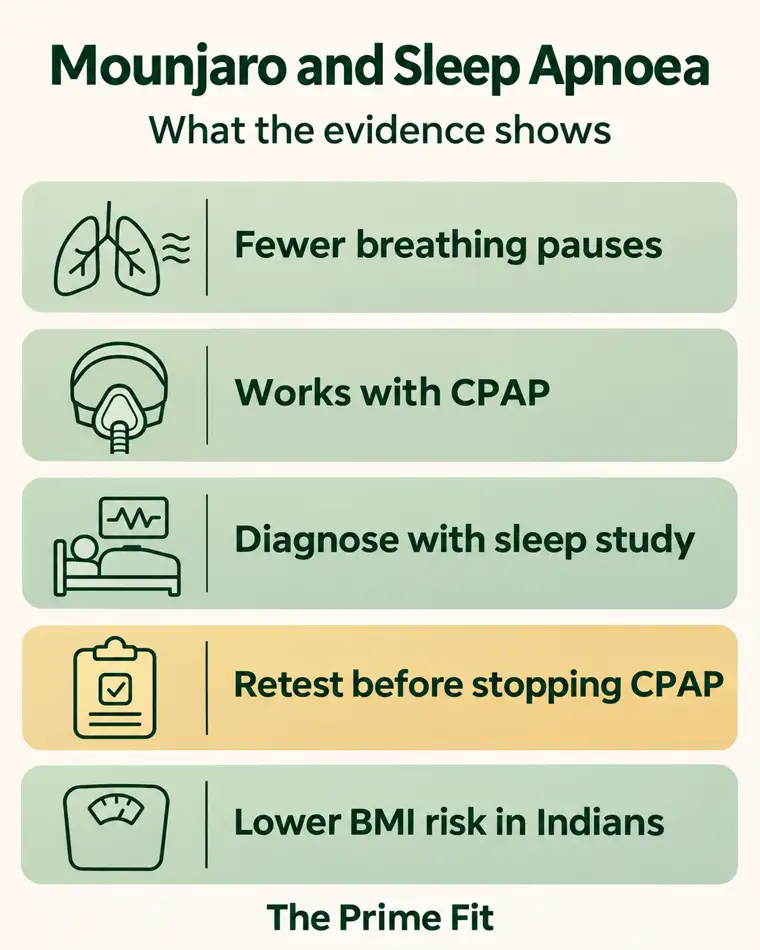
Can Mounjaro for sleep apnoea really help? For adults who have obesity together with moderate to severe obstructive sleep apnoea, the evidence says yes. In the SURMOUNT-OSA trial, tirzepatide (the medicine in Mounjaro) substantially reduced the number of breathing interruptions per hour of sleep compared with placebo over about a year, both in people using CPAP and in people who were not.
That is an important finding, but it needs careful reading. The benefit came largely with significant weight loss, it was seen in people whose sleep apnoea had been confirmed by a sleep study, and it does not mean a CPAP machine can be put away. Whether CPAP can be reduced or stopped is a decision for a sleep specialist after a repeat sleep study.
This guide explains what obstructive sleep apnoea is, why weight matters, what the trial showed, how the condition is diagnosed and treated, and who should be assessed. Spellings vary: “sleep apnoea” and “sleep apnea” are the same condition.
What is obstructive sleep apnoea?
Obstructive sleep apnoea, or OSA, is a condition in which the upper airway repeatedly narrows or closes during sleep. Each time, airflow drops or stops for ten seconds or more, oxygen levels may dip, and the brain briefly rouses the sleeper to reopen the airway. This can happen many times an hour, all night, usually without the person remembering it.
The result is broken, shallow sleep and repeated strain on the heart and blood vessels. Untreated moderate to severe OSA is associated with high blood pressure, heart rhythm problems, heart disease, stroke, type 2 diabetes and road accidents caused by sleepiness.
What are the symptoms of sleep apnoea?
- Loud, habitual snoring, often heard from another room
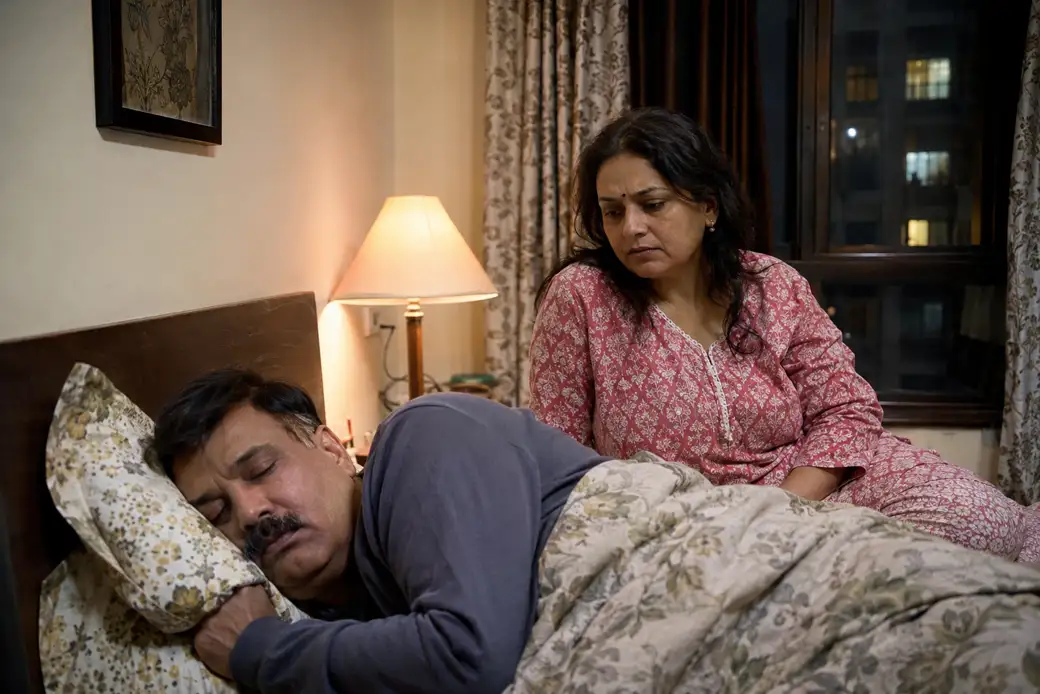
- Pauses in breathing, choking or gasping noticed by a bed partner
- Daytime sleepiness: dozing in meetings, in front of the television, or as a passenger
- Morning headache and a dry mouth on waking
- Waking unrefreshed however long you sleep
- Poor concentration, irritability or low mood
- Blood pressure that is hard to control
Snoring alone is not sleep apnoea. Many people snore without any breathing pauses. Equally, some people with OSA, particularly women, snore little and mainly report tiredness, poor sleep or morning headaches.
Why does excess weight make sleep apnoea worse?
The airway behind the tongue and soft palate is a soft tube held open by muscle tone. During sleep that tone relaxes. Extra weight narrows the tube in several ways.
- Fat around the neck presses on the airway from outside.
- Fat within the tongue and throat tissues makes them bulkier, so they fall back more easily.
- Abdominal fat pushes the diaphragm up and reduces lung volume when lying down, which removes some of the downward pull that helps keep the airway open.
This is why weight loss by any method tends to improve OSA, and why greater weight loss generally brings greater improvement. It is also why the condition can return if weight is regained.
Why can Indians have sleep apnoea at a lower BMI?
People of South Asian origin tend to carry more fat around the abdomen and neck at a given body mass index than people of European origin. Differences in the shape of the jaw and face may also leave a smaller airway to begin with. For both reasons, OSA can occur in Indians who do not look very overweight.
This fits the lower Asian Indian cut-offs used for weight-related risk: overweight from a BMI of 23 and obesity from 25, with a waist above 90 cm in men or 80 cm in women signalling excess abdominal fat. You can check yours with our BMI calculator. A normal-looking BMI does not rule out sleep apnoea if the symptoms are present.
What did the SURMOUNT-OSA trial find?
SURMOUNT-OSA was a randomised, placebo-controlled study published in 2024. It enrolled adults with obesity and moderate to severe OSA and followed them for about a year. It was run as two parallel studies: one in people who were not using CPAP, and one in people who were using CPAP and continued it. Participants received weekly tirzepatide, increased to the highest dose they could tolerate, or placebo, alongside lifestyle advice.
The main measure was the apnoea-hypopnoea index (AHI), the number of breathing interruptions per hour of sleep. The key findings, described approximately:
- People on tirzepatide had a much larger fall in AHI than those on placebo, in both studies. On average the number of events per hour fell by roughly half or a little more with tirzepatide, while the placebo groups changed only slightly.
- Body weight fell substantially on tirzepatide, by close to a fifth of starting weight on average.
- A sizeable minority of people on tirzepatide ended the study with an AHI in the normal range, or in the mild range without daytime sleepiness.
- Blood pressure, markers of inflammation and patient-reported sleep quality also improved.
- Side effects were the familiar ones: mainly nausea, loose stools, vomiting and constipation, usually mild to moderate.
Reading the result sensibly
Participants started with severe disease on average, so even after a large improvement many still had some sleep apnoea. The trial lasted about a year, was in people with obesity, and did not test stopping CPAP. It tells us tirzepatide is an effective additional treatment, not a replacement for a proper sleep assessment.
Does Mounjaro stop snoring?
The trial measured breathing interruptions, not snoring volume, so there is no reliable figure for snoring. In practice, snoring that is driven by excess weight often becomes quieter as weight falls, and partners frequently notice the change before the person does. Snoring caused mainly by nasal blockage, enlarged tonsils, alcohol or sleeping position may change little. Quieter snoring is encouraging, but it is not proof that sleep apnoea has resolved.
Is tirzepatide approved for sleep apnoea?
Following the trial, regulators in some countries, including the United States, have approved tirzepatide for moderate to severe obstructive sleep apnoea in adults with obesity, to be used with a reduced-calorie diet and physical activity. Approved uses differ from country to country and change over time.
In India, ask your prescriber what Mounjaro is currently approved for and whether you meet the criteria for treatment on weight or diabetes grounds. Our guide to who is eligible for weight loss injections explains the usual criteria, and who should not take Mounjaro covers the situations where it is unsuitable.

Can Mounjaro replace CPAP?
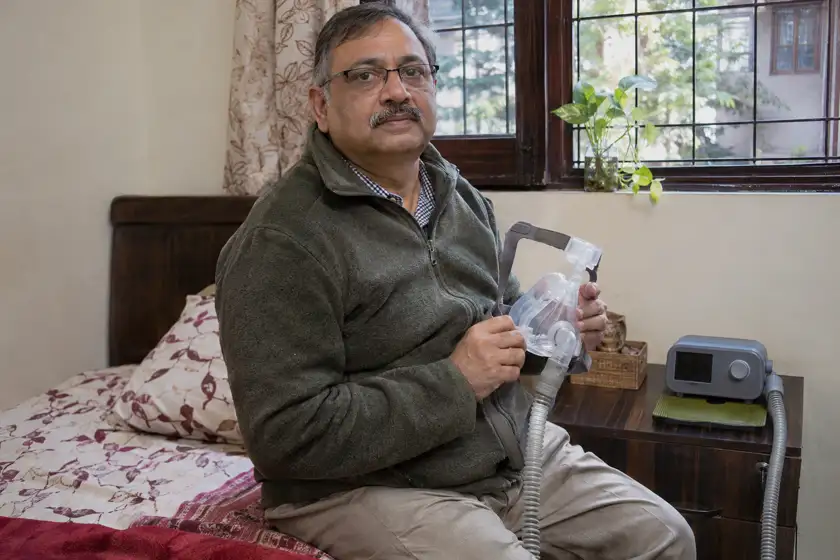
Not by itself, and not by your own decision. CPAP (continuous positive airway pressure) works from the first night by holding the airway open with gentle air pressure. Tirzepatide works gradually, over months, through weight loss. During those months the airway still collapses if CPAP is not used.
- Keep using CPAP every night while you lose weight.
- Tell your sleep specialist about your weight loss. The pressure setting or mask fit may need adjusting as your weight and face shape change.
- Ask for a repeat sleep study once your weight has fallen substantially and stabilised.
- Stop or reduce CPAP only if the sleep specialist confirms, from that study, that it is safe.
Do not stop CPAP because you feel better
Feeling more alert and snoring less are welcome signs, but they do not measure oxygen dips or breathing pauses. Stopping CPAP without a repeat sleep study can leave significant sleep apnoea untreated, with risks to the heart and to your safety on the road.
How is sleep apnoea diagnosed?
Diagnosis needs a sleep study. Questionnaires about snoring, sleepiness, blood pressure and neck size help decide who should be tested, but they cannot confirm or exclude the condition.
- Laboratory sleep study (polysomnography). An overnight test in a sleep laboratory that records brain activity, breathing, oxygen, heart rhythm and body position. It is the most complete test.
- Home sleep apnoea test. A smaller device worn overnight at home that records breathing, oxygen and heart rate. It is convenient and suits many adults with a high likelihood of OSA and no major heart or lung disease. A normal home test in someone with strong symptoms may still need a laboratory study.
Both give an AHI, which is used to grade severity.
| Severity | Breathing events per hour (AHI) | What it usually means |
|---|---|---|
| Normal | Fewer than 5 | No sleep apnoea on this test |
| Mild | 5 to under 15 | Treatment depends on symptoms and other health conditions |
| Moderate | 15 to under 30 | Treatment is generally advised |
| Severe | 30 or more | Treatment is strongly advised; higher risk to heart health and alertness |
What other treatments are there for sleep apnoea?
| Treatment | How it helps | Best suited to |
|---|---|---|
| CPAP | Air pressure through a mask keeps the airway open | Moderate to severe OSA; the standard first choice |
| Oral appliance (mandibular advancement device) | A fitted dental device holds the lower jaw forward | Mild to moderate OSA, or people who cannot use CPAP |
| Positional therapy | Devices or habits that keep you off your back | OSA that occurs mainly when lying on the back |
| Weight loss (diet, activity, medicines or surgery) | Reduces fat around the airway and abdomen | Anyone with OSA and excess weight |
| Surgery to the nose, throat or jaw | Removes or repositions obstructing tissue | Selected cases with a clear structural cause |
| Avoiding alcohol and sedatives | Both relax the airway muscles and deepen pauses | Everyone with OSA or heavy snoring |
Alcohol in the evening is a particular problem, because it worsens both snoring and breathing pauses. See GLP-1 injections and alcohol. For people with severe obesity, weight-loss surgery is another route to large and lasting weight loss; our comparison of injections versus bariatric surgery explains the trade-offs.
Why does sleep apnoea matter before anaesthesia or sedation?
Anaesthetic and sedative medicines relax the airway and blunt the drive to breathe. In someone with OSA, especially if undiagnosed, this raises the risk of breathing problems during and after a procedure. Before any operation, endoscopy or dental sedation:
- tell the surgical and anaesthetic team that you have, or might have, sleep apnoea;
- bring your CPAP machine to hospital if you use one;
- tell them you take Mounjaro, because it slows stomach emptying and the team may give specific fasting or timing instructions.
More detail is in GLP-1 medicines before surgery, anaesthesia or endoscopy.
Is it safe to drive with sleep apnoea?
Sleepiness at the wheel is one of the most serious consequences of untreated OSA. If you have fought sleep while driving, drifted between lanes or had a near miss, stop driving until you have been assessed and treated. Effective treatment, usually CPAP, restores alertness in most people within days to weeks.
What improvement can you expect, and when should you retest?
Improvement follows weight loss, so it is gradual. Many people notice quieter snoring and better mornings within the first few months, but the full effect on breathing pauses was measured at about a year in the trial. Results vary: people who lose more weight tend to improve more, and those with a strong structural cause may improve less. Our guide to Mounjaro results month by month describes the usual pace of weight loss.
Consider a repeat sleep study when:
- your weight has fallen substantially, for example by about a tenth of your starting weight or more, and has been stable for a while;
- your CPAP pressure feels too strong or the mask no longer fits;
- symptoms have changed, for better or for worse;
- you and your sleep specialist are discussing whether CPAP is still needed.
If treatment is stopped and weight returns, sleep apnoea commonly returns with it, so long-term weight maintenance is part of the plan.
Who should be assessed for sleep apnoea?
- Anyone with loud habitual snoring plus witnessed pauses, gasping or daytime sleepiness
- People with a BMI of 25 or more, or a large waist or neck, who wake unrefreshed
- People with high blood pressure that needs several medicines, atrial fibrillation, type 2 diabetes or heart failure
- Anyone who has nodded off while driving
- People planning surgery or sedation who snore heavily
- Women after menopause with new snoring, poor sleep or morning headaches

Common myths
- “Snoring is just a sign of deep sleep.” Loud habitual snoring means the airway is partly obstructed. With pauses or sleepiness, it needs testing.
- “Only very overweight men get sleep apnoea.” Women, and Indians with a modest BMI, are affected too.
- “Once I start Mounjaro I can stop CPAP.” Only a repeat sleep study can show whether CPAP is still needed.
- “A nightcap helps me sleep.” Alcohol makes breathing pauses longer and sleep more broken.
- “If I sleep eight hours I cannot have sleep apnoea.” Hours in bed do not show sleep quality. Waking tired after a full night is a classic clue.
Questions to ask your healthcare provider
- Do my symptoms and measurements justify a sleep study, and should it be at home or in a laboratory?
- What was my AHI, and how low did my oxygen fall?
- Am I eligible for Mounjaro in India on the basis of my weight and health conditions?
- Should I start or continue CPAP while I lose weight?
- When should my sleep study be repeated?
- Is it safe for me to drive at present?
How The Prime Fit helps
At The Prime Fit, assessment for medical weight management includes asking about snoring, sleep quality and daytime sleepiness, because these shape both risk and priorities. Where sleep apnoea is suspected, we advise a formal sleep evaluation with a sleep specialist. For people who are suitable for Mounjaro our team provides nutrition support to protect muscle and energy during weight loss, and regular follow-up to track weight, waist, blood pressure and symptoms. We encourage patients to keep their sleep specialist informed so that CPAP settings and repeat testing keep pace with their progress.
Frequently asked questions
Does Mounjaro cure sleep apnoea?
It can greatly reduce breathing interruptions in adults with obesity, and some people improve enough to fall into the normal or mild range. Many still have some sleep apnoea afterwards, and it can return if weight is regained. A repeat sleep study is the only way to know where you stand.
How long does Mounjaro take to improve sleep apnoea?
Improvement tracks weight loss and builds over months. The trial measured the main result at about one year. Some people notice quieter snoring and better mornings earlier than that.
Can I stop CPAP once I lose weight on Mounjaro?
Only if a sleep specialist confirms it after a repeat sleep study. Until then, continue CPAP every night. Your pressure settings may need adjusting as your weight falls.
Will Mounjaro help snoring if I do not have sleep apnoea?
Mounjaro is not a treatment for simple snoring and is prescribed only when the criteria for its approved uses are met. If excess weight is contributing, snoring often eases as weight falls by any method. Other causes such as nasal blockage need their own treatment.
Is Mounjaro approved for sleep apnoea in India?
Approved uses differ by country and are updated over time. Some regulators abroad have approved tirzepatide for moderate to severe OSA in adults with obesity. Ask your prescriber about the current position in India and whether you qualify on weight or diabetes grounds.
Can thin people have sleep apnoea?
Yes. Jaw and airway shape, enlarged tonsils, nasal blockage, age and family history all play a part. Indians can also develop OSA at a lower BMI than Western populations.
Is a home sleep test good enough?
For many adults with typical symptoms and no major heart or lung disease, a home test is adequate. If it is normal but symptoms are strong, or if other sleep disorders are suspected, a laboratory study may be advised.
Do other weight-loss medicines help sleep apnoea?
Weight loss by any effective method tends to improve OSA. Tirzepatide currently has the most direct trial evidence in people with obesity and moderate to severe OSA.
This article is general patient education and is not a substitute for individual medical advice. Sleep apnoea should be diagnosed and managed by qualified sleep and medical professionals. Mounjaro is a prescription medicine: follow the leaflet supplied with your pen and your prescriber’s instructions, and do not change CPAP or any other treatment without professional advice.