In this article
- PCOS in brief
- Why PCOS makes weight so hard to lose
- How GLP-1 medicines act on the PCOS loop
- What the studies show
- What the guidelines say
- Who with PCOS might be suitable?
- GLP-1 medicines and metformin compared
- The contraceptive pill: an important interaction
- Fertility and planning a pregnancy
- What improves, and when
- Side effects and precautions for women with PCOS
- Eating for PCOS on GLP-1 treatment
- Why weight treatment matters beyond periods
- Treatments that work alongside
- Exercise
- Tests before and during treatment
- What happens when treatment stops?
- Three illustrative examples
- Questions to ask your healthcare provider
- Common myths
- How The Prime Fit helps women with PCOS
- Frequently asked questions
Women with polycystic ovary syndrome (PCOS) are often told to “just lose weight” by people who do not appreciate how difficult PCOS makes it. Insulin resistance drives hunger, cravings and fat storage around the waist. Diets that work for others produce slow results or none, and the weight that is lost returns quickly. Many women arrive at a weight centre after years of effort, tired of being blamed.
It is no surprise, then, that interest in GLP-1 medicines such as Wegovy (semaglutide) and Mounjaro (tirzepatide) is high among women with PCOS. These medicines act on appetite and on insulin, the two things PCOS disturbs. The question is whether they help, how much, and whether they are safe for women who may want to conceive.
This guide sets out what is known. It is general information and does not replace advice from your own healthcare provider and gynaecologist. GLP-1 medicines are prescription treatments and are not suitable during pregnancy or when trying to conceive.
PCOS in brief
PCOS is the most common hormonal condition in women of reproductive age, affecting roughly one in ten, and possibly more in India. It is diagnosed when at least two of the following are present, after other causes have been excluded:
- Irregular or absent periods, reflecting infrequent ovulation
- Signs of raised androgens: excess facial or body hair, acne, scalp hair thinning, or raised androgen levels on blood tests
- Polycystic ovaries on ultrasound, or a raised anti-Müllerian hormone level in adults
PCOS is not only a gynaecological condition. It carries a higher lifetime risk of type 2 diabetes, gestational diabetes, fatty liver, sleep apnoea, high blood pressure and abnormal lipids, and it affects mood, body image and fertility.
Why PCOS makes weight so hard to lose
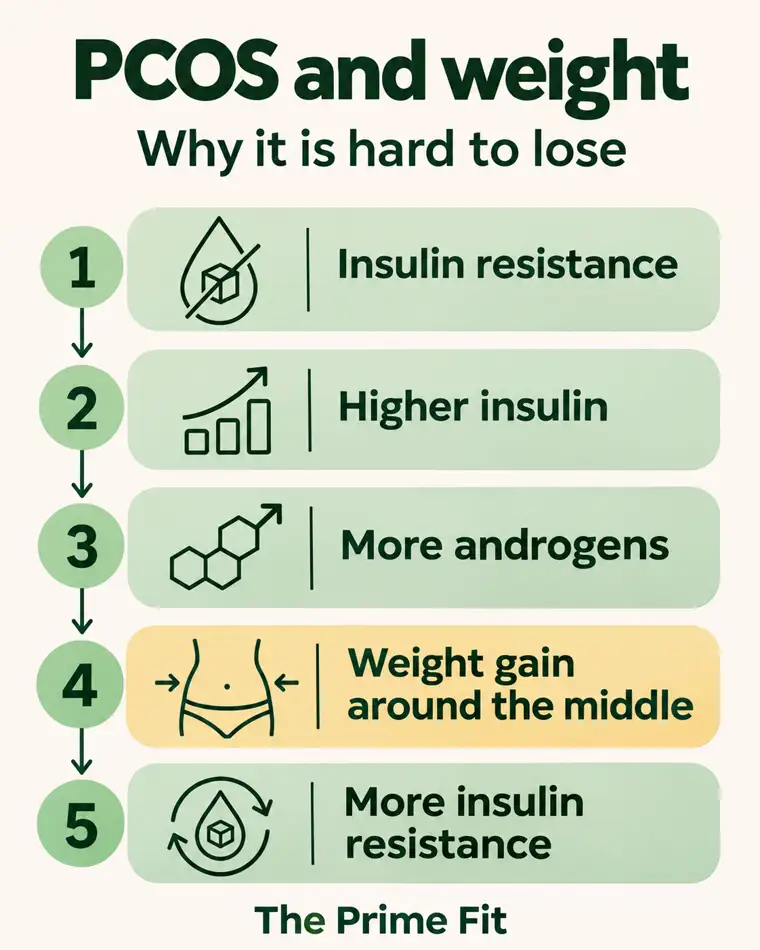
The link is insulin. A majority of women with PCOS have insulin resistance, including many who are not overweight. The body compensates by producing more insulin, and high insulin levels have three effects:
- They promote fat storage, particularly around the abdomen.
- They stimulate the ovaries to make more androgens and lower the protein that binds testosterone in the blood, worsening acne, hair growth and irregular cycles.
- They increase hunger and cravings, especially for sweet and starchy foods, and cause energy dips after meals.
Excess weight then worsens insulin resistance, completing a loop. Breaking that loop, by any means, improves every feature of PCOS.
How much weight loss is needed?
Losing 5 to 10 percent of body weight often restores more regular cycles and ovulation and improves insulin and androgen levels. For a woman of 80 kg, that is 4 to 8 kg. Larger losses bring further metabolic benefit.
How GLP-1 medicines act on the PCOS loop
| Problem in PCOS | What GLP-1 medicines do |
|---|---|
| Increased hunger and cravings | Reduce appetite and the pull of sweet and fatty foods through brain centres for hunger and reward |
| Insulin resistance and high insulin | Improve insulin sensitivity as weight falls, and make insulin release more efficient after meals |
| Abdominal fat | Visceral fat falls proportionally more than total fat |
| Raised androgens | Fall indirectly as insulin levels drop and binding protein rises |
| Irregular ovulation | Often resumes as weight and insulin improve |
| Risk of diabetes | Blood sugar improves; progression to diabetes is reduced |
These medicines do not act directly on the ovaries in any established way. The hormonal improvements follow the changes in weight and insulin.
What the studies show
The large trials of semaglutide and tirzepatide for weight management included many women, some of whom had PCOS, but they were not designed to study PCOS itself. Evidence specific to PCOS comes from smaller trials, mostly of the older GLP-1 medicines liraglutide and exenatide, and more recently semaglutide.
| Medicine | What studies in women with PCOS have found | Strength of evidence |
|---|---|---|
| Liraglutide (daily injection) | Greater weight loss than placebo; reduced waist and androgen measures; more regular cycles in several trials | Several small to medium randomised trials |
| Exenatide | Weight loss and improved cycle frequency, more so when combined with metformin | Small trials |
| Semaglutide (weekly injection) | Substantial weight loss in women who had not responded to metformin and lifestyle; improved cycles and metabolic markers | Small studies; larger trials in progress |
| Tirzepatide (weekly injection) | Expected to help through greater weight loss; direct PCOS data are still limited | Early reports; trials under way |
Pooled analyses of these trials conclude that GLP-1 medicines reduce weight, BMI and waist more than metformin, and improve insulin resistance and, in some studies, androgen levels and menstrual regularity. The trials have been short, typically three to six months, and small. Larger and longer studies with the newer medicines, measuring ovulation, pregnancy rates and long-term health, are needed and are being carried out.
What can reasonably be expected
From the general weight-management trials, women lose on average about 15 percent of body weight with semaglutide 2.4 mg and about 20 percent with higher doses of tirzepatide over 16 to 18 months. There is no strong evidence that women with PCOS respond less well. With that degree of weight loss, most women see improvement in cycles and metabolic tests. Acne and excess hair respond more slowly and less completely, and often need separate treatment.
What the guidelines say
The international evidence-based guideline on PCOS, updated in 2023, recommends healthy lifestyle as first-line care for all women with PCOS. It advises that anti-obesity medicines, including GLP-1 medicines, can be considered in addition to lifestyle for managing higher weight in adults with PCOS, in line with general guidelines for the population, and stresses the need for effective contraception during treatment because of limited safety data in pregnancy. Metformin is recommended mainly for metabolic features, and the combined contraceptive pill for cycle control and androgen-related symptoms.
In other words, GLP-1 medicines are an option for weight management in women with PCOS who qualify on weight grounds. They are not licensed as a treatment for PCOS as such, and they are not a fertility treatment.
Who with PCOS might be suitable?
- BMI of 30 or above, or 27 or above with a weight-related condition such as prediabetes, type 2 diabetes, high blood pressure, abnormal lipids, fatty liver or sleep apnoea. For Indian women, risk begins at lower BMI and a waist of 80 cm or more, and healthcare professionals assess individually.
- Lifestyle measures and, where appropriate, metformin have not produced enough lasting weight loss.
- Not pregnant, not breastfeeding and not trying to conceive in the next few months.
- Able to use reliable contraception.
- No personal or family history of medullary thyroid carcinoma or MEN 2, and no history of pancreatitis.
- No active eating disorder.
Who is not suitable
- Lean PCOS: women with a healthy weight and no weight-related conditions. The focus is on diet quality, activity, and treatment of cycles and symptoms.
- Adolescents: treatment decisions belong with a specialist; adult criteria do not apply.
- Women actively trying to conceive, pregnant or breastfeeding.
GLP-1 medicines and metformin compared
| Metformin | GLP-1 medicines | |
|---|---|---|
| How taken | Tablets, once to three times a day | Weekly injection (semaglutide, tirzepatide) or daily injection (liraglutide) |
| Weight loss | Modest, usually 1 to 3 kg | Larger: about 15 to 20% of body weight with the newer medicines |
| Insulin resistance | Improves | Improves, largely through weight loss |
| Cycle regularity | Improves in some women | Improves with weight loss |
| Use when trying to conceive | Can be continued on medical advice | Must be stopped in advance |
| Common side effects | Nausea, loose stools, metallic taste; low vitamin B12 with long use | Nausea, constipation, diarrhoea, vomiting |
| Cost | Low | Considerably higher |
| Evidence in PCOS | Decades of use | Growing; smaller, shorter trials |
The two are often used together. Studies suggest the combination can produce more weight loss and better cycle outcomes than either alone, though digestive side effects may add up. Many healthcare professionals continue metformin when a GLP-1 medicine is started, and keep it going when the GLP-1 medicine is stopped before pregnancy.
The contraceptive pill: an important interaction
Many women with PCOS take the combined oral contraceptive pill to regulate periods and reduce acne and hair growth. This makes one difference between the medicines especially relevant.
| Medicine | Effect on the pill | What to do |
|---|---|---|
| Tirzepatide (Mounjaro) | Can reduce and delay absorption of oral contraceptives when treatment starts and after each dose increase | Add a barrier method for 4 weeks after starting and after every increase, or switch to a non-oral method |
| Semaglutide (Wegovy, Ozempic) | No clinically important effect shown | Continue as usual; follow missed-pill rules if you have severe vomiting or diarrhoea |
If you rely on the pill and would rather not change, tell your healthcare provider; it may influence the choice of medicine. An intrauterine device, implant or injection is unaffected by either.
Why contraception matters more, not less, on treatment
Women with PCOS who have had irregular cycles for years often assume they cannot conceive easily. As weight and insulin fall, ovulation can return within weeks, and it returns before the first regular period. Unplanned pregnancies in women taking these medicines have been widely reported. Use reliable contraception from the first dose.

Fertility and planning a pregnancy
Weight loss before conception improves ovulation, the response to fertility treatment, and pregnancy outcomes, including lower risks of gestational diabetes, high blood pressure and miscarriage. For a woman with PCOS and obesity who hopes to conceive in a year or two, a period of GLP-1 treatment to reach a healthier weight, followed by a planned stop, can be a sound strategy. Small studies of weight loss with GLP-1 medicines before fertility treatment have reported encouraging pregnancy rates, but this is not established practice.
The timeline
| Stage | What to do |
|---|---|
| 12 to 18 months before | Assessment; start treatment with reliable contraception; nutrition and strength training |
| 3 to 6 months before | Tell your healthcare provider your plans; agree a stop date; check vitamin D, B12, iron, thyroid and blood sugar |
| At least 2 months before (semaglutide) or 1 month before (tirzepatide) | Stop the injection; continue contraception during this washout; start folic acid as advised |
| Trying to conceive | No GLP-1 medicine; metformin may continue on advice; structured eating to hold weight |
| Positive pregnancy test on treatment | Stop the injection and contact your healthcare provider and obstetrician promptly |
| Pregnancy and breastfeeding | No GLP-1 medicine; early screening for gestational diabetes |
Appetite returns after stopping, and some weight regain is common. Planning meals and follow-up for this period protects the progress you have made.
What improves, and when
| Feature | Typical response | Timeframe |
|---|---|---|
| Appetite and cravings | Reduce clearly | Weeks |
| Weight and waist | Steady fall | From month 2; most over 6 to 12 months |
| Blood sugar and insulin | Improve; prediabetes often reverses | 3 to 6 months |
| Menstrual cycles | More regular in many women | 3 to 6 months, after 5 to 10% weight loss |
| Ovulation and fertility | Often improve | Can be within weeks; use contraception |
| Triglycerides, liver enzymes, blood pressure | Improve | 3 to 6 months |
| Acne | May improve modestly | Months; often needs dermatological treatment |
| Excess facial and body hair | Slow, partial improvement at best | 6 to 12 months or more; usually needs other treatment |
| Scalp hair thinning | Variable; temporary shedding can occur with rapid weight loss | Months |
| Dark skin patches on the neck and underarms | Often lighten as insulin falls | Months |
| Mood and energy | Improve for many; needs attention in some | Variable |
Side effects and precautions for women with PCOS
The side effects are the same as for anyone: nausea, constipation, diarrhoea, vomiting and reflux, mainly around dose increases. A few points deserve emphasis in PCOS.
- With metformin: both can upset the stomach. Starting the GLP-1 medicine slowly, taking metformin with food, and using a slow-release form can help.
- Hair shedding: rapid weight loss can cause temporary shedding, which is distressing for women already troubled by thinning. Adequate protein, iron and a steady pace reduce it.
- Vitamin B12: long-term metformin lowers B12, and a small appetite adds to the risk. Have it checked.
- Iron: heavy or returning periods plus low intake can cause deficiency.
- Disordered eating: binge eating and other eating difficulties are more common in PCOS. Tell your healthcare provider about any history before starting.
- Mood: depression and anxiety are more frequent in PCOS. Report any change.
- Gallstones: women are at higher risk, and rapid weight loss adds to it.
Seek medical help urgently if
You have severe or persistent abdominal pain, repeated vomiting and cannot keep fluids down, yellowing of the eyes, or swelling of the face or throat or difficulty breathing. If you have a positive pregnancy test, stop the injection and contact your healthcare provider.
Eating for PCOS on GLP-1 treatment
The medicine reduces appetite. The quality of what you eat still decides how you feel and how your hormones respond.
- Protein at every meal to protect muscle and steady blood sugar: dal, chana, rajma, paneer, curd, soya, eggs, fish, chicken.
- Slow carbohydrates in modest portions: whole wheat or millet roti, brown rice, oats, whole dals. Eat them after the protein and vegetables.
- Vegetables at lunch and dinner.
- Healthy fats in small amounts: nuts, seeds, and cooking oil measured by the teaspoon.
- Very little sugar and refined flour: sweetened drinks, biscuits, bakery items and mithai drive insulin up.
- Three regular meals, without long gaps.
- Iron, vitamin B12, vitamin D and folate from food, with supplements where tests show a need.
A sample day
| Meal | Vegetarian | Non-vegetarian |
|---|---|---|
| Breakfast | 2 besan or moong chillas with paneer, curd | 2-egg vegetable omelette, 1 whole wheat toast |
| Mid-morning | Guava or apple; a few almonds | Fruit; chaas |
| Lunch | 1 to 2 jowar or wheat rotis, chana or rajma, sabzi, salad, curd | Small katori of rice, fish curry, sabzi, salad |
| Evening | Sprouts chaat or roasted chana | Boiled egg or roasted chana |
| Dinner | Palak paneer or tofu with vegetables, dal, 1 phulka | Grilled chicken with vegetables, dal, 1 phulka |
Why weight treatment matters beyond periods
PCOS is often treated as a problem of cycles and skin, but its long-term consequences are metabolic. Women with PCOS are several times more likely to develop type 2 diabetes, and to develop it younger. They have higher rates of gestational diabetes, fatty liver, sleep apnoea, high blood pressure and abnormal lipids. When periods are very infrequent, the lining of the womb can thicken over time, which is why regular bleeds, whether natural or induced by treatment, matter for long-term health. Reducing excess weight lowers each of these risks. That is the strongest reason to treat weight seriously in PCOS, whatever method is used.
Treatments that work alongside
| Concern | Treatments your experts may use |
|---|---|
| Irregular periods | Combined contraceptive pill, cyclical progestogen, or weight loss and metformin |
| Acne | Dermatological treatment; the combined pill |
| Excess facial or body hair | Hair removal methods including laser; the combined pill; anti-androgen medicines under specialist care, with reliable contraception |
| Scalp hair thinning | Dermatology assessment; topical treatment; correction of iron and vitamin deficiencies |
| Insulin resistance and prediabetes | Diet, exercise, metformin, weight loss |
| Trying to conceive | Weight loss beforehand; ovulation-inducing medicines from a fertility specialist |
| Low mood, anxiety, eating difficulties | Psychological support; medical treatment where needed |
A GLP-1 medicine addresses weight and insulin. It works best as one part of a plan that also deals with the symptoms that matter to you.
Exercise
Muscle is where most glucose is used, so building and using it improves insulin sensitivity directly. Aim for resistance exercise two to three times a week and at least 150 minutes of brisk walking or similar activity. A ten-minute walk after meals blunts the rise in blood sugar. During weight loss on medication, strength training also ensures that what you lose is fat.
Tests before and during treatment
- Weight, waist, blood pressure and body composition
- Fasting glucose and HbA1c; sometimes a glucose tolerance test and fasting insulin
- Lipid profile and liver enzymes
- Thyroid function and prolactin, to exclude other causes of irregular periods
- Androgen levels and other hormones as your healthcare provider advises
- Vitamin B12, vitamin D, haemoglobin and ferritin
- Pregnancy test before starting
- Pelvic ultrasound if not already done
What happens when treatment stops?
PCOS is a lifelong tendency. When a GLP-1 medicine is stopped, appetite returns, and weight, insulin resistance and cycle irregularity tend to follow unless other measures hold the line. This matters most for women who stop in order to conceive. A structured eating plan, continued strength training, metformin where prescribed, and regular follow-up help maintain the gains. After pregnancy and breastfeeding, treatment can be reconsidered.
Three illustrative examples
These invented examples show typical courses. They are not predictions for any individual.
Age 27, irregular periods, BMI 34
She has taken metformin for two years with little weight change and has prediabetes. With a copper IUD in place, she starts a weekly injection and a dietitian-led plan. Over nine months she loses 14 kg, her periods come every five weeks, and her blood sugar is normal.
Age 31, on the pill, planning a baby in two years
She prefers to stay on the combined pill for acne. Her healthcare provider chooses semaglutide, which does not interact with it. After a year she has lost 12 kg. Treatment is stopped two months before she stops the pill, and she continues metformin, folic acid and her meal plan while trying to conceive.
Age 24, lean PCOS
Her BMI is 22 with irregular cycles and acne. She does not qualify for weight loss medication. A plan focused on protein, slow carbohydrates and strength training, with gynaecological treatment for her cycles, is the right approach.
Questions to ask your healthcare provider
- Do I meet the criteria for a GLP-1 medicine, given my weight and tests?
- Should I continue metformin alongside it?
- Which medicine suits me, given my contraception?
- When would I need to stop if I want to conceive?
- What improvement in my periods and blood tests should I expect, and by when?
- How will my acne and hair growth be treated?
- Which vitamins should be checked?
Common myths
“GLP-1 injections cure PCOS”
They treat the weight and insulin resistance that worsen PCOS. The underlying tendency remains.
“They are approved for PCOS”
They are licensed for weight management and diabetes. Women with PCOS can be treated if they meet those criteria.
“With PCOS I cannot get pregnant, so contraception is unnecessary”
Fertility often returns quickly with weight loss.
“They harm fertility”
Weight loss generally improves fertility. The medicines are stopped beforehand as a precaution.
“If I take the injection, I can stop metformin and ignore my diet”
Diet, activity and, where prescribed, metformin remain part of treatment, particularly after the injection is stopped.
“Every woman with PCOS should take them”
They are for women with excess weight and related risks, not for lean PCOS.
How The Prime Fit helps women with PCOS
At The Prime Fit, a PCOS assessment covers your cycle, symptoms, contraception and pregnancy plans, with blood tests for sugar, hormones, thyroid and vitamins. Your healthcare provider advises whether medication is appropriate and which one fits your situation, and coordinates with your gynaecologist. Our dietitians design a PCOS meal plan around Indian food with weekly follow-up, whether or not you take medication, and plan your nutrition for the period before and during pregnancy.
To discuss your options, book a consultation or read about our PCOS weight loss programme and GLP-1 therapy.
Frequently asked questions
Can Mounjaro or Wegovy help with PCOS weight loss?
Yes, for women who meet the weight criteria. Studies of GLP-1 medicines in PCOS show meaningful weight loss and improvements in insulin resistance and cycle regularity.
Are these medicines approved for PCOS?
No. They are licensed for weight management and type 2 diabetes. Guidelines say they can be considered for higher weight in adults with PCOS, with effective contraception.
Will my periods become regular?
Many women see more regular cycles after losing 5 to 10 percent of body weight, usually within three to six months.
Are they better than metformin?
They produce more weight loss. Metformin is inexpensive, has long experience and can be continued when trying to conceive. They are often used together.
Can I take them with the contraceptive pill?
Yes. With tirzepatide, add a barrier method for four weeks after starting and after each dose increase, or use a non-oral method. Semaglutide has not shown an important effect on the pill.
Can I use them while trying to conceive?
No. Stop at least two months before for semaglutide and one month before for tirzepatide, as your healthcare provider advises.
Will they improve acne and facial hair?
Possibly, slowly and partly, as insulin and androgen levels fall. Most women need separate treatment for these.
I have lean PCOS. Can I take them?
They are not indicated for women at a healthy weight. Diet quality, strength training and treatment of cycles and symptoms are the focus.
Which is better for PCOS, Mounjaro or Wegovy?
Tirzepatide produces more weight loss on average, but has an interaction with the pill. Semaglutide has more PCOS-specific data. The choice depends on your circumstances.
Will PCOS symptoms return if I stop?
They can, if weight is regained. Continuing diet, activity and metformin where prescribed helps maintain the improvement.
This article is general information and is not a substitute for a consultation. GLP-1 medicines are not licensed specifically for PCOS and must not be used in pregnancy. Decisions about treatment, contraception and fertility should be made with your healthcare provider and gynaecologist.