In this article
- The storage rules in plain language
- The real problem in India: heat
- Ways to keep a pen cool on the move
- Travelling by air
- Travelling by train, bus or car
- At your destination
- Cold-weather travel: the opposite risk
- Timing your dose around travel
- If something goes wrong
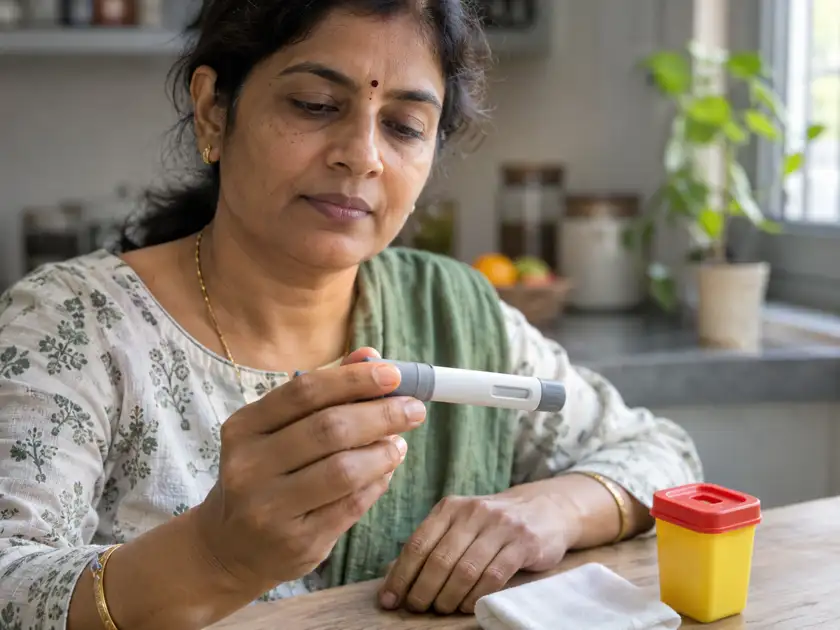
- Needles and disposal while travelling
- Eating and drinking on the move
- If you fall ill while travelling
- Special trips
- A simple countdown before you leave
- Your packing checklist
- Common myths
- How The Prime Fit helps you travel with confidence
- Frequently asked questions
A weekly injection fits easily into ordinary life. Travel is where questions begin. Will the pen survive a May afternoon in Delhi? Can it go through airport security? What happens if the hotel has no fridge, or the train is delayed by eight hours? What if your injection day falls in the middle of a long flight?
GLP-1 medicines such as Mounjaro (tirzepatide), Wegovy and Ozempic (semaglutide) are proteins. Heat, freezing and strong light can damage them without any visible change, so a little care is needed. The good news is that weekly dosing is flexible, the pens are small, and with the right preparation you can travel for work, holidays, weddings or pilgrimage without interrupting treatment.
This guide gives practical advice for travel within India and abroad. Storage rules differ between products and pen types, so the leaflet in your own pack is the final authority. This is general information and does not replace your healthcare provider’s or pharmacist’s advice.
The storage rules in plain language
| Rule | What it means in practice |
|---|---|
| Refrigerate at 2°C to 8°C | The main shelf of a fridge, not the door and not next to the freezer compartment |
| Do not freeze | A pen that has frozen must be discarded, even if it has thawed and looks normal |
| Protect from light | Keep the pen in its carton, or with its cap on, in a closed pouch |
| Limited time at room temperature | Most products may be kept out of the fridge, below about 30°C, for a limited number of days or weeks. The exact allowance depends on the product and whether the pen is single-dose or multi-dose |
| Avoid heat | Above about 30°C the medicine degrades faster. A closed car in summer can exceed 60°C |
| In-use period for multi-dose pens | Once a multi-dose pen has been used for the first time, it must be discarded after the number of weeks stated in the leaflet |
| Check before injecting | The liquid should be clear and colourless or nearly so, with no particles |
Before you travel, find three facts in your leaflet
1. How many days your product may stay out of the fridge, and up to what temperature. 2. For a multi-dose pen, how long it can be used after the first dose. 3. Whether it can go back into the fridge after being at room temperature. Write them on a card and keep it with the pen.
The real problem in India: heat
In most of India, “room temperature” in the leaflet sense, below about 30°C, is not the temperature of a room for much of the year. Summer afternoons reach 40°C to 46°C on the plains. A bag in a parked car, on a bus luggage rack, in an auto-rickshaw or on a railway platform will be far hotter than the air. This means the out-of-fridge allowance on the leaflet cannot be relied on in an Indian summer unless the pen is actively kept cool.
The practical rule: outside air-conditioned spaces between about March and October, treat the pen as needing a cool pouch at all times.
Ways to keep a pen cool on the move
| Method | How it works | Good for | Watch out for |
|---|---|---|---|
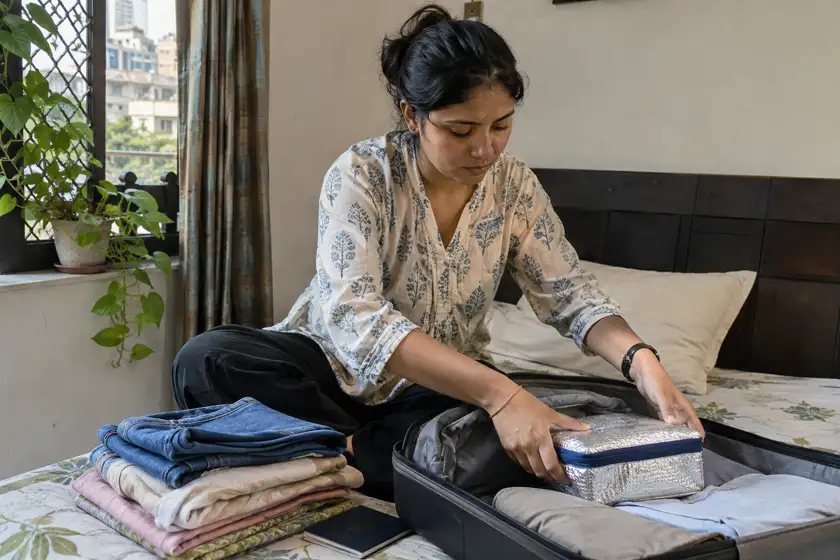
| Insulated medicine pouch with gel packs | Pre-chilled or frozen gel packs keep the inside cool | Journeys of a few hours up to about a day | The pen must not touch a frozen pack directly; wrap the pack in cloth or use the pouch’s separate compartment |
| Evaporative cooling wallet | Crystals activated by soaking in water keep contents cool as the water evaporates | Multi-day trips; no fridge or electricity needed; re-soak every day or two | Keeps contents cool, not fridge-cold; less effective in very humid weather and inside sealed bags |
| Small vacuum flask | Insulates the pen; add a small cool pack wrapped in cloth | Day trips; sturdy protection | Check the pen fits; avoid loose ice |
| Medical-grade travel cooler | Rechargeable or phase-change coolers that hold 2°C to 8°C for many hours | Long journeys, frequent travellers | Cost; charge before leaving; follow instructions |
| Ice in a plastic bag | Improvised cooling | Emergencies only | High risk of freezing the pen and of water damage. Keep the pen in a sealed bag, wrapped in a towel, away from the ice |
A small thermometer strip or digital thermometer inside the pouch removes guesswork. Whatever method you use, keep the pouch in the shade and inside your bag, not against a sunny window.
Travelling by air
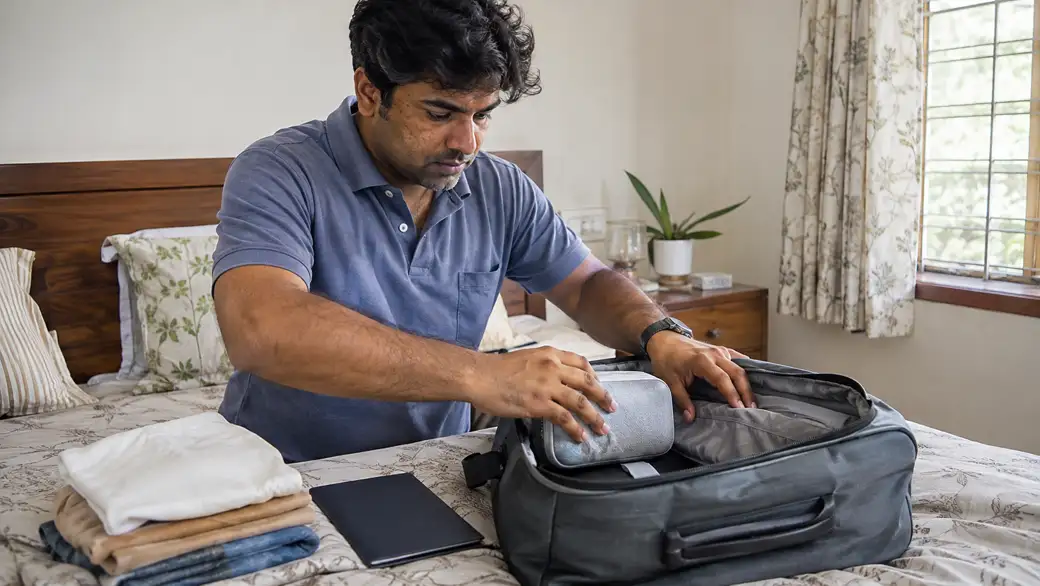
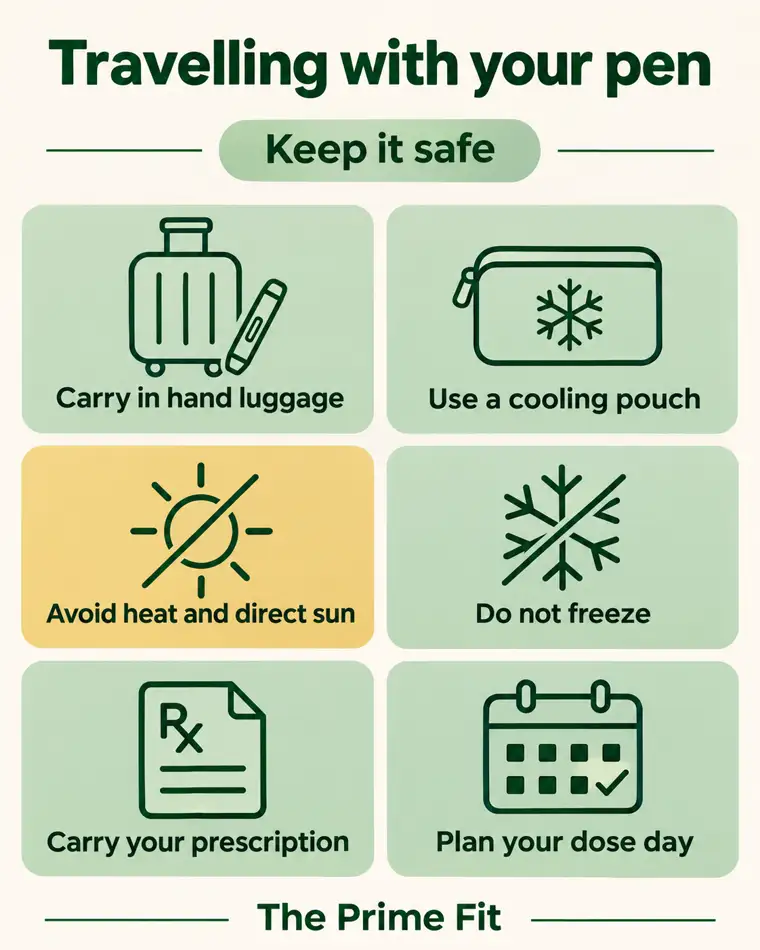
Carry it in your hand luggage
Always keep your medicine in cabin baggage. Checked bags can be lost or delayed, may sit on hot tarmac, and aircraft holds can become very cold at altitude, with a risk of freezing.
Airport security
- Injectable medicines and the needles needed to use them are permitted in hand baggage when carried with supporting documents.
- Carry your prescription and, ideally, a short letter from your healthcare provider naming the medicine, the dose and the need for needles and cool storage.
- Keep the pens in their original cartons with the pharmacy label and bill.
- Tell the security officer that you are carrying injectable medication and a cool pack. Gel packs for medicines are usually allowed; they may be inspected.
- X-ray screening does not harm these medicines.
On the aircraft
Keep the pouch under the seat in front of you or in the overhead locker away from heating vents. Cabin temperature is well within the safe range. Do not ask the crew to put your medicine in the galley fridge or on ice; it may freeze or be forgotten.
International travel
- Check the rules of your destination and any transit country for bringing in prescription medicines. Some require a healthcare professional’s letter, limit the quantity, or need prior approval.
- Carry only what you need for the trip plus a small reserve, in original packaging.
- Your medicine may be sold under a different name, strength or pen type abroad, or not be available at all. Do not plan to buy it at your destination.
- Keep a copy of your prescription with the generic name of the medicine, since brand names differ.
- Check that your travel insurance covers existing conditions and loss of medicines.
Travelling by train, bus or car
Trains
Air-conditioned coaches are usually within a safe temperature range, but platforms, waiting rooms and non-AC coaches are not. Keep the pen in a cool pouch throughout, in a bag that stays with you, away from the window. For overnight journeys, an evaporative wallet or a well-insulated pouch is more reliable than gel packs that will have thawed by morning. Delays are common, so plan cooling for longer than the timetable suggests.
Road trips
- Never leave the pen in a parked car, even for a short stop. Take the pouch with you.
- In the car, keep it on the floor in the shade of the cabin, not in the boot, on the dashboard or in the glove box.
- Direct air-conditioning vents are fine for cooling the bag, but do not place the pen against a vent blowing very cold air for hours.
- Carry a spare cool pack in an insulated lunch bag for swapping.
Buses and local transport
Keep the pouch on your lap or in a bag by your feet, not in the luggage hold or roof carrier.
At your destination
Hotels and guest houses
- Request a room with a refrigerator when booking, and say it is for medicine.
- Minibars often cool unevenly and can freeze items at the back. Place the pen in its carton in the door or the middle, not against the cooling plate, and turn the dial to a moderate setting. A thermometer helps.
- Some hotel fridges switch off when the room key card is removed. Ask reception, or leave a spare card in the slot.
- If there is no fridge in the room, the hotel may store your medicine in a staff or kitchen refrigerator. Put it in a sealed, labelled bag and confirm it will not be placed in a freezer.
Staying with relatives
Use the main shelf of the fridge, in a labelled box, away from the freezer section and out of children’s reach. Tell your hosts what it is so that it is not moved.
Power cuts
A closed refrigerator stays cold for several hours. Keep the door shut. For long outages, move the pen to your cool pouch with fresh packs.
Cold-weather travel: the opposite risk
In the hills in winter, or in places such as Ladakh, Himachal Pradesh, Kashmir and Sikkim, the danger is freezing. Keep the pen close to your body in an inner pocket when outdoors, do not leave it in a vehicle overnight, and do not put it in snow or outside on a window ledge to “keep it cold”. At night, keep it inside the room, away from the window. A pen that has frozen must not be used.
Timing your dose around travel
Weekly dosing gives you room to manoeuvre.
| Situation | What usually works |
|---|---|
| Short trip of a few days | Take your dose at home before you leave or after you return, if your injection day allows, and avoid carrying a pen at all |
| Injection day falls on a travel day | Take it a day early or late, within the limits for your medicine, or inject on arrival |
| Prone to nausea after injecting | Avoid injecting on the morning of a long flight, a winding hill drive or a wedding feast. Inject two or three days before, or after you arrive |
| Dose increase is due | Postpone the increase until you are home. Staying on a familiar dose is far more comfortable when food and routine are unpredictable |
| Crossing time zones | No precise adjustment is needed for a weekly medicine. Take it on the same day of the week in local time |
| Changing your injection day permanently | Allowed, provided the minimum gap between doses for your medicine is respected |
The minimum gap between two doses and the missed-dose window differ between medicines. As a guide, tirzepatide needs at least three days between doses and a missed dose can be taken within four days; semaglutide for weight management needs at least two days between doses, and a missed dose is taken if the next one is more than two days away. Check your leaflet or ask your healthcare provider before you travel.
If something goes wrong
| Problem | What to do |
|---|---|
| You missed a dose while travelling | Follow the missed-dose rule for your medicine. If it is too late, skip it and take the next dose on your usual day. Do not double up |
| You missed two or more weeks | Contact your healthcare provider before restarting; a lower dose may be needed to avoid strong side effects |
| The pen got warm | Compare what happened with the allowance in your leaflet. Brief exposure within the stated limits is acceptable. If it was left in a hot car or in direct sun, or you are unsure, do not use it; ask your pharmacist or healthcare professional |
| The pen froze | Discard it |
| The liquid looks cloudy, coloured or has particles | Do not use it |
| The pen is lost or broken | Contact your healthcare provider for a prescription. Buy only from a licensed pharmacy, and check that the product and strength match |
| You run out abroad | See a local healthcare professional. Do not buy from informal sellers. A short gap is safer than a doubtful product |
Missing a single weekly dose is not dangerous. Appetite may return somewhat for a few days. People with diabetes should monitor their blood sugar more closely if a dose is missed.
Needles and disposal while travelling
- Carry enough new needles for every dose plus spares, if your pen uses separate needles.
- Never reuse or share needles or pens.
- Take a small, hard, lidded container for used needles, such as a travel sharps box or a sturdy plastic bottle with a screw cap.
- Do not leave used needles in hotel bins or on public transport. Bring the container home, or ask a pharmacy or centre about disposal.
- Used single-dose pens with a retracted needle can be carried home in the same container.
Eating and drinking on the move
Travel changes meals, and GLP-1 treatment makes the stomach less forgiving. A few habits prevent most trouble.
Stay hydrated
Thirst is blunted on these medicines, and travel, heat and air-conditioning all dry you out. Carry a bottle, sip regularly, and aim for 2 to 3 litres a day. Use sealed bottled or filtered water. Keep ORS sachets in your bag.
Protect your protein
Travel food is mostly starch and oil. Pack or look for protein at each meal.
| Situation | Better choices | Go easy on |
|---|---|---|
| Snacks to carry | Roasted chana, peanuts, almonds, makhana, khakhra, protein bar with low sugar, fruit | Chips, biscuits, namkeen, sweets |
| Airport or station | Idli with sambar, egg or paneer sandwich, curd, boiled eggs, grilled chicken or paneer wrap | Samosas, pakoras, burgers with fries, sweet coffee drinks |
| Hotel breakfast buffet | Eggs, curd, sprouts, idli, upma or poha in a small portion, fruit | Pastries, puri-bhaji, fruit juice, large parathas |
| Restaurant meals | Tandoori or grilled starters, dal, sabzi, salad, 1 roti or a small portion of rice | Creamy gravies, naan, fried starters, dessert every meal |
| Highway dhaba | Dal, tandoori roti, sabzi, curd, omelette | Heavy butter, deep-fried items, large lassi |
| Weddings and feasts | Survey first; salad, protein dishes and one or two favourites in small amounts | Second helpings; fried snacks with drinks |
Eat small and slowly
Large or oily meals on a slowed stomach, followed by a bumpy drive or a flight, are a recipe for nausea. Eat half of what you would have eaten before treatment, pause, and see how you feel.
Motion sickness
If you are prone to it, sit facing forward, look at the horizon, eat lightly beforehand and avoid injecting just before a journey. Ginger and plain crackers help some people. Ask your healthcare provider about a travel-sickness medicine if needed.
Constipation
Travel slows the bowel further. Carry isabgol or your prescribed laxative, eat fruit and vegetables where you can, and walk daily.
Food and water safety
A stomach infection with vomiting and diarrhoea is harder to cope with on a GLP-1 medicine, because dehydration develops faster. Choose freshly cooked hot food, peel fruit yourself, avoid cut fruit and ice of unknown origin, and wash or sanitise your hands before eating.
Alcohol
Holidays and weddings bring drinks. Alcohol worsens nausea, reflux and dehydration on these medicines. If you drink, keep it to a small amount, with food and water.
If you fall ill while travelling
Seek medical care promptly if
You have vomiting or diarrhoea lasting more than a day, cannot keep fluids down, pass very little urine or feel dizzy on standing; severe or persistent abdominal pain; high fever; or, if you have diabetes, repeated low or very high blood sugar readings. Tell the healthcare professional you are taking a GLP-1 medicine and when your last dose was. If you are due a dose while actively vomiting or dehydrated, delay it and take advice.
Special trips
Pilgrimage and trekking
Long walking days, altitude, simple food and limited facilities call for extra care. Keep doses stable for several weeks beforehand, carry snacks with protein and salt, drink regularly, and protect the pen from both heat in the plains and freezing at altitude. If you have diabetes or heart disease, see your healthcare provider before you go.
Work travel
Frequent travellers do best with a fixed kit that is always packed: pouch, spare cool pack, needles, sharps container, prescription copy and snacks. Choose an injection day that is usually spent at home, such as Sunday.
Long stays abroad
For stays of more than a few weeks, speak to your healthcare provider well in advance about the quantity you can carry, storage during the journey, and how to arrange follow-up or a local prescription.

A simple countdown before you leave
- Two weeks before: check you have enough pens and needles; ask your healthcare provider for a prescription copy and travel letter; decide whether a dose increase should wait.
- One week before: read the storage and missed-dose sections of your leaflet and note the key facts; buy or test your cool pouch at home with a thermometer.
- Two days before: plan your injection day around the journey; freeze or chill the cool packs; pack snacks, ORS and your sharps container.
- On the day: move the pen from the fridge to the pouch just before leaving; keep it in your hand luggage; set a phone reminder for your next dose in local time.
Your packing checklist
| Item | Why |
|---|---|
| Pens for the trip, plus a reserve dose if your healthcare provider agrees, in original cartons | Delays happen; packaging identifies the medicine |
| Needles and spares, if used | One new needle per dose |
| Insulated pouch or cooling wallet, spare cool pack | Temperature control |
| Small thermometer | To check the pouch or hotel fridge |
| Prescription, healthcare professional’s letter, pharmacy bill | Airport security, customs, emergencies |
| Card with your leaflet’s storage and missed-dose rules | Quick reference |
| Sharps container | Safe disposal |
| Alcohol swabs, if you use them | Clean injection site |
| ORS sachets, isabgol or prescribed laxative, any anti-nausea medicine prescribed | Dehydration, constipation, nausea |
| Protein snacks and a water bottle | Reliable nutrition and fluids |
| Glucose meter, strips and glucose tablets, if you have diabetes | Monitoring and treating low sugar |
| Healthcare professional’s and centre’s contact details; travel insurance papers | Help when needed |
| Phone reminder set for injection day | Routine is easily lost when travelling |
Common myths
“The pen must stay in a fridge at every moment”
Most products allow a limited period at controlled room temperature. The issue in India is that real temperatures are often well above that limit, so a cool pouch is needed.
“Putting it on ice is the safest option”
Direct contact with ice or a frozen pack can freeze the medicine, which ruins it.
“Needles are not allowed on flights”
Needles needed for prescribed injectable medicines are permitted with supporting documents.
“If the liquid looks clear, it is fine”
Heat damage is usually invisible. Go by how the pen was stored, not only by appearance.
“It is safer to skip treatment whenever I travel”
Repeated gaps reduce the benefit and bring back side effects on restarting. With simple preparation, most trips need no interruption.
How The Prime Fit helps you travel with confidence
At The Prime Fit, your treatment plan takes your calendar into account. Before a trip, your healthcare provider can advise on dose timing and whether to postpone an increase, and provide a prescription copy and travel letter. Your dietitian prepares eating strategies for flights, hotels, weddings and long drives, and the team is a message away if you have a problem while you are away.
To plan treatment around your travel, book a consultation or read about our GLP-1 support programme.
Frequently asked questions
Can I take Mounjaro, Wegovy or Ozempic on a flight?
Yes. Carry it in your hand luggage in its original packaging, with your prescription and a healthcare professional’s letter, and tell security staff you have injectable medication and a cool pack.
How long can the pen stay out of the fridge?
It depends on the product and pen type. Most allow a limited period below about 30°C. Check the leaflet in your pack, and remember that Indian summer temperatures are often higher than that limit.
How do I keep my pen cool in summer?
Use an insulated medicine pouch with gel packs or an evaporative cooling wallet, keep it in the shade inside your bag, and never leave it in a parked car. Do not let the pen touch ice directly.
What if my pen gets too hot?
If the exposure was brief and within the limits in your leaflet, it is usually acceptable. If it was left in a hot car or direct sun, or you are unsure, do not use it and ask your pharmacist or healthcare professional.
What if my pen freezes?
Discard it. A frozen pen must not be used, even after thawing.
Do I need to adjust my dose time for a different time zone?
No precise adjustment is needed for a weekly injection. Take it on your usual day of the week in local time, keeping the minimum gap between doses.
Can I change my injection day for a trip?
Yes, as long as the minimum interval between two doses for your medicine is respected. Check your leaflet or ask your healthcare provider.
What if I miss a dose while travelling?
Follow the missed-dose rule for your medicine. If the window has passed, skip that dose and continue on your usual day. If you miss two or more weeks, speak to your healthcare provider before restarting.
Should I put my medicine in checked luggage?
No. Checked bags can be lost, overheated on the ground or frozen in the hold. Keep it in cabin baggage.
Can I buy my medicine at my destination?
Do not rely on it. Availability, names and strengths vary, and a prescription is needed. Carry enough for your trip.
This article is general information and is not a substitute for a consultation. Storage and dosing rules differ between products; follow the leaflet supplied with your medicine and your healthcare provider’s advice. Check airline and destination-country rules before travelling.