In this article
- What fatty liver disease is
- How common is it, and why are Indians at risk?
- Why it matters beyond the liver
- Symptoms and how it is found
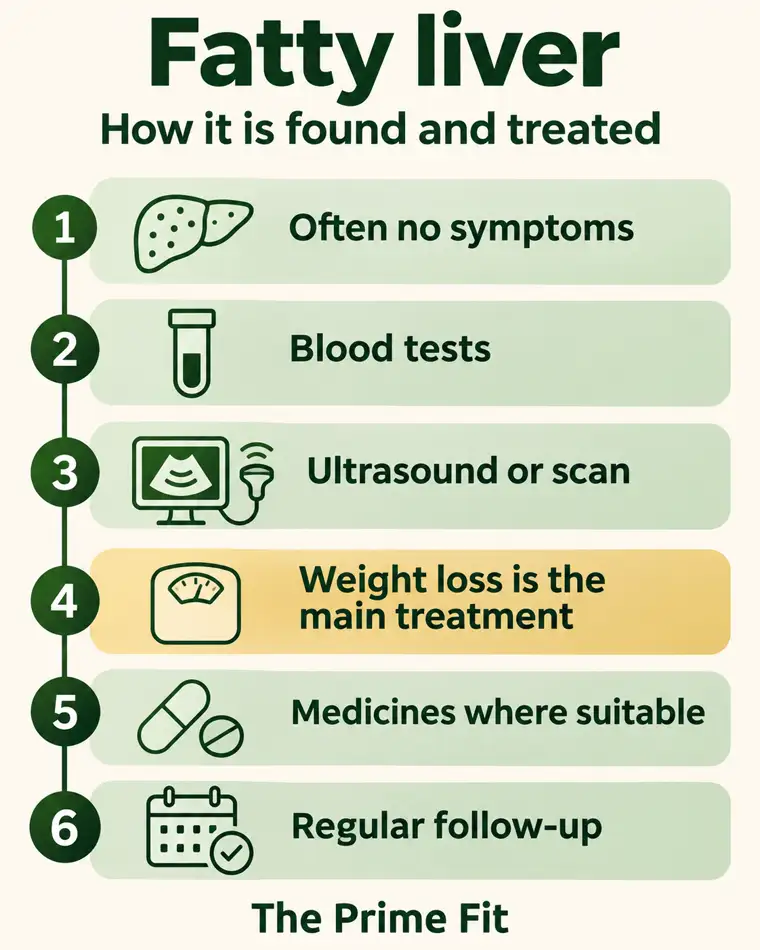
- The tests that matter
- Weight loss: the treatment that works
- What GLP-1 medicines do for the liver
- Who with fatty liver might be offered a GLP-1 medicine?
- Other treatments your healthcare provider may mention
- Eating for your liver
- Alcohol and fatty liver
- Exercise helps the liver directly
- Pace matters: avoid crash weight loss
- What to expect and how progress is tracked
- Are GLP-1 medicines safe for the liver?
- Three illustrative examples
- Questions to ask your healthcare provider
- Common myths
- How The Prime Fit helps
- Frequently asked questions
“Your ultrasound shows a fatty liver.” It is one of the most common findings on health check-ups in India, and one of the most frequently ignored, because it usually causes no symptoms. Yet fatty liver is not harmless. In a proportion of people it leads to inflammation, scarring and, over many years, cirrhosis or liver cancer. It is also a marker of risk for diabetes and heart disease.
Until recently, the only proven treatment was weight loss, which most people found hard to achieve and harder to maintain. GLP-1 medicines such as Wegovy (semaglutide) and Mounjaro (tirzepatide) have changed that. In trials using liver biopsies, they have cleared liver inflammation in a majority of patients and improved scarring in many, and semaglutide has been approved for this purpose in some countries.
This guide explains fatty liver in plain language, the tests that matter, what the evidence shows, and how treatment, diet and activity work together. It is general information. If you have been told you have fatty liver, particularly with raised liver tests or scarring, ask your healthcare provider whether you need to see a liver specialist.
What fatty liver disease is
A healthy liver contains very little fat. When more than about five percent of liver cells contain fat, the condition is called fatty liver, or steatosis. When this occurs in someone with excess weight, type 2 diabetes or other features of metabolic ill-health, and not because of heavy drinking, it is now called metabolic dysfunction-associated steatotic liver disease, or MASLD. You may know it by its older name, non-alcoholic fatty liver disease (NAFLD).
In some people, the fat triggers inflammation and injury to liver cells. This stage is called metabolic dysfunction-associated steatohepatitis, or MASH (formerly NASH). Ongoing inflammation leads to scarring, known as fibrosis, which is graded from F0, none, to F4, cirrhosis.
| Stage | What is happening | Can it reverse? |
|---|---|---|
| Simple fatty liver (steatosis) | Fat in liver cells; little or no inflammation | Yes, readily, with weight loss |
| Steatohepatitis (MASH) | Fat with inflammation and cell injury | Yes, in most people, with sufficient weight loss |
| Fibrosis F1 to F2 | Mild to moderate scarring | Often improves when inflammation resolves |
| Fibrosis F3 | Advanced scarring, bridging between areas of the liver | Can improve; needs specialist care |
| Cirrhosis F4 | Extensive scarring with distorted structure | Largely permanent; the aim is to prevent complications |
The amount of scarring, not the amount of fat, is what predicts liver-related illness. That is why identifying fibrosis matters more than the “grade” of fat on an ultrasound report.
How common is it, and why are Indians at risk?
Studies suggest that roughly one adult in three in India has fatty liver, and the figure is far higher among people with obesity or type 2 diabetes, where it reaches well over half. Indians are particularly prone for several reasons:
- A tendency to store fat inside the abdomen and liver at lower body weights
- High rates of insulin resistance and type 2 diabetes
- Diets rich in refined carbohydrate, sugar and fried foods
- Sedentary work and low levels of physical activity
- Genetic variants that increase liver fat
Fatty liver also occurs in people who are not visibly overweight, sometimes called lean fatty liver, which is more frequent in Asians. A normal BMI does not rule it out if the waist is large or blood sugar and triglycerides are raised.
Why it matters beyond the liver
Most people with fatty liver will never develop cirrhosis. The commonest cause of serious illness and death in people with fatty liver is cardiovascular disease, followed by cancers and then liver disease itself. Fatty liver is, in effect, a visible sign of metabolic risk throughout the body. It roughly doubles the risk of developing type 2 diabetes and is linked with chronic kidney disease. Treating it well means treating the whole metabolic picture: weight, blood sugar, blood pressure and cholesterol.
Symptoms and how it is found
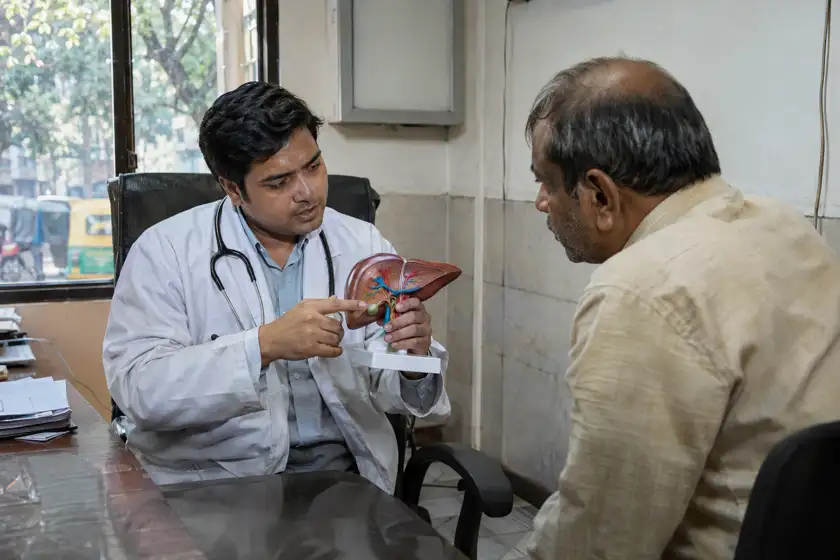
Fatty liver is usually silent. Some people have tiredness or a dull discomfort under the right ribs. It is typically discovered when an ultrasound is done for another reason or when liver enzymes are raised on a routine blood test. Symptoms such as jaundice, swelling of the abdomen or legs, easy bruising, vomiting blood or confusion suggest advanced disease and need urgent assessment.
The tests that matter
| Test | What it shows | Points to know |
|---|---|---|
| Liver enzymes (ALT, AST) | Liver cell irritation | Can be normal even with significant disease; a rising or persistently raised level deserves attention |
| Ultrasound | Presence of fat, often graded 1 to 3 | The grade reflects how bright the liver looks, not how much scarring there is |
| FIB-4 score | An estimate of fibrosis risk calculated from age, AST, ALT and platelet count | A low score, below about 1.3, makes advanced scarring unlikely. A higher score calls for further testing |
| Elastography (FibroScan and similar) | Liver stiffness, a measure of scarring; some machines also estimate fat | Quick and painless. A low stiffness reading is reassuring; high readings need specialist review |
| Blood tests for other causes | Hepatitis B and C, and other conditions where relevant | To make sure nothing else is being missed |
| Metabolic tests | Fasting glucose, HbA1c, lipids, blood pressure, waist | Fatty liver rarely travels alone |
| Liver biopsy | The definitive test for inflammation and scarring | Now reserved for selected cases, since non-invasive tests have improved |
A sensible approach, widely recommended, is to calculate a FIB-4 score for everyone with fatty liver, and to arrange elastography for those whose score is not low. Ask your healthcare provider what your result is.
What do “grade 1, 2 and 3” mean?
These describe how much fat the ultrasound suggests: mild, moderate or marked. They do not measure inflammation or scarring. A person with grade 1 fatty liver can have significant fibrosis, and a person with grade 3 can have none. The grade is a reason to act, not a measure of danger.
Weight loss: the treatment that works
Research using repeat liver biopsies has shown a clear relationship between the amount of weight lost and the degree of healing.
| Weight loss achieved | Effect on the liver |
|---|---|
| 3 to 5% | Liver fat begins to fall |
| 5 to 7% | Substantial reduction in fat; liver enzymes improve |
| 7 to 10% | Inflammation resolves in a majority of people |
| 10% or more | Scarring improves in a substantial proportion; resolution of steatohepatitis in most |
For a person weighing 90 kg, a 10 percent loss is 9 kg. With lifestyle measures alone, only a minority manage to lose and maintain that much. This is where effective weight loss medicines make the difference.
What GLP-1 medicines do for the liver
GLP-1 medicines help the liver mainly through weight loss, and also by improving insulin resistance and reducing the flow of fat and sugar to the liver. There are few GLP-1 receptors on liver cells themselves, so the benefit is thought to be largely indirect.
Semaglutide
In a large trial of adults with biopsy-proven steatohepatitis and moderate to advanced scarring, weekly semaglutide 2.4 mg was compared with placebo. At 72 weeks:
- Steatohepatitis had resolved, without worsening of scarring, in about 63 in 100 people on semaglutide, compared with about 34 in 100 on placebo.
- Scarring had improved by at least one stage, without worsening of steatohepatitis, in about 37 in 100, compared with about 22 in 100 on placebo.
- Body weight fell by about 10 percent on average, and liver enzymes, blood sugar and other markers improved.
On the strength of these results, semaglutide has been approved in some countries for adults with steatohepatitis and moderate to advanced fibrosis. The trial is continuing, to see whether these changes translate into fewer cases of cirrhosis and liver failure.
Tirzepatide
In a one-year trial of adults with biopsy-proven steatohepatitis and moderate to advanced scarring:
- Steatohepatitis resolved, without worsening of scarring, in roughly 44 to 62 in 100 people, depending on the dose, compared with about 10 in 100 on placebo.
- Scarring improved by at least one stage in about half of those treated, compared with about 30 in 100 on placebo.
Larger and longer trials are in progress. Tirzepatide has not, at the time of writing, been specifically licensed for liver disease, but the weight loss it produces is in the range known to benefit the liver.
In everyday terms
Most people with fatty liver who lose weight on these medicines see their liver enzymes fall within a few months and liver fat decrease on scans. In many, ultrasound reports return to normal.
What the evidence does and does not show
These medicines clear liver inflammation in a majority of treated patients and improve scarring in many. Whether they prevent cirrhosis, liver cancer and liver-related death is expected but not yet proven. In people who already have cirrhosis, trials have not shown reversal of scarring.
Who with fatty liver might be offered a GLP-1 medicine?
- People with fatty liver who also meet the usual weight criteria: BMI 30 or above, or 27 or above with a weight-related condition, with individual judgement for Indian patients
- People with fatty liver and type 2 diabetes, in whom a GLP-1 medicine treats both
- People with steatohepatitis and fibrosis, under the guidance of a liver specialist
- Those who have not achieved sufficient weight loss with lifestyle measures
Simple fatty liver in a person with a healthy weight and no metabolic problems is managed with diet, activity and monitoring.
If you already have cirrhosis
People with compensated cirrhosis, meaning the liver is scarred but still working, have been treated with semaglutide in trials without safety concerns specific to the liver, although scarring did not improve. Treatment decisions belong with a hepatologist. In decompensated cirrhosis, with fluid in the abdomen, jaundice, bleeding or confusion, these medicines are generally not used, and nutrition needs specialist management because muscle loss is a serious risk.
Other treatments your healthcare provider may mention
| Treatment | Role |
|---|---|
| Diet and physical activity | The foundation for everyone |
| Liver-directed medicines | A medicine acting on a thyroid hormone receptor in the liver has been approved in some countries for steatohepatitis with fibrosis. Others are in development |
| Pioglitazone | A diabetes medicine that improves steatohepatitis in some patients; can cause weight gain and fluid retention |
| Vitamin E | Used in selected people without diabetes who have biopsy-proven steatohepatitis; not for general use |
| Statins | Safe in fatty liver and important for heart protection; they do not treat the liver itself |
| Bariatric surgery | Produces large, durable weight loss and resolves steatohepatitis in most patients; considered at higher BMI |
| Newer dual and triple hormone medicines | Showing strong effects on liver fat in trials; availability varies |
“Liver tonics” and herbal preparations are widely sold. None has good evidence for treating fatty liver, and some herbal products have caused liver injury. Tell your healthcare provider about every supplement, protein powder and herbal or traditional remedy you take, since unexplained rises in liver enzymes are sometimes traced to one of them, and stop any that your healthcare provider considers a possible cause.
Eating for your liver
The same eating pattern that helps weight and blood sugar helps the liver. Studies favour a Mediterranean-style pattern, which translates well to Indian food: plenty of vegetables, pulses, whole grains, nuts, fruit and unsaturated oils, with fish where eaten, and little sugar and refined flour.
| Eat more of | Why |
|---|---|
| Vegetables at every main meal | Fibre and antioxidants; low in calories |
| Dals, chana, rajma, sprouts | Protein and fibre without excess fat |
| Whole grains and millets in moderate portions | Slower rise in blood sugar than refined grains |
| Curd, paneer in moderation, eggs, fish, chicken | Protein to protect muscle during weight loss |
| Nuts and seeds, a small handful | Unsaturated fats; walnuts and flaxseed provide omega-3 |
| Whole fruit, one or two servings | Fibre; far better than juice |
| Mustard, groundnut, rice bran or olive oil, in measured amounts | Better fat quality than vanaspati or repeatedly heated oil |
| Coffee, 2 to 3 cups without sugar, if it suits you | Consistently linked with less liver scarring in studies |
| Cut down on | Why |
|---|---|
| Sugary drinks, packaged juices, sweetened tea and coffee | Fructose is converted to fat in the liver more readily than any other nutrient |
| Sweets, mithai, desserts, biscuits | Sugar plus refined flour and fat |
| Maida: white bread, naan, bakery items, noodles | Rapidly absorbed carbohydrate |
| Deep-fried foods and namkeen | Excess calories; poor-quality fat |
| Large portions of rice, roti or potatoes | Surplus carbohydrate is stored as liver fat |
| Red and processed meat in excess | Linked with fatty liver in studies |
| Alcohol | See below |
A sample day
| Meal | Vegetarian | Non-vegetarian |
|---|---|---|
| Breakfast | Vegetable oats or 2 moong chillas with curd; coffee or tea without sugar | 2-egg vegetable omelette, 1 whole wheat toast; coffee without sugar |
| Mid-morning | 1 fruit; a few walnuts | 1 fruit; chaas |
| Lunch | Salad, 1 to 2 rotis or a small katori of brown rice, dal or chana, sabzi, curd | Salad, small katori of rice, fish curry cooked in little oil, sabzi |
| Evening | Roasted chana or sprouts chaat | Boiled egg or roasted chana |
| Dinner | Paneer or tofu with mixed vegetables, dal, 1 phulka | Grilled chicken or fish with vegetables, dal, 1 phulka |
Alcohol and fatty liver
Alcohol and metabolic fatty liver damage the liver through overlapping pathways, and the two together are worse than either alone. Even amounts usually described as moderate have been linked with faster progression of scarring in people who already have fatty liver. If you have steatohepatitis or any degree of fibrosis, the safest amount is none. If you have simple fatty liver, the less the better. Alcohol also adds abdominal fat, raises triglycerides and worsens the digestive side effects of GLP-1 medicines.
Exercise helps the liver directly
Physical activity reduces liver fat even when weight does not change, by improving insulin sensitivity and the way muscle uses fuel. Both aerobic and resistance exercise work. Aim for at least 150 minutes a week of brisk walking, cycling or swimming, plus strength training two or three times a week. During weight loss on medication, resistance exercise also protects muscle, which matters especially in liver disease.
Pace matters: avoid crash weight loss
Very rapid weight loss, well over 1.5 kg a week, has occasionally been associated with a temporary worsening of liver inflammation and increases the risk of gallstones. A steady loss of 0.5 to 1 kg a week is ideal. If you are losing faster than this for several weeks on treatment, tell your healthcare provider.
What to expect and how progress is tracked
| Time | What often happens | What is checked |
|---|---|---|
| Before treatment | Baseline established | Liver enzymes, platelets, FIB-4, ultrasound; elastography if indicated; glucose, lipids |
| 3 months | 5% or more weight lost; liver enzymes begin to fall | Weight, waist, liver enzymes |
| 6 months | Around 10% lost in many; enzymes often normal | Liver enzymes, HbA1c, lipids |
| 12 months | Fat reduced or cleared on imaging in many | Repeat ultrasound or elastography; FIB-4 |
| Long term | Benefit maintained if weight is maintained | Yearly review; specialist follow-up for those with fibrosis |
Liver enzymes can fluctuate, and a single reading means little. The trend over months, along with weight, waist and stiffness measurements, gives the true picture. If treatment stops and weight returns, liver fat generally returns too.
Are GLP-1 medicines safe for the liver?
Yes. They are not processed by the liver in a way that requires dose changes in liver disease, and liver enzymes typically improve on treatment. The precautions are those that apply to everyone: gallbladder problems, which are somewhat more frequent and can cause abnormal liver tests with pain or jaundice; rare pancreatitis; and dehydration from vomiting. Jaundice, dark urine, pale stools or severe abdominal pain on treatment need prompt assessment.
See a healthcare professional promptly if you have
Yellowing of the eyes or skin, dark urine, swelling of the abdomen or legs, easy bruising or bleeding, black stools or vomiting blood, confusion or unusual drowsiness, or severe pain in the upper abdomen.

Three illustrative examples
These invented examples show typical courses. They are not predictions for any individual.
Grade 2 fatty liver found on a check-up
A 39-year-old man weighing 94 kg has raised ALT, a low FIB-4 score and prediabetes. He starts treatment with a nutrition plan, stops sugary drinks and beer, and walks daily. After a year he has lost 13 kg, his ALT and blood sugar are normal, and a repeat ultrasound shows no fat.
Diabetes with moderate scarring
A 56-year-old woman with type 2 diabetes has a raised FIB-4 score, and elastography suggests moderate fibrosis. A hepatologist confirms steatohepatitis. She is treated with a GLP-1 medicine, loses 11 percent of her weight, and her liver stiffness falls over 18 months. She remains under specialist follow-up.
Lean fatty liver
A 45-year-old man with a BMI of 24 but a waist of 96 cm and high triglycerides has fatty liver. He does not meet the criteria for weight loss medication. A dietitian-led plan that cuts sugar and refined carbohydrate, with strength training, reduces his waist by 7 cm and normalises his triglycerides and liver enzymes.
Questions to ask your healthcare provider
- Do I have simple fatty liver, or is there inflammation or scarring?
- What is my FIB-4 score, and do I need elastography?
- Should I see a liver specialist?
- How much weight do I need to lose to help my liver?
- Am I a candidate for a GLP-1 medicine?
- Is any alcohol safe for me?
- How often should my liver be rechecked?
Common myths
“Fatty liver is harmless and everyone has it”
It is common, but a proportion of people develop inflammation and scarring, and it signals higher risk of diabetes and heart disease.
“Only people who drink get liver disease”
Metabolic fatty liver is now the commonest liver condition, and it occurs in people who do not drink at all.
“Normal liver enzymes mean a healthy liver”
Enzymes can be normal even with significant scarring.
“Grade 3 means my liver is failing”
The grade describes fat, not damage. Scarring is assessed separately.
“Liver tonics and detox drinks will clean the liver”
There is no evidence for them. Weight loss, diet, activity and avoiding alcohol are what work.
“Weight loss injections harm the liver”
They improve liver fat and inflammation in most people.
“Thin people cannot have fatty liver”
Lean fatty liver is well recognised in Indians.
How The Prime Fit helps
At The Prime Fit, liver health is part of every assessment. We check liver enzymes and calculate a fibrosis score, arrange an ultrasound or elastography where indicated, and refer to a liver specialist when scarring is suspected. Your dietitian builds a liver-friendly Indian meal plan, low in sugar and refined carbohydrate and adequate in protein, with weekly follow-up, and your healthcare provider advises on whether medication is appropriate and tracks your liver tests over time.
To have your liver risk assessed, book a consultation or read about our fatty liver diet programme and GLP-1 therapy.
Frequently asked questions
Can GLP-1 medicines treat fatty liver?
They reduce liver fat and, in biopsy trials, resolved liver inflammation in a majority of treated patients. Semaglutide has been approved for steatohepatitis with fibrosis in some countries.
Can fatty liver be reversed?
Yes. Simple fatty liver and steatohepatitis usually improve or resolve with weight loss of 7 to 10 percent or more. Mild to moderate scarring can also improve. Cirrhosis is largely permanent.
How much weight do I need to lose?
About 5 percent reduces liver fat, 7 to 10 percent resolves inflammation in most people, and 10 percent or more gives the best chance of improving scarring.
Which is better for the liver, Wegovy or Mounjaro?
Both have shown resolution of liver inflammation in a majority of patients in biopsy trials. They have not been compared directly for liver outcomes. The choice depends on your overall health.
Are weight loss injections safe if my liver enzymes are raised?
Generally yes, when the cause is fatty liver, and enzymes usually fall with treatment. Other causes should be excluded first.
What does grade 1, 2 or 3 fatty liver mean?
It describes the amount of fat seen on ultrasound: mild, moderate or marked. It does not measure scarring, which is assessed with a FIB-4 score or elastography.
What is a FibroScan?
A quick, painless scan that measures liver stiffness to estimate scarring. It is used when blood-based scores suggest a possible risk of fibrosis.
Can I drink alcohol if I have fatty liver?
It is best avoided. With inflammation or any scarring, the safest amount is none.
Is coffee good for the liver?
Studies consistently link 2 to 3 cups of coffee a day, without sugar, with less liver scarring. It is an addition to, not a replacement for, weight loss and diet.
Will the fat come back if I stop treatment?
If weight is regained, liver fat usually returns. Maintaining weight loss maintains the benefit.
This article is general information and is not a substitute for a consultation. Trial figures are approximate. If you have fatty liver with raised liver tests or scarring, ask your healthcare provider whether you should see a liver specialist.