In this article
- What is belly fat? Subcutaneous and visceral fat
- Why do Indians gain fat around the belly?
- Waist cut-offs for Indians: how much is too much?
- Can you spot-reduce belly fat?
- What really works to lose belly fat?
- How should you eat to lose belly fat? An Indian approach
- Sample day: vegetarian and non-vegetarian
- Which exercise is best for belly fat?
- Is it fat or bloating?
- When does belly fat need medical treatment?
- How long does it take to lose belly fat?
- Common myths about belly fat
- Questions to ask your healthcare provider
- How The Prime Fit helps
- Frequently asked questions
If you want to know how to lose belly fat, the honest answer has two parts. First, you cannot choose where your body burns fat: crunches, belts, creams and “belly fat” teas do not remove fat from the abdomen. Second, the good news: when you lose fat overall through food, movement, sleep and, where appropriate, medical treatment, the deep fat around the abdominal organs is often among the first to respond.
This matters more for Indians than for many other populations. People of South Asian origin tend to carry more fat around the abdomen, and more fat overall, at a lower body weight. A person can look slim in a shirt, have a “normal” BMI, and still have a waist that signals risk for diabetes and heart disease.
This guide explains the types of belly fat, how to measure your waist properly, the Indian cut-offs, and what really works. It is general information and not a substitute for an assessment by your healthcare provider.
What is belly fat? Subcutaneous and visceral fat
There are two main kinds of fat in the abdominal area.
| Feature | Subcutaneous fat | Visceral fat |
|---|---|---|
| Where it sits | Just under the skin; the fat you can pinch | Deep inside the abdomen, around the liver, intestines and other organs |
| How it feels | Soft | The belly may feel firm and rounded, because the fat lies behind the muscle wall |
| Health effect | Less strongly linked to metabolic disease | Strongly linked to insulin resistance, type 2 diabetes, fatty liver, high blood pressure and heart disease |
| Response to lifestyle change | Slower, and varies by body area | Often responds early to overall fat loss and regular aerobic exercise |
| Can liposuction remove it? | Yes | No |
Visceral fat is not just stored energy. It is metabolically active tissue that releases fatty acids and inflammatory signals, much of which reaches the liver directly. This is one reason a large waist is associated with fatty liver, raised triglycerides, higher blood sugar and higher blood pressure, a cluster often called metabolic syndrome.
Why do Indians gain fat around the belly?
Research over several decades has shown that South Asians, on average, have a higher percentage of body fat and more abdominal fat than Europeans of the same BMI, along with less muscle. This is sometimes called the “thin-fat” pattern. The reasons are not fully understood and probably include genetics, nutrition in early life and lifestyle.
Everyday factors add to this tendency:
- Meals built mainly around refined carbohydrate: white rice, maida, large stacks of rotis, with little protein.
- Sweet tea several times a day, biscuits, namkeen, fried snacks and mithai.
- Long hours of sitting at desks and in traffic, and very little strength-building activity.
- Late, heavy dinners and short sleep.
- Alcohol, which adds energy and usually comes with fried or salty snacks.
- Hormonal changes: menopause in women, and conditions such as PCOS.
Because of this pattern, Indian guidelines use lower thresholds than international ones: overweight starts at a BMI of 23 and obesity at 25. You can check yours with our BMI calculator and read about the newer staging approach in India’s new obesity definition.
Waist cut-offs for Indians: how much is too much?
Waist circumference is the simplest practical guide to visceral fat. For Asian Indian adults, the cut-offs that indicate higher risk are:
| Measure | Men | Women |
|---|---|---|
| Waist circumference: higher risk from | 90 cm (about 35.5 inches) | 80 cm (about 31.5 inches) |
| Waist-to-height ratio: aim for | Below 0.5 | Below 0.5 |
| BMI: overweight from | 23 | 23 |
| BMI: obesity from | 25 | 25 |
The waist-to-height ratio is a useful second check: your waist should be less than half your height.
Illustrative example: a man who is 165 cm tall with a waist of 92 cm has a ratio of 92 divided by 165, which is about 0.56. His waist is above the 90 cm cut-off, and above half his height (82.5 cm). Even if his BMI were below 25, this would be worth discussing with a healthcare professional.
How to measure your waist correctly
- Stand upright, feet together, abdomen relaxed. Do not hold your breath in.
- Find the bottom of your lowest rib and the top of your hip bone at the side. The tape goes midway between these two points, which is usually close to the level of the navel but not always.
- Keep the tape horizontal all the way round, snug but not pressing into the skin.
- Read the number at the end of a normal breath out.
- Measure on bare skin or over a single thin layer, at the same time of day each time. Once every two to four weeks is enough.
Can you spot-reduce belly fat?
No. This is the most persistent myth in fitness. When your body needs energy, it draws fat from stores all over the body, in a pattern set largely by your genes, sex and hormones. Exercising the muscle beneath a fat store does not preferentially burn that store. Studies in which people trained one body area for weeks, including abdominal exercise programmes, have generally found no meaningful extra fat loss in that area compared with the rest of the body.
The useful version of the truth
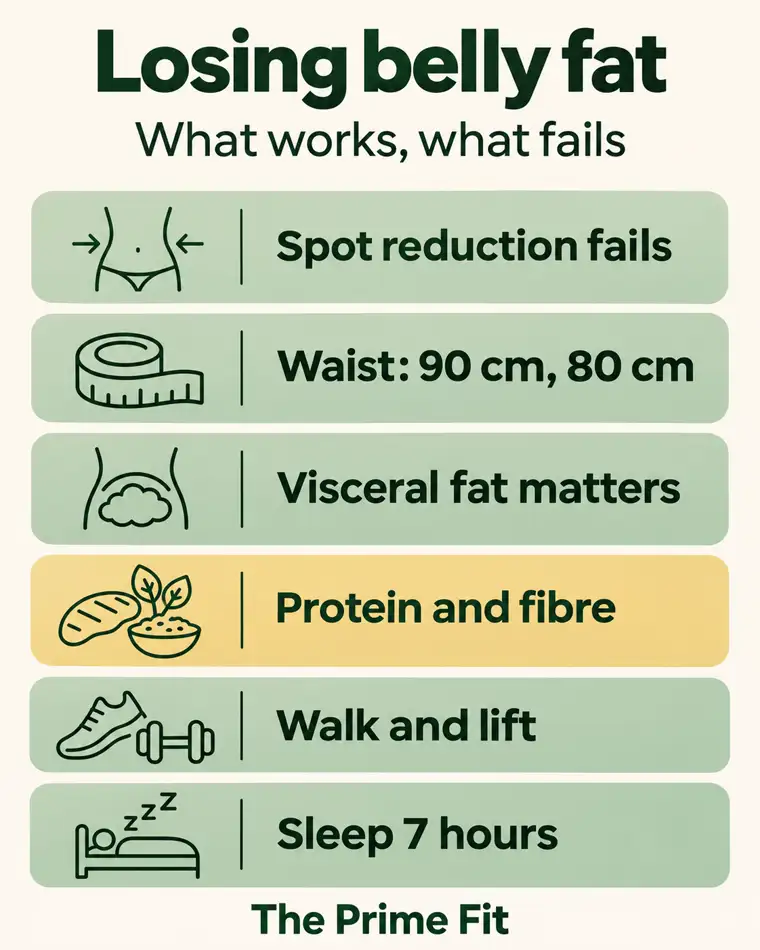
You cannot target belly fat with a particular exercise or food. You can reduce it by losing fat overall, and visceral fat tends to fall early when you do. A waist measurement that drops by a few centimetres is a real health gain, even if the scale moves slowly.
What really works to lose belly fat?
Five things have good evidence behind them. None is dramatic; together they are effective.
- A modest, sustained calorie deficit. Losing even 5 to 10% of body weight usually brings a clear fall in waist size, liver fat, blood sugar and blood pressure.
- Enough protein and fibre. These keep you full and help protect muscle while you lose fat.
- Regular aerobic activity. Brisk walking, cycling or swimming reduces visceral fat, sometimes even before the scale changes much.
- Strength training. This preserves and builds muscle, which Indians tend to have less of, and improves how the body handles sugar.
- Sleep and stress management. Regularly sleeping less than about six hours increases hunger and is associated with more abdominal fat. Aim for seven to eight hours. Loud snoring with daytime sleepiness may point to sleep apnoea and deserves a medical check.

How should you eat to lose belly fat? An Indian approach
There is no single “belly fat diet”. The principles are the same as for any healthy fat loss, applied to Indian food.
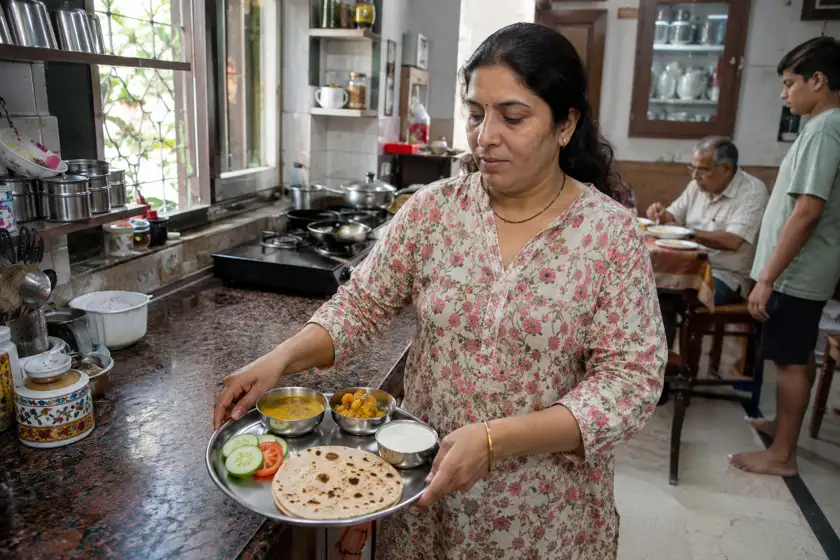
- Rebuild the plate. Half vegetables, a quarter protein (dal, chana, rajma, paneer, curd, soya, eggs, fish or chicken), a quarter whole grains (roti, rice, millets).
- Cut liquid sugar first. Sweet tea and coffee, soft drinks, packaged juices, sweet lassi and sugarcane juice add energy without filling you up.
- Reduce refined carbohydrate, not all carbohydrate. Fewer rotis, a smaller rice portion, less maida, bread, biscuits and bakery items. Dal, whole grains and fruit stay.
- Measure cooking fat. Oil and ghee by the teaspoon. Roast, steam, grill or air-fry in place of deep-frying.
- Add protein to every meal. Most Indian vegetarian diets are low in protein. Our vegetarian high-protein meal plan shows how to raise it with ordinary foods.
- Limit alcohol. It supplies energy, lowers restraint around food and adds to liver fat.
- Eat dinner earlier and lighter where your routine allows.
Simple swaps
| Common habit | Swap |
|---|---|
| 3 to 4 cups of sweet tea with biscuits | 2 cups with little or no sugar; roasted chana or a fruit in place of biscuits |
| Aloo paratha with butter | Paneer, dal or methi paratha made with little oil, with curd |
| Large plate of rice with a little dal | Small katori of rice, a full katori of dal, sabzi and salad |
| Samosa, pakora or namkeen in the evening | Sprouts chaat, roasted makhana, boiled egg or peanuts in a small handful |
| Soft drink or packaged juice | Water, plain chaas, nimbu pani without sugar |
Sample day: vegetarian and non-vegetarian
This is an illustrative example. Portions depend on your size, activity and medical conditions; people with diabetes or kidney disease need individual advice.
| Meal | Vegetarian | Non-vegetarian |
|---|---|---|
| Breakfast | 2 moong dal chillas with paneer filling, mint chutney | 2-egg vegetable omelette with 1 multigrain roti or toast |
| Mid-morning | 1 fruit (guava, apple, orange or papaya), plain chaas | 1 fruit, plain chaas |
| Lunch | 2 rotis, 1 katori dal or rajma, seasonal sabzi, salad, curd | 1 to 2 rotis, chicken or fish curry cooked in little oil, sabzi, salad |
| Evening | Roasted chana or sprouts chaat, tea without sugar | Boiled egg or roasted chana, tea without sugar |
| Dinner | Paneer or soya bhurji, sauteed vegetables, 1 roti or a small katori of rice | Grilled fish or chicken tikka, sauteed vegetables, 1 roti or dal soup |
Which exercise is best for belly fat?
The best exercise is the one you will do most days. For visceral fat, the evidence favours a combination.
- Aerobic activity: build up to at least 150 minutes a week of moderate activity such as brisk walking, where you can talk but not sing. More, up to about 300 minutes a week, brings further benefit.
- Strength training: two or three sessions a week covering the legs, back, chest and core. Body-weight exercises and resistance bands are enough to begin.
- Less sitting: stand and walk for a few minutes every half hour to an hour. A short walk after meals also helps blood sugar.
- Core work: planks, bridges and similar exercises for strength and posture, not for fat removal.
If you are starting from very little activity, our guide to walking for fat loss gives a gradual plan, and the beginner strength plan is suitable whether or not you take any medicine. If you have heart disease, chest pain on exertion, uncontrolled blood pressure or joint problems, check with your healthcare provider before starting.
Is it fat or bloating?
Not every prominent belly is fat. Bloating from gas, constipation or food intolerance changes through the day: flatter in the morning, larger after meals, and often uncomfortable. Fat does not change from hour to hour.
See a healthcare professional promptly if
Your abdomen is growing quickly over weeks; it feels hard or tense; you have persistent pain, vomiting, yellowing of the eyes, swelling of the legs, breathlessness, a change in bowel habit, blood in the stool or unexplained weight loss. In women, persistent bloating with pelvic pain or feeling full quickly should be checked. Weight gain mainly around the trunk with thin arms and legs, easy bruising, wide purple stretch marks or muscle weakness also needs assessment.
When does belly fat need medical treatment?
Lifestyle change is the foundation for everyone. Medical treatment may be added when weight and waist are causing, or are likely to cause, health problems. A healthcare professional will usually check blood pressure, fasting glucose or HbA1c, cholesterol and triglycerides, liver enzymes and thyroid function, and may suggest an ultrasound if fatty liver is suspected. Our guide to GLP-1 medicines and fatty liver explains that link in more detail.
GLP-1 based medicines such as Mounjaro and Wegovy reduce appetite and lead to substantial overall weight loss in many eligible people, and body composition studies show that visceral fat falls along with total fat. They are prescription medicines for people who meet specific criteria, not cosmetic treatments for a slightly rounded tummy, and they work alongside diet and exercise, not in place of them. See who is eligible for weight loss injections.
For people with more severe obesity and related disease, bariatric surgery may be discussed. Liposuction and similar body-contouring procedures are different: they remove subcutaneous fat for shape, do not remove visceral fat, and have not been shown to improve blood sugar, cholesterol or blood pressure.
How long does it take to lose belly fat?
With consistent changes, many people notice looser clothing within four to eight weeks, and a measurable fall in waist size over two to three months. A sensible pace of fat loss for most adults is about 0.5 kg a week. The lower abdomen is often the last place to slim down, particularly the soft subcutaneous layer, and loose skin after pregnancy or large weight loss does not respond to diet at all.

Common myths about belly fat
- “A hundred crunches a day will flatten the stomach.” Crunches strengthen muscle. They do not remove the fat over it.
- “Sweat belts, waist trainers and sauna suits burn belly fat.” They cause temporary water loss and compress the abdomen. Fat is unchanged.
- “Jeera water, lemon-honey water, green tea or apple cider vinegar melt belly fat.” These are harmless for most people in normal amounts, but none removes abdominal fat. Honey adds sugar.
- “Rice at night goes straight to the belly.” No single food or mealtime sends fat to one place. Total intake and portion size matter.
- “I am thin, so my belly is not a health problem.” A waist above the cut-off carries risk even with a normal BMI, which is common in Indians.
Questions to ask your healthcare provider
- What are my BMI, waist circumference and waist-to-height ratio, and what do they mean for my risk?
- Should I be tested for diabetes or prediabetes, cholesterol, fatty liver or thyroid problems?
- Is my blood pressure in a healthy range?
- Is it safe for me to start brisk walking and strength training, given my heart and joints?
- Do my snoring and tiredness need a sleep assessment?
- What is a realistic target for my weight and waist over the next six months?
- Am I a candidate for medical treatment, and what would it involve?
How The Prime Fit helps
At The Prime Fit, the starting point is an assessment, not a product. That includes your weight history, BMI and waist measurement using Indian cut-offs, relevant blood tests, medicines and related conditions such as diabetes, fatty liver, PCOS or sleep problems. From this, the team builds a plan around your usual food through our clinical nutrition service, with practical guidance on activity.
Where medicines are appropriate and safe, they are prescribed and monitored as part of that plan, and regular follow-up tracks waist, weight and health markers so that the approach can be adjusted over time. No treatment can promise a flat stomach, and we do not offer guarantees; the aim is a healthier waist and lower long-term risk.
Frequently asked questions
Can I lose belly fat without losing weight elsewhere?
No. Fat is lost from the whole body in a pattern you cannot control. The encouraging part is that the deep visceral fat in the abdomen often responds early to overall fat loss and regular exercise.
What waist size is unhealthy for Indians?
For Asian Indian adults, risk rises from a waist of 90 cm in men and 80 cm in women. A waist of more than half your height is another warning sign.
Which exercise burns the most belly fat?
No exercise burns belly fat specifically. Regular aerobic activity such as brisk walking, combined with strength training two or three times a week, is the best-supported approach for reducing visceral fat.
Do abdominal exercises help at all?
Yes, for core strength, posture and back health. They do not remove the fat lying over the muscles.
Why do I have a belly even though my weight is normal?
Indians often carry more abdominal fat and less muscle at a given weight. Bloating, posture and weak abdominal muscles can also contribute. Measure your waist; if it is above the cut-off, ask your healthcare provider for a metabolic check.
Is visceral fat dangerous?
Excess visceral fat is linked to insulin resistance, type 2 diabetes, fatty liver, high blood pressure and heart disease. Reducing it lowers these risks.
Do weight loss injections reduce belly fat?
In eligible people, GLP-1 based medicines reduce total body fat, including visceral fat, when used with diet and exercise under medical supervision. They do not target the belly specifically and are not suitable for everyone.
How quickly can I lose belly fat?
Expect gradual change: looser clothes within one to two months and a measurable drop in waist size over two to three months of consistent habits. Quick fixes that promise more do not deliver lasting fat loss.
This article is general information and is not a substitute for a consultation with your own healthcare provider. Cut-offs and figures are approximate guides for adults and do not apply in pregnancy. If you have a medical condition, take regular medicines, or have any of the warning signs described above, seek medical advice before changing your diet or exercise.