In this article
- Do jeera water, apple cider vinegar and detox drinks burn fat?
- Does jeera water help weight loss?
- Does apple cider vinegar burn fat?
- Lemon water and lemon-honey water: what do they really do?
- What about methi, ajwain, saunf, cinnamon and green tea?
- What does “detox” actually mean?
- How many calories are in these drinks?
- Why do people feel these drinks work?
- Who should be careful with these drinks?
- Detox drinks on GLP-1 medicines
- What actually helps you lose fat?
- Common myths about detox drinks
- Questions to ask your healthcare provider
- How The Prime Fit helps
- Frequently asked questions
Jeera water at dawn, a spoon of apple cider vinegar before meals, warm lemon-honey water, methi seeds soaked overnight, a “detox” tea before bed. Almost every Indian household has tried at least one, and social media promises that each will “melt belly fat” or “flush toxins”.
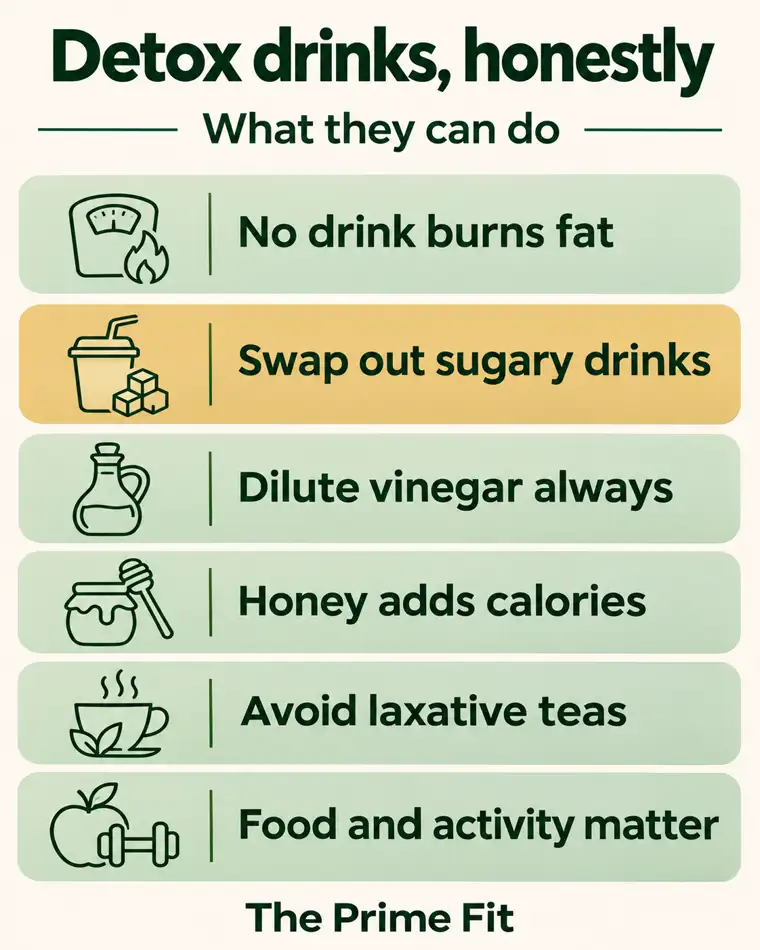
Do jeera water, apple cider vinegar and detox drinks burn fat? No. None of them burns body fat to a degree that matters. The research that exists is small and short, and at best suggests minor effects. Where people do lose weight, it is usually because the drink has replaced sweet chai, juice or a snack, or because it marks the start of a more careful day.
That does not make every drink useless or harmful. Some are sensible low-calorie habits. A few can cause real problems, particularly for people with diabetes, kidney disease or acid reflux, and for those on GLP-1 medicines. This guide goes through them one by one. It is general information, not personal medical advice.
Do jeera water, apple cider vinegar and detox drinks burn fat?
Body fat is lost when, over weeks and months, the body uses more energy than it takes in. A drink could help in only a few ways: by containing fewer calories than what it replaces, by making you feel fuller so you eat less, or by slightly raising the energy you burn. For the drinks in this article, the first effect is real, the second is small and inconsistent, and the third is negligible.
| Drink | What the evidence suggests | Main cautions |
|---|---|---|
| Jeera (cumin) water | A few small, short trials of cumin powder or extract reported modest changes. Jeera water itself is barely studied. | Generally safe in kitchen amounts |
| Apple cider vinegar | Small trials suggest a slight effect on weight and post-meal blood sugar at best. Evidence is weak. | Tooth enamel, throat and stomach irritation, interactions with some medicines |
| Lemon water | No fat-burning effect. Useful as a low-calorie drink. | Acidic, so hard on teeth if sipped all day |
| Lemon-honey water | No fat-burning effect. Honey adds sugar and calories. | Raises blood sugar, relevant in diabetes |
| Methi (fenugreek) water | Some evidence for a modest effect on blood sugar and fullness, mostly from seed powder. Not shown to burn fat. | Can add to the effect of diabetes medicines, gas and loose stools |
| Green tea | Very small effect on weight, not clinically meaningful. | Caffeine. Concentrated extracts have been linked to rare liver injury. |
| Ajwain, saunf or dalchini water | Traditional digestive drinks. No good evidence for fat loss. | Large amounts of cassia cinnamon are not advised |
| “Detox” or “slimming” teas | Any quick drop on the scale is water and stool, not fat. | Often contain laxatives. Dehydration, cramps, low potassium. |
Does jeera water help weight loss?
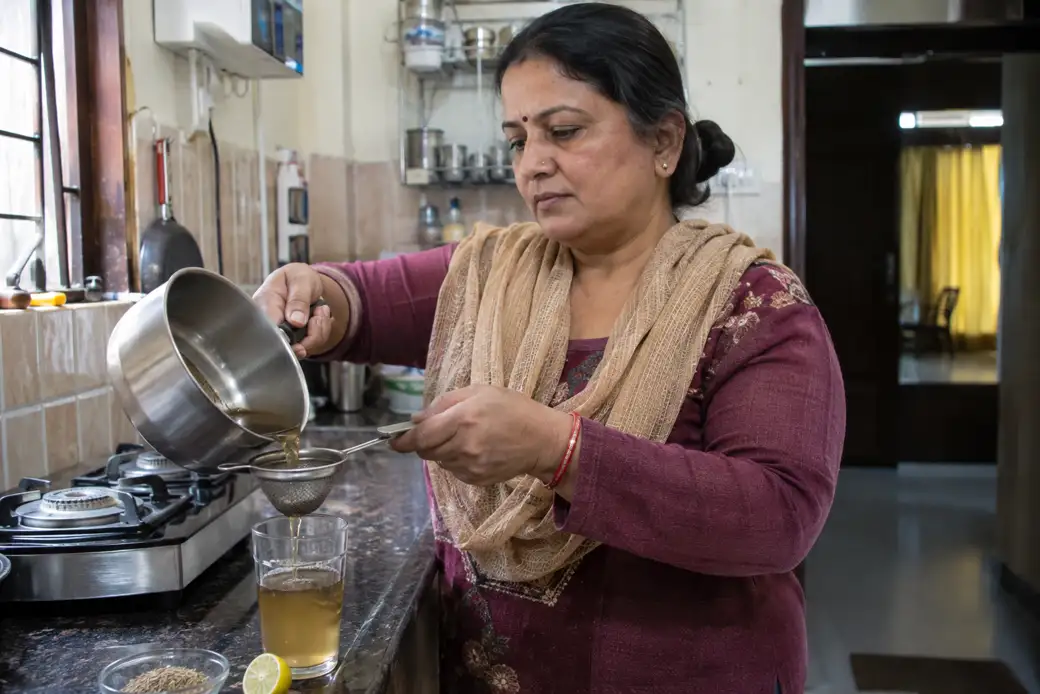
Jeera water is made by soaking or boiling a teaspoon of cumin seeds in water and straining it. It has almost no calories and many people find it settles the stomach.
The research often quoted online comes from a handful of small trials, mostly in overweight women, that used cumin powder mixed into food or concentrated cumin capsules, not jeera water. Some reported modest improvements in weight and cholesterol over a few weeks. These studies were short, small and have not been confirmed in large, well-designed trials.
A fair summary: jeera water is a harmless, pleasant drink for most people and a good replacement for sweet morning tea. It is not a fat burner.

Does apple cider vinegar burn fat?
Apple cider vinegar has the most research and the most exaggeration. A frequently cited Japanese trial in adults with obesity found that 15 to 30 ml of vinegar a day for 12 weeks led to about 1 to 2 kg more weight loss than a placebo drink, and the weight returned after stopping. Other small studies suggest vinegar taken with a carbohydrate-rich meal slightly blunts the rise in blood sugar afterwards, possibly by slowing stomach emptying.
A more recent study that reported much larger losses was widely shared online and has since been retracted by the journal that published it, so it should not be relied on. Overall, the evidence points to a small effect at most.
The risks, on the other hand, are well documented:
- Tooth enamel: vinegar is acidic and erodes enamel with regular use.
- Throat and food pipe: undiluted vinegar and vinegar tablets have caused burns and irritation.
- Stomach: it can worsen acidity, reflux and nausea.
- Medicines: it may add to the blood-sugar-lowering effect of diabetes medicines. Large amounts taken over a long time have been linked in case reports to low potassium, a concern for people on water tablets or certain heart medicines.
If you still choose to use it
Keep to no more than 1 to 2 teaspoons, up to about 1 tablespoon (15 ml) a day, always diluted in a full glass of water and taken with a meal. Never drink it neat. Rinse your mouth with plain water afterwards and do not brush for at least 30 minutes. Vinegar in food, such as in a salad dressing or sirka pyaaz, is a gentler way to have it.
Lemon water and lemon-honey water: what do they really do?
Warm lemon water provides a little vitamin C and almost no calories. It does not dissolve fat, “alkalise” the body or speed metabolism. If it helps you drink more water in the morning, that is its benefit.
Honey changes the picture. Honey is mostly sugar. One teaspoon has about 20 kcal and one tablespoon about 60 kcal. Nutritionally, the body handles it much like table sugar, and it raises blood glucose. A daily glass of lemon-honey water with a tablespoon of honey adds roughly 60 kcal a day. That is not harmful for most people, but it is the opposite of fat burning. People with diabetes or prediabetes should count it as sugar.
What about methi, ajwain, saunf, cinnamon and green tea?
Methi (fenugreek) water. Fenugreek seeds are rich in soluble fibre. Studies, mainly using seed powder in larger amounts than a soaked teaspoon, suggest modest improvements in blood sugar and some increase in fullness. If you take insulin or sulphonylurea tablets, adding methi regularly could contribute to low blood sugar, so tell your healthcare provider. Large amounts are not advised in pregnancy.
Ajwain and saunf water. These are traditional remedies for gas and indigestion.
Dalchini (cinnamon) water. Research on cinnamon and blood sugar is mixed. The common cassia variety contains coumarin, which can affect the liver in high intakes, so a pinch in cooking or tea is preferable to spoonfuls every day.
Green tea. The combination of catechins and caffeine slightly increases energy use, but pooled trial results show an average weight change too small to matter. Two or three cups a day are fine for most adults. Concentrated green tea extract capsules are a different matter, as they have been linked to rare cases of liver injury.
Fibre-based trends such as chia water and psyllium are covered in our article on “Nature’s Ozempic” remedies.

What does “detox” actually mean?
In medicine, detoxification refers to the treatment of poisoning or drug and alcohol dependence. In marketing, “toxins” are never named and never measured. Your liver, kidneys, gut, lungs and skin clear waste products continuously. Reviews of commercial detox diets have found no good-quality evidence that they remove toxins or produce lasting weight loss.
Juice cleanses and liquid-only days do lower the number on the scale quickly. Most of that is water, stored carbohydrate and the contents of the gut, and it returns within days. Juice-only plans are also very low in protein, which encourages muscle loss, and fruit juice delivers sugar without the fibre of whole fruit.
Detox products that can cause harm
“Slimming” teas and powders often contain senna or other laxatives and can cause cramps, diarrhoea, dehydration and low potassium. Raw vegetable juices are not automatically safe: bottle gourd (lauki) juice that tastes bitter has caused serious poisoning in India and should never be drunk. Unlabelled herbal “fat burner” powders may contain undeclared drugs. Avoid any product that does not list its ingredients.
How many calories are in these drinks?
The most useful thing about a morning drink is what it replaces. Figures are approximate and depend on recipe and portion.
| Drink (about 200 ml) | Approximate calories |
|---|---|
| Plain water, jeera water, ajwain or saunf water | 0 to 5 kcal |
| Lemon water without sugar or honey | About 5 kcal |
| Apple cider vinegar, 1 tablespoon in water | About 3 kcal |
| Lemon water with 1 teaspoon honey | About 25 kcal |
| Lemon water with 1 tablespoon honey | About 65 kcal |
| Chaas, unsweetened | 30 to 40 kcal |
| Milk tea with 2 teaspoons sugar | 70 to 100 kcal |
| Packaged fruit juice or sweet lassi | 90 to 150 kcal |
Illustrative example
Suppose someone replaces two cups of sweet milk tea a day, at about 80 kcal each, with jeera water. That saves about 160 kcal a day, or 4,800 kcal over 30 days. Since a kilogram of body fat stores roughly 7,700 kcal, this is equivalent in theory to about 0.6 kg of fat in a month. The jeera did not burn anything: the saving came from the sugar and milk that were not drunk. This is an illustrative example, and real results vary.
Why do people feel these drinks work?
- They replace calories. Sweet tea, biscuits and juice quietly drop out of the morning.
- They add water. Drinking water before a meal can modestly reduce how much some people eat.
- They start a routine. People who begin a morning ritual often also walk more and eat more carefully.
- Less bloating feels like less fat. A flatter stomach by evening is usually gas and fluid, not fat loss.
- Short-term scale changes mislead. Body weight moves by 1 to 2 kg from day to day with salt, fluid and bowel habits.
Who should be careful with these drinks?
- People with diabetes on insulin or sulphonylureas: vinegar, methi and cinnamon may add to glucose lowering, while honey raises glucose. Discuss before making them daily habits.
- People with acid reflux, gastritis or ulcers: vinegar and lemon on an empty stomach commonly worsen symptoms.
- People with kidney disease or on water tablets: avoid laxative teas and large amounts of vinegar or concentrated juices, and ask about fluid and potassium limits.
- Pregnant and breastfeeding women: avoid detox products, laxative teas and medicinal quantities of methi or herbs.
- People with dental erosion or sensitive teeth: limit acidic drinks.
- Anyone with a history of an eating disorder: cleanses and “detox days” can trigger relapse.
Stop the product and seek urgent medical care for persistent vomiting or diarrhoea, severe abdominal pain, vomiting blood or black stools, fainting, palpitations or marked muscle weakness, yellowing of the eyes or dark urine, or confusion. People with diabetes should treat shakiness, sweating and confusion as possible low blood sugar.
Detox drinks on GLP-1 medicines
Mounjaro, Wegovy and Ozempic slow stomach emptying and commonly cause nausea, acidity and burping, especially early on. Vinegar and strong lemon drinks on an empty stomach can aggravate all three. Laxative teas add to the risk of dehydration, which is already a concern if you are eating and drinking less.
Plain water, sipped through the day, is the best choice. Mild jeera or saunf water is fine if you enjoy it. For safer ways to handle gut symptoms, see our guide to constipation, acidity and bloating on Mounjaro.
What actually helps you lose fat?
- A modest, sustained calorie deficit built around home food, with smaller portions of rice, roti, fried snacks and sweets.
- Enough protein at each meal. Vegetarian: dal, chana, rajma, paneer, curd, soya, tofu. Non-vegetarian: eggs, fish, chicken.
- Vegetables and whole fruit for fibre and fullness, instead of juice.
- Fewer liquid calories: sweet tea and coffee, soft drinks, packaged juice, sweet lassi and alcohol.
- Daily movement and strength training twice a week. See our walking for fat loss guide.
- Medical assessment when needed. For Asian Indians, overweight begins at a BMI of 23 and obesity at 25, and a waist above 90 cm in men or 80 cm in women indicates excess abdominal fat. Check yours with our BMI calculator.
During festivals and fasts, choose nimbu pani without sugar, chaas or plain water over sherbets and packaged drinks.
When lifestyle measures have not been enough, evidence-based treatments exist. Our articles on how GLP-1 medicines work and who is eligible for weight loss injections explain when they are considered.

Common myths about detox drinks
- “Jeera water melts belly fat.” No food or drink removes fat from one area. Fat loss happens across the body with an overall energy deficit.
- “Apple cider vinegar burns fat while you sleep.” The best studies show a small effect at most, and nothing specific to sleep.
- “Honey is healthy, so it does not count as sugar.” Honey is sugar with a trace of other compounds. It has calories and raises blood glucose.
- “It works only on an empty stomach.” There is no evidence that timing matters, and acidic drinks on an empty stomach often cause acidity.
- “A detox cleans the liver and kidneys.” These organs clean themselves. They are protected by avoiding excess alcohol, controlling weight, blood sugar and blood pressure, not by teas.
- “Natural means safe.” Laxative herbs, bitter lauki juice and concentrated extracts have all caused harm.
Questions to ask your healthcare provider
- Are any of the drinks or herbal products I use unsafe with my medicines?
- I have diabetes. Could methi, vinegar or cinnamon affect my blood sugar or my doses?
- Is my acidity or reflux linked to what I drink in the morning?
- How much fluid should I have each day with my kidney and heart health?
- What is a realistic weight and waist target for me, and over what time?
- Would I benefit from structured nutrition support or medical treatment for weight?
How The Prime Fit helps
At The Prime Fit, we begin with a medical assessment of your weight history, health conditions, medicines and relevant blood tests, so that the plan addresses causes and risks, not just the number on the scale. Our clinical nutrition support builds on the foods your household already cooks, vegetarian or non-vegetarian, and you are welcome to keep traditional drinks you enjoy where they are safe for you.
For people who meet medical criteria, treatment options are discussed openly with their benefits and side effects, and regular follow-up tracks progress and adjusts the plan. We do not sell detox products, and we do not promise specific results.
Frequently asked questions
Does jeera water burn belly fat?
No. Jeera water is a near-zero-calorie drink that may ease bloating, but there is no good evidence that it burns fat, and no drink can target belly fat. It can help if it replaces sweet tea or juice.
How much weight can I lose with apple cider vinegar?
Small trials suggest a slight effect at most, in the range of about 1 to 2 kg over 12 weeks in one study, which was regained after stopping. It is not a reliable weight-loss method and carries risks for teeth and the stomach.
Is lemon-honey water good for weight loss?
It does not burn fat. Lemon water without honey is a fine low-calorie drink. Honey adds about 20 kcal per teaspoon and raises blood sugar, so it should be counted as sugar.
Should I drink these on an empty stomach?
There is no evidence that an empty stomach makes them more effective. Acidic drinks such as vinegar and lemon are more likely to cause acidity and enamel wear when taken that way. With or after a meal is gentler.
Are detox teas safe?
Many contain senna or other laxatives. They cause loss of water and stool, not fat, and can lead to cramps, dehydration and low potassium. They are best avoided, especially with kidney or heart conditions.
Can people with diabetes drink methi water or apple cider vinegar?
Small kitchen amounts are usually tolerated, but both may lower blood sugar a little and could add to the effect of insulin or sulphonylurea tablets. Speak to your healthcare provider before making them a daily habit, and never use them in place of prescribed medicine.
Can I have apple cider vinegar while on Mounjaro or Wegovy?
It is not recommended as a routine. These medicines already slow stomach emptying and can cause nausea and acidity, which vinegar may worsen. If you wish to use it, keep it small, diluted and with food, and tell your prescriber.
What is the best morning drink for weight loss?
Plain water. Jeera water, unsweetened lemon water, green tea or unsweetened tea and coffee are reasonable alternatives. The benefit comes from avoiding sugar, not from any fat-burning property.
This article is for general education and does not replace advice from your own healthcare provider or dietitian. Calorie figures are approximate. Do not use home remedies in place of prescribed treatment, and check with your healthcare provider before using herbal or “detox” products if you have diabetes, kidney, liver or heart disease, are pregnant, or take regular medicines. Individual results vary and no outcome is guaranteed.