In this article
- What is the gut microbiome?
- How could gut bacteria affect weight?
- What does the research on gut bacteria and obesity show?
- Do probiotics help you lose weight?
- Prebiotics: feeding the bacteria you already have
- Indian fermented foods: what they do and do not offer
- What harms gut health?
- Gut health on GLP-1 medicines
- A gut-friendly Indian day
- Should you take a probiotic supplement?
- When gut symptoms need a healthcare professional
- Common myths about gut health and weight
- Where gut health fits in a weight loss plan
- Questions to ask your healthcare provider
- How The Prime Fit helps
- Frequently asked questions
Gut health has become one of the most talked-about ideas in weight loss. Probiotic capsules, gut tests and fermented drinks are sold with the promise that fixing your bacteria will fix your weight. So what does the science say about gut health, probiotics and weight?
The honest answer has two parts. Yes, the trillions of microbes in your intestine are connected to appetite, blood sugar and how the body stores fat, and people living with obesity tend to have a different mix of gut bacteria from lean people. But no, there is no probiotic supplement that reliably produces meaningful weight loss. In human trials the effects have been small, inconsistent and dependent on the particular strain.
What does hold up is less exciting and more useful: eat more fibre from a wide variety of plants, include fermented foods you enjoy, limit ultra-processed food, and treat the gut as one part of your health, not a shortcut. This guide explains the evidence and shows how everyday Indian foods such as curd, chaas, idli, dosa and kanji fit in.
What is the gut microbiome?
The gut microbiome is the community of bacteria, along with smaller numbers of fungi and viruses, that lives mostly in the large intestine. These microbes are not passengers. They break down fibre that human enzymes cannot digest, produce certain vitamins, help train the immune system and maintain the lining of the gut.
No two people have the same microbiome. It is shaped by how you were born and fed as a baby, where you live, what you eat, the medicines you have taken (antibiotics in particular), your age and your sleep. It also changes within days when your diet changes.
How could gut bacteria affect weight?
Researchers have proposed several routes. All are plausible, and most are better demonstrated in animals than in people.
- Short-chain fatty acids. When bacteria ferment fibre they produce compounds such as butyrate and propionate. These nourish the gut lining and, in laboratory and some human studies, stimulate gut cells to release fullness hormones, including natural GLP-1 and PYY.
- Gut barrier and inflammation. A diet low in fibre and high in fat may thin the protective mucus layer, allowing bacterial fragments into the bloodstream and promoting low-grade inflammation, which is linked to insulin resistance.
The mention of GLP-1 often gets exaggerated online. Fibre-fed bacteria nudge your own GLP-1 modestly and briefly. That is very different from the sustained effect of a prescription medicine. Our explainer on what GLP-1 is and how these medicines work shows why the two are not comparable.

What does the research on gut bacteria and obesity show?
The idea took off after striking experiments in mice. Mice raised without any gut bacteria gained more fat when they were given microbes from obese mice, or from obese humans, than when they received microbes from lean donors, despite eating similar food. This showed that, in mice at least, the microbiome can influence weight.
Human findings are more modest.
- Association is clear. On average, people with obesity have a less diverse microbiome. Early claims about a simple ratio of two bacterial groups predicting obesity have not held up consistently across studies.
- Direction is unclear. Diet changes the microbiome quickly, so a different microbiome may be a result of how someone eats as much as a cause of their weight.
- Transplant trials are sobering. Small trials in which people with obesity received gut bacteria from lean donors have generally not produced meaningful weight loss, even when the recipient’s bacteria changed.
Do probiotics help you lose weight?
Probiotics are live microbes that, when taken in adequate amounts, give a health benefit. For weight, the evidence looks like this.
| Approach | What human studies suggest | Strength of evidence |
|---|---|---|
| Probiotic capsules or sachets | Pooled analyses show, at best, small average reductions in weight or waist, with many trials showing nothing. Effects vary by strain and stop when the product is stopped | Weak and inconsistent |
| Prebiotic fibre supplements (such as inulin) | May modestly improve fullness and blood sugar handling; little direct effect on weight | Limited |
| Fermented foods as part of the diet | Regular curd and yoghurt intake is associated with less weight gain over time in observational studies, which cannot prove cause | Moderate for association |
| Higher fibre intake from foods | Consistently linked with better weight control, fullness and metabolic health | Good |
| Gut bacteria transplant | No meaningful weight loss in small trials; not a treatment for obesity | Negative so far |
Where probiotic trials have found a benefit, the difference has typically been small, often less than a kilogram over a few months. That is within the range of normal day-to-day variation on a bathroom scale.
Prebiotics: feeding the bacteria you already have
You already carry a large and personal microbial community. Feeding it is more reliable than trying to add to it. Prebiotics are the fibres and resistant starches that reach the large intestine undigested and become food for bacteria.
Indian kitchens are full of them:
- Pulses: chana, rajma, lobia, whole moong, masoor and all dals
- Whole grains and millets: whole wheat atta, jowar, bajra, ragi, oats, barley (jau)
- Vegetables: onion, garlic, bhindi, lauki, beans, carrots, leafy greens
- Fruit: banana (slightly underripe has more resistant starch), guava, apple, papaya
- Seeds and husks: flaxseed, chia, isabgol (psyllium)
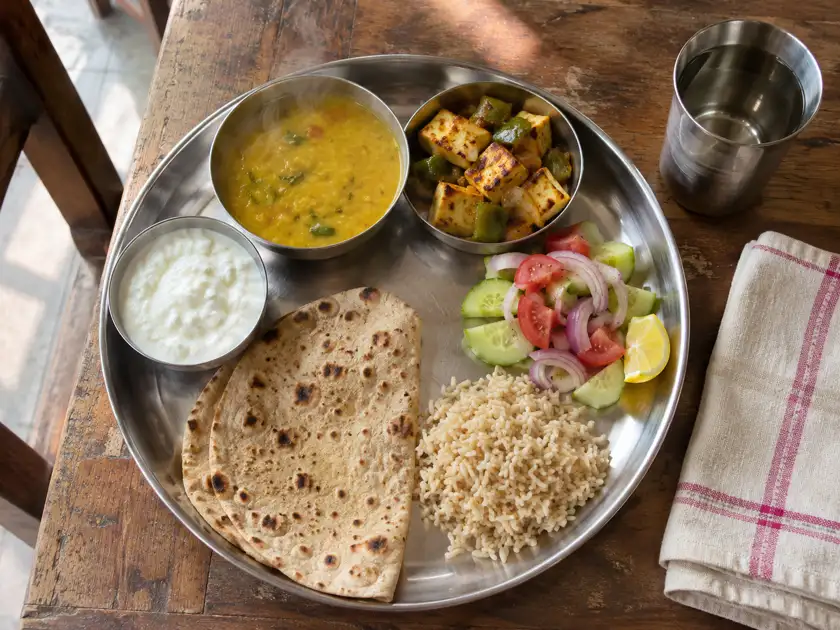
One often-quoted finding from a large citizen-science project is that people who ate a wide variety of plant foods each week, around 30 different types, had more diverse gut bacteria than those who ate ten or fewer. This is an observation, not a prescription, but variety is a sensible target. A typical Indian thali with dal, sabzi, salad, roti, curd and chutney already covers many types.
Increase fibre gradually and drink enough water. A sudden jump causes gas and bloating, which people then wrongly blame on “bad gut health”.
Indian fermented foods: what they do and do not offer
India has one of the richest fermented food traditions in the world. These foods are worth eating, but it helps to be accurate about what each provides. Not every fermented food is a probiotic: the microbes must be alive when you eat them, and cooking kills them.
| Food | Live bacteria when eaten? | What it offers | Watch for |
|---|---|---|---|
| Curd (dahi) | Yes, if fresh and not heated | Live lactic acid bacteria, protein (about 3 to 4 g per 100 g), calcium | Strains and counts vary from home to home, so it is not a standardised probiotic. Choose unsweetened |
| Chaas (buttermilk) | Yes | Hydration, some protein, very few calories when made from low-fat curd | Added salt, especially if you have high blood pressure |
| Idli | No, steaming kills them | Fermentation makes the batter easier to digest and may improve the availability of some nutrients; steamed, low in fat | Portion size and what you eat with it |
| Dosa | No, cooking kills them | Same fermented batter benefits; pairs well with sambar for protein and fibre | Oil, ghee, butter and potato filling add calories quickly |
| Kanji | Yes, if home-made and not boiled | Live bacteria from natural fermentation of black carrot or beetroot with mustard; almost no calories | High salt; hygiene during fermentation |
A few practical points follow from this table.
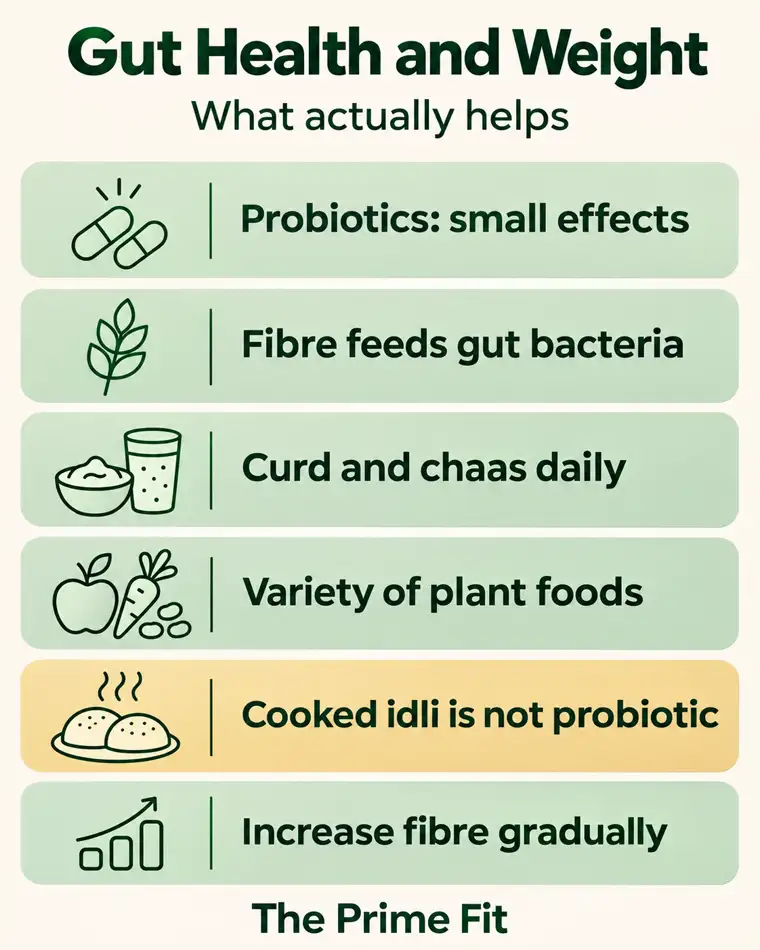
- Curd and chaas are the simplest daily fermented foods for most Indian households. A katori of plain curd with lunch or a glass of chaas in the afternoon is enough.
- Idli and dosa are good foods, but not probiotic foods. Their value is as a steamed or lightly cooked, easily digested meal, particularly with sambar and a vegetable.
- Sweetened probiotic drinks and flavoured yoghurts can carry a surprising amount of sugar. Read the label.
Controlled research on fermented foods is still limited. One small but well-known trial found that a diet rich in fermented foods increased microbiome diversity and lowered some markers of inflammation over about ten weeks. It did not test weight loss.
What harms gut health?
- Low fibre, highly processed diets. Packaged snacks, refined flour and sugary drinks displace the foods bacteria need.
- Unnecessary antibiotics. They are sometimes essential, but self-medicating for colds and viral fevers, which is common in India, disrupts gut bacteria and drives resistance.
- Poor sleep and chronic stress, both of which are linked with microbiome changes and with weight gain through other routes.
Gut health on GLP-1 medicines
People taking Mounjaro, Wegovy or Ozempic often ask whether they need a probiotic. There is no good evidence that probiotics improve weight loss on these medicines or reliably prevent their side effects.
What matters more in practice is that appetite falls, so fibre and fluid intake often fall with it. This is a major reason for constipation and bloating on treatment. Keeping vegetables, dal, fruit and fluids in a smaller diet is the priority, as described in our guides to constipation on GLP-1 medicines and the GLP-1 diet plan for Indians.
A gut-friendly Indian day
This is an illustrative example of how fibre variety and fermented foods fit into an ordinary day. It is not a prescribed weight loss diet, and portions depend on your needs.
| Meal | Vegetarian | Non-vegetarian |
|---|---|---|
| Breakfast | 2 to 3 idlis with sambar and a little coconut chutney | Vegetable omelette (2 eggs) with 1 multigrain roti |
| Mid-morning | 1 guava or apple, a few almonds | 1 guava or apple, a few almonds |
| Lunch | 1 to 2 jowar or wheat rotis, rajma or chana, bhindi sabzi, salad, 1 katori curd | 1 to 2 rotis, fish or chicken curry, mixed vegetable sabzi, salad, 1 katori curd |
| Afternoon | 1 glass chaas with roasted jeera and mint | 1 glass chaas with roasted jeera and mint |
| Evening | Sprouted moong chaat with onion, tomato and lemon | Boiled egg or chana chaat |
| Dinner | Moong dal, lauki or palak sabzi, 1 roti or a small katori of rice | Dal, grilled chicken or egg curry, sabzi, 1 roti |
Should you take a probiotic supplement?
For weight loss alone, the evidence does not justify it. If you wish to try one for digestive comfort, keep expectations modest and consider these points.
- Choose a product that names its strains and gives a count valid to the expiry date.
- Give it about four weeks. If you notice nothing, there is little reason to continue.
- Do not use a supplement as a reason to skip fibre and fermented foods.
Who should check with a healthcare professional first
Probiotics are generally safe for healthy adults, but rare bloodstream infections have been reported in vulnerable people. Speak to your healthcare provider before taking them if you have a weakened immune system, are on chemotherapy or strong immune-suppressing medicines, have a serious heart valve problem, have a central venous line, have recently had major surgery, or are critically unwell. The same applies to premature babies.
When gut symptoms need a healthcare professional
“Gut health” products are sometimes used to self-treat symptoms that deserve proper assessment. See a healthcare professional if you have:
- Blood in the stool or black, tarry stools
- Unintentional weight loss
- Persistent diarrhoea or a lasting change in bowel habit, particularly after the age of 45 to 50
- Difficulty swallowing or persistent vomiting
- Severe or night-time abdominal pain
- Anaemia or unexplained tiredness
- A family history of bowel cancer or coeliac disease with new symptoms
Severe abdominal pain, repeated vomiting, or signs of dehydration need same-day medical care.
Common myths about gut health and weight
Myth: A probiotic capsule will melt belly fat. No supplement has shown reliable, meaningful fat loss in human trials.
Myth: Obesity is caused by “bad bacteria”. The microbiome is one influence among many, and it is as much shaped by diet as it shapes weight.
Myth: Idli and dosa are probiotics. The batter is fermented, but cooking kills the bacteria. They are still good foods.
Myth: You need a detox or cleanse to reset the gut. There is no evidence that cleanses improve the microbiome, and laxative-based products can cause dehydration and salt imbalance.
Myth: A home stool test can tell you exactly what to eat. Microbiome tests are not validated for guiding weight loss, and there is no agreed definition of a “healthy” result.

Where gut health fits in a weight loss plan
Think of gut health as a supporting player. For Asian Indians, health risks rise at a lower body size than in Western populations: overweight is defined from a BMI of 23, obesity from 25, and a waist above 90 cm in men or 80 cm in women signals higher risk. You can check yours with our BMI calculator.
If you are in these ranges, the interventions with the strongest evidence are a sustainable reduction in calories with adequate protein, regular activity including strength work, enough sleep and, where medically appropriate, prescription treatment such as GLP-1 therapy. A high-fibre, varied diet with fermented foods makes all of these easier to sustain: it keeps you fuller, steadies blood sugar and keeps the bowels regular. That is a real benefit, even if it is not the dramatic one advertised.
Questions to ask your healthcare provider
- Are my digestive symptoms something that needs tests, or are they likely to be diet-related?
- Is there any reason I should avoid probiotic supplements, given my health and medicines?
- Do I have lactose intolerance, and if so, are curd and chaas still suitable?
- If I start a GLP-1 medicine, how do I prevent constipation and bloating?
- Is my weight and waist in a range where medical treatment should be considered?
How The Prime Fit helps
The Prime Fit approaches weight as a medical condition with many contributors. Care starts with an assessment of your health history, measurements, relevant blood tests and current eating pattern, including digestive symptoms that might affect what you can comfortably eat.
Our clinical nutrition support builds plans around familiar Indian foods, with attention to fibre, protein, fermented foods and practical cooking at home, for vegetarian and non-vegetarian households alike. For people who are prescribed medicines, follow-up includes managing gut side effects through diet and dose pacing.
Frequently asked questions
Do probiotics help with weight loss?
Not reliably. Human trials show small and inconsistent effects that depend on the strain, often less than a kilogram over a few months, and many show no effect at all. Probiotics are not a treatment for obesity.
Is curd as good as a probiotic supplement?
They are different things. Fresh curd contains live bacteria along with protein and calcium, but the strains and amounts vary. Supplements contain defined strains at a stated dose. For general health and weight management, daily curd as part of a fibre-rich diet is a reasonable and inexpensive choice.
Are idli and dosa probiotic foods?
No. The batter is fermented, which improves digestibility, but steaming and cooking kill the live bacteria. They remain good choices, especially idli with sambar, as long as oil and portions are sensible.
What is kanji and is it good for the gut?
Kanji is a traditional North Indian drink made by fermenting black carrots or beetroot in water with mustard seeds and salt for a few days. Home-made, unboiled kanji contains live bacteria. It is high in salt, so a small glass is enough, and people with high blood pressure should be cautious.
Can poor gut health cause weight gain?
Gut bacteria appear to influence appetite, blood sugar and fat storage, and animal studies show they can affect weight. In humans the link is real but modest, and diet shapes the microbiome as much as the reverse. It is one factor, not the main cause.
Should I take a probiotic with Mounjaro, Wegovy or Ozempic?
There is no good evidence that it improves results or prevents side effects. Adequate fibre, fluids and foods such as curd and chaas are more useful. If you want to try a supplement, tell your prescriber.
How long does it take to improve gut health?
The mix of gut bacteria begins to shift within days of a change in diet, but the change lasts only as long as the new eating pattern does. Consistency over months matters more than a short reset.
Are probiotics safe for everyone?
They are generally safe for healthy adults. People with weakened immunity, those who are critically ill or have a central line, and premature babies should not take them without medical advice, because rare serious infections have been reported.
This article is general patient education and is not a substitute for personal medical advice, diagnosis or treatment. Speak to a registered medical practitioner or qualified dietitian before making significant changes to your diet, starting supplements, or beginning any prescription weight loss treatment.