In this article
- What are artificial sweeteners?
- Stevia, sucralose and aspartame compared
- Do artificial sweeteners help with weight loss?
- How much sugar would you actually save?
- Are artificial sweeteners safe?
- Does aspartame cause cancer?
- Sucralose, stevia and gut health: what is known?
- What about erythritol and other sugar alcohols?
- Sweeteners and diabetes
- “Sugar free” on Indian labels: what to check
- How to use sweeteners sensibly in an Indian diet
- Who should be careful with sweeteners?
- Common myths about sweeteners
- Questions to ask your healthcare provider
- How The Prime Fit helps
- Frequently asked questions
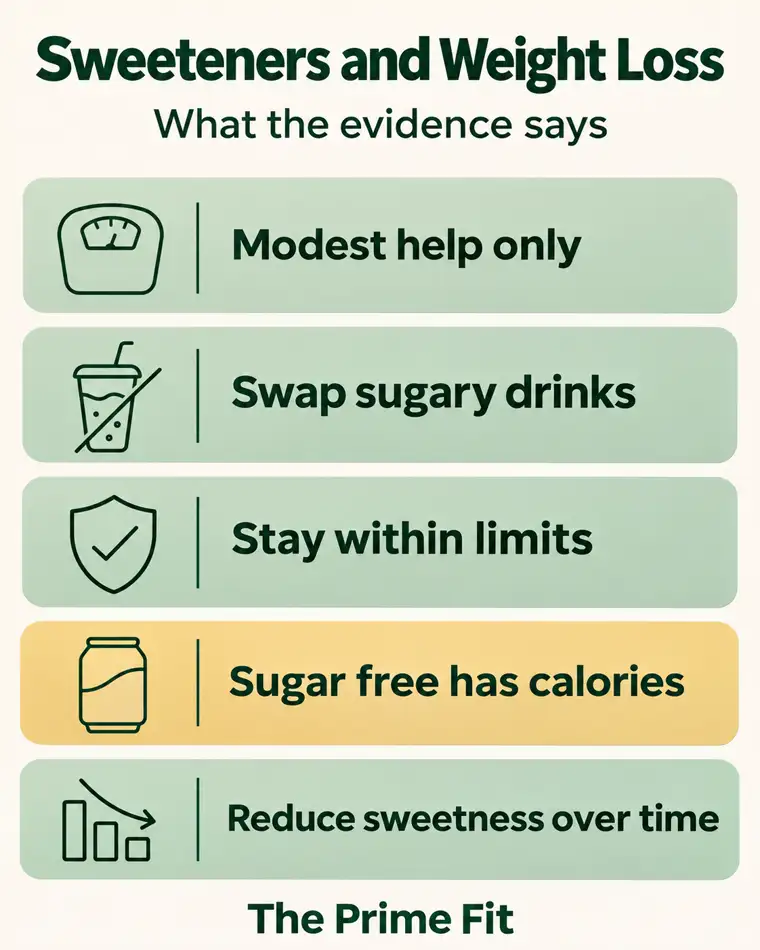
Do artificial sweeteners help with weight loss? A little, in the right situation. When sweeteners replace sugar, especially in soft drinks, tea and coffee, controlled trials show a small reduction in calorie intake and body weight. They do not cause weight loss by themselves, and long-term studies have not shown a lasting benefit. In 2023 the World Health Organization advised against relying on non-sugar sweeteners as a way to control weight.
On safety, stevia, sucralose and aspartame are all approved for use in India and internationally, and are considered safe within their acceptable daily intake, a limit that ordinary use rarely approaches. Some open questions remain about long-term effects, which is a reason for moderation, not alarm.
The practical message: a sweetener is a reasonable stepping stone away from sugar. The better long-term aim is to get used to less sweetness overall.
What are artificial sweeteners?
“Non-sugar sweeteners” is the broader and more accurate term. They are substances that taste sweet but provide few or no calories, because they are hundreds of times sweeter than sugar and are used in tiny amounts, or because the body does not absorb them fully.
- Artificial (synthetic) sweeteners: aspartame, sucralose, saccharin, acesulfame potassium.
- Plant-derived high-intensity sweeteners: steviol glycosides from the stevia leaf, and monk fruit extract.
- Sugar alcohols (polyols): erythritol, xylitol, sorbitol, maltitol. These are less sweet, provide some calories (erythritol almost none) and are common in “sugar free” sweets and chewing gum.
Jaggery, honey, brown sugar, coconut sugar and date syrup are not sweeteners in this sense. They are sugars, with similar calories to white sugar.
Stevia, sucralose and aspartame compared
| Feature | Stevia (steviol glycosides) | Sucralose | Aspartame |
|---|---|---|---|
| Source | Purified extract of the stevia leaf | Made from sugar by chemical modification | Made from two amino acids |
| Sweetness compared with sugar | About 200 to 300 times | About 600 times | About 200 times |
| Calories in normal use | Negligible | Negligible | Negligible |
| Use in hot drinks and cooking | Stable to heat | Generally stable; suitable for tea and most cooking | Loses sweetness with prolonged heat; best in cold or warm drinks |
| Taste | Can have a bitter or liquorice-like aftertaste | Closest to sugar for many people | Clean sweet taste |
| Acceptable daily intake (international expert committee) | 4 mg per kg body weight, as steviol | 15 mg per kg body weight | 40 mg per kg body weight |
| Special caution | Often blended with fillers or sugar alcohols; read the label | Research on gut bacteria is ongoing | Must be avoided in phenylketonuria |

Do artificial sweeteners help with weight loss?
The evidence comes in two kinds, and they point in slightly different directions.
Randomised trials, in which people are assigned to use sweeteners in place of sugar, generally show a small reduction in body weight and calorie intake over weeks to months. The benefit is clearest when diet drinks replace sugar-sweetened drinks.
Long-term observational studies, which follow large groups for years, tend to find that people who use more sweeteners have higher rates of weight gain, type 2 diabetes and heart disease. This does not prove that sweeteners cause these problems. People who are already gaining weight or developing diabetes are more likely to switch to sweeteners, which can make sweeteners look harmful when they are not the cause.
The World Health Organization reviewed both kinds of evidence and, in 2023, issued a conditional recommendation that non-sugar sweeteners should not be used as a means of weight control or of reducing the risk of chronic disease. The guideline does not apply to people who already have diabetes, and it does not say sweeteners are unsafe at normal intakes. Its core point is that sweeteners are not a long-term weight solution, and that reducing the sweetness of the diet as a whole is preferable.
How much sugar would you actually save?
Sugar provides about 4 kcal per gram, and a teaspoon is about 4 g, so roughly 16 kcal.
Illustrative example: someone who drinks three cups of chai a day with two teaspoons of sugar in each takes in 6 teaspoons, or about 24 g of sugar and 96 kcal a day from tea alone. Replacing that with a sweetener, or better, gradually with nothing, removes those calories. Over a month that is close to 2,900 kcal. It is a useful saving, but only if it is not replaced by a biscuit with each cup.
The saving is far larger for soft drinks. A typical 250 ml sugar-sweetened drink contains roughly 25 to 28 g of sugar, about 100 to 110 kcal.
Are artificial sweeteners safe?
Each approved sweetener has an acceptable daily intake, or ADI. This is the amount a person can consume every day over a lifetime without appreciable risk, and it is set with a wide safety margin below the level at which effects were seen in studies.
Illustrative example: the ADI for aspartame is 40 mg per kg. For a 70 kg adult that is 2,800 mg a day. A can of diet soft drink usually contains about 200 to 300 mg of aspartame, so that adult would need to drink more than 9 to 14 cans every day to exceed the limit, assuming no other sources. One or two sachets in tea is a small fraction of this.
For sucralose at 15 mg per kg, the same adult’s limit is 1,050 mg a day. For stevia at 4 mg per kg, expressed as steviol, it is 280 mg a day. Normal table-top use stays well below both.

Does aspartame cause cancer?
In July 2023 the International Agency for Research on Cancer classified aspartame as “possibly carcinogenic to humans”, its Group 2B. This category means the evidence is limited and a link cannot be ruled out. It describes how strong the evidence is, not how large any risk might be. At the same time, the international expert committee that sets intake limits reviewed the same evidence and kept the acceptable daily intake unchanged at 40 mg per kg, concluding there was no convincing reason to lower it.
In practical terms, occasional or moderate use within the limit is considered acceptable. People who drink several diet soft drinks every day have good reason to cut down, mainly towards water.
Phenylketonuria
People with phenylketonuria (PKU), a rare inherited condition, cannot break down phenylalanine, which aspartame contains. They must avoid aspartame completely. Products containing it carry a warning for this reason.
Sucralose, stevia and gut health: what is known?
Some studies suggest that certain sweeteners, including sucralose and saccharin, can change the mix of gut bacteria and, in some people, the blood sugar response to glucose. Other studies have found no meaningful effect. The findings vary between individuals, and it is not yet known whether these changes matter for long-term health.
Stevia has a good safety record as a purified extract. Only purified steviol glycosides are approved as sweeteners. Crude stevia leaf powders are a different product and have not been assessed in the same way.
The reasonable conclusion is to use the smallest amount that works for you, and not to assume that any sweetener, plant-derived or synthetic, is free of effects simply because it has no calories.
What about erythritol and other sugar alcohols?
Sugar alcohols deserve a separate note because many stevia products sold in India are bulked with erythritol, and most “sugar free” sweets and chocolates use maltitol or sorbitol.
- Digestive effects. In larger amounts, sugar alcohols draw water into the bowel and can cause bloating, gas and loose stools. Maltitol and sorbitol are the usual culprits. If you already have nausea or bowel changes on a GLP-1 medicine, these can make things worse.
- Calories and blood sugar. Maltitol still provides calories and raises blood sugar to some degree.
- Heart health questions. Recent studies have linked higher blood levels of erythritol and xylitol with a greater risk of heart attack and stroke. These findings are early, the body also makes some erythritol itself, and cause has not been established. Until more is known, moderate use is sensible, particularly for people with heart disease.
For bowel symptoms during treatment, see our guide to GLP-1 side effects.
Sweeteners and diabetes
High-intensity sweeteners do not raise blood sugar directly, so replacing sugar with them in tea, coffee or drinks can help people with diabetes reduce their sugar load. The World Health Organization guidance against using sweeteners for weight control specifically excludes people with existing diabetes.
What matters more is the rest of the plate. A “sugar free” mithai is still made of khoya, ghee, nuts or flour, and a sugar-free biscuit is still mostly maida and fat. Both raise blood sugar and add calories. Our Indian diabetes diet chart shows how to build meals that keep blood sugar steadier.
“Sugar free” on Indian labels: what to check
| Product | What “sugar free” usually means | What to check |
|---|---|---|
| Table-top sachets, tablets and drops | A high-intensity sweetener with a bulking agent | Which sweetener, and whether dextrose, maltodextrin or erythritol is added |
| Diet soft drinks | Sweetened with aspartame, acesulfame potassium or sucralose | Number of cans a day; caffeine content |
| Sugar-free mithai | Sugar replaced by sweeteners or sugar alcohols | Calories and fat per piece, which are often similar to the regular sweet |
| Sugar-free biscuits and chocolates | Often sweetened with maltitol | Total carbohydrate, fat and calories per 100 g |
| “No added sugar” juices and health drinks | No table sugar added, but natural sugars remain | Total sugars per 100 ml |
| Protein powders and bars | Usually sucralose, stevia or sugar alcohols | The full ingredient list |
Indian food labels are required to declare when a product contains a sweetener and to name it. Read the ingredient list to see which one you are getting.
How to use sweeteners sensibly in an Indian diet
- Use them as a bridge. If you take two teaspoons of sugar in chai, move to one, then to a sweetener, then to half the sweetener, then to none. Taste adapts within a few weeks for most people.
- Prioritise drinks. Swapping sugary soft drinks, packaged juices and sweet lassi gives the largest saving.
- Do not “spend” the saving. A diet drink does not cancel a samosa.
- Keep the dose small. One to three sachets or a few drops a day is typical and well within limits.
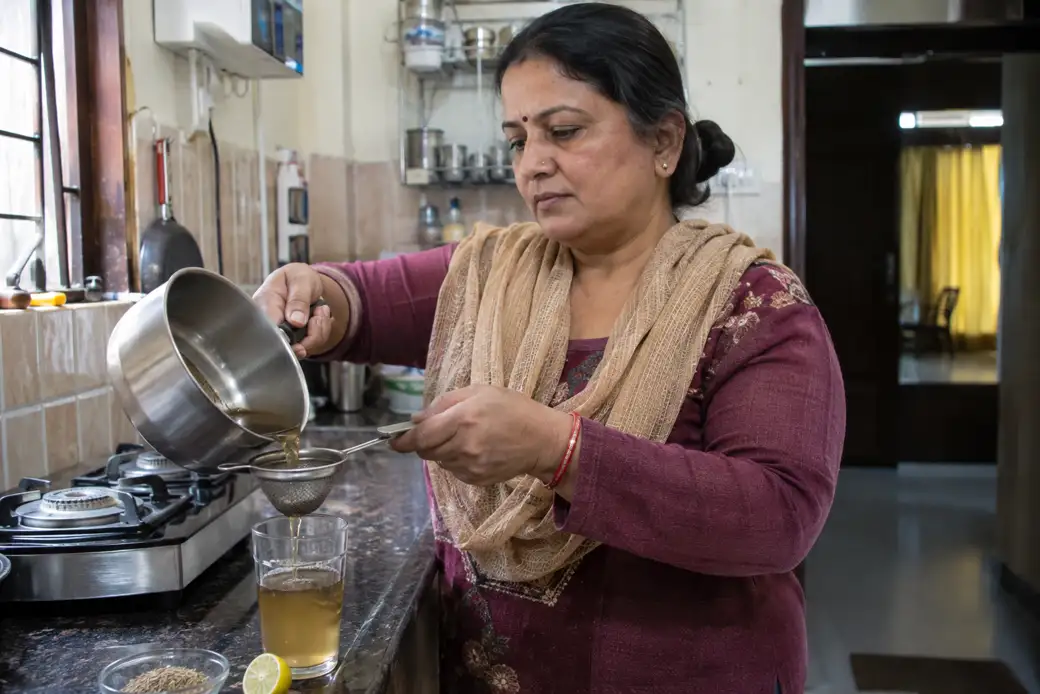
- Choose flavour over sweetness. Elaichi, cinnamon, ginger, saffron and roasted jeera add taste without sugar.
| Occasion | Usual choice | Lower-sugar option (vegetarian unless stated) |
|---|---|---|
| Morning chai | Chai with 2 teaspoons of sugar and biscuits | Chai with elaichi and less or no sugar, with roasted chana, or a boiled egg for non-vegetarians |
| With lunch | Soft drink or sweet lassi | Salted chaas with jeera, or plain nimbu pani |
| Evening | Packaged juice | Whole fruit, coconut water in moderation, or soda with lemon |
| After dinner | Mithai or ice cream | A small bowl of curd with fruit, or one or two dates with nuts on some days |
| Festivals | Several sweets through the day | One sweet you truly enjoy, eaten slowly after a meal; phirni or kheer made at home with less sugar |
If you are on treatment, our GLP-1 diet plan for Indians sets out meals for each stage.
Who should be careful with sweeteners?
- People with phenylketonuria: avoid aspartame entirely.
- Pregnant and breastfeeding women: approved sweeteners in moderate amounts are generally considered acceptable, but saccharin is often avoided in pregnancy. Discuss your intake with your healthcare provider.
- Children: sweeteners are not recommended as a routine part of a child’s diet. Water and milk are the best drinks.
- People with irritable bowel or frequent loose stools: limit sugar alcohols.
- People who get headaches or other symptoms after a particular sweetener: avoid that one.
- People with heart disease: keep erythritol and xylitol intake modest until the research is clearer.
When to see a healthcare professional
See a healthcare professional if you have strong, persistent sugar cravings with weight gain, increased thirst or urination, a BMI of 23 or above with a waist over 90 cm in men or 80 cm in women, or a family history of diabetes. These are reasons to check blood sugar, not just to change your sweetener. Seek urgent care for swelling of the lips or face, difficulty breathing or a widespread rash after any food product.

Common myths about sweeteners
- “Sweeteners make you gain weight.” Trials in which sweeteners replace sugar show a small weight reduction, not gain. The associations seen in long-term studies are likely to be at least partly explained by who chooses to use sweeteners.
- “Stevia is natural, so unlimited use is fine.” Stevia sweeteners are purified extracts with their own intake limit, and many products contain added fillers.
- “Jaggery and honey are fine for weight loss.” They are sugars with similar calories to white sugar. The trace minerals in jaggery do not change that.
- “Sugar free means calorie free.” Sugar-free sweets, biscuits and chocolates usually have nearly as many calories as the originals.
- “Aspartame has been proven to cause cancer.” It has been classified as possibly carcinogenic on limited evidence, and the acceptable daily intake was left unchanged.
- “Diet drinks are as good as water.” They are better than sugary drinks, but water remains the best everyday choice.
Questions to ask your healthcare provider
- Given my blood sugar and weight, is a sweetener a sensible swap for me?
- Which sweetener suits my health conditions and medicines?
- How much sugar a day is reasonable for me?
- Could my bloating or loose stools be related to sugar alcohols?
- Is it safe for me to use sweeteners during pregnancy or breastfeeding?
- Should I be tested for diabetes or prediabetes?
How The Prime Fit helps
At The Prime Fit, sweeteners are discussed as one small part of a wider plan. An assessment covers your weight, waist, medical history and relevant blood tests, and you can check where you stand with our BMI calculator. Nutrition support through clinical nutrition looks at where the sugar in your day actually comes from, whether chai, drinks, sweets or packaged foods, and builds practical swaps around your own food habits, vegetarian or non-vegetarian. Follow-up visits review progress and adjust the plan. Where medical treatment such as GLP-1 therapy is appropriate, it is considered alongside food changes.
Frequently asked questions
Do artificial sweeteners help you lose weight?
They can help a little when they replace sugar, particularly in drinks. They do not cause weight loss on their own, and long-term benefit has not been shown.
Which is the safest sweetener: stevia, sucralose or aspartame?
All three are approved and considered safe within their acceptable daily intake. None has been shown to be clearly safer than the others. People with phenylketonuria must avoid aspartame.
Is stevia better than sugar for weight loss?
Replacing sugar with stevia removes the sugar calories, which helps modestly. Check the label, as many stevia products contain fillers or sugar alcohols.
Do sweeteners raise blood sugar or insulin?
High-intensity sweeteners do not raise blood sugar directly. Some studies suggest effects on glucose response through gut bacteria in some people, but findings are inconsistent.
Can I use sweeteners on Mounjaro or Wegovy?
Yes, there is no known interaction. Go easy on sugar alcohols such as maltitol and sorbitol, which can worsen bloating and loose stools.
Is jaggery or honey healthier than sugar?
Not for weight or blood sugar. They are sugars with similar calories and should be limited in the same way.
How many diet soft drinks a day are safe?
The intake limit for aspartame would allow many cans a day for an adult, but that is a safety ceiling, not a target. Keeping to one a day or fewer, and drinking mainly water, is a sensible approach.
Can sweeteners be used in cooking and baking?
Sucralose and stevia are generally stable to heat. Aspartame loses sweetness with prolonged heating and is better added to cold or warm foods after cooking.
This article is general information and is not a substitute for a medical consultation. Figures from studies and intake limits are approximate and may be updated by regulators. Speak to your healthcare provider about sweetener use if you have diabetes, phenylketonuria, heart disease or a digestive condition, or are pregnant or breastfeeding.