In this article
- What is intermittent fasting?
- 16:8, 5:2 and other methods compared
- Does intermittent fasting work for weight loss?
- Who should not fast
- How to start intermittent fasting safely
- What breaks a fast? Chai, coffee and nimbu pani
- What should you eat in the eating window?
- Sample Indian 16:8 day (veg and non-veg)
- The 5:2 diet with Indian food
- Side effects and warning signs
- Intermittent fasting with PCOS, thyroid, festivals and weight-loss medicines
- Common myths about intermittent fasting
- What if intermittent fasting does not work for you?
- Questions to ask your healthcare provider
- How The Prime Fit helps
- Frequently asked questions
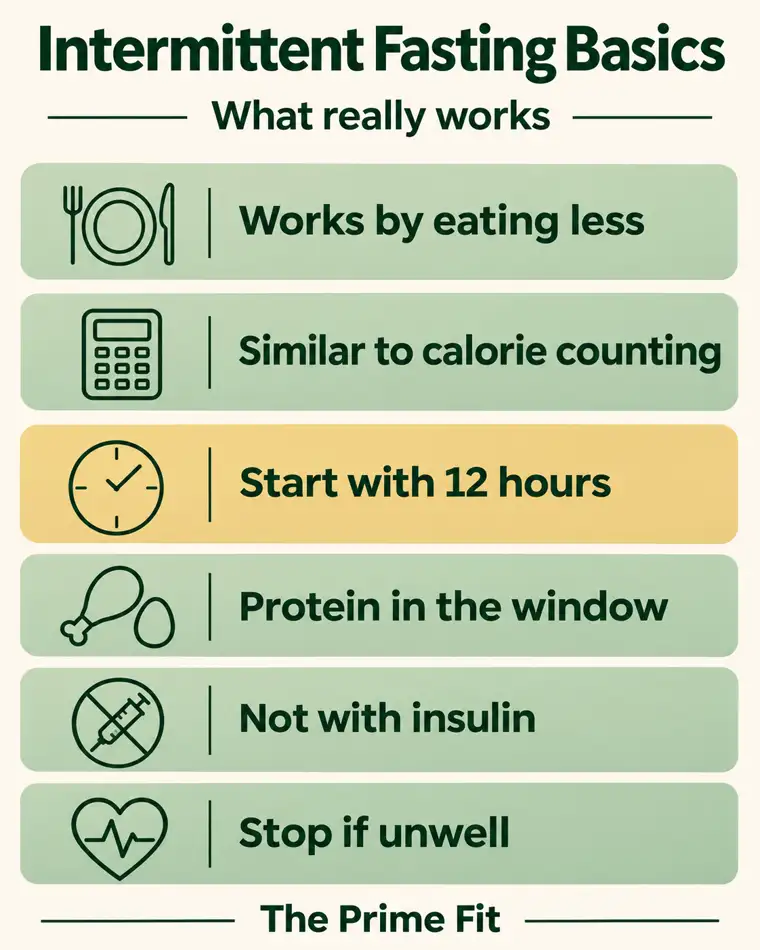
Intermittent fasting for weight loss works, but for a plainer reason than most social media posts suggest. When you eat within fewer hours, or eat very little on two days a week, you usually take in fewer calories overall. In trials that compared intermittent fasting directly with ordinary daily calorie reduction, weight loss was similar. Fasting is one workable method, not a superior one.
That still makes it useful. Many people find one clear rule, such as “nothing after 7 pm”, easier to follow than counting every roti. Others feel irritable, overeat when the window opens, or have medical reasons not to fast at all. This guide explains the common methods, what the research shows, how to adapt them to Indian meals, and who should not fast.
What is intermittent fasting?
Intermittent fasting is a pattern of eating that sets when you eat, and leaves what you eat to you. Periods of normal eating alternate with periods of little or no calorie intake. During the fast, water, plain tea, black coffee and other drinks without calories are allowed.
It differs from most religious fasts. Navratri, Ekadashi and Karva Chauth fasts, and the Ramadan fast, each have their own rules on foods, fluids and timing, and are observed for spiritual reasons. Some, such as a waterless fast, carry different risks.
16:8, 5:2 and other methods compared
| Method | What it involves | Suits | Watch for |
|---|---|---|---|
| 12:12 | 12-hour overnight fast, for example 8 pm to 8 am | Beginners, and people who snack late at night | Modest effect unless food choices also improve |
| 14:10 | 10-hour eating window, for example 9 am to 7 pm | Most working adults. A realistic long-term pattern | Sweet tea and biscuits outside the window |
| 16:8 | 8-hour eating window, for example 11 am to 7 pm | People comfortable with two meals and a snack | Too little protein, overeating at the first meal |
| 5:2 | Five days of normal eating and two non-consecutive days of about 500 to 600 kcal | People who prefer two strict days to daily limits | Headache and low energy on fasting days. Not suited to many medical conditions |
| Alternate-day fasting | Very low intake every other day | Few people in practice | Hard to sustain. Best done only with supervision |
| One meal a day | All food in a single sitting | Not generally advised | Difficult to meet protein and nutrient needs. Acidity and overeating |
The 16:8 pattern is also called time-restricted eating. The longer and stricter the fast, the higher the drop-out rate tends to be in studies.

Does intermittent fasting work for weight loss?
Yes, modestly, and about as well as conventional dieting. The findings can be summarised without exaggeration.
- Weight loss is real but moderate. Trials lasting several months to a year generally report losses of a few percent of body weight, with wide variation between individuals.
- It is not better than daily calorie restriction. When total calories are matched, intermittent fasting and ordinary portion control give similar weight loss and similar changes in blood sugar, blood pressure and cholesterol.
- The main mechanism is eating less. A shorter window removes late-night snacking and some meals. Claims of a special fat-burning or metabolic advantage in humans are not well supported.
- Adherence decides the result. The method you can follow for years will beat the method that is perfect for three weeks.
- Muscle can be lost, as with any diet. Some studies have raised this concern for fasting in particular, which makes protein and strength training important.
Much of the talk about autophagy, the body’s cell-recycling process, comes from laboratory and animal research. How much a 16-hour fast changes it in people, and whether that affects health, is not established.
Who should not fast
For some people intermittent fasting is unsafe, and for others it needs a healthcare professional’s plan before it begins.
Do not start intermittent fasting if any of these apply
Diabetes treated with insulin or sulfonylurea tablets, unless your healthcare provider has adjusted your medicines and told you how to monitor: fasting on these can cause dangerously low blood sugar. Pregnancy or breastfeeding. A current or past eating disorder. Age under 18.
| Group | Why fasting is a concern |
|---|---|
| Diabetes on insulin or sulfonylureas | These medicines lower blood sugar whether or not you eat, so missed meals can cause hypoglycaemia. Doses must be reviewed by a healthcare professional first |
| Type 1 diabetes | Risk of both low sugar and ketoacidosis. Specialist guidance only |
| Pregnancy and breastfeeding | Energy and nutrient needs are higher. Weight-loss fasting is not advised |
| Eating disorders, past or present | Rigid food rules can trigger restriction and binge cycles |
| Children and teenagers under 18 | Growth needs regular nutrition |
| Underweight or frail older adults | Risk of malnutrition, muscle loss and falls |
| Kidney, liver or heart disease, or medicines that must be taken with food | Individual medical advice is needed before any fasting plan |
If you have type 2 diabetes treated with other medicines, fasting may be possible, but ask your healthcare provider first. Some diabetes tablets need caution with prolonged fasting or dehydration. Our Indian diabetes diet chart offers a steadier alternative.
How to start intermittent fasting safely
- Begin with 12 hours overnight for one to two weeks. Finishing dinner by 8 pm and eating breakfast at 8 am is already a fast.
- Extend gradually to 14 hours, and to 16 only if you feel well.
- Bring dinner earlier in preference to skipping it. A late, heavy dinner is the habit most worth changing in Indian households.
- Drink water through the fast. In hot weather, more is needed.
- Plan the first meal. Break the fast with protein and vegetables, not with fried snacks or sweets.
- Keep your medicines on schedule and ask your healthcare provider how to time any that need food.

What breaks a fast? Chai, coffee and nimbu pani
Strictly, anything with calories ends the fast. In practice:
- Fine during the fast: water, plain soda water, black coffee, black or green tea without sugar, and jeera or saunf water.
- Breaks the fast: chai with milk and sugar, coffee with milk, juice, coconut water, lassi, chaas, fruit, biscuits and “just one bite” of anything.
- Nimbu pani: acceptable without sugar or honey.
The morning cup of milky sweet chai is where many Indian fasting plans quietly fail. If you cannot do without it, a 12 or 14-hour plan that includes your chai inside the window is better than a 16-hour plan you break daily.
What should you eat in the eating window?
Fasting does not cancel out poor food choices. A window filled with paratha, biryani, namkeen and mithai can easily exceed a full day’s needs. The window should contain balanced meals.
- Protein at each meal. Many adults losing weight are advised about 1.0 to 1.2 g per kg of body weight a day, if the kidneys are healthy. Illustrative example: at 70 kg that is 70 to 84 g a day, which is hard to reach in one meal and manageable across two meals and a snack.
- Vegetables and salad for half the plate.
- Measured whole grains: phulka, brown rice, millets, dalia.
- Limited sugar and fried food.
Sample Indian 16:8 day (veg and non-veg)
This is a pattern for an 11 am to 7 pm window. Shift the times to suit your work, and adjust portions to your size and activity.
| Time | Vegetarian | Non-vegetarian |
|---|---|---|
| On waking to 11 am | Water, black coffee or tea without sugar | Same |
| 11 am, first meal | 2 besan or moong dal chillas with vegetables, curd, 1 fruit | 2 or 3-egg vegetable omelette, 1 phulka or toast, 1 fruit |
| 2.30 pm, main meal | 2 phulkas, dal or rajma, seasonal sabzi, salad, curd | 2 phulkas or 1 katori rice, chicken or fish curry, sabzi, salad |
| 5 pm, snack | Roasted chana or sprouts chaat, chaas, tea if wanted | Boiled eggs or roasted chana, chaas |
| 6.45 pm, light dinner | Paneer or tofu with sautéed vegetables, or dal with sabzi | Grilled fish or chicken with sautéed vegetables, or dal with sabzi |
| After 7 pm | Water or herbal tea without sugar | Same |
For more meal ideas, see our vegetarian high-protein meal plan.
The 5:2 diet with Indian food
On the 5:2 plan, two non-consecutive days a week are limited to roughly a quarter of usual intake, traditionally about 500 kcal for women and 600 kcal for men. The other five days are normal, balanced eating, not feasting.
A fasting day works best as two small, protein-rich meals with plenty of vegetables: for example, a moong dal chilla with curd late in the morning, and a bowl of dal or grilled paneer, fish or chicken with sautéed vegetables in the evening, with water and unsweetened drinks between. Avoid heavy exercise on these days at first. Because intake is so low, this pattern needs medical clearance if you take any regular medicine.
Side effects and warning signs
In the first week or two, hunger, headache, irritability, acidity, constipation and poor concentration are common and usually settle. Enough water, fibre in the window and a gradual start help. Rapid weight loss by any method can also raise the risk of gallstones.
Stop the fast and seek help
Break the fast at once if you have sweating, shaking, palpitations, confusion or blurred vision, which can mean low blood sugar: take sugar or a sweet drink and seek medical advice. Get urgent care for fainting, chest pain, severe weakness, persistent vomiting or signs of dehydration such as very little urine and dizziness on standing.
See your healthcare provider if fasting leads to binge eating, preoccupation with food, missed periods, marked hair fall or continuing fatigue.
Intermittent fasting with PCOS, thyroid, festivals and weight-loss medicines
- PCOS: a moderate window such as 12 to 14 hours with balanced meals is reasonable for many women. Fasting has not been shown to be better than other diets. See our PCOS diet plan.
- Hypothyroidism: thyroid tablets are taken with water and do not break the fast. Keep the timing your healthcare provider advised.
- Religious fasts: if you have diabetes or take regular medicines, speak to your healthcare provider before Navratri, Ramadan or Karva Chauth fasts.
- GLP-1 medicines: appetite is already low on Mounjaro, Wegovy or Ozempic, so strict fasting can lead to too little protein and fluid. Read our guide to fasting on GLP-1 medicines.
Common myths about intermittent fasting
| Myth | What is more accurate |
|---|---|
| “Fasting burns fat faster than any diet” | With equal calories, results are similar to ordinary dieting |
| “You can eat anything in the window” | Total intake and food quality still decide the result |
| “Longer fasts are always better” | Longer fasts are harder to sustain and riskier, without clear extra benefit for most people |
| “Skipping breakfast ruins your metabolism” | Meal timing has little effect on metabolic rate. Some small studies suggest an earlier eating window may suit blood sugar better than a late one |
| “Fasting detoxes the body” | The liver and kidneys do this continuously. Fasting adds no proven detox effect |
| “Fasting cures diabetes” | Weight loss by any method can improve blood sugar. Fasting on certain diabetes medicines is dangerous without supervision |
| “It is safe for everyone because it is natural” | Several groups should not fast, as listed above |

What if intermittent fasting does not work for you?
If weight has not changed after six to eight weeks of honest effort, look first at what is eaten in the window, liquid calories, weekend eating, sleep and activity. Add strength training twice a week and regular walking; our guide to walking for fat loss can help.
For Asian Indians, overweight begins at a BMI of 23 and obesity at 25, and a waist above 90 cm in men or 80 cm in women adds risk. You can check yours with the BMI calculator. If your BMI is in the obesity range, or you have diabetes, fatty liver, sleep apnoea or joint problems, it is reasonable to see a healthcare professional about structured treatment instead of trying one diet after another.
Questions to ask your healthcare provider
- Is intermittent fasting safe with my medical conditions and medicines?
- Do any of my medicines need a change in dose or timing if I fast?
- If I have diabetes, how often should I check my sugar, and at what reading should I break the fast?
- Which method and window would suit me?
- How much protein should I aim for each day?
- What weight-loss target and pace are realistic?
- What other options do I have if fasting does not suit me?
How The Prime Fit helps
At The Prime Fit, a medical assessment comes before any eating plan: weight, waist, history, current medicines and relevant blood tests. That is how we identify people for whom fasting is unsuitable and those who need their medicines reviewed first.
Our clinical nutrition support then helps you choose a pattern that fits your routine, whether that is an eating window, structured portion control or another approach, using the food your family already eats. Follow-up tracks progress and adjusts the plan, including around festivals and travel.
Frequently asked questions
Is intermittent fasting good for weight loss?
It can be. It helps many people eat less, and trials show weight loss similar to ordinary calorie-controlled diets. It is not more effective when calories are equal.
Which is better, 16:8 or 5:2?
Neither has been shown to be clearly better. Choose the one you can follow safely for the long term. Many people find 14:10 or 16:8 easier to fit around Indian family meals.
Can I drink chai during the fasting hours?
Tea with milk and sugar breaks the fast. Black or green tea and black coffee without sugar do not.
How much weight can I lose with intermittent fasting?
It varies widely. Studies generally report a loss of a few percent of body weight over several months. No particular result can be promised.
Can people with diabetes do intermittent fasting?
Not without a healthcare professional’s advice. People on insulin or sulfonylureas are at risk of dangerously low blood sugar and should not fast unless their healthcare provider has adjusted treatment and given a monitoring plan.
Who should not do intermittent fasting?
People with diabetes on insulin or sulfonylureas without medical supervision, pregnant or breastfeeding women, anyone with a current or past eating disorder, those under 18, and people who are underweight or frail.
Does intermittent fasting cause muscle loss?
Any weight loss includes some muscle. Eating enough protein within the window and doing strength training twice a week help to limit it.
Can I exercise while fasting?
Most healthy adults can walk or do light to moderate exercise while fasting. Drink water, and stop if you feel dizzy or weak. People with diabetes should ask their healthcare provider first.
This article is general information and is not a substitute for a consultation. Findings from studies are described approximately. Do not begin fasting or change any medicine without speaking to your healthcare provider if you have diabetes or another medical condition, are pregnant or breastfeeding, or have a history of an eating disorder.