In this article
- Why most GLP-1 medicines are injections
- The forms of semaglutide at a glance
- How to take the tablet correctly
- Dose steps for the diabetes tablet
- How much weight is lost with the tablet?
- Tablets and injections compared
- Who might prefer the tablet?
- Who is usually better served by an injection?
- Side effects
- Interactions and timing with other medicines
- Switching between tablets and injections
- If fear of needles is the only obstacle
- Sticking with treatment: which is easier in real life?
- Three illustrative examples
- What else is coming in tablet form?
- Beware of “oral GLP-1” supplements and drops
- Making the tablet work: practical tips
- Eating well on oral semaglutide
- Questions to ask your healthcare provider
- Common myths
- How The Prime Fit helps you choose
- Frequently asked questions
For many people, the main obstacle to GLP-1 treatment is not cost or side effects. It is the needle. The idea of injecting oneself every week puts some people off before they have even seen how small the needle is. It is natural to ask whether the same medicine can be taken as a tablet.
It can. Semaglutide, the active ingredient in Ozempic and Wegovy, is also made as a daily tablet called Rybelsus, licensed for type 2 diabetes. Higher-strength tablets for weight management have been tested and approved in some countries, and other oral medicines in the same class are following. But a tablet is not simply an injection without the needle. It is absorbed differently, has to be taken under strict conditions, and at its diabetes doses produces less weight loss than the weekly injections.
This guide explains how oral semaglutide works, how to take it correctly, how its results compare with injections, and who it suits. It is general information. Product availability, strengths and licensed uses differ between countries and change over time, so check current details with your healthcare provider.
Why most GLP-1 medicines are injections
GLP-1 medicines such as semaglutide and tirzepatide are peptides, small proteins. If swallowed in the ordinary way, they are broken down by stomach acid and digestive enzymes like any protein in food, and almost none reaches the bloodstream. Injecting under the skin bypasses the gut.
Oral semaglutide solves the problem with a helper ingredient, an absorption enhancer known as SNAC. In the stomach, SNAC briefly raises the local pH around the tablet, protecting semaglutide from breakdown and helping it pass through the stomach lining. Even so, only about one percent of the dose is absorbed. That is why the tablet strengths, measured in milligrams per day, are so much larger than the weekly injection doses, and why the conditions under which the tablet is taken matter so much.
The forms of semaglutide at a glance
| Rybelsus (tablet) | Ozempic (injection) | Wegovy (injection) | |
|---|---|---|---|
| How often | Once a day | Once a week | Once a week |
| Licensed for | Type 2 diabetes | Type 2 diabetes | Weight management |
| Dose steps | 3 mg, 7 mg, 14 mg daily | 0.25, 0.5, 1 mg weekly (2 mg in some countries) | 0.25, 0.5, 1, 1.7, 2.4 mg weekly |
| How taken | On an empty stomach with a sip of water; wait 30 minutes | Under the skin, any time of day | Under the skin, any time of day |
| Storage | Room temperature, in the original blister | Refrigerated | Refrigerated |
| Typical weight effect | About 3 to 4 kg at 14 mg in people with diabetes | About 4 to 6 kg at 1 mg in people with diabetes | About 15% of body weight in people without diabetes |
A newer formulation of the tablet with different strengths, designed to deliver the same amount of medicine, has been introduced in some countries. Always go by the strength on your own prescription.
How to take the tablet correctly
This is the most important section for anyone prescribed oral semaglutide. Because so little is absorbed, small departures from the instructions can reduce the effect substantially.
- Take it first thing in the morning on a completely empty stomach, after the overnight fast.
- Swallow it whole with a small sip of plain water, no more than about half a glass (up to 120 ml). Do not use tea, coffee, milk, juice or any other drink.
- Do not split, crush or chew the tablet.
- Wait at least 30 minutes before eating, drinking anything else or taking other oral medicines. Waiting longer may increase absorption.
- Then eat. Do not delay breakfast for many hours afterwards.
- Take it at the same time every day.
- Keep tablets in the original blister pack until the moment you take one. They are sensitive to moisture. Do not transfer them to a pill organiser.
- If you miss a dose, skip it and take the next day’s dose as usual. Do not take two.
Morning routine in practice
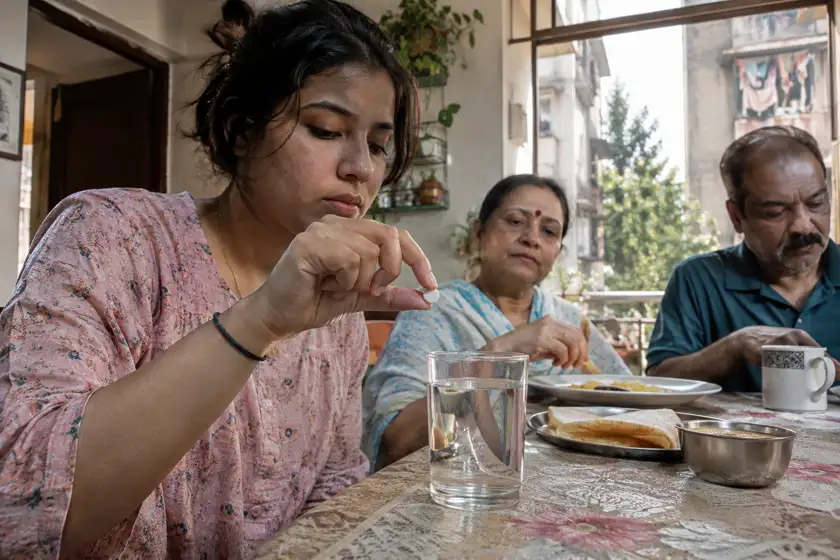
Keep the blister and a small glass by your bed. On waking, take the tablet with a sip of water. Have your bath, get ready or go for a walk. Thirty minutes or more later, have your tea and breakfast and take your other medicines.
Common mistakes
| Mistake | Why it matters |
|---|---|
| Taking it with morning tea or coffee | Any drink other than a little plain water reduces absorption sharply |
| Taking it with a full glass of water | Too much water dilutes the enhancer around the tablet |
| Eating within 30 minutes | Food in the stomach blocks absorption |
| Taking it with other tablets | They interfere with each other |
| Taking it at night or after a meal | The stomach is not empty |
| Storing tablets loose in a box | Moisture degrades them |
| Cutting the tablet to make a lower dose | The tablet is designed to work whole |
Dose steps for the diabetes tablet
| Stage | Daily dose | Purpose |
|---|---|---|
| First 30 days | 3 mg | Starting dose to let the body adjust; not intended for blood-sugar control |
| From day 31 | 7 mg | Maintenance dose |
| After at least 30 days on 7 mg, if needed | 14 mg | Higher maintenance dose for additional blood-sugar control |
Two 7 mg tablets should not be taken in place of one 14 mg tablet, because two tablets together alter absorption. As with injections, staying longer on a step is acceptable if you have side effects.
How much weight is lost with the tablet?
In the trials of oral semaglutide in people with type 2 diabetes, the 14 mg dose lowered HbA1c by roughly 1 to 1.4 percentage points and body weight by about 3 to 4.5 kg over six months to a year. That is a useful effect for someone whose main aim is blood-sugar control, and it compares well with many other diabetes tablets, most of which are weight-neutral or cause weight gain.
For weight management as the primary goal, it falls well short of the weekly injections.
| Medicine and dose | Who was studied | Approximate average weight loss |
|---|---|---|
| Oral semaglutide 14 mg daily | Type 2 diabetes | 3 to 4.5 kg |
| Injectable semaglutide 1 mg weekly | Type 2 diabetes | 4.5 to 6.5 kg |
| Injectable semaglutide 2.4 mg weekly | Obesity without diabetes | About 15% of body weight |
| Tirzepatide 10 to 15 mg weekly | Obesity without diabetes | About 20% of body weight |
| Higher-dose oral semaglutide (25 to 50 mg daily) | Obesity without diabetes, in trials | About 14 to 15% of body weight |
The last row shows that tablets can match the injection when the dose is high enough. In trials of high-dose oral semaglutide in adults with obesity, weight loss over about 15 months was similar to that seen with the 2.4 mg injection. A higher-strength tablet for weight management has been approved in some countries on this basis. Whether it is available to you depends on where you live.
Tablets and injections compared
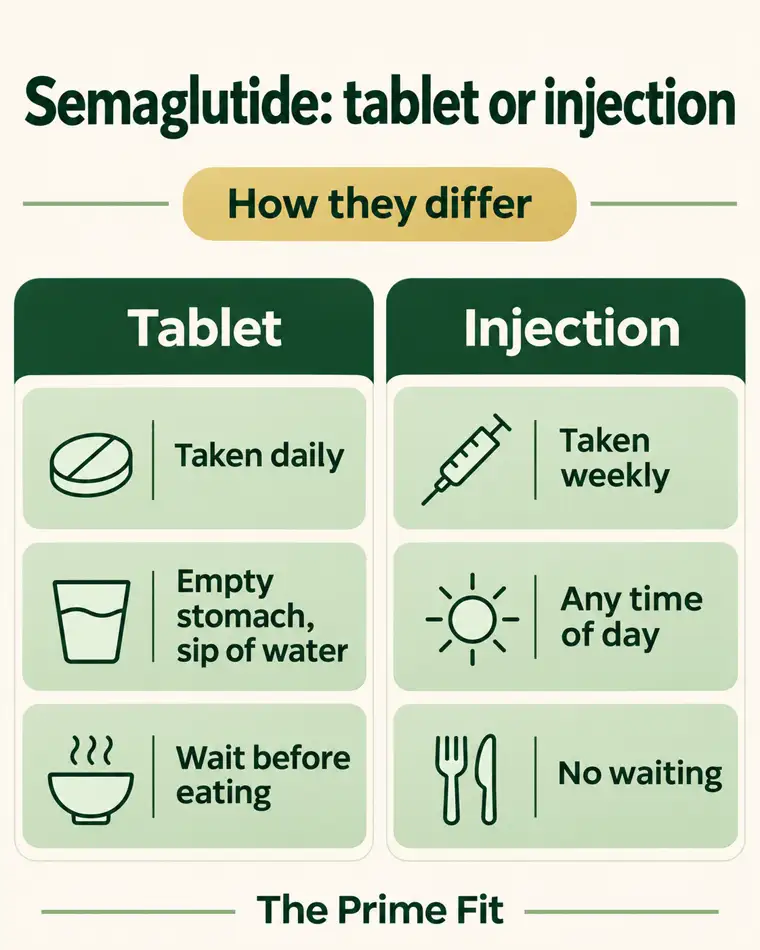
| Feature | Daily tablet | Weekly injection |
|---|---|---|
| Needles | None | A very fine, short needle once a week |
| Frequency | Every day | Once a week |
| Rules for taking | Strict: empty stomach, sip of water, 30-minute wait | Flexible: any time, with or without food |
| Effect of a mistake | Reduced absorption that day | Little; the dose is delivered reliably |
| Storage | Room temperature; easy for travel and hot climates | Refrigeration; cool pouch needed when travelling |
| Weight loss | Modest at diabetes doses; larger with higher-dose tablets where available | Larger at weight-management doses |
| Blood-sugar control | Good | Good to very good |
| Side effects | Similar digestive effects | Similar digestive effects; occasional injection-site reactions |
| Missed dose | One day’s effect lost | Covered by the long action for some days |
| Interactions | Timing conflicts with other morning medicines | Fewer |
| Privacy and convenience | Discreet; no sharps | Needs disposal of needles or pens |
Who might prefer the tablet?
- People with type 2 diabetes who need better blood-sugar control and would welcome some weight loss
- Those with a strong fear of needles that has not eased after seeing and trying the pen
- People with a regular morning routine who can reliably wait 30 minutes before breakfast
- Frequent travellers, or those without dependable refrigeration
- People who take few other morning medicines
Who is usually better served by an injection?
- People whose main goal is substantial weight loss and who meet the criteria for weight-management treatment
- Those who cannot manage the fasting routine: shift workers, people who must eat or take medicines immediately on waking, or those who forget daily tablets
- People taking several medicines that must also be taken on an empty stomach
- Those who prefer to think about treatment once a week
- People who need a medicine with trial evidence for a specific benefit, such as reducing heart attacks in obesity or treating sleep apnoea
Many people who dread the idea of injecting find, on trying it, that the weekly pen is far easier than expected. The needle is fine and short, most people feel little or nothing, and the whole process takes under a minute. It is worth asking your healthcare provider or nurse to demonstrate before deciding.

Side effects
The side effects of oral semaglutide are those of semaglutide in any form: nausea, diarrhoea, constipation, vomiting, abdominal discomfort, reduced appetite and indigestion. They are most common in the first weeks and after dose increases, and usually settle. Small, low-fat meals, eating slowly and adequate fluids help.
The same precautions apply as for the injections:
- Not for people with a personal or family history of medullary thyroid carcinoma or MEN 2.
- Not recommended in pregnancy or breastfeeding. Stop at least two months before a planned pregnancy. The tablet is specifically not advised during breastfeeding, because the absorption enhancer passes into milk.
- Caution with a history of pancreatitis, gallbladder disease or severe stomach or bowel disease.
- Eye checks in people with diabetic retinopathy.
- Risk of low blood sugar when combined with insulin or sulfonylureas, whose doses may need reducing.
- Tell your surgeon or anaesthetist before any procedure.
Seek urgent medical help if
You have severe, persistent abdominal pain, repeated vomiting and cannot keep fluids down, yellowing of the eyes, signs of dehydration, or swelling of the face or throat or difficulty breathing.
Interactions and timing with other medicines
Because the tablet needs an empty stomach and a clear 30 minutes, it can clash with other medicines that have their own timing rules.
| Other medicine | Issue | Usual advice |
|---|---|---|
| Thyroid tablets (levothyroxine) | Also taken on an empty stomach; oral semaglutide can increase the amount of thyroid hormone absorbed | Ask your healthcare provider how to schedule both; thyroid function should be monitored |
| Other morning tablets | Taken together, they reduce semaglutide absorption | Take them at least 30 minutes after the semaglutide tablet |
| Insulin and sulfonylureas | Risk of low blood sugar | Doses may be reduced; monitor sugar |
| Medicines needing precise blood levels | Slower stomach emptying may alter absorption | Inform your healthcare provider; monitoring may be advised |
| Antacids and acid-reducing medicines | Generally no dose change needed, but follow the timing rule | Take after the 30-minute wait |
| Calcium, iron and other supplements | Interfere if taken together | Take later in the day |
Give your healthcare provider and pharmacist a complete list of your medicines and supplements so that a workable morning schedule can be planned.
Switching between tablets and injections
Because the ingredient is the same, switching does not mean starting from the beginning, but the doses do not convert in any simple arithmetic way.
- From the tablet to a weekly injection: the first injection is usually given the day after the last tablet, at a dose your healthcare provider chooses based on your tablet dose.
- From a weekly injection to the tablet: the tablet is typically started within about a week after the last injection, again at a dose chosen by your healthcare provider.
- Do not take both forms together. That would be a double dose of the same medicine.
- To a different molecule, such as tirzepatide: the new medicine is usually started low and increased step by step.
If fear of needles is the only obstacle
Needle anxiety is common and nothing to be embarrassed about. Before ruling out an injection that might suit your goals better, a few things are worth knowing and trying.
- The needle is tiny. Pen needles are about 4 to 6 millimetres long and as fine as a hair. They go into the fat layer under the skin, not into muscle or a vein.
- You do not see it going in. With many pens the needle is hidden or very short; you press the pen against the skin and hold a button.
- It is once a week. Fifty-two brief moments a year, compared with 365 mornings of a strict tablet routine.
- Practise first. Ask for a demonstration with a training pen, or have the nurse give the first dose while you watch.
- Use simple techniques: sit comfortably, breathe out slowly as you inject, choose the abdomen or thigh where there is more padding, and let the alcohol swab dry fully to avoid stinging.
- Have someone with you for the first few doses, or ask a family member to give it.
If the fear remains strong, say so. A tablet taken reliably is better than an injection avoided, and your healthcare provider can plan accordingly.
Sticking with treatment: which is easier in real life?
The best medicine is the one you actually take as intended. Daily tablets suit people who like routine, but the fasting rule means that a late night, an early flight or a rushed morning can spoil a dose. Weekly injections remove daily decisions but depend on remembering one day a week and keeping the pen cold. Studies of everyday use show that many people stop either form within a year, most often because of cost, side effects or inconvenience. Think honestly about your mornings, your travel and your other medicines when choosing. Cost also differs between products and doses, so ask your healthcare provider and pharmacist to compare the monthly expense of the realistic options for you.
Three illustrative examples
These invented examples show how the choice is typically made. They are not recommendations for any individual.
Diabetes first, weight second
A 58-year-old man with type 2 diabetes and a BMI of 28 needs better glucose control and dislikes injections. He wakes early, takes no other morning medicines and can easily wait half an hour. The tablet suits him well. Over nine months his HbA1c falls from 8.1 to 6.9 percent and he loses 4 kg.
Weight is the main goal
A 36-year-old woman with a BMI of 34 and PCOS wants to lose 15 kg. She is nervous about needles. After a demonstration she finds the pen manageable, and her healthcare provider prescribes a weekly injection licensed for weight management. The tablet at diabetes doses would not have met her goal.
A crowded morning
A 62-year-old woman takes thyroid tablets, a bone medicine and two others, several of which need an empty stomach. Fitting in a further fasting tablet is impractical, and she often forgets doses. A weekly injection, given by her daughter every Sunday, proves far simpler.
What else is coming in tablet form?
Oral treatment for obesity is an active area of research. Besides higher-dose oral semaglutide, pharmaceutical companies have developed small-molecule GLP-1 medicines that are not peptides. These are absorbed like ordinary tablets, without the need for an empty stomach or a waiting period. In late-stage trials, one such medicine produced average weight loss in the region of 10 to 12 percent over about 16 months. Regulatory decisions and launches are happening country by country.
These developments are promising, particularly for affordability and convenience. Until a product is approved and available where you live, it is not an option for treatment, and tablets or capsules sold online as “oral GLP-1” outside the regulated system should be avoided.
Beware of “oral GLP-1” supplements and drops
The popularity of these medicines has produced a market in supplements, drops, patches and powders that use similar names. None of them contains a GLP-1 medicine, and none has evidence of comparable effect. Claims that berberine, fibre blends or herbal extracts are “nature’s Ozempic” are marketing. The only oral GLP-1 medicines are prescription products dispensed by a pharmacy.
Making the tablet work: practical tips
- Link the tablet to waking, not to breakfast. Take it before you leave the bedroom.
- Set a 30-minute timer on your phone.
- Use the waiting time for something fixed: bathing, prayer, a short walk or stretching.
- Keep a small glass marked at roughly 100 ml so that you do not over-pour.
- If you drink tea in bed, change the order: tablet first, tea after the timer.
- When travelling, keep the blister in your hand luggage; no cooling is needed.
- On fasting days, ask your healthcare provider how to time the tablet.
- If you repeatedly struggle with the routine, tell your healthcare provider. A weekly injection may suit you better than a tablet taken imperfectly.
Eating well on oral semaglutide
The same principles apply as with the injections.
| Meal | Vegetarian | Non-vegetarian |
|---|---|---|
| On waking | Tablet with a sip of water; wait 30 minutes | Tablet with a sip of water; wait 30 minutes |
| Breakfast | Moong chilla with curd, or vegetable oats with milk | 2-egg omelette with 1 whole wheat toast |
| Mid-morning | Fruit; chaas | Fruit; chaas |
| Lunch | 1 to 2 rotis, dal, sabzi, salad, curd | 1 to 2 rotis or a small katori of rice, fish or chicken curry, sabzi, salad |
| Evening | Roasted chana or sprouts | Boiled egg or roasted chana |
| Dinner | Paneer or tofu with vegetables, dal, 1 phulka | Grilled chicken or fish with vegetables, 1 phulka |
Protein at each meal, vegetables at lunch and dinner, less fried and sugary food, and regular activity improve both blood sugar and weight, and reduce side effects.
Questions to ask your healthcare provider
- Is my main goal blood-sugar control, weight loss or both, and which form suits that goal?
- Can I realistically follow the tablet’s morning routine with my other medicines?
- How should I time my thyroid or other tablets?
- What weight loss should I expect on this dose?
- If the tablet is not enough, what is the next step?
- Is a higher-strength tablet for weight management available here?
- Could I see how the injection pen works before deciding?
Common myths
“The tablet is a weaker, safer version”
It is the same medicine with the same precautions. The dose reaching the bloodstream at diabetes strengths is lower than with the weight-management injection.
“I can take it with my morning tea”
Only a sip of plain water, then a 30-minute wait.
“14 mg in a tablet must be stronger than 2.4 mg in an injection”
Only about one percent of the tablet is absorbed, so the numbers cannot be compared.
“Tablets work as well as injections for weight loss”
Not at the diabetes doses. Higher-dose tablets tested for weight management have matched the injection in trials.
“Two 7 mg tablets equal one 14 mg”
Taking two tablets together changes absorption. Use the prescribed strength.
“Any product called oral GLP-1 is the same thing”
Supplements and drops with similar names do not contain these medicines.
How The Prime Fit helps you choose
At The Prime Fit, the form of treatment is chosen to fit your goals and your daily life. After an assessment of your weight, blood sugar and other medicines, your healthcare provider explains what tablets and injections can each achieve for you, shows you the pen if you are unsure about needles, and plans a workable routine. Whichever you use, a dietitian builds your Indian meal plan and reviews you every week.
To discuss the options, book a consultation or read about Ozempic Wegovy and our GLP-1 therapy programme.
Frequently asked questions
Is there a tablet form of Ozempic or Wegovy?
Yes. Semaglutide is available as a daily tablet called Rybelsus, licensed for type 2 diabetes. Higher-strength tablets for weight management have been approved in some countries.
Does Rybelsus work for weight loss?
It produces modest weight loss, about 3 to 4.5 kg on average at 14 mg in people with diabetes. It is licensed for blood-sugar control, not weight management.
Are tablets as effective as injections?
At diabetes doses, the tablet causes less weight loss than the weight-management injections. Higher-dose tablets studied for obesity have produced similar weight loss to injectable semaglutide.
How do I take the tablet?
On waking, on an empty stomach, swallowed whole with a sip of plain water (up to about 120 ml). Wait at least 30 minutes before eating, drinking or taking other medicines.
Can I take it with tea, coffee or milk?
No. Anything other than a small amount of plain water reduces absorption.
What if I miss a tablet?
Skip the missed dose and take your usual dose the next day. Do not double up.
Do the tablets have fewer side effects?
The side effects are similar: mainly nausea, diarrhoea and constipation, especially when starting and after dose increases.
I take thyroid tablets. Can I take oral semaglutide?
Usually, but both need an empty stomach, and oral semaglutide can increase thyroid hormone absorption. Your healthcare provider will advise on timing and check your thyroid levels.
Can I switch from the tablet to an injection?
Yes. The injection is usually started the day after the last tablet, at a dose your healthcare provider selects. Do not take both.
Are “oral GLP-1” supplements sold online the same?
No. Supplements, drops and patches do not contain GLP-1 medicines. Genuine oral GLP-1 treatment is a prescription medicine from a pharmacy.
This article is general information and is not a substitute for a consultation. Product names, strengths, licensed uses and availability vary by country and change over time. Follow your healthcare provider’s instructions and the leaflet supplied with your medicine.