In this article
- First, is it really not working?
- Reason 1: It is too early, or the dose is still low
- Reason 2: The dose has not been increased when it could be
- Reason 3: Missed, late or irregular doses
- Reason 4: A problem with the pen, the technique or the product
- Reason 5: Liquid calories
- Reason 6: Small amounts of energy-dense food, often
- Reason 7: Too little protein and loss of muscle
- Reason 8: Very little movement
- Reason 9: Alcohol
- Reason 10: Poor sleep and chronic stress
- Reason 11: Other medicines that promote weight gain
- Reason 12: A medical condition working against you
- And sometimes: you have reached a natural plateau
- Things that can hide fat loss on the scale
- Biology: some people respond less
- A step-by-step plan
- What your healthcare provider may suggest
- What not to do
- A sample day that addresses the common gaps
- Three illustrative examples
- Questions to ask your healthcare provider
- Common myths
- How The Prime Fit helps when progress stalls
- Frequently asked questions
You have started a GLP-1 medicine such as Mounjaro (tirzepatide), Wegovy or Ozempic (semaglutide). You have read about people losing 15 or 20 percent of their body weight. Weeks pass, and your scale has barely moved, or it moved and then stopped. It is discouraging, and it is easy to conclude that the medicine does not work for you.
That conclusion is usually premature. In the large trials, around 85 to 90 percent of participants lost at least 5 percent of their weight. Among the rest, and among the many people who lose less than they hoped, the explanation is most often something specific: a dose that is still too low, an expectation that runs ahead of the timeline, calories that slip past the medicine’s effect, or a medical factor working against it.
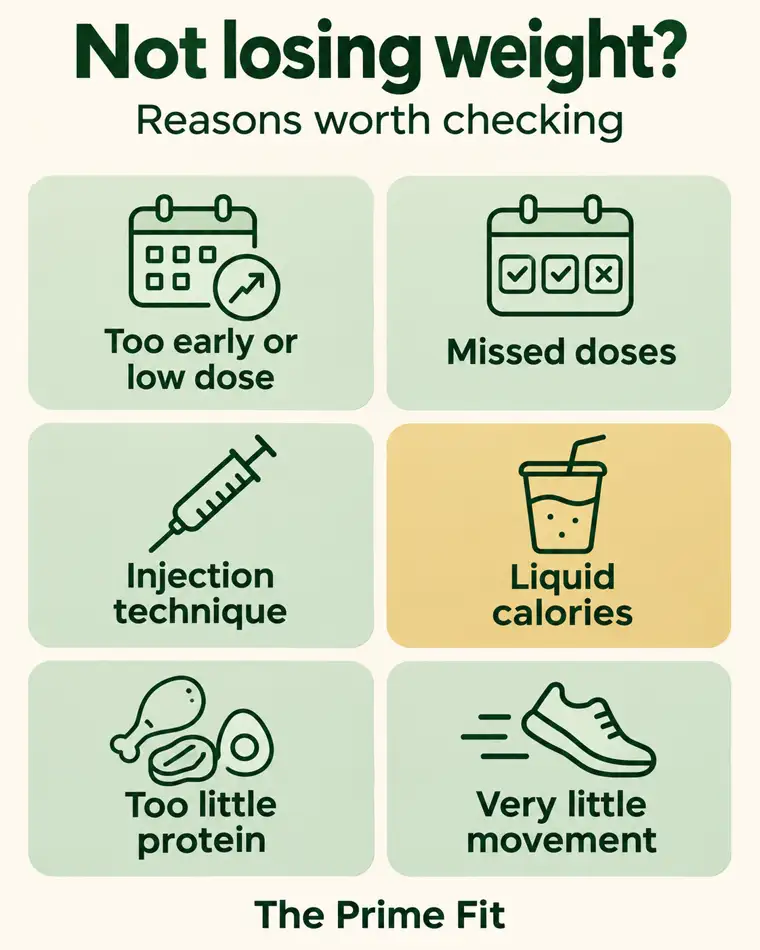
This guide goes through the twelve most common reasons, roughly in the order worth checking, with what to do about each. It is general information. Changes to your dose or other medicines must be made by your healthcare provider.
First, is it really not working?
Before troubleshooting, check your result against what is normal.
| Time on treatment | What is typical | When to be concerned |
|---|---|---|
| Month 1 (starting dose) | Anything from no change to 2 or 3 kg. The starting dose is for adjustment | Not yet. This month does not predict the outcome |
| Months 2 to 3 | Dose rising; 3 to 6% of body weight lost in total | If there is no reduction in appetite at all |
| After about 3 months at a treatment dose | At least 5% lost | Less than 5% suggests a poor response; review with your healthcare provider |
| Months 6 to 12 | Steady loss, slowing gradually | A stall of more than 6 to 8 weeks while well short of your goal |
| Months 12 to 18 | Weight levels off at about 15% (semaglutide) or 20% (tirzepatide) on average | This plateau is expected, not a failure |
Two more checks. Are you weighing correctly: same scale, same time of day, once a week, without clothes? And are you looking at a trend over four weeks, not day-to-day changes? Body weight swings by a kilogram or more with salt, fluid, bowel habit and the menstrual cycle.
A healthy rate
After the first few weeks, 0.5 to 1 kg a week is good progress, and less than that is still progress. Two kilograms a month is 24 kilograms a year. Slow is not the same as stuck.
Reason 1: It is too early, or the dose is still low
This is the commonest reason of all. Treatment begins with a dose chosen for tolerance, 2.5 mg of tirzepatide or 0.25 mg of semaglutide, which is not expected to produce much weight loss. It takes about 20 weeks to reach the top dose of tirzepatide and 16 weeks to reach the maintenance dose of semaglutide if every step is taken on time, and most weight is lost in the months after that.
What to do: be patient through the first three months. Use them to build the eating and activity habits that will carry the result. Judge the medicine after about three months at a proper treatment dose.
Reason 2: The dose has not been increased when it could be
Some people remain on a low dose for months, because of cost, missed appointments, an abundance of caution, or because nobody reviewed it. If appetite has returned and weight has stalled, and you are tolerating the current dose, an increase is the logical next step.
What to do: ask your healthcare provider whether your dose should go up. Equally, do not push for an increase if you are still losing steadily; keeping a higher dose in reserve is useful later.
Reason 3: Missed, late or irregular doses
These medicines work through a steady level in the blood. Skipping doses, stretching the interval to ten days or two weeks to make a pen last, or stopping and restarting repeatedly lowers that level and lets appetite return. Restarting after a gap usually means going back to a lower dose, which sets the timeline back further.
What to do: inject on the same day every week, with a phone reminder. If cost is the reason for stretching doses, tell your healthcare provider; there may be a better solution.

Reason 4: A problem with the pen, the technique or the product
| Possible problem | How it reduces the effect | How to check |
|---|---|---|
| Heat or freezing | The medicine is a protein and is damaged by temperature | Has it always been refrigerated? Was it left in a car, or did it freeze? |
| Used beyond its in-use period or expiry | Loss of potency | Check the dates and the leaflet |
| Injection technique | Not holding the pen long enough, or leakage, means a partial dose | Ask a nurse or healthcare professional to watch you inject |
| Wrong dose selected | With multi-dose pens or vials, a lower dose than intended may be given | Have the dose setting checked |
| Injecting into scarred or lumpy skin | Poor absorption | Rotate sites |
| Counterfeit or unregulated product | May contain little or no active ingredient | Was it bought from a licensed pharmacy with a prescription and bill? |
What to do: if you feel no change in appetite at all at a dose that usually has an effect, raise these points with your healthcare provider and pharmacist.
Reason 5: Liquid calories
GLP-1 medicines make you feel full by slowing the stomach and acting on the brain. Liquids pass through quickly and produce little fullness, so they slip past the effect. It is common to find that someone eating very small meals is taking in several hundred calories a day from drinks.
| Drink | Approximate calories |
|---|---|
| Tea or coffee with milk and 2 teaspoons of sugar, 4 cups a day | 250 to 300 |
| Fruit juice, 1 large glass | 120 to 150 |
| Soft drink, 1 can | 140 |
| Sweet lassi or milkshake, 1 glass | 250 to 400 |
| Café-style sweet coffee or cold coffee | 250 to 450 |
| Beer, 2 bottles, or 3 large pegs with cola | 300 to 600 |
| “Health” drinks and smoothies with fruit, honey and nuts | 250 to 500 |
What to do: write down everything you drink for three days. Move to water, plain chaas, nimbu pani without sugar, and tea or coffee with little or no sugar. Keep milk and protein shakes, which count as food, within your plan.
Reason 6: Small amounts of energy-dense food, often
With a reduced appetite, large meals disappear. What sometimes replaces them is grazing: a few biscuits with each tea, a handful of namkeen, a piece of mithai, the children’s leftovers, nuts by the bowl, spoonfuls while cooking. None of it feels like eating, and none of it triggers fullness, but energy-dense foods add up quickly. Portions also tend to creep back up after the first few months as the body adapts.
| Small item | Approximate calories |
|---|---|
| 4 glucose or cream biscuits | 120 to 200 |
| A handful of namkeen or bhujia (30 g) | 150 to 170 |
| 1 piece of mithai | 150 to 250 |
| A large handful of nuts (50 g) | 300 |
| 2 tablespoons of ghee or oil added to food | 240 |
| 1 samosa or 2 pakoras | 200 to 300 |
| A small bar of chocolate | 200 to 250 |
What to do: keep an honest food diary for three days, including every bite and sip. Return to three defined meals and one or two planned snacks. Keep snack foods out of sight, and measure oil and ghee by the teaspoon.
Reason 7: Too little protein and loss of muscle
If the little you eat is mostly roti, rice, tea and biscuits, a larger share of the weight you lose is muscle. Muscle is the tissue that burns energy at rest. Losing it lowers your daily needs, so weight loss slows sooner and regain comes more easily. You may also notice weakness and hair shedding.
What to do: aim for a protein food at every meal, eaten first: dal, chana, paneer, curd, soya, eggs, fish or chicken. Many adults on treatment are advised about 1.0 to 1.5 grams of protein per kilogram of body weight a day. Add resistance exercise two or three times a week.
Reason 8: Very little movement
The medicine reduces intake; it does not increase the energy you use. People who are tired in the early weeks often move less than before without noticing. Low activity reduces the calorie gap and, more importantly, removes the signal that preserves muscle.
What to do: walk every day, building to 30 to 45 minutes or about 7,000 to 10,000 steps, with short walks after meals. Add strength training. Exercise alone rarely produces large weight loss, but it shapes what you lose and is the strongest predictor of keeping weight off.

Reason 9: Alcohol
Alcohol supplies 7 calories per gram with no nutrition, is burned before fat, loosens restraint around food and disturbs sleep. Weekend drinking can cancel much of a week’s deficit.
What to do: try four weeks without alcohol and watch the trend. If you drink, keep it occasional and small.
Reason 10: Poor sleep and chronic stress
Short sleep raises the hunger hormone ghrelin, lowers the fullness hormone leptin, reduces insulin sensitivity and increases cravings for sweet and fatty food the next day. Chronic stress raises cortisol, which favours abdominal fat and comfort eating. Both can blunt the effect of the medicine. Untreated sleep apnoea, common with excess weight, does the same.
What to do: aim for seven to eight hours at regular times. Finish dinner early and limit screens late at night. If you snore heavily or are sleepy in the day, ask about a sleep study. Build in daily stress relief that is not food: a walk, breathing exercises, prayer, time with friends.
Reason 11: Other medicines that promote weight gain
Several commonly prescribed medicines increase appetite or weight. They can partly offset a GLP-1 medicine.
| Type of medicine | Examples |
|---|---|
| Diabetes medicines | Insulin; sulfonylureas such as glimepiride and gliclazide; pioglitazone |
| Steroids | Prednisolone and other oral steroids |
| Antipsychotics | Olanzapine, quetiapine, risperidone and others |
| Some antidepressants | Mirtazapine, amitriptyline, paroxetine |
| Anti-seizure and nerve-pain medicines | Valproate, gabapentin, pregabalin |
| Some blood pressure medicines | Older beta-blockers |
| Some hormonal treatments | Injectable progestogen contraception |
| Some allergy medicines | Sedating antihistamines taken long term |
What to do: give your healthcare provider a full list of your medicines. Do not stop any of them yourself. In many cases there is an alternative with less effect on weight, or the dose of a diabetes medicine can be reduced as your sugars improve.
Reason 12: A medical condition working against you
| Condition | Effect | What to check |
|---|---|---|
| Type 2 diabetes | People with diabetes lose about two-thirds to three-quarters as much on the same dose | This is expected; review diabetes medicines that cause weight gain |
| Underactive thyroid | Slows metabolism modestly; causes fluid retention | TSH; adjust thyroid dose if needed |
| PCOS with marked insulin resistance | Slower response in some women | Metformin, diet quality, strength training |
| Menopause | Shift of fat to the abdomen; loss of muscle | Protein, resistance exercise, sleep |
| Sleep apnoea | Fatigue, hunger, insulin resistance | Sleep study |
| Depression, binge eating or emotional eating | Eating driven by mood can override reduced appetite | Psychological support alongside treatment |
| Cushing’s syndrome (rare) | Weight gain with thin skin, easy bruising, purple stretch marks, muscle weakness | Specialist testing if features are present |
| Fluid retention | Heart, kidney or liver problems, or some medicines, add weight as fluid | Swelling of the ankles; medical review |
What to do: ask your healthcare provider whether your baseline tests were complete and whether any should be repeated.
And sometimes: you have reached a natural plateau
If you have already lost 10, 15 or 20 percent of your weight over a year or more and the scale has stopped, you have probably reached the plateau that every treatment produces. A smaller body needs fewer calories, hunger hormones rise, and energy use becomes more efficient. Eventually intake and needs balance at a new, lower weight.
This is success. If your health goals have been met, the task now is maintenance. If they have not, your healthcare provider can discuss a higher dose, a different medicine or an additional approach.
Things that can hide fat loss on the scale
- Constipation: retained stool can add a kilogram or more. It is common on these medicines.
- Salt and fluid: a salty meal, travel or hot weather causes water retention for a day or two.
- The menstrual cycle: weight often rises by 1 to 2 kg before a period.
- New strength training: muscles hold more water in the first weeks, and you may gain a little muscle while losing fat.
- Time of day and clothing: evening weight is higher than morning weight.
This is why waist measurement, clothes fit, photographs and, where available, body-composition readings are valuable. If your waist is shrinking while the scale is flat, you are losing fat.
Biology: some people respond less
After everything above has been checked, a minority of people simply respond less to a particular medicine. Research into the genetics of response is at an early stage, and there is no test yet that predicts it. A weak response to one medicine does not mean a weak response to another: some people who lose little on semaglutide do well on tirzepatide, and the reverse. It is not a reflection of effort or character.
A step-by-step plan
| Step | What to do | How long |
|---|---|---|
| 1 | Confirm the facts: weekly weight on the same scale, waist measurement, how long at which dose | Today |
| 2 | Check doses taken, storage and injection technique | This week |
| 3 | Keep a complete three-day diary of food and drink, including weekends | This week |
| 4 | Remove liquid calories and unplanned snacks; set three meals with protein first | 4 weeks |
| 5 | Walk daily and start strength training twice a week | Ongoing |
| 6 | Fix sleep; pause alcohol | 4 weeks |
| 7 | See your healthcare provider: review dose, other medicines and blood tests such as TSH and HbA1c; treat constipation | At your next review |
| 8 | If still less than 5% after about 3 months at a treatment dose, or stalled short of your health goals: discuss a higher dose, a switch of medicine, or other options | With your healthcare provider |
What your healthcare provider may suggest
- Increasing the dose, if you are not at the maximum and are tolerating the current one.
- Switching medicine, for example from semaglutide to tirzepatide, starting low and building up.
- Adjusting other medicines that promote weight gain.
- Treating a contributing condition, such as an underactive thyroid or sleep apnoea.
- A more structured nutrition programme, with weekly dietitian follow-up.
- Psychological support for emotional or binge eating.
- Other treatments, such as a gastric balloon or bariatric surgery, particularly at higher BMI or when a large weight loss is needed.
What a good healthcare professional will not suggest is exceeding the licensed dose, shortening the interval between injections, or adding a second GLP-1 medicine.
What not to do
- Do not increase the dose yourself or inject more often.
- Do not stop eating. Severe restriction costs muscle, slows metabolism and leads to rebound eating.
- Do not add “fat burners”, slimming teas or laxatives. They are ineffective and can be harmful.
- Do not stop other prescribed medicines because you suspect they cause weight gain.
- Do not weigh yourself daily if it drives anxiety. Once a week is enough.
- Do not compare your second month with someone else’s twelfth.
- Do not give up after six weeks.

A sample day that addresses the common gaps
| Meal | Vegetarian | Non-vegetarian |
|---|---|---|
| On waking | Water; tea with little or no sugar | Water; tea or coffee with little or no sugar |
| Breakfast | 2 moong chillas with paneer, curd | 2-egg vegetable omelette, 1 whole wheat toast |
| Mid-morning | Fruit; water | Fruit; plain chaas |
| Lunch | Salad, dal or chana, sabzi, 1 roti, curd | Salad, fish or chicken curry, sabzi, small katori of rice |
| Evening | Roasted chana or sprouts; tea without biscuits | Boiled egg or roasted chana; tea without biscuits |
| Dinner, early | Paneer or tofu with vegetables, dal, 1 phulka | Grilled chicken or fish with vegetables, dal, 1 phulka |
| After dinner | 10-minute walk; kitchen closed | 10-minute walk; kitchen closed |
Three illustrative examples
These invented examples show how the cause is usually found. They are not advice for any individual.
Still on the starting dose
A 42-year-old woman has lost 1 kg in ten weeks and is frustrated. She missed her review and has remained on the lowest dose. Her healthcare provider increases it step by step, and over the next five months she loses 9 kg.
Small meals, large drinks
A 35-year-old man eats very little at meals but has four sweet teas, a cold coffee and a soft drink most days, and beer at weekends. His diary shows about 700 to 800 calories a day from drinks. He switches to water, plain chaas and unsweetened tea, and his weight begins to fall by 3 kg a month.
A medicine in the way
A 51-year-old woman with type 2 diabetes has lost 2 kg in four months. She takes a sulfonylurea and has been snacking to prevent low sugars. Her healthcare provider stops the sulfonylurea as her readings allow, and a thyroid test leads to a small increase in her thyroid tablet. She loses a further 8 kg over six months.
Questions to ask your healthcare provider
- Given my dose and time on treatment, is my progress within the expected range?
- Should my dose be increased?
- Could any of my other medicines be slowing my weight loss?
- Should my thyroid, blood sugar or other tests be repeated?
- Would switching to a different medicine be reasonable?
- Can I have my body composition measured?
- If medication is not enough, what are my other options?
Common myths
“If it does not work in the first month, it never will”
The first month is on a starting dose. Most weight loss comes later.
“The medicine works no matter what I eat or drink”
It reduces appetite. Liquid calories, grazing and alcohol can still outweigh it.
“A plateau means I have become resistant”
A plateau after substantial loss is the body reaching a new balance.
“Eating less and less will restart weight loss”
Severe restriction costs muscle and backfires. Protein and strength training work better.
“If one GLP-1 medicine fails, the others will too”
Responses differ between medicines.
“The scale is the only measure that counts”
Waist, body composition, blood tests and how you function tell you more.
How The Prime Fit helps when progress stalls
At The Prime Fit, a stall triggers a structured review, not blame. Your healthcare provider checks the dose, your injection routine, your other medicines and relevant blood tests. Your dietitian goes through a detailed food and drink record with you, sets protein targets and rebuilds your meal pattern. We measure waist and body composition, so that fat loss is not missed, and we discuss honestly when a change of medicine or another treatment would serve you better.
If your progress has stalled, book a consultation or read about our GLP-1 support programme.
Frequently asked questions
Why am I not losing weight on Mounjaro, Wegovy or Ozempic?
The commonest reasons are that it is still early or the dose is low, doses have been missed, calories are coming from drinks and snacks, protein and activity are low, or another medicine or condition is working against you.
How long before I should expect weight loss?
Appetite usually falls within weeks, and clear weight loss appears by two to three months as the dose rises. Assess the medicine after about three months at a treatment dose.
What counts as not responding?
Losing less than about 5 percent of your starting weight after roughly three months at a treatment dose suggests a poor response and should be reviewed with your healthcare provider.
Should I ask for a higher dose?
If appetite has returned, weight has stalled and you tolerate the current dose, an increase is reasonable to discuss. If you are still losing steadily, there is no need.
Can I still gain weight on these medicines?
Yes, if intake from liquid calories, snacks or alcohol exceeds your needs, or if doses are missed. Fluid retention and constipation can also raise the scale temporarily.
Why did I stop losing weight after a few months?
Possibly portion creep, lower activity or the need for a dose review. After a large loss, it may be the expected plateau as your body reaches a new balance.
Should I eat less to restart weight loss?
Not drastically. Focus on protein, vegetables, fewer liquid calories and snacks, and strength training. Very low intake costs muscle and slows metabolism.
Will switching medicine help?
It can. Some people who respond poorly to one medicine do better on another. Your healthcare provider will start the new one low and increase gradually.
Do people with diabetes lose less weight?
On average, yes, and some diabetes medicines promote weight gain. Your healthcare provider can review these as your sugars improve.
What if nothing works?
After a full review, options include a different medicine, a more intensive nutrition programme, a gastric balloon or bariatric surgery. A poor response to one treatment does not rule out success with another.
This article is general information and is not a substitute for a consultation. Calorie figures are approximate. Do not change the dose of any prescription medicine, or stop other medicines, without your healthcare provider’s advice.