In this article
- Does Mounjaro cause muscle loss?
- How much of the weight lost on Mounjaro is muscle?
- Why does muscle matter during weight loss?
- Who is at higher risk of losing muscle on Mounjaro?
- How much protein do you need on Mounjaro?
- Which Indian foods give the most protein?
- How do you eat enough protein when your appetite is low?
- What is a simple resistance training plan for beginners?
- What are the signs you may be losing muscle?
- How can you track muscle while losing weight?
- Do creatine and other supplements help protect muscle?
- How fast should you lose weight on Mounjaro?
- Common myths about Mounjaro and muscle
- Questions to ask your healthcare provider
- How The Prime Fit helps
- Frequently asked questions
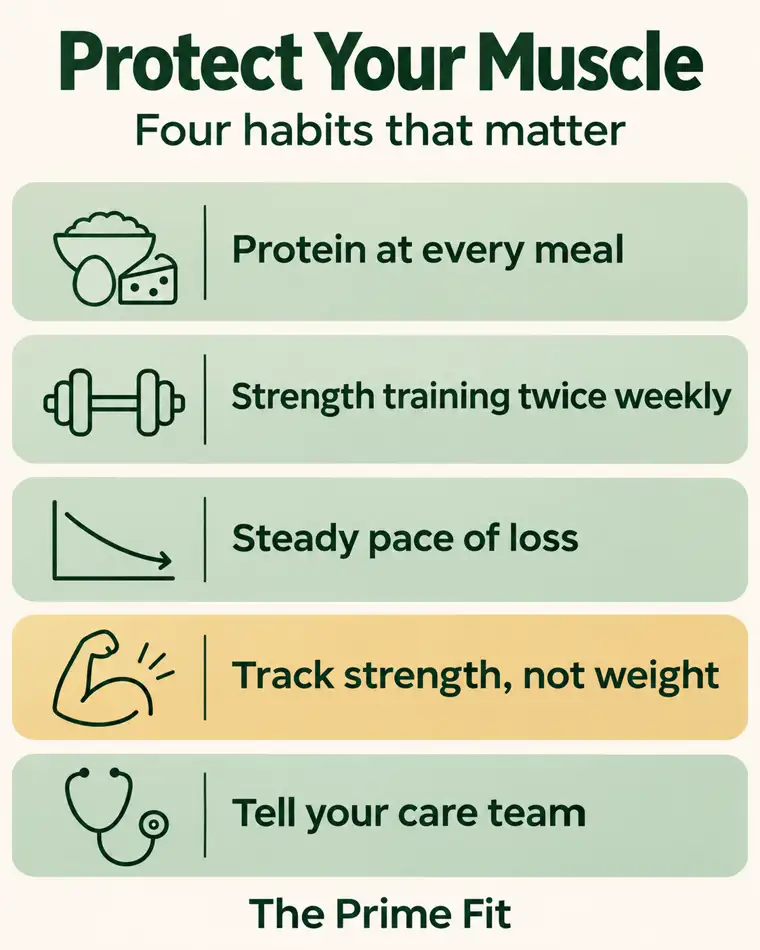
Mounjaro muscle loss is a real but manageable concern. Any weight loss, whether from diet, surgery or medicine, includes some lean tissue, and Mounjaro (tirzepatide) is no exception. In the trial that measured body composition, most of the weight lost was fat, with a smaller share coming from lean mass. How to prevent muscle loss on Mounjaro comes down to three things: eating enough protein, doing resistance exercise two to three days a week, and losing weight at a steady pace.
The medicine does not attack muscle. What happens is simpler: appetite falls, you eat much less, and if protein intake and activity fall too, the body breaks down some muscle along with fat. That is why two people on the same dose can end up with very different results in strength and shape.
This guide explains how much muscle is usually lost, who is at higher risk, how much protein you may need, which Indian foods provide it, a beginner strength plan and how to track progress. It is general information. Your own targets should be set with your healthcare provider, particularly if you have kidney disease, diabetes or are over 60.
Does Mounjaro cause muscle loss?
Mounjaro causes weight loss, and weight loss of any kind includes some lean tissue. There is no good evidence that tirzepatide damages muscle directly. The loss comes from eating fewer calories over many months.
Two points keep this in proportion.
- Lean mass is not only muscle. Body scans report “lean mass”, which includes water, organs and connective tissue as well as muscle. A fall in lean mass therefore overstates the fall in actual muscle.
- A lighter body needs a little less muscle. Carrying 15 kg less means the legs and trunk have less load to move, so some reduction is expected and is not harmful in itself.
The aim is not zero lean loss, which is unrealistic. The aim is to lose mostly fat and to keep, or even improve, your strength and function.
How much of the weight lost on Mounjaro is muscle?
In the large tirzepatide weight-management trial, a subgroup of participants had body-composition scans before and after treatment. Roughly three quarters of the weight they lost was fat and about one quarter was lean mass. That proportion is similar to what is seen with weight loss from diet alone or from other methods, and the ratio of fat to lean tissue in the body improved overall.
These are averages from a trial in which participants also received lifestyle advice. Individuals vary widely. Someone who eats very little protein and does no strength work may lose a larger share as muscle. Someone who trains and eats well may lose very little.
Why does muscle matter during weight loss?
Muscle is more than appearance. It is working tissue that affects health at every age.
| What muscle does | Why it matters to you |
|---|---|
| Strength and balance | Climbing stairs, carrying shopping, getting up from the floor, and avoiding falls later in life |
| Blood sugar control | Muscle is the main place where glucose is used after a meal, so more active muscle helps insulin work better |
| Energy use | Muscle uses energy even at rest. Keeping it helps a little with maintaining weight after treatment |
| Healthy ageing | Muscle and strength decline naturally from midlife. Losing extra during weight loss is harder to regain when you are older |
This matters especially in India. At the same BMI, people of Indian origin tend to carry more body fat, particularly around the abdomen, and less muscle than people of European origin. This is one reason Asian Indian cut-offs are lower: overweight from a BMI of 23 and obesity from 25, with a waist above 90 cm in men or 80 cm in women signalling risk. You can check yours with our BMI calculator. Starting with less muscle means there is less to spare.
Who is at higher risk of losing muscle on Mounjaro?
- Adults over about 60, who build muscle more slowly and lose it faster
- People eating very little protein, common with largely cereal-based vegetarian meals
- Those losing weight very quickly, especially when appetite is severely suppressed
- People who do no resistance exercise or who are mostly sedentary
- Anyone with prolonged nausea, vomiting or very low appetite who is skipping meals
- Those who start with low muscle mass despite a high weight
If several of these apply to you, mention it to your prescriber early. A slower dose schedule, a dietitian review or supervised exercise may be advised.
How much protein do you need on Mounjaro?
There is no protein figure in the Mounjaro prescribing information. Nutrition guidance for adults losing weight commonly suggests about 1.0 to 1.5 g of protein per kg of body weight per day, depending on age, activity, starting weight and health. The right figure is individual. For people with a high body weight, the target is often based on a reference or adjusted weight, not actual weight, so let your dietitian set it.
Kidney disease changes the target
If you have chronic kidney disease, protein in your urine or a single kidney, a higher protein intake may not be suitable. Your target may be lower. Follow the figure given by your care team and do not raise it on your own.
Illustrative example
This is an illustrative example, not a prescription. A woman has a reference weight of 70 kg and has been advised 1.2 g per kg per day.
- 70 kg x 1.2 g = 84 g of protein a day
- At the lower end, 70 x 1.0 = 70 g. At the upper end, 70 x 1.5 = 105 g
- Spread over three meals and one snack, 84 g is about 21 g on each occasion
Many Indian diets provide well under this, often because meals centre on roti, rice and vegetables with a small portion of dal. Counting your intake for two or three typical days is usually revealing.

Which Indian foods give the most protein?
Figures below are approximate and vary with brand, recipe and portion.
| Food and serving | Approximate protein | Type |
|---|---|---|
| Paneer, 100 g | 18 g | Vegetarian |
| Soya chunks, 30 g dry weight | 15 g | Vegetarian |
| Tofu, 100 g | 8 to 12 g | Vegetarian |
| Cooked dal, rajma or chana, 1 katori | 7 to 9 g | Vegetarian |
| Curd, 200 g | 6 to 7 g | Vegetarian |
| Milk, 1 glass of 250 ml | 8 g | Vegetarian |
| Moong or besan chilla, 2 medium | About 10 g | Vegetarian |
| Roasted chana, 30 g | 6 g | Vegetarian |
| Eggs, 2 whole | 12 g | Non-vegetarian |
| Chicken breast, 100 g cooked | About 28 g | Non-vegetarian |
| Fish, 100 g cooked | About 21 g | Non-vegetarian |
| Whey or plant protein powder, 1 scoop | About 20 to 24 g, check the label | Supplement |
For full menus, see our vegetarian high-protein meal plan and the Mounjaro diet plan with a 7-day Indian menu.
How do you eat enough protein when your appetite is low?
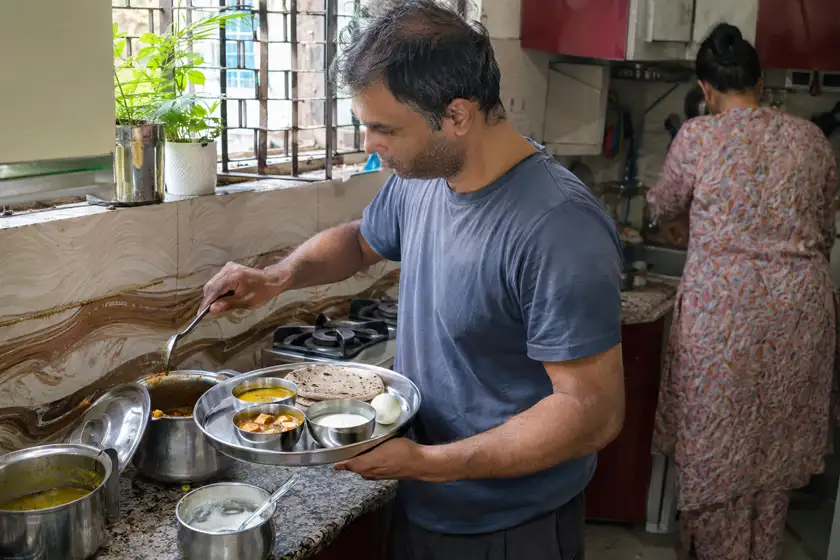
On Mounjaro, a full thali can feel impossible. The solution is to spread protein across the day and to eat it first.
- Protein first. Start each meal with the dal, paneer, egg, curd, chicken or fish, then vegetables, then roti or rice.
- Four or five small eating occasions are easier than two large meals.
- Use soft and liquid options on difficult days: curd, chaas, milk, thin moong dal, egg bhurji or a protein shake.
- Add protein to what you already eat: besan or soya flour in atta, paneer in sabzi, roasted chana with tea.
- Do not skip meals because you are not hungry. Eat a small protein portion by the clock.
An illustrative day
This illustrative example uses the approximate figures from the table above.
| Meal | Vegetarian | Non-vegetarian |
|---|---|---|
| Breakfast | 2 moong chillas with 50 g paneer filling (about 19 g) | 2-egg omelette with a glass of milk (about 20 g) |
| Mid-morning | 200 g curd (about 7 g) | 200 g curd (about 7 g) |
| Lunch | 1 katori dal, 100 g paneer sabzi, salad, 1 roti (about 26 g) | 100 g chicken curry, 1 katori dal, salad, small rice (about 36 g) |
| Evening | 30 g roasted chana and a glass of milk (about 14 g) | 30 g roasted chana (about 6 g) |
| Dinner | Soya chunk curry from 30 g dry chunks, 1 katori dal, sabzi (about 23 g) | 100 g grilled fish, 1 katori dal, sabzi (about 29 g) |
| Day total | About 89 g | About 98 g |
What is a simple resistance training plan for beginners?
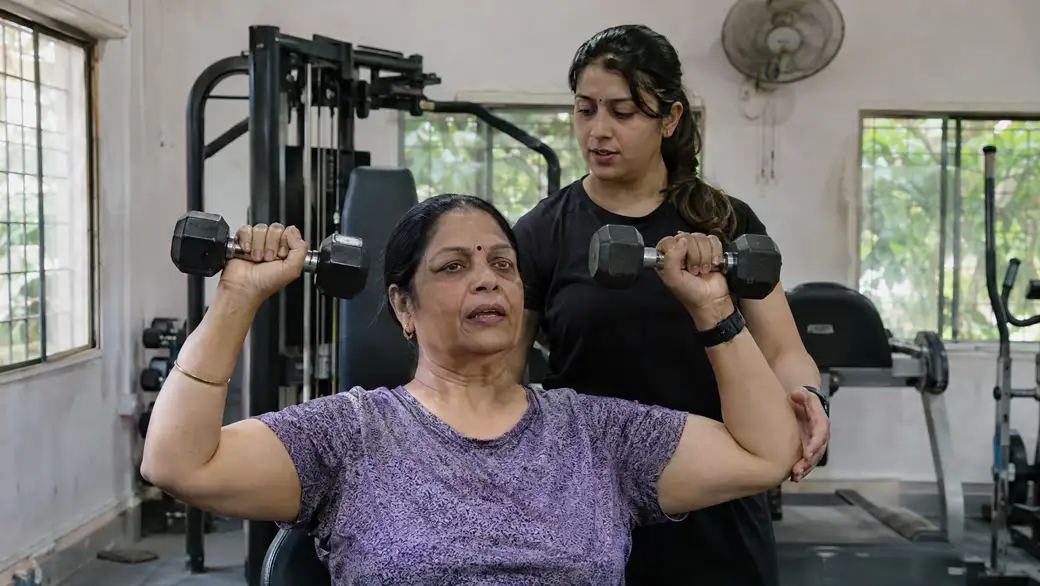
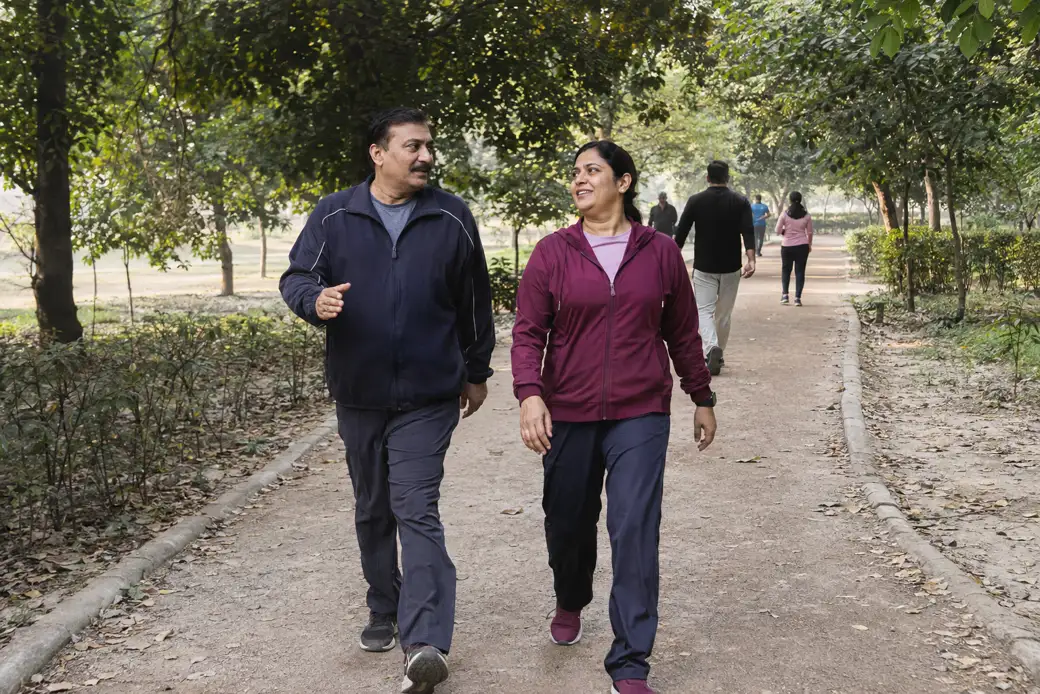
Protein is the building material. Resistance exercise is the signal that tells the body to keep muscle. Walking is excellent for the heart and for fat loss, but by itself it does not protect muscle well. Aim for resistance training on two to three non-consecutive days a week.
| Movement | Beginner exercise at home | Sets and repetitions |
|---|---|---|
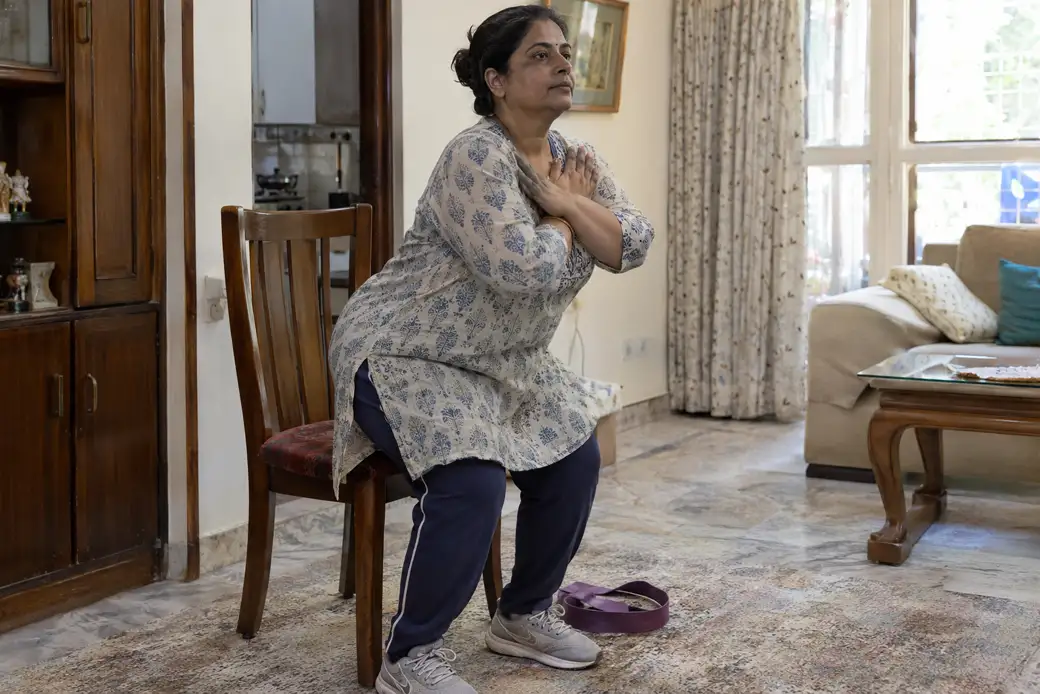
| Legs | Sit-to-stand from a chair | 2 to 3 sets of 8 to 12 |
| Push | Wall push-up | 2 to 3 sets of 8 to 12 |
| Pull | Resistance band row | 2 to 3 sets of 10 to 12 |
| Hips | Glute bridge on a mat | 2 to 3 sets of 10 to 15 |
| Shoulders | Overhead press with filled water bottles | 2 to 3 sets of 8 to 12 |
- When all sets feel easy, add resistance: a heavier bottle, a stronger band or a slower lowering phase.
- Train after a small meal, not on an empty stomach, and drink water. Dizziness is more likely when you are eating little.
- If you have heart disease, joint problems, uncontrolled blood pressure or diabetic eye disease, ask your healthcare provider which exercises are safe before you begin.
A fuller routine with progressions is in our beginner strength training plan for GLP-1 medicines.
What are the signs you may be losing muscle?
- Everyday tasks feel harder: stairs, rising from a low chair or the floor, opening jars
- Grip strength is falling, or bags feel heavier than before
- Clothes are looser but you feel weaker, not lighter and more energetic
- Persistent tiredness that does not improve with sleep
- Your training numbers are going down week after week
When to seek medical advice
Contact your care team promptly if you have marked weakness, repeated dizziness or fainting, a fall, vomiting that stops you eating or drinking, or very rapid weight loss. Severe muscle pain with dark urine, sudden weakness on one side of the body, chest pain or breathlessness need urgent medical care.
How can you track muscle while losing weight?
The weighing scale cannot tell fat from muscle. Use a few simple measures together.
| Method | What it tells you | Limits |
|---|---|---|
| Strength log | Whether repetitions and loads are holding or rising. The most practical sign that muscle is being kept | Needs consistent exercises and honest recording |
| Waist measurement | Loss of abdominal fat. A shrinking waist with stable strength is the pattern you want | Measure at the same point and time of day |
| Bioimpedance scales (BIA) | An estimate of fat and lean mass | Strongly affected by hydration, meals and time of day. Follow trends, not single readings |
| DEXA body-composition scan | A more accurate measure of fat, lean mass and bone | Lean mass still includes water. Not needed for everyone |
Do creatine and other supplements help protect muscle?
Supplements are optional and come after food and training.
- Protein powder is useful when food alone cannot meet your target, which is common when appetite is low. It is a convenience, not a necessity.
- Creatine monohydrate has good evidence for improving strength and lean mass when combined with resistance training. It has not been tested in large trials in people taking tirzepatide, and it does little without training. It can raise the creatinine reading on a kidney blood test, so tell your prescriber before starting. See our creatine guide.
- Vitamin D and vitamin B12 are worth correcting if a blood test shows a deficiency. Both are commonly low in India.
- BCAAs, “muscle-preserving” blends and hormone boosters have little or no proven benefit, and some are unsafe.
Check any supplement with your prescriber if you have kidney or liver disease, are pregnant or breastfeeding, or take regular medicines.
How fast should you lose weight on Mounjaro?
Faster loss generally costs more lean tissue. Many programmes consider a loss of roughly 0.5 to 1 kg a week reasonable, a little quicker in the first weeks. Mounjaro is started at 2.5 mg once weekly and increased in 2.5 mg steps after at least 4 weeks on each dose, as your prescriber advises. There is no requirement to reach the highest dose.
If weight is falling very fast, you are barely eating, or strength is dropping, tell your prescriber. Staying longer on the current dose is a common and sensible adjustment. Never change the dose on your own. The steps are explained in our Mounjaro dosage guide.

Common myths about Mounjaro and muscle
“Most of the weight lost on Mounjaro is muscle”
Trial body-composition data showed the opposite: most of the weight lost was fat.
“Walking 10,000 steps is enough to keep muscle”
Walking is valuable, but muscle needs resistance to be maintained.
“Strength training will make women bulky”
It will not, particularly in a calorie deficit. It helps you keep shape and strength.
“A vegetarian diet cannot provide enough protein”
It can, with planned portions of dal, paneer, curd, soya, tofu and milk.
Questions to ask your healthcare provider
- What daily protein target is right for my weight, age and kidney function?
- Is my rate of weight loss appropriate, or should I stay on this dose longer?
- Which resistance exercises are safe with my joints, heart and blood pressure?
- Should my body composition or grip strength be measured?
- Do I need tests for vitamin D, vitamin B12, iron or thyroid function?
- Is creatine or protein powder suitable for me?
How The Prime Fit helps
At The Prime Fit, protecting muscle is treated as part of weight loss, not an afterthought. Your plan begins with an assessment of your health, weight history and medicines. Our team offers nutrition support to set a realistic protein target around the foods you already eat, vegetarian or non-vegetarian, and guidance on getting started with resistance exercise at your level. At follow-up we look at how you feel and function as well as the number on the scale, and adjust the plan if weight is falling too quickly.
You can read more about our GLP-1 support programme.
Frequently asked questions
Does Mounjaro cause muscle loss?
Any weight loss includes some lean tissue, and this applies to Mounjaro too. In trial body-composition data most of the weight lost was fat. The medicine is not known to damage muscle directly.
How can I prevent muscle loss on Mounjaro?
Eat enough protein spread across the day, do resistance exercise two to three days a week, avoid very rapid weight loss, and tell your prescriber if your strength is falling.
How much protein should I eat on Mounjaro?
Commonly about 1.0 to 1.5 g per kg of body weight per day, but the figure is individual and may be lower if you have kidney disease. Ask your care team to set your target.
Can vegetarians get enough protein on Mounjaro?
Yes. Dal, chana, rajma, paneer, curd, milk, soya chunks and tofu can meet most targets when included at every meal. A protein powder can fill a gap if appetite is very low.
Is walking enough to protect muscle?
Walking supports heart health and fat loss but does not protect muscle well by itself. Add resistance exercise such as sit-to-stands, wall push-ups and band rows.
Should I take creatine while on Mounjaro?
It is optional. Creatine helps strength when combined with resistance training, but it has not been studied in large trials with tirzepatide. Check with your prescriber first, especially if you have kidney problems.
How do I know if I am losing muscle and not fat?
Warning signs include growing weakness, falling grip strength, difficulty with stairs and tiredness despite looser clothes. A strength log, waist measurement and, where advised, a body-composition test help to confirm.
Will the muscle come back if I stop Mounjaro?
Muscle can be rebuilt at any age with resistance training and adequate protein, although it is slower in older adults. Stopping the medicine does not rebuild it by itself, and regained weight tends to be mainly fat.
This article is general information and is not a substitute for a consultation. Trial figures and food values are approximate. Follow the leaflet supplied with your pen and the advice of your prescriber, and speak to your healthcare provider before changing your diet, exercise, supplements or dose, especially if you have kidney disease, diabetes or another long-term condition.