In this article
- Why BMI alone was never enough
- What changed in 2025
- The Indian stages
- The international framework: preclinical and clinical obesity
- Check yourself at home
- Conditions that count
- Worked examples
- What each stage means for treatment
- Why this is good news
- Criticisms and open questions
- Measuring body fat
- Tests worth having if your BMI or waist is raised
- Moving from Stage 2 back towards health
- Everyday steps for Indian households
- Children, adolescents and older adults
- Questions to ask your healthcare provider
- Common myths
- How The Prime Fit assesses you
- Frequently asked questions
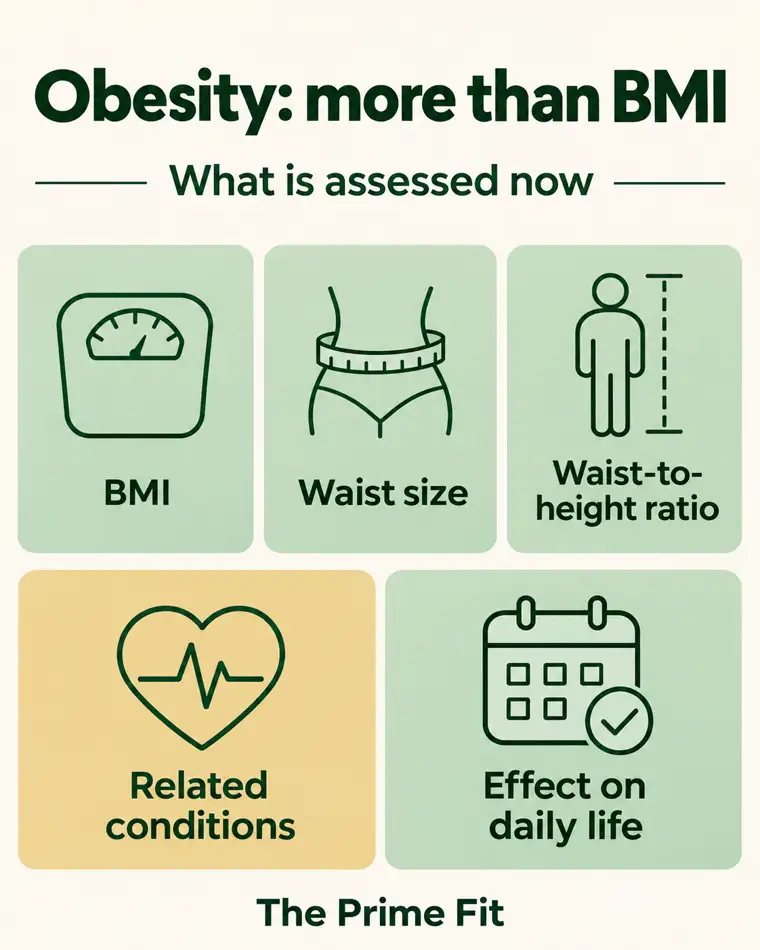
For decades, a single number decided whether a person was called overweight or obese: the body mass index, or BMI. It is easy to calculate, and it has been useful for studying populations. As a way of deciding whether an individual is unwell and needs treatment, it has always been crude. A muscular athlete and a sedentary person with a large waist can have the same BMI. So can a person with diabetes, sleep apnoea and painful knees, and a person with no health problems at all.
In January 2025, two expert groups published proposals to fix this. An international commission introduced the terms “clinical obesity” and “preclinical obesity”. In the same month, Indian specialists published updated guidelines for Asian Indians, replacing the old categories with “Stage 1” and “Stage 2” obesity. Both move the focus from weight alone to where fat is carried and what it is doing to the body.
These changes have been widely reported, and not always clearly. This guide explains them. It is general information, summarising published guidance as accurately as possible; the exact criteria your healthcare provider uses may differ. It is not a substitute for an assessment.
Why BMI alone was never enough
BMI is your weight in kilograms divided by the square of your height in metres. It says nothing about what the weight is made of or where it sits.
| What BMI cannot tell you | Why it matters |
|---|---|
| Fat versus muscle | Muscle weighs more than fat for the same volume. A person with little muscle can have a “normal” BMI and a high body fat percentage |
| Where the fat is | Fat inside the abdomen and around the organs is far more harmful than fat under the skin of the hips and thighs |
| Whether health is affected | Two people with the same BMI can have completely different blood sugar, blood pressure, liver and joint health |
| Ethnic differences | At the same BMI, Asian Indians carry more body fat and more abdominal fat than Europeans |
| Age and sex differences | Women and older adults have more fat and less muscle at a given BMI |
The Indian problem
For Indians, BMI is especially misleading. Studies over many years have shown that Indians develop type 2 diabetes, high blood pressure, fatty liver and heart disease at lower BMI values and at younger ages than Western populations. The typical pattern is a relatively slim build with a prominent abdomen, low muscle mass and a high proportion of body fat: sometimes described as “thin outside, fat inside”.
This is why India adopted lower BMI cut-offs in 2009: 23 for overweight and 25 for obesity, against 25 and 30 internationally. The 2025 update goes a step further.
What changed in 2025
| International commission | Indian guidelines | |
|---|---|---|
| Published | January 2025, in a leading diabetes and endocrinology journal | January 2025, by a group of Indian obesity and diabetes specialists |
| Key terms | Preclinical obesity and clinical obesity | Stage 1 obesity and Stage 2 obesity |
| Role of BMI | A screening tool only; excess fat should be confirmed by another measure | BMI above 23 as the entry point, combined with abdominal measures and health effects |
| What decides the category | Whether excess fat is causing organ dysfunction or limiting daily activities | Whether there is abdominal obesity together with functional limitation or obesity-related disease |
| Main message | Obesity can be a disease in itself when it impairs health, and a risk state when it does not yet | Indians need earlier identification, with attention to the waist, and treatment matched to stage |
The two frameworks use different words but share the same logic. Excess fat without evident harm is one situation. Excess fat that is already damaging health is another, and needs more active treatment.
The Indian stages
In the updated Indian guidance, the old “overweight” category is dropped. Anyone with a BMI above 23 is considered to have obesity, which is then staged.
| Stage 1 obesity | Stage 2 obesity | |
|---|---|---|
| BMI | Above 23 | Above 23 |
| Abdominal fat | May or may not be increased | Increased: a large waist or a high waist-to-height ratio |
| Effect on daily life | No limitation of everyday activities | Limitation of everyday activities due to weight, such as breathlessness on exertion or joint pain, and/or |
| Obesity-related disease | None apparent | One or more conditions linked to excess fat, such as type 2 diabetes |
| How it is sometimes described | Increased fat without evident effects on organ function | Excess fat, particularly abdominal, with an impact on physical function or health |
| Main approach | Lifestyle: nutrition, activity, behaviour change, to prevent progression | Lifestyle plus, where appropriate, medication or surgery, and treatment of associated conditions |
This is a summary of the published proposal. Clinicians apply it with judgement, and criteria may be refined.
Measures of abdominal fat
| Measure | Raised if |
|---|---|
| Waist circumference, men | 90 cm or more |
| Waist circumference, women | 80 cm or more |
| Waist-to-height ratio, both sexes | 0.5 or more |
The international framework: preclinical and clinical obesity
| Preclinical obesity | Clinical obesity | |
|---|---|---|
| Excess body fat | Confirmed | Confirmed |
| Organ function | Preserved | Reduced, due to excess fat |
| Daily activities | Not limited | May be substantially limited: mobility, bathing, dressing, continence |
| What it is | A state of increased risk of future disease | A chronic disease in its own right |
| Management | Health advice, monitoring, and treatment to reduce risk where it is high | Timely, evidence-based treatment aimed at restoring function |
The commission listed signs of organ dysfunction in adults that can indicate clinical obesity. They include breathlessness or sleep apnoea, heart failure, raised blood pressure, raised blood sugar with abnormal blood fats, fatty liver disease with scarring, kidney changes, urinary incontinence, joint pain and stiffness in the knees or hips, swelling of the legs, reproductive problems such as absent ovulation in PCOS, and a significant limitation of everyday activities.
It also recommended that excess fat be confirmed by at least one measure besides BMI, such as waist circumference, waist-to-hip ratio, waist-to-height ratio, or a direct measurement of body fat. Where BMI is very high, above 40, excess fat can be assumed.
Check yourself at home
Step 1: BMI
Divide your weight in kilograms by your height in metres, twice. For example, 72 kg at 1.65 m: 72 ÷ 1.65 ÷ 1.65 = 26.4.
| Height | Weight at BMI 23 | Weight at BMI 25 | Weight at BMI 27.5 | Weight at BMI 30 |
|---|---|---|---|---|
| 150 cm | 51.8 kg | 56.3 kg | 61.9 kg | 67.5 kg |
| 155 cm | 55.3 kg | 60.1 kg | 66.1 kg | 72.1 kg |
| 160 cm | 58.9 kg | 64 kg | 70.4 kg | 76.8 kg |
| 165 cm | 62.6 kg | 68.1 kg | 74.9 kg | 81.7 kg |
| 170 cm | 66.5 kg | 72.3 kg | 79.5 kg | 86.7 kg |
| 175 cm | 70.4 kg | 76.6 kg | 84.2 kg | 91.9 kg |
| 180 cm | 74.5 kg | 81 kg | 89.1 kg | 97.2 kg |
Step 2: Waist
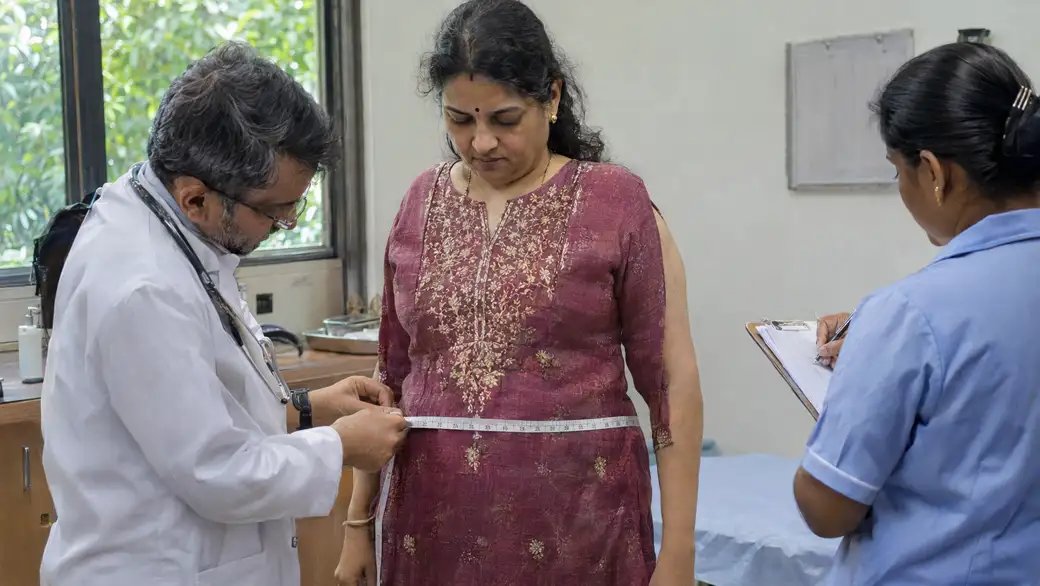
- Stand, breathe out normally, and relax the abdomen.
- Find the lowest rib and the top of the hip bone at your side. Place the tape midway between them, roughly at the level of the navel.
- Keep the tape horizontal and snug, not tight, against bare skin.
- Read the measurement at the end of a normal breath out.
Step 3: Waist-to-height ratio
Divide your waist by your height, in the same units. The simple rule is to keep your waist below half your height.
| Height | Waist at a ratio of 0.5 |
|---|---|
| 150 cm | 75 cm |
| 155 cm | 77.5 cm |
| 160 cm | 80 cm |
| 165 cm | 82.5 cm |
| 170 cm | 85 cm |
| 175 cm | 87.5 cm |
| 180 cm | 90 cm |
Step 4: Function and health
Ask yourself, and your healthcare provider:
- Do I get breathless on stairs or a brisk walk that others my age manage?
- Do my knees, hips or back hurt in a way that limits what I do?
- Do I snore heavily, stop breathing in sleep, or feel sleepy in the day?
- Have I been told I have prediabetes, diabetes, high blood pressure, abnormal lipids, fatty liver, PCOS or gout?
- Do I struggle with everyday tasks such as tying shoelaces, squatting or getting up from the floor?
The first three steps tell you whether excess fat is likely. The fourth is what distinguishes Stage 1 from Stage 2, and it needs a clinical assessment and blood tests to answer properly.
Conditions that count
| System | Obesity-related conditions and limitations |
|---|---|
| Metabolic | Type 2 diabetes, prediabetes, high triglycerides, low HDL cholesterol, gout |
| Heart and vessels | High blood pressure, coronary artery disease, heart failure, stroke |
| Liver | Fatty liver disease, particularly with inflammation or scarring |
| Breathing and sleep | Obstructive sleep apnoea, breathlessness on exertion |
| Joints and movement | Osteoarthritis of the knees and hips, back pain, reduced mobility |
| Reproductive | PCOS with irregular ovulation, infertility, low testosterone in men |
| Kidneys and bladder | Protein in the urine, stress incontinence |
| Digestive | Reflux disease, gallstones |
| Daily function | Difficulty with stairs, walking, squatting, dressing, bathing |
| Mental health | Low mood, anxiety and stigma often accompany obesity and deserve attention |
Worked examples
These invented examples show how the staging works. They are illustrations, not diagnoses.
| Person | BMI | Waist and ratio | Health and function | Likely category |
|---|---|---|---|---|
| Woman, 29, 158 cm, 61 kg | 24.4 | 78 cm; ratio 0.49 | No conditions; active; normal tests | Stage 1 |
| Man, 41, 172 cm, 76 kg | 25.7 | 96 cm; ratio 0.56 | Prediabetes, fatty liver, high triglycerides | Stage 2 |
| Woman, 52, 155 cm, 70 kg | 29.1 | 94 cm; ratio 0.61 | Knee osteoarthritis limiting walking; high blood pressure | Stage 2 |
| Man, 26, 178 cm, 84 kg, trains with weights | 26.5 | 84 cm; ratio 0.47 | Muscular; normal tests; body fat in the healthy range | BMI raised by muscle; excess fat not confirmed |
| Man, 47, 168 cm, 64 kg | 22.7 | 93 cm; ratio 0.55 | Type 2 diabetes, low muscle mass | Below the BMI threshold, but abdominal obesity with disease. Needs the same attention |
The last two rows show the limits of any scheme built on BMI. The muscular man is not unwell. The slim man with a large waist and diabetes is, even though his BMI is “normal”. This is the pattern Indian healthcare professionals see every day, and it is why the waist tape is as important as the weighing scale.

What each stage means for treatment
| Situation | Main aim | What is usually recommended |
|---|---|---|
| BMI below 23, waist normal | Stay there | Healthy eating, regular activity, weight and waist check once a year |
| BMI below 23, waist raised | Reduce abdominal fat; build muscle | Blood tests for sugar, lipids and liver; less refined carbohydrate and sugar; more protein; strength training |
| Stage 1 obesity | Prevent progression to Stage 2 | Structured nutrition plan, 150 minutes or more of activity a week, strength training, sleep, yearly screening. Medication is not usually the first step |
| Stage 2 obesity | Reduce fat and treat its consequences | All of the above, plus assessment for weight loss medication or procedures, and treatment of diabetes, blood pressure and other conditions |
| Stage 2 with higher BMI or severe disease | Substantial, durable weight loss | Medication, a gastric balloon or bariatric surgery may be discussed, with long-term follow-up |
The staging guides the intensity of treatment. It does not by itself decide whether you are prescribed a medicine. Weight loss medicines have their own licensed criteria, usually a BMI of 30 or above, or 27 or above with a weight-related condition, and healthcare professionals apply these with individual judgement for Indian patients, taking the stage into account.
Why this is good news
- Earlier warning. People with a modest BMI but a large waist are no longer falsely reassured.
- Less over-diagnosis. Muscular or healthy people with a higher BMI are not automatically labelled as ill.
- Treatment matched to need. Those whose health is already affected are recognised as having a disease that deserves treatment, not just advice.
- A focus on health, not appearance. The question becomes “is fat harming this person?”, not “how much does this person weigh?”
- Less blame. Calling clinical obesity a disease acknowledges its biological basis.
Criticisms and open questions
The new frameworks have been welcomed, with some reservations.
- They are more complex. BMI takes seconds. Staging needs measurements, history and tests, which is harder in busy centres and large screening programmes.
- “Preclinical” or “Stage 1” may be taken too lightly. It is a state of raised risk, especially for Indians, and should prompt action, not complacency.
- Cut-offs are not universal. Waist thresholds differ between populations and between guidelines.
- Insurance and access. How the categories will affect eligibility for treatment and reimbursement is still being worked out.
- Measurement varies. Waist measurement is less reproducible than weight, and home body-fat scales are imprecise.
- People with normal BMI and abdominal obesity fall outside the stages, though they are at clear risk.
Guidelines evolve. Treat the stages as a framework for a conversation with your healthcare provider, not as a label.
Measuring body fat
| Method | What it does | Strengths and limits |
|---|---|---|
| Waist circumference | Estimates abdominal fat | Free, quick, strongly linked to risk; technique must be consistent |
| Waist-to-height ratio | Adjusts waist for height | One cut-off for everyone; easy to remember |
| Waist-to-hip ratio | Compares abdominal with hip fat | Useful; a little more effort to measure |
| Bioimpedance (body composition scales and analysers) | Estimates fat and muscle from electrical resistance | Convenient; affected by hydration; best for tracking change on the same machine |
| DEXA scan | Measures fat, lean tissue and bone by low-dose X-ray | Accurate; shows regional and visceral fat; costlier |
| Skinfold callipers | Estimates fat under the skin | Cheap; depends heavily on the operator |
| Ultrasound, CT or MRI | Shows liver and visceral fat | Used for specific questions, not routine screening |
As a rough guide, body fat above about 25 percent in men and 32 to 35 percent in women is commonly regarded as excess, though definitions vary with age and method.
Tests worth having if your BMI or waist is raised
- Blood pressure
- Fasting glucose and HbA1c
- Lipid profile
- Liver enzymes, with an ultrasound if they are raised or your waist is large
- Kidney function and a urine test
- Thyroid function
- Uric acid, vitamin D and vitamin B12, as your healthcare provider advises
- A sleep assessment if you snore heavily or are sleepy in the day
- Hormone tests where PCOS is suspected
Many Indians with a modestly raised BMI discover prediabetes or fatty liver through these tests. Finding them is what moves someone from Stage 1 to Stage 2, and what makes treatment worthwhile.
Moving from Stage 2 back towards health
The stages are not permanent. Weight loss of 5 to 10 percent improves blood sugar, blood pressure and liver fat. Losses of 10 to 15 percent or more can put type 2 diabetes into remission in some people, resolve fatty liver inflammation and markedly improve sleep apnoea and joint pain. As conditions resolve and function returns, a person’s situation changes, even if their BMI remains above 23.
| Weight loss | Typical benefits |
|---|---|
| 3 to 5% | Lower blood sugar and triglycerides; liver fat begins to fall |
| 5 to 10% | Lower blood pressure; prediabetes often reverses; better mobility |
| 10 to 15% | Improvement in sleep apnoea, fatty liver inflammation and knee pain; diabetes remission possible in some |
| 15% or more | Greater chance of remission of diabetes; lower cardiovascular risk in those with heart disease |
Everyday steps for Indian households
- Measure waists as well as weights, for every adult in the family, once or twice a year.
- Shift the plate: more dal, pulses, curd, paneer, eggs, fish or chicken and vegetables; smaller portions of rice and roti.
- Cut liquid sugar: sweet tea, soft drinks, packaged juices.
- Build muscle: strength exercise twice a week, at any age. Low muscle is half of the Indian problem.
- Walk daily, including ten minutes after meals.
- Sleep seven to eight hours.
- Screen early: blood sugar, lipids and blood pressure from the age of 30, or 25 if there is a family history of diabetes.
- Start with children: less screen time, more play, fewer packaged snacks.
| Meal | Vegetarian | Non-vegetarian |
|---|---|---|
| Breakfast | 2 besan or moong chillas with curd | 2-egg vegetable omelette, 1 whole wheat toast |
| Lunch | Salad, dal or rajma, sabzi, 1 to 2 phulkas, curd | Salad, fish or chicken curry, sabzi, small katori of rice |
| Evening | Roasted chana or sprouts; tea with little sugar | Boiled egg or roasted chana |
| Dinner | Paneer or tofu with vegetables, 1 phulka | Grilled chicken or fish with vegetables, 1 phulka |
Children, adolescents and older adults
The stages described here are for adults. In children and adolescents, excess weight is assessed with age- and sex-specific growth charts, not adult BMI cut-offs, and by a paediatrician. In adults over 65, a slightly higher BMI is not necessarily harmful, and loss of muscle is often the greater concern. A large waist with weak muscles, sometimes called sarcopenic obesity, carries more risk than either alone, and the priority is to build strength and protect muscle while reducing abdominal fat, not simply to lower the number on the scale. In both groups, the principle of the new frameworks still applies: look at fat distribution, function and health, not weight alone.
Questions to ask your healthcare provider
- What are my BMI, waist and waist-to-height ratio?
- Can my body fat and muscle be measured?
- Do I have any obesity-related condition, and which tests should I have?
- Would you consider me Stage 1 or Stage 2?
- What degree of weight loss would make a difference to my health?
- Is lifestyle change enough for me, or should we discuss medication or other treatment?
- How often should I be reviewed?
Common myths
“My BMI is normal, so I am fine”
Not if your waist is more than half your height. Many Indians with diabetes have a normal BMI.
“My BMI is above 23, so I am diseased”
A raised BMI is a prompt to check your waist, your blood tests and your function. Stage 1 means risk, not illness.
“Stage 1 needs no action”
It is the best time to act, because lifestyle change alone is often enough.
“The new definition is a way to sell more weight loss medicines”
The frameworks reserve active treatment for people whose health is affected and steer others to lifestyle measures.
“Body-fat scales at home give an accurate diagnosis”
They are useful for following trends, not for a precise figure.
“Obesity is only about willpower”
Genes, hormones, sleep, medicines, environment and early life all contribute. Clinical obesity is a disease, and it responds to treatment.
How The Prime Fit assesses you
At The Prime Fit, assessment has always gone beyond BMI. We measure waist, waist-to-height ratio and body composition, take a full history of function and symptoms, and test blood sugar, lipids, liver, kidney and thyroid function. That tells us whether excess fat is affecting your health, and how much. For Stage 1, our dietitians build a programme to prevent progression. For Stage 2, your healthcare provider discusses the full range of treatment alongside nutrition, from medication to a gastric balloon or a surgical opinion.
To find out where you stand, book a consultation or read about our dietitian-led programmes and GLP-1 therapy.
Frequently asked questions
What is the new definition of obesity in India?
Updated guidance published in 2025 treats a BMI above 23 as obesity and divides it into Stage 1, without effects on function or health, and Stage 2, with abdominal obesity plus functional limitation or obesity-related disease.
What is the difference between Stage 1 and Stage 2 obesity?
Stage 1 is excess fat without evident effects on daily activities or organ function. Stage 2 is excess fat, especially around the abdomen, that limits function or is accompanied by conditions such as type 2 diabetes.
What is clinical obesity?
A term from an international commission for obesity that is impairing organ function or daily activities. It is considered a chronic disease. Preclinical obesity is excess fat with preserved function.
Is BMI still used?
Yes, as a screening tool. It should be combined with waist measurement or body fat and an assessment of health.
What BMI is considered obese for Indians?
Indian cut-offs have long been lower than international ones: 23 and above was called overweight and 25 and above obese. The updated guidance treats a BMI above 23 as obesity, staged by its effects.
What waist size is unhealthy?
For Asian Indians, 90 cm or more in men and 80 cm or more in women, or a waist more than half your height.
How do I measure my waist correctly?
Stand relaxed, place the tape midway between your lowest rib and the top of your hip bone, keep it level and snug, and read it after breathing out normally.
I am slim but have a belly. Am I at risk?
Possibly. Abdominal fat with a normal BMI is common in Indians and is linked to diabetes and heart disease. Have your blood sugar, lipids and liver checked.
Does Stage 2 obesity mean I need injections or surgery?
Not automatically. It means your health is affected and more active treatment should be considered. Options range from a structured nutrition programme to medication or procedures, depending on your assessment.
Can Stage 2 obesity be reversed?
Weight loss of 5 to 15 percent or more improves or resolves many associated conditions and restores function.
This article is general information and summarises published guidance in simplified form. Criteria may be refined, and your healthcare provider may apply them differently. It is not a substitute for a medical assessment.