In this article
- Two different risks
- Risk one: the product
- Risk two: the missing assessment
- Eight ways self-treatment goes wrong
- “But my friend did it and was fine”
- Why people do it, and better answers
- The law, in brief
- Online care is not the problem
- How to get treatment online safely
- What a proper programme includes
- If you have already bought or used an unverified product
- If someone you know is using an informal source
- Slimming centres, gyms and wellness centres
- Social media claims, decoded
- A note for parents
- The true cost comparison
- Three illustrative examples
- Questions to ask any provider
- Common myths
- How The Prime Fit keeps treatment safe
- Frequently asked questions
A message arrives on WhatsApp: “Mounjaro available, all doses, no prescription needed, delivery in two days.” A gym trainer mentions that he can arrange pens. A social media page offers a “slimming injection course” with a discount for three months. A friend offers her spare pen because she had side effects.
For someone who has struggled with weight for years, and who has heard how well these medicines work, the temptation is obvious. It seems quicker, cheaper and less embarrassing than seeing a healthcare professional. And the medicine, after all, is the same medicine. Or so it appears.
This guide explains why that reasoning fails, in two separate ways. The first concerns the product. The second, which gets less attention, concerns the missing healthcare professional. It then shows how to obtain treatment online in a way that is safe and legitimate. It is general information, not legal advice.
Two different risks
| Risk | The question | What can go wrong |
|---|---|---|
| The product | Is what is in the pen what the label says, and has it been stored properly? | Counterfeit, contaminated, wrong dose, wrong ingredient, or spoiled by heat |
| The missing assessment | Is this medicine suitable and safe for you, at this dose, with your other medicines? | Contraindications missed, interactions missed, wrong dosing, no monitoring, nobody to call |
Even a perfectly genuine pen, bought from a licensed pharmacy, can cause harm if it is used by the wrong person or in the wrong way. That is why GLP-1 medicines are prescription-only.
Risk one: the product
Drug regulators and the manufacturers have warned repeatedly about falsified and unregulated GLP-1 products. What has been found includes:
- Counterfeit pens made to look like well-known brands, some containing no active ingredient.
- Pens containing insulin relabelled as semaglutide, which have caused severe low blood sugar and hospital admissions.
- Vials of powder or liquid sold as “peptides” or “for research use only”, of unknown purity and sterility, with instructions to mix and draw up doses at home.
- Different chemical forms of the ingredient that have not been tested in people.
- Wrong concentrations, leading to large overdoses.
- Genuine products diverted or stolen, which have been out of the cold chain.
- Products past their expiry date or relabelled.
The cold chain
GLP-1 medicines are proteins. They must be kept at 2°C to 8°C from the factory to your refrigerator. A genuine pen that has spent a summer afternoon in a courier van, or weeks in a seller’s cupboard, may have lost its potency. There is no way to tell by looking. Licensed distributors and pharmacies are required to maintain and document cold storage. Informal sellers are not.
Red flags
- No prescription requested
- Sold through social media, messaging apps, gyms, salons or slimming centres
- No bill, or payment in cash or to a personal account only
- A price far below what pharmacies charge
- No manufacturer’s name, licence details, batch number or expiry on the carton
- Foreign packaging without Indian labelling
- Vials, powders or pre-filled syringes without a brand
- Delivered without insulated cold packaging
- Described as “generic Mounjaro”, “compounded” or “research grade”
- Guarantees of a specific weight loss
Risk two: the missing assessment
Suppose the pen is genuine and has been stored correctly. Here is what a healthcare professional’s assessment would have covered, and what happens when it is skipped.
| What a healthcare professional checks | What can go wrong without it |
|---|---|
| Whether you qualify: BMI, waist, weight-related conditions | People at a healthy weight take a medicine with no proven benefit for them, and lose muscle and bone |
| Family history of medullary thyroid cancer or MEN 2 | A contraindication is missed. Few people know which type of thyroid cancer a relative had |
| Pregnancy, breastfeeding and contraception | The medicine is taken in early pregnancy. Fertility often improves with weight loss, and tirzepatide reduces the reliability of the pill around dose changes |
| Previous pancreatitis, gallstones, stomach disease | A higher risk of serious complications goes unrecognised |
| Diabetes medicines | Insulin or a sulfonylurea is continued at full dose, causing dangerous low blood sugar |
| Diabetic eye disease | Retinopathy worsens as sugar falls quickly, with no eye check |
| Kidney function | Vomiting and dehydration cause kidney injury in someone with reduced function |
| Other medicines | Doses of blood pressure tablets, thyroid tablets, warfarin and others are not adjusted |
| Mental health and eating disorders | Appetite suppression worsens restriction in someone with an eating disorder |
| Baseline blood tests | Undiagnosed diabetes, thyroid disease, anaemia or very high triglycerides are missed |
| Planned surgery or endoscopy | The anaesthetist is not told; food remains in the stomach despite fasting |
| Dose and schedule | Starting too high, increasing too fast, or taking doses too close together |

Eight ways self-treatment goes wrong
1. Starting at the wrong dose
These medicines begin at a low dose, 2.5 mg of tirzepatide or 0.25 mg of semaglutide, and increase every four weeks. People buying informally often get whatever strength is available, or assume that a higher dose will work faster. Starting at a maintenance dose can cause severe vomiting, dehydration and hospital admission.
2. Measuring errors
With vials and syringes, doses are drawn up by volume. Confusing units, millilitres and milligrams has led to people injecting five or ten times the intended dose. Poison centres abroad have reported sharp rises in calls about such errors. With multi-dose pens, guessing doses by “clicks” from online charts carries similar risk.
3. Increasing too fast
Without guidance, people step up as soon as the scale slows, sometimes weekly. Side effects accumulate, eating and drinking become difficult, and treatment is abandoned.
4. Dangerous combinations
A person with diabetes who adds a GLP-1 medicine without reducing insulin or a sulfonylurea risks hypoglycaemia. Some people unknowingly combine two medicines of the same class.
5. No one to recognise a complication
Severe abdominal pain may be pancreatitis or a gallbladder attack. Persistent vomiting may be leading to kidney injury. Someone treating themselves may wait, hoping it will pass, and when they do reach a hospital they may not mention the injection.
6. Losing muscle instead of fat
Without advice on protein and strength training, and without anyone checking how fast weight is falling, a large share of the loss can be muscle. Hair shedding, weakness and nutritional deficiencies follow.
7. Stopping and rebounding
Informal supply is unreliable and expensive in the end. People take the medicine for a few months, run out, regain the weight, and start again at a high dose because that is what they were on before, with severe side effects.
8. Injection and hygiene problems
Nobody demonstrates the device. Needles are reused. Pens are shared between family members or friends, which can transmit blood-borne infections even when the needle is changed. Home-mixed vials can be contaminated.
“But my friend did it and was fine”
Many people who self-treat come to no obvious harm, particularly in the short term. That is how risk works. Most people who drive without a seat belt arrive safely. The assessment exists for the person with the undiagnosed gallstones, the early pregnancy, the sulfonylurea in the medicine cabinet, or the relative with a rare thyroid cancer. Nobody knows in advance whether they are that person. That is precisely what the assessment is for.
There is also harm that is not dramatic: months of treatment at the wrong dose with poor results, muscle lost, money spent, and weight regained.
Why people do it, and better answers
| Reason | A better solution |
|---|---|
| Cost | Tell your healthcare provider that cost matters. Approved generics, the lowest effective dose and different products can reduce it considerably. An unverified product is not a saving |
| Embarrassment about weight | A good centre treats obesity as a medical condition, without judgement. Teleconsultation is an option |
| “The healthcare professional will say I do not qualify” | If you do not qualify, the medicine is unlikely to benefit you and there are other approaches that will |
| Convenience | Legitimate online consultation and pharmacy delivery exist |
| Speed, before a wedding or event | These medicines take months and are intended for long-term use. They are the wrong tool for a deadline |
| A friend’s spare pen | Her dose is not your dose, and the pen should never be shared |
| Distrust of healthcare professionals or tests | Ask what each test is for. A good healthcare professional will explain and will not order what is unnecessary |
The law, in brief
In India, GLP-1 medicines are prescription drugs. A pharmacy, whether physical or online, may dispense them only against a valid prescription from a registered medical practitioner, and must record the sale. Selling them without a prescription, selling unapproved or spurious drugs, and importing medicines for sale without a licence are offences under the drug laws. The buyer has no recourse if something goes wrong, because there is no bill, no batch record and nobody accountable.
Online care is not the problem
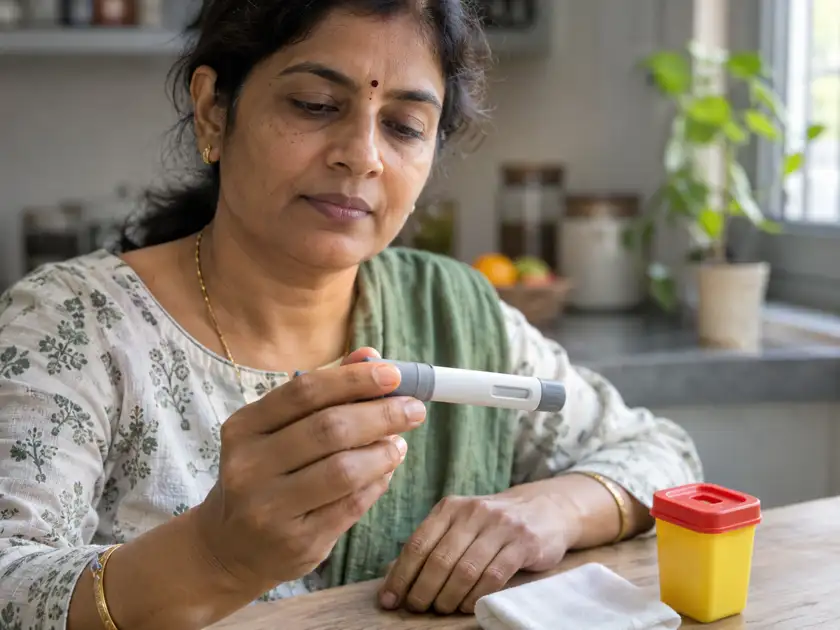
It is important to separate two very different things: buying a prescription medicine online without a prescription, and consulting a healthcare professional online. The second is legitimate, regulated and often very convenient.
Telemedicine guidelines in India allow registered healthcare professionals to consult patients remotely by video, audio or text, and to prescribe within defined limits. A proper teleconsultation for weight treatment involves a real assessment.
| A genuine online service | A seller in disguise |
|---|---|
| You speak to a named, registered healthcare professional whose registration number is shown | You fill in a short form or chat with an anonymous “advisor” |
| The healthcare professional takes a full history, including medicines, family history and pregnancy plans | A few tick-boxes, or no questions at all |
| Height, weight and often blood tests are requested before prescribing | Approval is instant |
| The healthcare professional may say you are not suitable, and offers alternatives | Everyone is approved |
| You receive a signed prescription with the healthcare professional’s details | No prescription, or one you never see |
| The medicine comes from a licensed pharmacy with a bill, batch number and cold packaging | A courier parcel from an individual |
| Follow-up is arranged, with dose changes decided by the healthcare professional | You choose your own dose and reorder |
| You are told what to do in an emergency and whom to contact | No contact after payment |
| A dietitian or structured programme is offered | Only the product is sold |
How to get treatment online safely
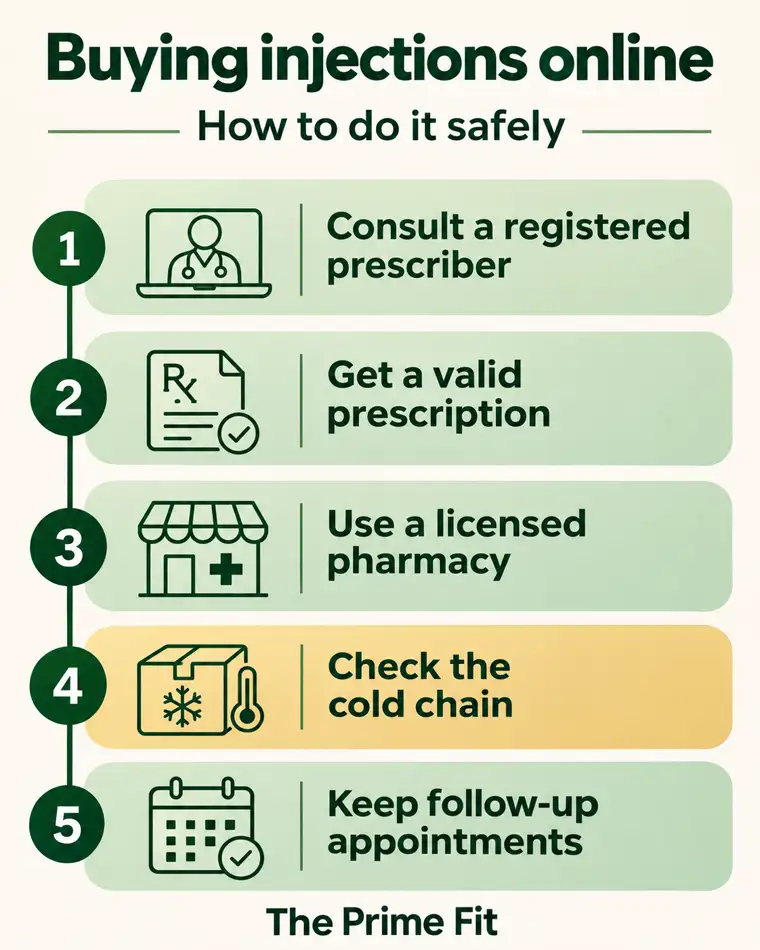
- Choose a centre or platform with named healthcare professionals. Check the healthcare professional’s qualification and registration number with the medical council.
- Expect a proper consultation. Be ready with your weight, height, waist, medical history, medicines and any recent blood tests.
- Do the tests requested. They can usually be done at a local laboratory, often with home collection.
- Ask questions: why this medicine, what dose, what to expect, what it will cost each month.
- Get a signed prescription naming the medicine, strength and dose schedule.
- Buy from a licensed pharmacy. For delivery, use an established one that asks for the prescription and ships in insulated cold packaging.
- Check the pack on arrival: seal, manufacturer, licence details, batch, expiry, temperature. Keep the carton and bill.
- Have the device demonstrated, by video if not in person, before the first dose.
- Keep your follow-up appointments, and do not change the dose between them.
- Know the warning signs and how to reach the team.
What a proper programme includes
| Element | Why it matters |
|---|---|
| Expert-led assessment and prescription | Suitability, contraindications, interactions |
| Baseline blood tests | Hidden conditions; a starting point to measure benefit |
| Stepwise dosing with review before each increase | Fewer side effects; the lowest effective dose |
| Adjustment of other medicines | Prevents low blood sugar and low blood pressure |
| Dietitian support | Protein, fibre, fluids; muscle protection |
| Exercise guidance | Strength and long-term maintenance |
| Access between appointments | Side effects handled early |
| Repeat tests and body measurements | Safety and progress |
| A maintenance plan | Keeping the result |
| Genuine medicine through a documented cold chain | You receive what was prescribed, in working condition |
If you have already bought or used an unverified product
- Stop using it. Do not take another dose.
- Keep everything: the pen or vial, packaging, any messages and payment records.
- See a healthcare professional and say exactly what you took, how much and when. You will not be judged, and the information matters for your care.
- Have basic tests if you have had symptoms: blood sugar, kidney function, and others your healthcare provider advises.
- Watch for warning signs for several days, since these medicines act for a week or more.
- Report the seller to the drug control authorities. It may protect someone else.
- If you want treatment, start again properly, with an assessment. Your healthcare provider will decide the right starting dose.
Go to an emergency department if you have
Sweating, shaking, confusion, drowsiness or fainting, which may indicate low blood sugar; severe or persistent abdominal pain; repeated vomiting and inability to keep fluids down; swelling of the face or throat or difficulty breathing; or redness, swelling, pus or fever at an injection site. Take the product with you.
If someone you know is using an informal source
Lecturing rarely helps. It is more useful to ask whether they have had any blood tests, whether they know what dose they are on, and whether anyone has checked their other medicines. Share the specific risks: counterfeit pens containing insulin, the interaction with the contraceptive pill, the need to tell an anaesthetist. Offer to help them find a healthcare professional. If they develop severe symptoms, make sure the treating healthcare professionals are told about the injection.
Slimming centres, gyms and wellness centres
Some non-medical establishments offer “weight loss injections” as part of a package. Ask who is prescribing. A prescription medicine must be prescribed by a registered healthcare professional who has assessed you, and dispensed by a licensed pharmacy. If the establishment cannot name the healthcare professional, show you the prescription and the product’s carton, and provide a bill, walk away. Be cautious, too, of injections described vaguely as “fat burners” or “lipolytic” shots, which are different products with little evidence behind them.
Social media claims, decoded
| What the post says | What it usually means |
|---|---|
| “No prescription needed” | The seller is not a licensed pharmacy |
| “Same formula as Mounjaro or Ozempic” | Not the approved product. Content unverified |
| “Research grade, 99% pure” | Not made or tested for human use |
| “Compounded” or “custom dose” | Mixed outside the approval system; strength and sterility uncertain |
| “Imported, international quality” | Brought in outside regulated channels; no Indian labelling or cold-chain record |
| “Lose 10 kg in a month, guaranteed” | No legitimate medicine can promise this, and such a pace would be unsafe |
| “Healthcare professional approved” with no healthcare professional named | No healthcare professional has assessed you |
| “Limited stock, pay now” | Pressure selling. A centre does not sell this way |
| Before-and-after photographs | Cannot be verified, and say nothing about what the person took or what happened later |
A note for parents
Teenagers and young adults see these products promoted constantly, and some obtain them through friends or online sellers. Appetite-suppressing medicines are particularly risky at this age, when the body is still growing and eating disorders most often begin. If you find a pen or vial, or notice rapid weight loss, skipped meals, vomiting or secrecy around food, start with a calm conversation and see a healthcare professional together. Treatment of excess weight in adolescents is a specialist matter and should never be self-directed.
The true cost comparison
| Informal source | Expert-led treatment | |
|---|---|---|
| Price of the pen | May look lower | Pharmacy price; approved lower-cost options can be chosen |
| Certainty about contents | None | Regulated product with batch record |
| Right dose for you | Guesswork | Individualised; often a lower dose is enough |
| Wasted months | Common | Progress reviewed and corrected |
| Cost of complications | Yours alone | Risk reduced; problems caught early |
| Savings on other medicines | None planned | Blood pressure and diabetes medicines often reduced |
| Result after a year | Often regain after an interrupted course | Sustained loss with a maintenance plan |
Three illustrative examples
These invented examples are based on the kinds of problems that have been reported. They are not accounts of real individuals.
The sulfonylurea nobody asked about
A 54-year-old man with diabetes buys pens through an acquaintance and continues his usual tablets. In the third week he becomes confused and sweaty at work with a very low blood sugar. In hospital, his glimepiride is identified as the cause in combination with the injection. Properly supervised, with the tablet stopped, he later does well.
The dose from a chart
A 31-year-old woman orders a vial labelled as a peptide and follows a dosing chart from an online forum. A unit conversion error leads her to inject many times the intended amount. She vomits for two days and needs intravenous fluids.
Doing it properly online
A 40-year-old woman in a small town has a video consultation with a registered healthcare professional, has blood tests collected at home, and is found to have prediabetes and fatty liver. She receives a prescription, the medicine arrives cold from a licensed pharmacy, a nurse demonstrates the pen by video, and a dietitian calls weekly. A year later she has lost 13 kg and her tests are normal.
Questions to ask any provider
- Who is the healthcare professional, and what is their registration number?
- What assessment and tests will I have before treatment?
- Will I receive a written prescription?
- Which pharmacy supplies the medicine, and how is it kept cold?
- Who decides my dose, and how often will I be reviewed?
- Whom do I contact if I have a problem?
- What support is there for diet and exercise?
- What happens if the medicine is not suitable for me?
Common myths
“The medicine is the same, so the source does not matter”
Without a licensed supply chain, there is no assurance that it is the same, or that it has been stored properly.
“A healthcare professional only adds cost”
The assessment is what prevents the serious harms, and often finds a lower dose or cheaper product that works.
“These are just slimming injections, not real medicines”
They are potent prescription drugs that affect blood sugar, the gut, the gallbladder and other medicines.
“Online consultation is not proper medical care”
A genuine teleconsultation with a registered healthcare professional is legitimate. Buying without a prescription is not.
“If it came in a branded box, it is genuine”
Packaging is easily copied.
“I can use my relative’s leftover pen”
Pens must never be shared, and the dose may be wrong for you.
How The Prime Fit keeps treatment safe
At The Prime Fit, treatment begins with a healthcare professional, in person or by teleconsultation, and never with a sale. You are assessed, tested and told honestly whether medication is suitable. If it is, you receive a written prescription, guidance to licensed pharmacies with proper cold storage, a demonstration of your device, a dietitian, and a team you can reach between appointments. If it is not, we plan an alternative that will help.
To start safely, book a consultation or read about our GLP-1 therapy programme.
Frequently asked questions
Can I buy Mounjaro, Wegovy or Ozempic without a prescription?
No. They are prescription medicines. A licensed pharmacy will ask for a valid prescription. Anyone selling without one is operating outside the law.
Is it safe to buy weight loss injections online?
It is safe when you have a prescription from a registered healthcare professional and buy from a licensed pharmacy that delivers with cold packaging. Buying from social media or informal sellers is not safe.
What are the risks of using them without a healthcare professional?
Counterfeit or spoiled products, missed contraindications, dangerous interactions with diabetes medicines, wrong dosing, unrecognised complications, muscle loss and no follow-up.
Are online consultations for weight loss legitimate?
Yes, when a named, registered healthcare professional takes a full history, arranges tests, issues a signed prescription and provides follow-up.
How do I know a seller is not genuine?
No prescription asked for, no bill, very low prices, sales through messaging apps or gyms, vials or powders, missing manufacturer details and no cold packaging are all warning signs.
Can I use a friend’s or relative’s pen?
No. Pens must not be shared because of infection risk, and the dose may be unsuitable for you.
What are “research peptides”?
Unapproved substances sold in vials, not intended for human use, with no assurance of content, purity or sterility. They should not be injected.
I already bought a pen online. What should I do?
Do not use it. Keep the packaging, see a healthcare professional, and report the seller. If you have used it and feel unwell, seek medical care and take the product with you.
Why do I need blood tests first?
They reveal conditions that affect safety and dosing, such as diabetes, kidney disease, thyroid problems and high triglycerides, and give a baseline to measure benefit.
Is expert-led treatment more expensive?
Not necessarily. Healthcare professionals can choose lower-cost approved products and the lowest effective dose, reduce other medicines, and prevent costly complications and wasted months.
This article is general information and is not legal or medical advice. Rules on prescribing and dispensing are set by the relevant authorities and may change. Always obtain prescription medicines through a registered healthcare professional and a licensed pharmacy.