In this article
- Why a diabetes medicine treats weight
- Obesity is a medical condition in its own right
- Who qualifies without diabetes
- Which medicines are for whom
- Results in people without diabetes
- What happens to blood sugar if you are not diabetic?
- Prediabetes: a strong reason to treat
- Safety without diabetes
- Who does not qualify
- What the assessment involves
- Monitoring during treatment
- Eating and exercise matter more, not less
- How long will treatment last?
- Cost and insurance
- The “taking medicine from diabetics” concern
- What to expect in the first three months
- Women without diabetes
- If you have a family history of diabetes
- Three illustrative examples
- Questions to ask your healthcare provider
- Common myths
- How The Prime Fit assesses people without diabetes
- Frequently asked questions
“But I don’t have diabetes.” Healthcare professionals hear this often when they suggest a GLP-1 medicine to a patient with excess weight. The reaction is understandable. These medicines became known as diabetes injections, the name Ozempic is associated with blood sugar, and people worry that a diabetes drug will push their sugar too low or that they are taking something meant for others.
The facts are different. Semaglutide, as Wegovy, and tirzepatide, as Mounjaro, have been tested in large trials of people without diabetes and are licensed for weight management in them. Weight loss is actually greater in people without diabetes than in those with it. And the risk of low blood sugar, without other diabetes medicines, is very small.
At the same time, “you do not need diabetes” does not mean “anyone can take them”. There are clear medical criteria. This guide explains who qualifies and who does not. It is general information, and only a healthcare professional who has assessed you can decide whether treatment is right for you.
Why a diabetes medicine treats weight
GLP-1 is a gut hormone with several actions. It helps the pancreas release insulin when blood sugar is raised, which is why GLP-1 medicines were first developed for type 2 diabetes. It also acts on the brain to produce fullness and reduce cravings, and slows the emptying of the stomach.
In the diabetes trials, researchers noticed that participants were losing weight. The appetite effect turned out to be independent of diabetes: it occurs in anyone. Separate trials were then run in people with obesity who did not have diabetes, using higher doses and measuring weight as the main outcome. Those trials led to approval for weight management.
The key idea
The same hormone signal does two jobs. In diabetes, the blood sugar effect is the main purpose. In obesity, the appetite effect is. Having one condition is not required to benefit from treatment of the other.
Obesity is a medical condition in its own right
For a long time, excess weight was treated as a lifestyle matter that became medical only when it caused diabetes or heart disease. That view has changed. Obesity is now recognised as a chronic disease, with biological drivers in genes, hormones and the brain’s regulation of appetite, and with consequences for almost every organ.
Waiting for diabetes to appear before treating weight makes little sense, in the same way that one would not wait for a stroke before treating high blood pressure. Treating excess weight earlier prevents diabetes and other complications from developing.
Who qualifies without diabetes
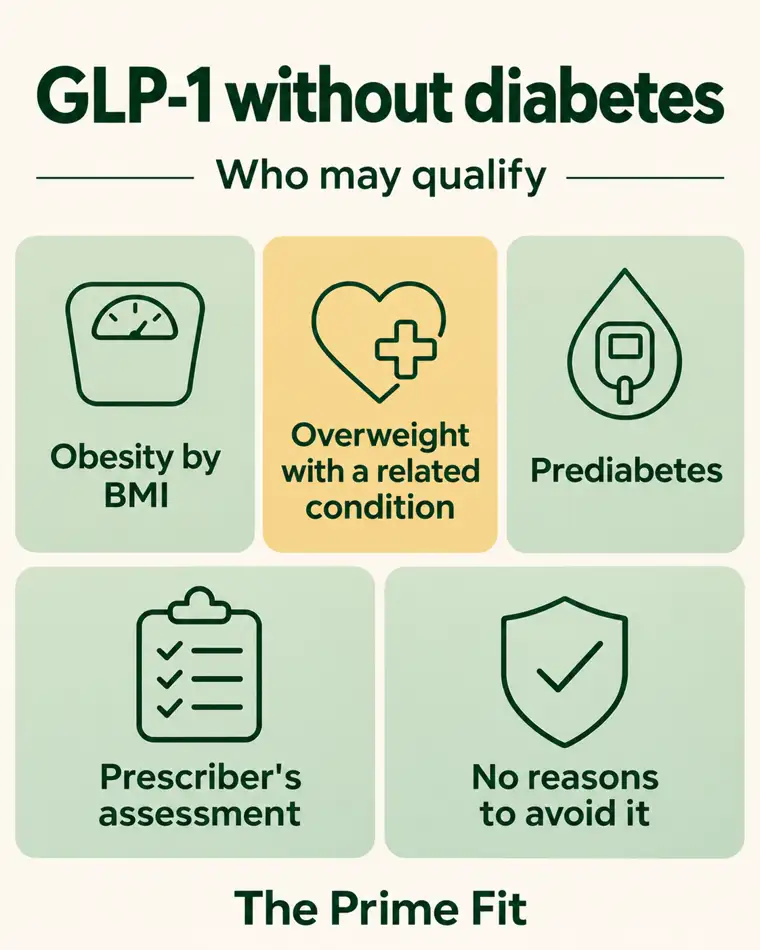
The licensed criteria for weight management are based on BMI and on weight-related health conditions.
| Category | BMI | Additional requirement |
|---|---|---|
| Obesity | 30 or above | None |
| Overweight with a related condition | 27 to 29.9 | At least one weight-related health problem |
Treatment is used alongside a reduced-calorie diet and increased physical activity. For Asian Indians, health risks begin at lower BMI values, with overweight defined from 23 and obesity from 25, and at a waist of 90 cm in men and 80 cm in women. Healthcare professionals therefore assess Indian patients individually.
Weight-related conditions that count
- Prediabetes
- High blood pressure
- Abnormal cholesterol or triglycerides
- Obstructive sleep apnoea
- Cardiovascular disease
- Fatty liver disease related to metabolism
- Polycystic ovary syndrome with insulin resistance
- Osteoarthritis of weight-bearing joints
Type 2 diabetes is on the list of qualifying conditions, but it is only one of several. A person with a BMI of 28 and sleep apnoea qualifies just as a person with a BMI of 28 and diabetes does.
Which medicines are for whom
| Medicine | Licensed for people without diabetes? | Notes |
|---|---|---|
| Wegovy (semaglutide 2.4 mg) | Yes, for weight management | Also licensed to reduce cardiovascular events in people with overweight or obesity and heart disease |
| Mounjaro (tirzepatide) | Yes, for weight management | Also licensed for type 2 diabetes, at the same doses |
| Liraglutide 3 mg (daily) | Yes, for weight management | Older medicine; smaller average weight loss |
| Ozempic (semaglutide up to 1 or 2 mg) | No. Licensed for type 2 diabetes | Use purely for weight loss is off-label |
| Rybelsus (semaglutide tablet) | No. Licensed for type 2 diabetes | Higher-dose tablets for weight are approved in some countries |
Licensed uses vary between countries and change over time. If you do not have diabetes, your healthcare provider will choose a product approved for weight management.
Results in people without diabetes
The headline results of these medicines come from trials in people without diabetes.
| Medicine | Average weight loss without diabetes | Average weight loss with type 2 diabetes |
|---|---|---|
| Semaglutide 2.4 mg, 68 weeks | About 15% | About 10% |
| Tirzepatide 10 to 15 mg, 72 weeks | About 20 to 21% | About 13 to 15% |
People without diabetes lose roughly a third more. The likely reasons are that they are not taking other medicines that promote weight gain, they do not retain calories previously lost as sugar in the urine, and they tend to be less insulin resistant.
What else improves
| Measure | Typical change in trials of people without diabetes |
|---|---|
| Waist circumference | Reduced by about 13 to 18 cm |
| Systolic blood pressure | Lower by about 5 to 7 mmHg |
| Triglycerides | Lower by about 15 to 25% |
| Blood sugar in those with prediabetes | Returned to normal in a large majority |
| Progression to type 2 diabetes | Greatly reduced; by more than 90% over three years in one tirzepatide study |
| Markers of inflammation | Substantially lower |
| Liver fat and enzymes | Reduced |
| Sleep apnoea | Breathing interruptions roughly halved with tirzepatide |
| Knee osteoarthritis pain | Clearly reduced with semaglutide |
| Heart attack and stroke, in those with existing heart disease | About 20% fewer with semaglutide |
| Physical function and quality of life | Improved |
What happens to blood sugar if you are not diabetic?
This is the commonest worry, and the answer is reassuring.
GLP-1 medicines increase insulin release only when blood sugar is above normal. When sugar is in the normal range, that action switches off. They are “glucose-dependent”. In the weight-management trials of people without diabetes, clinically significant low blood sugar was rare and occurred at a similar rate to placebo.
| If you have | What to expect |
|---|---|
| Normal blood sugar | It stays normal. HbA1c may fall slightly within the normal range |
| Prediabetes | Fasting glucose and HbA1c usually fall, often back into the normal range |
| Type 2 diabetes | A substantial fall. Insulin and sulfonylurea doses need reducing to avoid low blood sugar |
Symptoms that feel like low sugar
Some people without diabetes report shakiness, light-headedness, headache or tiredness, particularly in the first weeks. These are usually caused by eating too little, going many hours without food, dehydration, or blood pressure running lower than before. True low blood sugar is uncommon. The remedy is regular small meals with protein and some whole-grain carbohydrate, and enough fluid. If such symptoms are frequent or severe, tell your healthcare provider, who may check your sugar during an episode.
People without diabetes do not need to monitor their blood sugar at home during treatment unless their healthcare provider advises it.
Prediabetes: a strong reason to treat
Prediabetes means blood sugar is above normal but below the threshold for diabetes: a fasting glucose of 100 to 125 mg/dL or an HbA1c of 5.7 to 6.4 percent. India has an estimated 136 million people with prediabetes, and Indians progress to diabetes faster than many other populations.
Weight loss is the most effective way to reverse it. In trials of people with obesity and prediabetes, a large majority on semaglutide or tirzepatide returned to normal blood sugar, and far fewer developed diabetes than on placebo. For a person with excess weight and prediabetes, this may be the single most valuable effect of treatment.
No GLP-1 medicine is licensed for prediabetes by itself. Eligibility comes through weight: prediabetes counts as a weight-related condition for those with a BMI of 27 or above.
Safety without diabetes
The side effects are the same as in people with diabetes, with two differences in emphasis.
| Issue | In people without diabetes |
|---|---|
| Nausea, vomiting, diarrhoea, constipation | The same; most common around dose increases |
| Low blood sugar | Rare, since no insulin or sulfonylureas are being taken |
| Diabetic eye disease | Not relevant |
| Gallstones | Somewhat more likely, because weight loss is larger and faster |
| Loss of muscle, hair shedding | More of a concern with larger weight loss; protein and strength training matter |
| Pancreatitis | Rare, as in diabetes |
| Thyroid C-cell tumour warning | The same contraindication applies |
| Contraceptive pill with tirzepatide | The same precaution applies |
| Pregnancy | Not used; stop in advance |
The medicines must not be used by anyone with a personal or family history of medullary thyroid carcinoma or MEN 2, or during pregnancy and breastfeeding, and are generally avoided after pancreatitis.
Seek medical help urgently if you have
Severe or persistent abdominal pain; repeated vomiting and cannot keep fluids down; yellowing of the eyes; or swelling of the face or throat or difficulty breathing.
Who does not qualify
- People at a healthy weight. With a BMI below the thresholds and no weight-related condition, the benefits shown in trials do not apply, and the risks of side effects, muscle loss and under-nutrition remain.
- People who want to lose a few kilograms for an event. The medicines are designed for long-term use, and weight returns after stopping.
- Women who are pregnant, breastfeeding or trying to conceive.
- Anyone with a contraindication, as above.
- People with an active eating disorder.
- Children and adolescents, outside specialist care.
Why not for cosmetic weight loss?
It is fair to ask why a slim person should not use a medicine that helps them stay slim. The answer lies in the balance of benefit and harm. In someone with obesity, a 15 to 20 percent weight loss lowers the risk of diabetes, heart disease and other conditions, and that benefit outweighs the side effects. In someone at a healthy weight there is no such health gain to set against nausea, loss of muscle and bone, nutritional deficiencies, gallstones and the cost and commitment of indefinite treatment. Their use in this way has also contributed to shortages for patients who need them.
What the assessment involves
- History: weight over the years, previous attempts, eating patterns, sleep, activity, medical conditions, family history, medicines, contraception and pregnancy plans.
- Measurements: height, weight, BMI, waist, blood pressure; body composition where available.
- Blood tests: fasting glucose and HbA1c, which sometimes reveal prediabetes or undiagnosed diabetes; lipids; liver and kidney function; thyroid function; blood count; vitamin B12, vitamin D and iron.
- Other tests if indicated: ultrasound for fatty liver or gallstones; a sleep study; hormone tests for PCOS.
- Discussion: options, expected results, side effects, cost and the long-term nature of treatment.
Many people who believe they have no medical problems discover at this stage that they have prediabetes, a fatty liver or high triglycerides. Among Indians with excess weight, such findings are the rule more than the exception.
Monitoring during treatment
| Check | How often | Why |
|---|---|---|
| Weight, waist, blood pressure | Every visit | Response; need to reduce blood pressure tablets |
| Side effects, eating pattern, protein intake | Every visit | To pace dose increases and protect muscle |
| Fasting glucose or HbA1c | At 3 to 6 months if raised at the start; then yearly | To confirm prediabetes is reversing |
| Lipids and liver enzymes | At 6 to 12 months | To track benefit |
| Kidney function | Yearly, or after significant vomiting or diarrhoea | Hydration and safety |
| Vitamins and iron | If symptoms arise, or yearly | Low intake |
| Body composition | Every few months where available | To confirm fat loss and muscle preservation |
Home blood sugar testing and eye screening, which matter in diabetes, are not routinely needed.
Eating and exercise matter more, not less
Because people without diabetes lose more weight, they have more muscle at stake. The essentials are:
- Protein at every meal: dal, chana, rajma, paneer, curd, soya, eggs, fish or chicken. Many adults are advised about 1.0 to 1.5 grams per kilogram of body weight a day.
- Three small meals, eaten slowly, without long gaps.
- Vegetables and fibre at lunch and dinner; whole fruit.
- Two to three litres of fluid a day.
- Strength training two to three times a week, plus daily walking.
- A steady pace: about 0.5 to 1 kg a week.
| Meal | Vegetarian | Non-vegetarian |
|---|---|---|
| Breakfast | 2 moong chillas with paneer, curd | 2-egg vegetable omelette, 1 whole wheat toast |
| Mid-morning | 1 fruit; a few almonds | 1 fruit; chaas |
| Lunch | Dal or chana, sabzi, salad, 1 roti, curd | Fish or chicken curry, sabzi, salad, small katori of rice |
| Evening | Roasted chana or sprouts chaat | Boiled egg or roasted chana |
| Dinner | Paneer or tofu with vegetables, dal, 1 phulka | Grilled chicken or fish with vegetables, dal, 1 phulka |
How long will treatment last?
Obesity is a long-term condition, and weight tends to return when these medicines are stopped. In trials, people who stopped semaglutide regained about two-thirds of their lost weight within a year, and blood sugar, blood pressure and other improvements faded with it. Most people therefore continue, often at the lowest effective dose, with regular review. This is true whether or not you have diabetes.
Cost and insurance
Treatment for weight management is often paid for by the patient, and insurance cover varies between policies and is sometimes more limited when the indication is obesity than when it is diabetes. Ask your insurer, and ask your healthcare provider about the monthly cost at your likely maintenance dose and about approved, more affordable products. Do not use a diabetes-dose product in an improvised way, and do not buy from unverified sources, to save money.
The “taking medicine from diabetics” concern
During periods of shortage in several countries, there was understandable concern that people using diabetes-licensed products for weight loss were depriving patients with diabetes. Regulators asked that those products be reserved for diabetes. That concern is about misdirected supply and cosmetic use. It is not an argument that people with obesity should go untreated. Obesity is a disease with serious consequences, and the appropriate response is to treat it with the products licensed for it.
What to expect in the first three months
| Period | What usually happens | What to do |
|---|---|---|
| Weeks 1 to 4 | Starting dose. Appetite begins to fall; weight may change little. Mild nausea in some | Small meals, protein first, water target, daily walk |
| Weeks 5 to 8 | First treatment dose. Clearer appetite control; steady weight loss begins | Start strength training. Add fibre to prevent constipation |
| Weeks 9 to 12 | Dose stepped up if needed and tolerated. Clothes looser | Check protein intake. Report dizziness, since blood pressure tablets may need reducing |
| Month 3 | About 5 to 8% of body weight lost on average | Review with your healthcare provider. Repeat blood sugar tests if they were raised at the start |
At no point should you need to treat low blood sugar. If you feel shaky or faint, eat something, drink water, and tell your team so that your eating pattern can be reviewed.
Women without diabetes
A large share of people treated for weight without diabetes are women of reproductive age, many with PCOS. Three points deserve attention. First, fertility often improves quickly as weight falls, even after years of irregular cycles, so reliable contraception is needed from the first dose. Second, tirzepatide can reduce the absorption of the oral contraceptive pill when it is started and after each dose increase, so a barrier method should be added for four weeks at those times, or a non-oral method used. Third, treatment must be stopped before a planned pregnancy, usually at least two months ahead for semaglutide and one month for tirzepatide. Women who have had gestational diabetes are at high risk of type 2 diabetes later, and weight loss between pregnancies is one of the most effective ways to reduce that risk.

If you have a family history of diabetes
A parent or sibling with type 2 diabetes roughly doubles to triples your own risk, and for Indians the risk begins at lower weights. A family history does not by itself qualify you for medication, but it is a strong reason to be assessed. If you also have excess weight, particularly around the waist, check your fasting glucose and HbA1c. Finding prediabetes changes the picture, and reversing it through weight loss is one of the best-proven ways to avoid following the family pattern.
Three illustrative examples
These invented examples show how eligibility is decided. They are not recommendations for any individual.
Obesity with no known medical problems
A 33-year-old woman has a BMI of 33 and feels well. Tests show prediabetes, raised triglycerides and a fatty liver, none of which she knew about. She qualifies, starts treatment with reliable contraception, loses 15 kg in a year, and all three results return to normal. Her blood sugar never falls too low.
Overweight with sleep apnoea
A 47-year-old man has a BMI of 28.5, a waist of 104 cm, moderate sleep apnoea and high blood pressure. His blood sugar is normal. He qualifies on the basis of his BMI and related conditions. After 14 months his breathing at night has improved and his blood pressure tablet has been halved.
Healthy weight, wants to slim down
A 29-year-old woman with a BMI of 23.5 and normal tests asks for an injection to lose 5 kg before her wedding. Her healthcare provider explains that it is not indicated and that the weight would return after stopping. A dietitian-led plan with strength training takes 4 kg off in three months.
Questions to ask your healthcare provider
- Do I meet the criteria for weight management treatment?
- Do my tests show prediabetes or any other weight-related condition?
- Which medicine licensed for weight management suits me?
- Do I need to check my blood sugar at home?
- What results can I realistically expect?
- How long would I need treatment, and what would it cost each month?
- If I do not qualify, what do you recommend instead?
Common myths
“These injections are only for diabetics”
Wegovy and Mounjaro are licensed for weight management in people without diabetes.
“They will make my blood sugar dangerously low”
Their effect on insulin switches off when sugar is normal. Low blood sugar is rare without other diabetes medicines.
“If I am not diabetic, they will work less well”
The opposite. People without diabetes lose more weight on average.
“Taking them will give me diabetes later”
They greatly reduce the chance of developing diabetes.
“Anyone can take them to slim down”
They are for people who meet medical criteria.
“Ozempic is the right choice for weight loss”
Ozempic is licensed for diabetes. The licensed options for weight management are different products.
How The Prime Fit assesses people without diabetes
At The Prime Fit, eligibility is based on a proper assessment, not on a label. We measure BMI, waist and body composition, test blood sugar, lipids, liver, kidney and thyroid function, and often uncover prediabetes or fatty liver that had gone unnoticed. If you qualify, your healthcare provider prescribes a medicine licensed for weight management and a dietitian supports you every week. If you do not, we tell you so and offer a nutrition programme that fits your goal.
To find out where you stand, book a consultation or read about our GLP-1 therapy programme.
Frequently asked questions
Can I take Mounjaro or Wegovy if I do not have diabetes?
Yes, if you meet the criteria for weight management: a BMI of 30 or above, or 27 or above with a weight-related condition, after a medical assessment.
Will a GLP-1 medicine cause low blood sugar if I am not diabetic?
Rarely. These medicines boost insulin only when blood sugar is raised. Shakiness or dizziness is more often due to eating too little or dehydration.
Do they work as well without diabetes?
Better, on average. People without diabetes lost about 15 percent with semaglutide and about 20 percent with tirzepatide, compared with 10 to 15 percent in those with diabetes.
Can I use Ozempic for weight loss without diabetes?
Ozempic is licensed for type 2 diabetes. For weight management, the licensed products are Wegovy and Mounjaro.
I have prediabetes. Do I qualify?
Prediabetes counts as a weight-related condition, so you qualify if your BMI is 27 or above. Weight loss often returns blood sugar to normal.
Do I need to check my blood sugar at home?
Not usually, unless your healthcare provider advises it.
Is it safe to take a diabetes medicine when I am not diabetic?
These medicines have been studied in large trials of people without diabetes and are licensed for them. The usual side effects and precautions apply.
Can I take them if my weight is normal?
No. They are not indicated for people at a healthy weight.
Will they prevent me from getting diabetes?
In people with obesity and prediabetes, they greatly reduce progression to diabetes for as long as the weight loss is maintained.
Will insurance cover treatment without diabetes?
It varies by policy. Check with your insurer.
This article is general information and is not a substitute for a consultation. Trial figures are approximate. Licensed uses vary by country and change over time.