In this article
- What is a continuous glucose monitor?
- What does normal glucose look like on a CGM?
- Can a CGM diagnose prediabetes or diabetes?
- Do continuous glucose monitors help weight loss without diabetes?
- What does the research on “personalised” glucose responses show?
- Who might genuinely benefit from a CGM?
- What are the downsides of wearing a CGM without diabetes?
- What flattens glucose curves and also helps weight?
- Indian meal swaps that a CGM usually confirms
- If you still want to try one: how to do it sensibly
- CGMs and GLP-1 medicines
- Common myths about CGMs and weight loss
- Who should see a healthcare professional, and when is it urgent?
- Questions to ask your healthcare provider
- How The Prime Fit helps
- Frequently asked questions
Continuous glucose monitors for weight loss without diabetes are one of the most visible health trends of the last few years. A small sensor on the arm, a graph on the phone, and a promise: learn which foods “spike” you, avoid them, and the weight will come off. If you are wondering whether one is worth buying, the short answer is this. There is no good evidence that wearing a continuous glucose monitor (CGM) leads to weight loss in people who do not have diabetes. For most people the money and effort are better spent elsewhere.
That does not make the device useless. A CGM is an excellent medical tool for people with diabetes, especially those on insulin. For a person without diabetes, a short period of wear, with someone qualified to interpret it, can occasionally be a helpful lesson in how meals, sleep and walking affect blood sugar. The problems begin when normal readings are treated as a disease, or when a glucose graph replaces the basics of eating and activity.
This guide explains what a CGM measures, what is normal, what research does and does not show, who might benefit, and what tends to work better for Indian diets. It is general information, not personal medical advice.
What is a continuous glucose monitor?
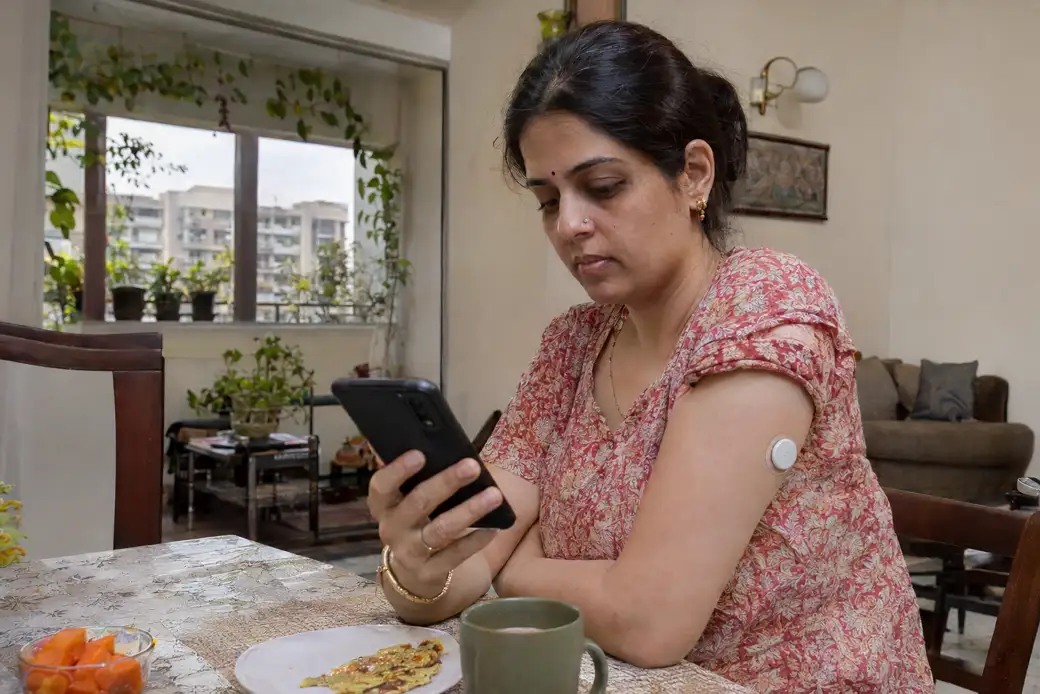
A CGM is a small sensor, usually worn on the back of the upper arm, with a fine filament that sits just under the skin. It does not measure blood glucose directly. It measures glucose in the fluid between your cells (interstitial fluid) every few minutes and sends the readings to a phone or reader. Most sensors are worn for about 10 to 15 days and then replaced.
Because the sensor reads tissue fluid rather than blood, its readings lag a little behind a finger-prick test, typically by several minutes. The gap is widest when glucose is changing quickly, such as just after a meal or during exercise. Accuracy also tends to be lower on the first day of wear and at the low end of the range.
What does normal glucose look like on a CGM?
Many people without diabetes are surprised by their first graph, because glucose is not a flat line. It rises after meals and settles again, dips a little during sleep, and can climb in the early morning or during hard exercise and stress. All of that is normal physiology.
In studies of healthy adults wearing sensors, glucose stayed between about 70 and 140 mg/dL for the large majority of the day. Brief rises above 140 mg/dL after a carbohydrate-rich meal were seen even in people with entirely normal tests. A single peak after a plate of rice or a festival sweet does not mean you have prediabetes.
| What you may see | Likely explanation | Usually a concern? |
|---|---|---|
| Rise after a meal that settles within 2 to 3 hours | Normal digestion and insulin response | No |
| Occasional peak above 140 mg/dL after a large carbohydrate meal | Seen in healthy people too | Not by itself |
| Apparent “low” in the night that recovers when you turn over | Pressure on the sensor from lying on that arm | Usually a false reading |
| Readings that stay high for many hours, or high fasting values on most mornings | Possible prediabetes or diabetes | Yes: get a laboratory test |
Can a CGM diagnose prediabetes or diabetes?
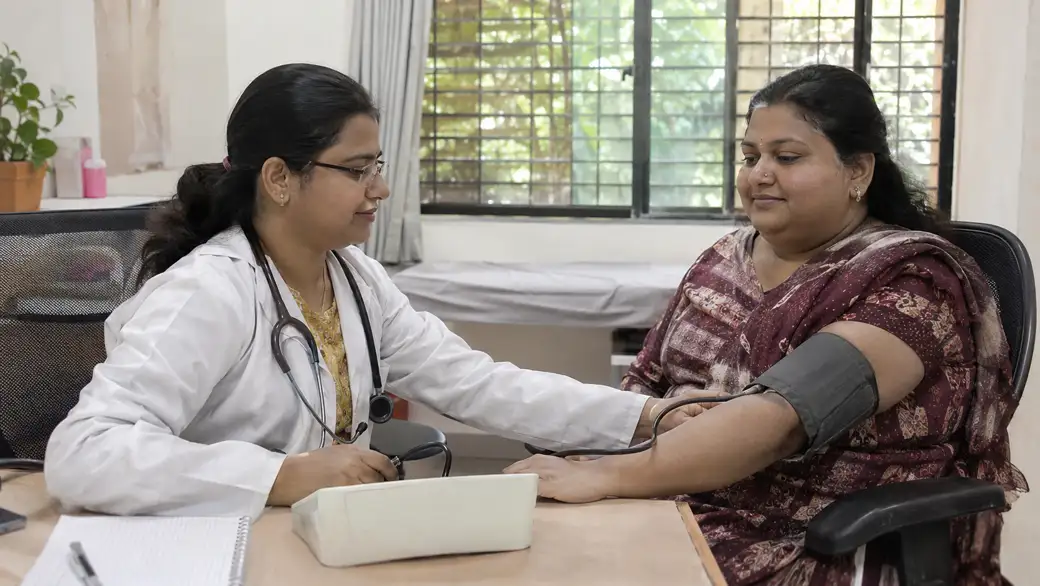
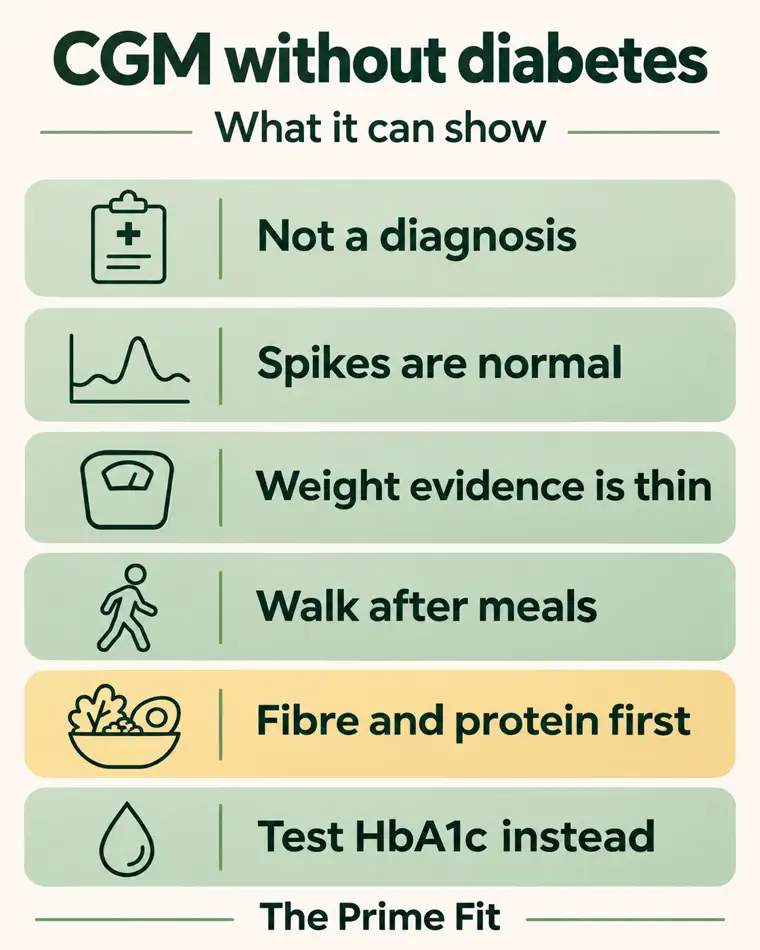
No. Diabetes and prediabetes are diagnosed with laboratory blood tests, not with a sensor. If your aim is to know where you stand, a fasting glucose and HbA1c are cheaper, more accurate for this purpose and recognised by every healthcare professional.
| Test | Normal | Prediabetes | Diabetes |
|---|---|---|---|
| Fasting plasma glucose | Below 100 mg/dL | 100 to 125 mg/dL | 126 mg/dL or above |
| HbA1c | Below 5.7% | 5.7 to 6.4% | 6.5% or above |
| 2 hours after a 75 g glucose drink | Below 140 mg/dL | 140 to 199 mg/dL | 200 mg/dL or above |
These are the commonly used cut-offs. A diagnosis normally needs a confirmed result and a healthcare professional’s interpretation, because anaemia, some haemoglobin variants and recent illness can affect HbA1c. This matters in India, where both anaemia and diabetes are common. Large national surveys suggest roughly 11% of Indian adults have diabetes and about 15% have prediabetes, often at a lower body weight than in Western populations. Testing is worthwhile. A sensor is simply not the right test. Our guide to blood tests before starting treatment explains what is usually checked.
Do continuous glucose monitors help weight loss without diabetes?
This is the central question, and the honest answer is that we do not have good evidence that they do. Studies of CGM use in people without diabetes are few, small and short. They have not shown consistent weight loss from wearing a sensor compared with ordinary diet advice. Where programmes that include a CGM report weight loss, the sensor usually comes bundled with coaching, calorie awareness and regular follow-up, so it is impossible to say what the sensor itself contributed.
The idea behind the trend is that glucose spikes cause insulin surges, and insulin drives fat storage. Parts of this are true: insulin does help store energy. But body fat changes with overall energy balance over weeks and months, not with the height of a single curve. Foods that barely move glucose, such as ghee, cheese, nuts, fried snacks and alcohol, can still add a large number of calories. A person who chases flat lines by swapping roti for paneer tikka in butter may see a beautiful graph and gain weight.
What does the research on “personalised” glucose responses show?
Research has shown that different people can have quite different glucose responses to the same food. One person may rise sharply after a banana and modestly after rice, while another shows the opposite.
What is less often mentioned is how variable the readings are within one person. The same meal eaten on different days can produce different curves, depending on sleep, stress, the previous meal, the time of day and activity. Studies in which volunteers wore two sensors at once found that the two devices sometimes disagreed about how the person responded to the same meal. So a single “spike” after one food on one day is weak evidence that the food is bad for you.
Most importantly, we do not yet have long-term trials showing that tailoring a diet to a personal glucose graph produces more weight loss, or better health, than a well-planned standard diet in people without diabetes.
Who might genuinely benefit from a CGM?
- People with type 1 diabetes, or type 2 diabetes on insulin. This is the group with the strongest evidence.
- Other people with type 2 diabetes, where a healthcare professional recommends it to guide food and medicine changes.
- Women with diabetes in pregnancy, if their obstetric or diabetes team advises it.
- People with suspected low sugars after meals, including some people after bariatric surgery, under specialist guidance.
- People with prediabetes, as a short, supervised learning exercise. Evidence here is limited, but one or two sensors with a dietitian’s input can make advice feel concrete.
What are the downsides of wearing a CGM without diabetes?
The sensor itself is low risk. The more important harms come from how the numbers are used.
- Anxiety and over-monitoring. Watching a graph all day can make ordinary rises feel like emergencies.
- Unnecessary food restriction. People cut out fruit, dal, roti or rice because of a single curve, and end up with less fibre and a narrower diet.
- A drift towards high-fat eating. Fat flattens glucose curves, so the graph can reward foods that add calories and saturated fat.
- False alarms. Pressure on the sensor during sleep can produce false low readings. Some sensors can also be affected by certain medicines or high-dose vitamin C. Check the leaflet.
- False reassurance. A tidy graph over two weeks does not rule out high cholesterol, high blood pressure, fatty liver or sleep apnoea.
If food tracking has been a problem before
If you have a history of an eating disorder, or you notice that numbers on a screen make you fearful of eating, a CGM is not a good idea. Speak to your healthcare provider about approaches that do not rely on constant measurement.
What flattens glucose curves and also helps weight?
The habits that produce steadier glucose are the same ones recommended for weight and heart health, and none of them requires a sensor.
- Eat vegetables and protein first. Small studies suggest that starting a meal with salad, sabzi, dal, curd, egg or chicken, and eating the rice or roti afterwards, reduces the rise after the meal.
- Add fibre. Whole dals, rajma, chana, vegetables, whole fruit and whole grains slow digestion.
- Watch the portion of refined carbohydrate. White rice, maida, poha, sweets, biscuits and sugary drinks raise glucose fastest.
- Walk after meals. Even 10 to 15 minutes of easy walking after lunch and dinner lowers the post-meal rise. See our guide to walking for fat loss.
- Protect sleep. Short or broken sleep makes the body less sensitive to insulin the next day.
Indian meal swaps that a CGM usually confirms
People who do wear a sensor for two weeks tend to learn the same lessons. Individual responses vary, and portions matter as much as food choice.
| Common meal | Steadier option | Why it helps |
|---|---|---|
| Poha or upma on its own | Smaller portion with peanuts, vegetables and a bowl of curd or 2 boiled eggs | More protein and fibre, less refined starch |
| Aloo paratha with pickle | Paneer or dal paratha with curd and salad | Protein slows the rise |
| Large plate of white rice with thin dal | 1 katori rice with thick dal, sabzi and salad eaten first | Smaller carbohydrate load, more fibre |
| Chicken biryani alone | Smaller serving with raita, salad and extra chicken pieces | Protein and vegetables balance the rice |
| Fruit juice or sweet lassi | Whole fruit, or chaas without sugar | Fibre intact, less sugar |
For a fuller plan, see our Indian diabetes diet chart for weight loss which works equally well for prediabetes.
If you still want to try one: how to do it sensibly
- Get laboratory tests first. Fasting glucose and HbA1c tell you whether there is a problem to investigate.
- Limit it to one or two sensors. Two to four weeks is enough to see your patterns.
- Keep a simple food, sleep and activity note alongside the graph, so that rises can be explained.
- Look at patterns, not single peaks. Repeat a meal on two or three days before drawing conclusions.
- Do not cut whole food groups on the basis of the graph. Adjust portions and combinations instead.
- Review the results with a healthcare professional or dietitian who can put them in context.
Illustrative example
A 38-year-old office worker with a normal HbA1c wears a sensor for 14 days. She sees her highest rises after late dinners of rice eaten quickly, and smaller rises when she has the same rice with dal and sabzi followed by a 15 minute walk. She keeps the walk and the earlier dinner, and stops the sensor. The lesson was useful. Continued monitoring would add little.
CGMs and GLP-1 medicines
People taking Mounjaro, Wegovy or Ozempic sometimes ask whether they should wear a sensor. For someone without diabetes, it is not routinely needed. These medicines lower glucose mainly when it is raised, so low blood sugar is uncommon unless they are combined with insulin or certain other diabetes tablets. If you have diabetes and use a GLP-1 medicine, your healthcare provider will advise whether finger-prick testing or a CGM suits you. You can read more in GLP-1 medicines for people without diabetes.
Common myths about CGMs and weight loss
| Myth | What we actually know |
|---|---|
| Every glucose spike is harmful | Rises after meals are normal in healthy people. Persistently high levels are the concern. |
| A flat line means a healthy diet | Fried and fatty foods can give flat lines. Glucose is one marker among many. |
| Fruit is bad because it raises glucose | Whole fruit in sensible portions is linked with better health. Juice is different. |
| Everyone should avoid rice and roti | Portion, accompaniments and activity matter more than a ban. |

Who should see a healthcare professional, and when is it urgent?
Whether or not you wear a sensor, arrange a check-up if you have risk factors for diabetes: a BMI of 23 or above, a waist over 90 cm in men or 80 cm in women, a parent or sibling with diabetes, PCOS, previous diabetes in pregnancy, high blood pressure or fatty liver. You can check your BMI with our BMI calculator.
See a healthcare professional soon if you notice increased thirst, passing urine often, unexplained weight loss, blurred vision, slow-healing wounds, repeated skin or genital infections, or if a sensor repeatedly shows fasting values of 100 mg/dL or more.
Seek urgent care
Go to an emergency department if very high readings come with vomiting, abdominal pain, deep or rapid breathing, drowsiness or confusion. Seek urgent help also for episodes of sweating, shaking, confusion or fainting that improve with sugar, especially if a finger-prick test confirms a low value.
Questions to ask your healthcare provider
- Based on my weight, waist and family history, which blood sugar tests do I need, and how often?
- Do my results suggest prediabetes, and what should I change first?
- Would a short period of CGM wear add anything for me?
- If I try one, who will help me interpret the readings?
- Which of my medicines or supplements could affect glucose or sensor accuracy?
- Is my weight at a level where medical treatment should be considered?
How The Prime Fit helps
At The Prime Fit, weight care starts with an assessment rather than a gadget. That includes your history, weight and waist measurements, and appropriate blood tests, so that prediabetes or diabetes is identified properly. Our clinical nutrition support focuses on practical Indian meals: portions, protein, fibre and timing that fit your household, fasting practices and work schedule.
Where medical treatment is appropriate, the options are discussed with you, including who is suitable for GLP-1 therapy. Regular follow-up then tracks the things that matter, such as weight, waist, symptoms and repeat tests. If a short period of glucose monitoring would genuinely help, your healthcare provider can advise. To discuss your situation, you can get in touch with the centre.
Frequently asked questions
Do continuous glucose monitors help with weight loss if I do not have diabetes?
There is no good evidence that they do. Studies in people without diabetes are small and short, and have not shown consistent weight loss from wearing a sensor.
Is it normal for glucose to rise after eating?
Yes. Glucose rises after meals and usually settles within 2 to 3 hours. Healthy people spend most of the day between about 70 and 140 mg/dL, with occasional brief rises above that.
Can a CGM tell me if I have prediabetes?
No. Prediabetes and diabetes are diagnosed with laboratory tests such as fasting glucose, HbA1c or an oral glucose tolerance test. A sensor may raise a suspicion, which then needs proper testing.
How accurate are glucose sensors?
They are accurate enough to guide diabetes care, but they read tissue fluid, lag behind blood by several minutes, and are less reliable on the first day, at low values and when pressed during sleep.
Should I stop eating rice if it spikes my glucose?
Usually not. Try a smaller portion, eat dal, sabzi and salad first, and walk for 10 to 15 minutes afterwards. Portion and combination matter more than a ban.
Do I need a CGM while taking Mounjaro or Wegovy?
Not routinely if you do not have diabetes. Low blood sugar is uncommon on these medicines alone. If you have diabetes, follow your healthcare provider’s advice on monitoring.
How long should I wear a CGM if I want to try one?
One or two sensors, about two to four weeks, is usually enough to see your patterns. Long-term wear without diabetes adds little.
What is a better investment than a CGM for weight loss?
A proper medical assessment with blood tests, a realistic eating plan, regular walking and strength training, good sleep and follow-up. These have far stronger evidence.
This article is general information and is not a substitute for a consultation. Figures from studies and surveys are approximate, and diagnostic cut-offs should be interpreted by your healthcare provider. Do not start, stop or change any medicine, or diagnose yourself, on the basis of sensor readings alone.