In this article
- Why new medicines are being developed
- The hormones involved
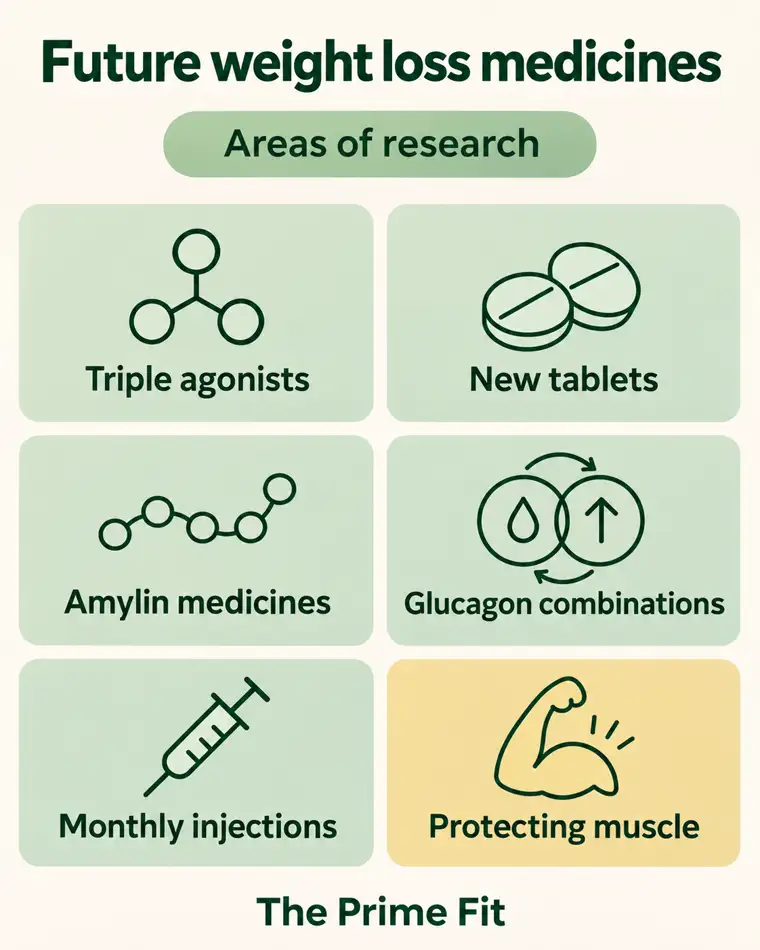
- The main groups of new medicines
- Retatrutide: the triple agonist
- Orforglipron and the new tablets
- Amylin: a second fullness signal
- Glucagon combinations and the liver
- Injections once a month, or less
- Protecting muscle
- Other developments
- How a medicine reaches the pharmacy
- What is still unknown about all of them
- Should you wait for something better?
- A warning about buying unapproved medicines
- Could I take part in a clinical trial?
- Terms you will see in the news
- What this means for treatment today
- Questions to ask your healthcare provider
- Common myths
- How The Prime Fit keeps you up to date
- Frequently asked questions
Ten years ago, the best weight loss medicines produced an average loss of 5 to 8 percent. Today, Wegovy (semaglutide) achieves about 15 percent and Mounjaro (tirzepatide) about 20 percent. Research has not stopped there. Dozens of new medicines are in development, and several are in the final stages of testing or beginning to reach the market in some countries.
The news coverage can be breathless: “stronger than Mounjaro”, “the Ozempic pill”, “an injection once a month”. Some of it is well founded. Much of it describes medicines that are not yet approved, whose long-term safety is unknown, and which may not be available in India for some time.
This guide explains what is coming, in plain language. An important caution applies throughout. This is a fast-moving field. The trial results quoted are approximate, taken from published studies and company announcements up to about mid-2026, and some of the medicines described may since have been approved, delayed or abandoned. Treat it as background, and ask your healthcare provider what is actually available.
Why new medicines are being developed
If current medicines work so well, why are more needed? Researchers are trying to solve several remaining problems.
| Limitation today | What new medicines aim to offer |
|---|---|
| Some people need more than 20% weight loss | Results approaching those of bariatric surgery |
| About one person in ten responds poorly | Different mechanisms, so that non-responders have alternatives |
| Weekly injections put some people off | Tablets, or injections given monthly or less often |
| Nausea and other digestive side effects | Better tolerability |
| Loss of muscle along with fat | Treatments that preserve or build lean tissue |
| Cost and limited supply | Tablets that are cheaper and easier to manufacture at scale; more competition |
| Refrigeration | Products stable at room temperature |
| Weight regain after stopping | Longer-lasting effects or simpler maintenance |
| Specific complications such as fatty liver | Medicines that act directly on the liver or other organs |
The hormones involved
Most of the new medicines combine or extend the actions of a handful of natural hormones that regulate appetite and metabolism.
| Hormone | Natural role | Why it is a target |
|---|---|---|
| GLP-1 | Released by the gut after meals; signals fullness, boosts insulin, slows the stomach | The basis of semaglutide and its relatives |
| GIP | A second gut hormone that boosts insulin and acts on fat tissue and the brain | Combined with GLP-1 in tirzepatide |
| Glucagon | Raises blood sugar, but also increases energy use and burns fat in the liver | Added to raise energy expenditure and reduce liver fat |
| Amylin | Released by the pancreas with insulin; promotes fullness through a different brain pathway | Adds to the effect of GLP-1; may be gentler on the stomach |
| PYY and others | Further fullness signals from the gut | Being tested in combinations |
The main groups of new medicines
| Group | Example | How given | Approximate weight loss reported in trials | Stage, as of about mid-2026 |
|---|---|---|---|---|
| Triple hormone agonist (GIP, GLP-1, glucagon) | Retatrutide | Weekly injection | About 24% at 48 weeks in a mid-stage trial; higher figures reported in later trials at 68 weeks or more | Late-stage trials reporting |
| Non-peptide GLP-1 tablet | Orforglipron | Daily tablet, no food restrictions | About 11 to 12% at 72 weeks at the highest dose | Late-stage trials completed; regulatory review and first approvals |
| Higher-dose oral semaglutide | Semaglutide 25 mg tablet | Daily tablet on an empty stomach | About 14% | Approved for weight management in some countries |
| Higher-dose injectable semaglutide | Semaglutide 7.2 mg | Weekly injection | About 19 to 21% | Late-stage trials completed; under regulatory review or approved in some regions |
| Amylin plus GLP-1 combination | Cagrilintide with semaglutide | Weekly injection | About 20 to 23% at 68 weeks | Late-stage trials completed; under regulatory review |
| Glucagon plus GLP-1 dual agonists | Survodutide, mazdutide | Weekly injection | About 15 to 19% in mid-stage trials | Late-stage trials; one approved in China |
| Long-acting antibody-based GLP-1 medicines | Maridebart cafraglutide | Injection once a month or less often | Up to about 20% at one year in a mid-stage trial | Late-stage trials under way |
| Next-generation amylin medicines | Several candidates | Weekly injection | Promising early and mid-stage results | Mid to late-stage trials |
| Muscle-preserving combinations | Bimagrumab with semaglutide | Infusion or injection plus weekly injection | Similar weight loss with a much higher share from fat | Mid-stage trials |
These figures come from different trials with different designs, durations and participants. They cannot be compared directly, and results in everyday practice are usually somewhat lower than in trials.

Retatrutide: the triple agonist
Retatrutide activates three receptors: GIP, GLP-1 and glucagon. The first two reduce appetite, as tirzepatide does. The glucagon action is intended to increase the body’s energy expenditure and the burning of fat, particularly in the liver.
What trials have shown
- In a mid-stage trial of adults with obesity, the highest dose produced an average weight loss of about 24 percent at 48 weeks, and weight was still falling when the study ended.
- In a sub-study of participants with fatty liver, liver fat fell dramatically, returning to normal levels in most people on the higher doses.
- Results from larger, longer late-stage trials have begun to appear, with reported weight loss in the high twenties in percentage terms over about 68 weeks at the top dose, along with improvement in knee osteoarthritis pain in one trial.
What is not yet known
- Long-term safety. Glucagon raises heart rate, and a small increase has been seen. Its significance will be clearer from large outcome trials.
- Side effects were similar in kind to current medicines, mainly digestive, with some reports of skin sensitivity or tingling. Discontinuation rates at the highest doses need watching.
- Whether very rapid, very large weight loss carries added risks for muscle, bone and gallstones.
- When and where it will be approved, and at what price.
Retatrutide is not an approved medicine at the time of writing. Products sold online under this name as “research peptides” are unregulated, of unknown content and unsafe to inject.
Orforglipron and the new tablets
Semaglutide and tirzepatide are peptides, which are digested if swallowed. The semaglutide tablet gets round this with an absorption enhancer, but must be taken on an empty stomach with a sip of water, thirty minutes before food, and only about one percent is absorbed.
Orforglipron is different. It is a small, non-peptide molecule that activates the GLP-1 receptor and is absorbed like an ordinary tablet. It can be taken once a day with or without food.
What trials have shown
- In a late-stage trial of adults with obesity without diabetes, the highest dose produced an average weight loss of about 11 to 12 percent over 72 weeks.
- In people with type 2 diabetes, it lowered HbA1c by roughly 1.3 to 1.6 percentage points, with moderate weight loss.
- Side effects were the familiar digestive ones. Trials have monitored the liver closely, since an earlier small-molecule candidate from another company was stopped because of liver concerns, and no such signal had been reported for orforglipron.
Why it matters
The weight loss is less than with the best injections, closer to semaglutide at moderate doses. Its importance lies elsewhere. Tablets are simpler to manufacture, need no refrigeration or pens, and can be produced in very large quantities. If priced accordingly, they could bring treatment to far more people. A tablet may also be a practical option for maintenance after weight has been lost with an injection, a strategy being tested in trials.
Higher-dose oral semaglutide
The existing semaglutide tablet has been tested at higher strengths for weight management, producing about 14 percent average weight loss, similar to the injection, and has been approved for this use in some countries. It still requires the empty-stomach routine.
Amylin: a second fullness signal
Amylin is a hormone released with insulin after meals. It acts on a different part of the brain from GLP-1 to produce satiety. Long-acting versions are being combined with GLP-1 medicines or developed alone.
- Cagrilintide with semaglutide: given together as a weekly injection, this combination produced about 20 to 23 percent weight loss over 68 weeks in people without diabetes in late-stage trials, and about 14 to 16 percent in people with type 2 diabetes. That is more than semaglutide alone, though it did not clearly exceed tirzepatide’s results.
- Newer amylin medicines given alone have shown substantial weight loss in early and mid-stage trials, in some cases with less nausea than GLP-1 medicines. If confirmed, they could suit people who cannot tolerate current treatment.
Glucagon combinations and the liver
Medicines that combine GLP-1 with glucagon action, such as survodutide and mazdutide, are being developed for obesity and, particularly, for fatty liver disease with inflammation and scarring. In mid-stage trials they produced weight loss of roughly 15 to 19 percent and marked improvements in liver fat and inflammation on biopsy. Mazdutide has been approved for weight management in China. Late-stage trials elsewhere are continuing.
For people whose main problem is fatty liver disease, this group may turn out to be especially relevant. Other liver-directed medicines that do not act through weight loss are also in use or in development.

Injections once a month, or less
A weekly injection is already convenient. Some new medicines aim for much longer intervals by attaching GLP-1-like peptides to an antibody, which stays in the body for weeks.
In a mid-stage trial, one such medicine given monthly produced weight loss of up to about 20 percent at one year, without a clear plateau, and there were hints that weight was maintained for some months after stopping or with dosing every few months. Digestive side effects were frequent with the first doses, and later trials are testing gentler starting schedules. Late-stage trials are in progress.
If these results hold, treatment a few times a year for maintenance could become possible.
Protecting muscle
With current medicines, about a quarter to a third of the weight lost is lean tissue. For most people this is acceptable if protein and strength training are in place, but in older adults it matters more. Several approaches are being tested:
- Antibodies that block signals limiting muscle growth, such as bimagrumab. Combined with semaglutide in a mid-stage trial, weight loss was similar to semaglutide alone, but more than nine-tenths of it came from fat, with lean mass largely preserved.
- Other agents acting on muscle pathways, taken as tablets, are in earlier trials.
These are some years from routine use, and their own safety needs to be established. For now, the proven ways to protect muscle are adequate protein and resistance exercise.
Other developments
| Development | What it means |
|---|---|
| Higher doses of existing medicines | Semaglutide at 7.2 mg weekly produced about 19 to 21% weight loss in trials, more than the 2.4 mg dose |
| Generic and biosimilar versions | As patents expire, more manufacturers can produce semaglutide, lowering prices. This is already under way in India and other countries |
| New trial evidence for current medicines | Outcome trials of tirzepatide for heart disease and other conditions are reporting |
| Use in more conditions | Trials in sleep apnoea, heart failure, kidney disease, fatty liver, osteoarthritis and addiction |
| Maintenance strategies | Trials of lower doses, longer intervals and switching from injection to tablet after weight loss |
| Predicting response | Research into genetic and other markers that might show who will respond to which medicine |
| Treatments for adolescents | Trials in younger age groups, with specialist oversight |
| Gene-based and very long-acting approaches | Early laboratory and animal work; many years from clinical use, if ever |
How a medicine reaches the pharmacy
| Stage | What happens | Typical duration |
|---|---|---|
| Laboratory and animal studies | Basic safety and activity | Several years |
| Phase 1 | Small studies in healthy volunteers: safety and dose | About 1 year |
| Phase 2 | Hundreds of patients: does it work, and at what dose? | 1 to 2 years |
| Phase 3 | Thousands of patients over a year or more: confirm benefit and identify less common side effects | 2 to 4 years |
| Regulatory review | Authorities examine all the data | About 1 year |
| Launch, country by country | Approval and supply in each market, which can lag well behind the first launch | Months to years |
| After approval | Monitoring in large numbers of users; outcome trials for heart disease and other endpoints | Ongoing |
Many candidates that look impressive in phase 2 do not reach the market. Several promising obesity medicines have been dropped in recent years because of side effects, liver signals or disappointing results in larger trials. A headline about a mid-stage result is not a promise of a product.
What is still unknown about all of them
- Long-term safety. Rare side effects appear only when very large numbers of people have taken a medicine for years.
- Hard outcomes. Semaglutide has been shown to reduce heart attacks and strokes. New medicines will need their own trials to show the same.
- How much weight loss is too much. Losses of 25 to 30 percent raise questions about muscle, bone, nutrition and gallstones, especially in older adults.
- What happens after stopping. Regain is expected, as with current medicines, unless shown otherwise.
- Performance in Indian patients, who develop metabolic disease at lower body weights and often eat vegetarian diets lower in protein.
- Price and access.
Should you wait for something better?
This is the practical question, and for most people who qualify for treatment today, the answer is no.
| Reason to consider waiting | Why it is usually not persuasive |
|---|---|
| A stronger medicine is coming | Most people do not need more than 15 to 20% weight loss to gain the main health benefits. Dates of approval and availability in India are uncertain |
| A tablet is coming | Tablets studied so far produce less weight loss than the best injections. An approved semaglutide tablet for diabetes already exists |
| Newer means safer | The opposite is often true. Older medicines have the longest safety record |
| Prices will fall | They may, and approved generics of semaglutide are already reducing cost. Ask about affordable options now |
| I can start later | Excess weight is doing harm in the meantime: to blood sugar, the liver, joints, the heart and sleep |
Starting an effective, approved treatment now does not close any doors. If a better option becomes available and suits you, your healthcare provider can switch you to it. The habits you build in the meantime, protein, strength training, regular meals, will serve you whatever medicine you take.
The exception is someone who does not currently qualify for or need medication. For them, a structured nutrition and exercise programme is the right treatment, and no future medicine changes that.
A warning about buying unapproved medicines
Because of the publicity, substances labelled retatrutide, cagrilintide and other names are sold online as “research chemicals” or “peptides”, often as vials of powder. These are not the products tested in trials. They are made without regulatory oversight, may contain the wrong substance, the wrong amount or contaminants, and come with dosing advice from anonymous forums. People have been harmed by them.
Do not inject unapproved products
If a medicine has not been approved by the drug regulator and dispensed by a licensed pharmacy on a healthcare professional’s prescription, do not use it. If you have, and you feel unwell, seek medical care and take the product with you.
Could I take part in a clinical trial?
Trials of new obesity medicines are conducted at hospitals and research centres, including some in India. Participants are carefully screened, receive close monitoring and are not charged for the study medicine, though they may be assigned to placebo. Trials registered in India are listed on the national clinical trials registry. If you are interested, ask your healthcare provider, and make sure any study is properly registered and approved by an ethics committee. Never pay to join a “trial”.
Terms you will see in the news
| Term | Meaning |
|---|---|
| Agonist | A medicine that activates a receptor in the same way as the natural hormone |
| Dual or triple agonist | One molecule that activates two or three different hormone receptors |
| Incretin | A gut hormone, such as GLP-1 or GIP, that boosts insulin after meals |
| Small molecule | A conventional chemical medicine that can be taken as an ordinary tablet, unlike a peptide |
| Peptide | A short chain of amino acids; usually has to be injected |
| Phase 2 and phase 3 | The middle and final stages of testing before approval |
| Placebo-adjusted | The result on the medicine minus the result on placebo; smaller than the headline figure |
| Efficacy estimate | The result in people who stayed on treatment; usually higher than the result counting everyone who started |
| Top-line results | A company’s first summary of a trial, before full publication and independent scrutiny |
| Head-to-head trial | A study comparing two medicines directly |
| Outcome trial | A large, long study measuring events such as heart attacks, not just weight |
| Compounded or research peptide | An unapproved preparation; not the product tested in trials |
Two of these explain why headline numbers vary. Companies often quote the efficacy estimate, and news reports often omit the placebo result. A fair reading asks how many people started, how many stopped, and what happened to those on placebo.

What this means for treatment today
- Effective treatment already exists. Semaglutide and tirzepatide are approved, well studied and available.
- Choice will widen. Over the next few years, expect more options in strength, form and price.
- Treatment will become more individual. The question will shift from “which is strongest” to “which suits this person”: their goal, other conditions, preferences and budget.
- The foundations will not change. Every one of these medicines works by reducing intake. Nutrition quality, protein, resistance exercise and follow-up will matter as much as they do now.
- Stay sceptical of hype. Wait for approval, and for your healthcare provider’s advice.
Questions to ask your healthcare provider
- Which approved medicines are available to me now, and which suits my situation?
- Is there any good reason for me to wait for a newer medicine?
- If something better becomes available, how would switching work?
- Are there approved, more affordable versions of current medicines?
- Is there a registered clinical trial that I might be suitable for?
- What can I do now, whatever medicine I take, to protect my muscle and health?
Common myths
“Retatrutide is available if you know where to look”
It is not approved at the time of writing. What is sold online under that name is unregulated.
“The new tablet is stronger than the injections”
Tablets reported so far produce less weight loss than tirzepatide. Their advantage is convenience and scale.
“Newer medicines have no side effects”
They share the digestive side effects of the class, and their long-term safety is less well known.
“More weight loss is always better”
Beyond what health requires, very large losses bring their own risks.
“Soon one injection will cure obesity permanently”
Nothing in late-stage development is a cure. All require continuing treatment.
“There is no point starting now”
Current treatment is effective, and delay allows harm to continue.
How The Prime Fit keeps you up to date
At The Prime Fit, we prescribe only approved medicines from licensed sources, and we follow the research closely so that our patients benefit as new options are approved in India. When a new treatment becomes available, your healthcare provider will tell you honestly whether it offers you anything over what you are taking. In the meantime, we focus on what makes every medicine work better: a proper assessment, the right dose, a dietitian-led plan and regular follow-up.
To discuss the treatments available now, book a consultation or read about our GLP-1 therapy programme.
Frequently asked questions
What is retatrutide?
An investigational weekly injection that activates three hormone receptors: GIP, GLP-1 and glucagon. In trials it has produced average weight loss of about 24 percent or more. It is not yet approved.
Is retatrutide better than Mounjaro?
Trial results suggest greater average weight loss, but the two have not been compared in completed head-to-head outcome studies, and retatrutide’s long-term safety is not yet established.
What is orforglipron?
A once-daily GLP-1 tablet that can be taken with or without food. In a late-stage trial it produced about 11 to 12 percent weight loss over 72 weeks.
Is there a weight loss pill as strong as the injections?
Higher-dose oral semaglutide has matched injectable semaglutide in trials. No tablet has yet matched tirzepatide.
When will these medicines be available in India?
That depends on approval by the Indian regulator and the manufacturers’ launch plans, which cannot be predicted reliably. Ask your healthcare provider about current availability.
Should I wait for a newer medicine?
Usually not. Approved treatments are effective now, and you can switch later if a better option suits you.
Can I buy retatrutide online?
Products sold online under that name are unapproved and unregulated. Do not inject them.
Will future medicines prevent muscle loss?
Some combinations in trials have preserved lean tissue while reducing fat. They are still under study. Protein and strength training remain the proven approach.
Will there be a monthly injection?
Long-acting medicines given monthly or less often are in late-stage trials, with promising mid-stage results.
Will prices come down?
Generic semaglutide and new tablets are expected to widen access and lower costs over time. Ask about approved, affordable options now.
This article is general information and is not a substitute for a consultation. It describes medicines under investigation; results quoted are approximate and reflect information available up to about mid-2026. Approval status and availability change. Do not use any medicine that has not been approved and prescribed for you.