In this article
Sooner or later, almost everyone on Mounjaro asks the same question: what happens when I stop? It is the right question to ask, and ideally it is asked before treatment starts, not in the week the last pen runs out.
The honest answer is that for most people, weight comes back if the medication stops and nothing else changes. That is not a reason to avoid treatment or to stay on it forever by default. It is a reason to plan the exit as carefully as the start.
What Happens in Your Body When You Stop
Tirzepatide is a once-weekly medicine because it stays in the body for a long time. After the last injection, levels fall gradually over several weeks rather than switching off overnight. That is why most people notice the change slowly, and why it is easy to miss until the scale has already moved.
- 01Appetite returns firstHunger, portion size and the pull toward food, often called food noise, tend to come back within a few weeks. This is usually the first thing people notice.
- 02Fullness fadesThe medicine slows how quickly the stomach empties. As it wears off, meals stop feeling as filling for as long, and second helpings feel easier.
- 03Blood sugar may driftFor anyone with type 2 diabetes or prediabetes, glucose control can worsen after stopping. This needs monitoring, not guesswork.
- 04Side effects easeNausea, constipation and reflux usually settle, which can make the period after stopping feel deceptively good.
This is physiology, not willpower
Hunger coming back after stopping is the expected effect of removing the medicine, not a sign you have failed or lack discipline. Planning for it is what makes the difference.

What the Research Shows
Two sets of trial data are most often quoted. Both measured what happened when people stopped medication in a trial setting, and both point the same way.
| Study | What was tested | What happened |
|---|---|---|
| SURMOUNT-4 (tirzepatide) | After 36 weeks on tirzepatide, participants were randomly assigned to continue or switch to placebo for a further 52 weeks | Those who continued lost more weight. Those switched to placebo regained a substantial share of what they had lost, on average around half or more |
| STEP 1 extension (semaglutide) | Participants were followed for a year after semaglutide treatment ended | On average, about two-thirds of the weight lost was regained within a year, and improvements in blood pressure and blood sugar largely reversed |
These are averages. Some people in these studies kept most of their loss; others regained all of it. And trial participants generally stopped at a fixed point, rather than tapering with structured support around them. What the research does show clearly is that stopping without a plan carries a high risk of regain.
Why the Weight Comes Back
Obesity behaves like a chronic condition. When weight falls, the body responds as though it needs to recover it, and those responses do not switch off when the medication does.
- Hunger hormones rise after weight loss and stay raised for a long time, independent of any medicine
- A smaller body burns less energy, and the body adapts further by becoming more efficient, so the same meals now go further
- Any muscle lost during treatment lowers resting energy use, making regain easier
- Habits that were never built while appetite was suppressed have nothing to fall back on when appetite returns
The regain trap
Regained weight tends to come back as fat rather than muscle. Someone who loses weight with substantial muscle loss, then regains, can end up at the same weight with a worse body composition than when they started.

Your Four Options: It Is Not All or Nothing
“Stay on it forever” or “stop and hope” are not the only choices. In practice there are four broad paths, and the right one depends on your health, your goals, your budget and how your body has responded.
| Option | What it means | Worth knowing |
|---|---|---|
| Continue long term | Stay on the dose that is working, with regular review | Gives the best chance of holding the result while you take it. Cost and long-term commitment are the trade-offs |
| Lower maintenance dose | Step down to a lower dose and hold there | Some clinicians use this approach. Evidence for reduced-dose maintenance is still limited, so it is monitored closely |
| Planned taper | Reduce the dose gradually over a period, then stop | Gives appetite time to return slowly while habits are tested. There is no single proven taper schedule |
| Stop with intensive support | Stop, and replace the medicine with closer dietitian and lifestyle follow-up | Possible for some people, but highest regain risk if support is light |
Whichever route you take, the decision belongs in a conversation with your healthcare provider, particularly if you have diabetes, high blood pressure or another condition that improved on treatment.
How to Come Off Mounjaro Well
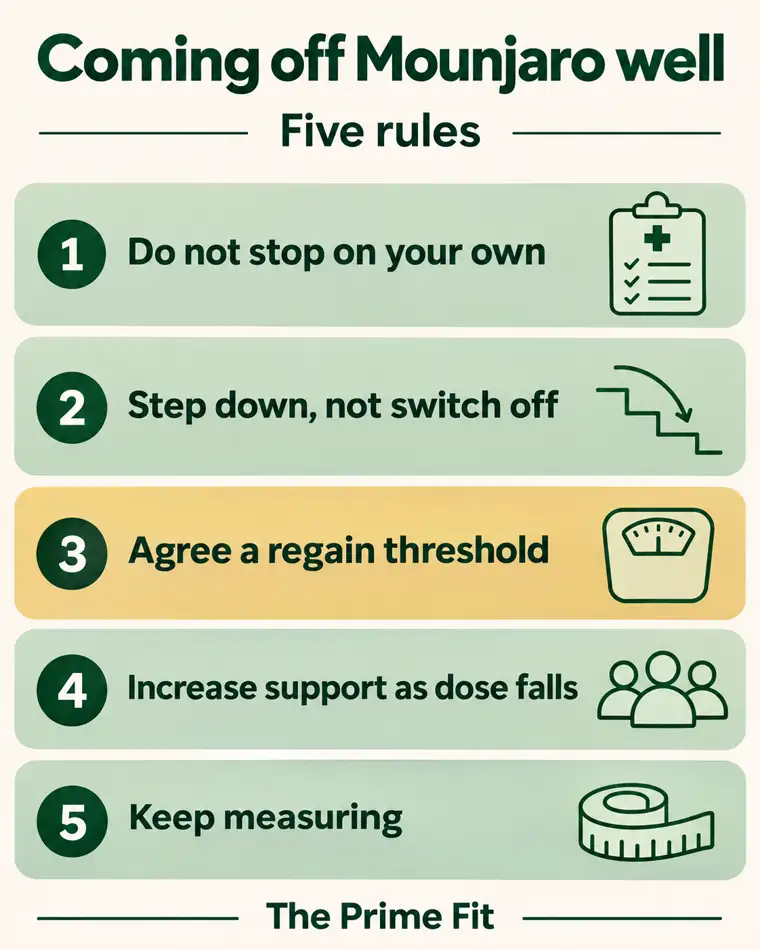
A good exit is planned weeks in advance. These are the principles we work to with patients.
- 01Do not stop on your ownStopping abruptly, or in the middle of dose escalation, is the version most likely to end in rapid regain. Agree the plan with your prescriber first.
- 02Step down rather than switch offMany clinicians reduce gradually rather than stopping in one go, so appetite returns slowly. The pace is set around your appetite, weight and blood sugar, not a fixed calendar.
- 03Agree a regain threshold in advanceDecide together what amount of regain triggers a review, for example, a few kilograms. A number agreed calmly beforehand stops small regain quietly becoming large regain.
- 04Increase support as the dose fallsThe months after stopping need more dietitian contact, not less. That is when habits are tested for the first time without help.
- 05Keep measuringWeekly weight, monthly waist and body composition. Catching drift early is far easier than reversing it later.
What to Have in Place Before the Last Dose
The habits that hold the result have to be built while the medication is still making them easier, not started once appetite has already returned.
- Protein at every meal, at a target set for your body weight, the strongest single dietary protection against regain
- Resistance training at least twice a week, established for months rather than started at the end
- A regular meal structure, so returning hunger meets a plan rather than an empty fridge
- A strategy for chai, namkeen and evening snacking, the most common places calories creep back in Indian routines
- A plan for weddings, festivals and travel, which are predictable rather than surprises
- Sleep and stress addressed, both raise appetite independently of any medication

Signs That Should Prompt a Review
None of these is an emergency, but each is a reason to speak to your care team rather than wait.
- Weight has risen past the threshold you agreed
- Hunger or food noise feels as strong as it did before treatment
- Home blood sugar or blood pressure readings are rising, if you monitor them
- Waist measurement is increasing even though weight looks stable
- You notice yourself avoiding the scale
Planning a pregnancy or surgery?
Both are common reasons to stop, and both should be discussed with your healthcare provider well in advance. Tirzepatide is not used during pregnancy, and anaesthetists need to know about GLP-1 medication before any procedure because it slows stomach emptying.
If You Need to Restart Later
Restarting is not failure. For a chronic condition, a second course of treatment is a reasonable medical decision. But it should not be done by picking up where you left off.
- 01Do not restart at your old doseAfter a break of more than a few weeks, the stomach is no longer used to the medicine. Restarting at a higher dose can bring side effects back as strongly as when you first began.
- 02Your healthcare provider decides the starting pointHow far to step back depends on how long you have been off it and how you tolerated it before.
- 03Use the second course differentlyA restart is the chance to build the habits the first course missed, so the next exit goes better.
If you are currently on treatment and thinking about stopping, our GLP-1 support programme covers the taper and the maintenance months that follow.
Key takeaways
- For most people, weight returns if Mounjaro stops and nothing else changes, appetite comes back first.
- Trial data for both tirzepatide and semaglutide show substantial average regain after stopping without a plan.
- There are four options, not two: continue, a lower maintenance dose, a planned taper, or stopping with intensive support.
- Stop with your prescriber, not on your own, and agree a regain threshold before the last dose.
- Protein, resistance training and a meal structure need to be established while still on treatment.
- Restarting is reasonable, but not at your previous dose without medical advice.
Frequently asked questions
Will I regain weight if I stop Mounjaro?
Most people regain some weight if they stop and nothing else changes. In trials, average regain after stopping was substantial. A planned taper, established habits and closer follow-up reduce that risk, though they do not remove it entirely.
How quickly does Mounjaro wear off?
Tirzepatide leaves the body gradually over several weeks after the last injection. Most people notice appetite returning within the first few weeks.
Should I taper Mounjaro or stop suddenly?
Many clinicians step down gradually rather than stopping in one go, so appetite returns slowly while habits are tested. There is no single proven schedule, so your healthcare provider sets the pace.
Is there a maintenance dose of Mounjaro?
Some clinicians step patients down to a lower dose and hold there. The evidence for reduced-dose maintenance is still limited, so it needs regular monitoring of weight and health markers.
Do I have to take Mounjaro for life?
Not necessarily. Some people continue long term, others taper and stop with strong support. It depends on your health, response, goals and budget, and should be reviewed with your healthcare provider rather than decided by default.
Can I restart Mounjaro if the weight comes back?
Yes, restarting can be a reasonable decision. After a break you usually should not restart at your previous dose, because side effects can return as strongly as when you first began. Your healthcare provider will decide the starting point.
Will my blood sugar change after stopping?
It can. If you have type 2 diabetes or prediabetes, glucose control may worsen after stopping, so monitoring and a plan with your healthcare provider are important.
Do I need to stop Mounjaro before surgery?
Tell your surgeon and anaesthetist that you take it. Because GLP-1 medication slows stomach emptying, they may give specific instructions about the last dose or fasting before the procedure.