In this article
- The two treatments in brief
- Head-to-head: the main differences
- How much weight can you expect to lose?
- Durability: what happens after two, five and ten years
- Type 2 diabetes
- Safety and risks
- Commitment and daily life
- Who is eligible for each?
- Who tends to do better with medication first
- Who tends to do better with surgery
- Using both: combination and sequence
- What about the options in between?
- The first year with each treatment
- Three illustrative examples
- The personal side of the decision
- Thinking about cost over time
- Questions to help you decide
- Common myths
- How The Prime Fit helps you choose
- Frequently asked questions
Ten years ago, a person with severe obesity who had not succeeded with diet and exercise had one highly effective option: bariatric surgery. Today there is a second. Weekly GLP-1 medicines such as Wegovy (semaglutide) and Mounjaro (tirzepatide) produce weight loss that earlier medicines never approached. Naturally, people ask which is better.
The honest answer is that neither is better for everyone. Surgery generally produces larger and longer-lasting weight loss and has decades of evidence, but it is an operation with permanent changes. Medication is non-surgical, adjustable and reversible, but it works only while it is taken and its results are, on average, smaller. For many people the real question is not “which one?” but “which first, and might I need both?”
This guide compares the two fairly, using the best available evidence, and explains who tends to suit each approach. It is general information. The right choice depends on your weight, health, preferences and circumstances, and should be made with healthcare professionals who can assess you in person.
The two treatments in brief
GLP-1 weight loss injections
Semaglutide acts on the GLP-1 receptor, and tirzepatide on both the GIP and GLP-1 receptors. Given once a week, they reduce appetite and cravings, increase fullness and slow stomach emptying. The dose is increased over several months. Treatment continues long term.
Bariatric (metabolic) surgery
The two most common operations are performed by keyhole surgery:
- Sleeve gastrectomy: about three-quarters of the stomach is removed, leaving a narrow tube. It reduces capacity and lowers the hunger hormone ghrelin.
- Gastric bypass (Roux-en-Y): a small stomach pouch is created and connected to the small intestine, bypassing most of the stomach and the first part of the intestine. It changes gut hormones powerfully, including a large natural rise in GLP-1 after meals.
Surgery works largely through hormones and appetite, not simply by restricting food. In that sense, surgery and GLP-1 medicines act on some of the same pathways.
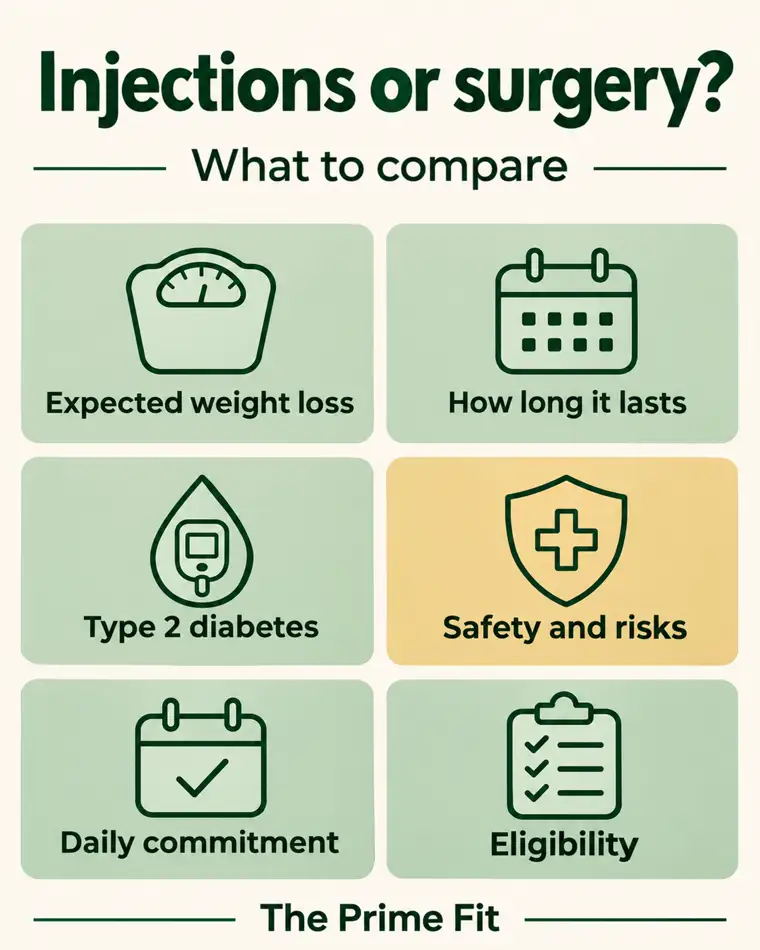
Head-to-head: the main differences
| GLP-1 injections | Bariatric surgery | |
|---|---|---|
| Average weight loss | About 15% (semaglutide) to about 20% (tirzepatide) of body weight over 16 to 18 months | About 25% (sleeve) to about 30% (bypass) of body weight at 1 to 2 years |
| How long it lasts | Maintained while treatment continues; most regain after stopping | Most of the loss is maintained for 10 years or more, with some regain |
| Type 2 diabetes | Marked improvement; remission in some, dependent on continued treatment | Remission in a majority in the first years, especially with shorter duration of diabetes; some relapse later |
| How it is given | Weekly self-injection | A keyhole operation under general anaesthesia |
| Reversibility | Fully reversible: stop the medicine | Sleeve is permanent; bypass is rarely reversed |
| Adjustability | Dose can be raised, lowered or paused | Fixed, though revision surgery is possible |
| Time off work | None | Usually 1 to 3 weeks |
| Common downsides | Nausea, constipation, diarrhoea, especially around dose increases | Early recovery, dietary stages, possible reflux or dumping syndrome, lifelong supplements |
| Serious risks | Uncommon: gallbladder problems, pancreatitis | Uncommon: leak, bleeding, clots, later nutritional deficiency or hernia |
| Cost pattern | Ongoing for as long as treatment continues | Largely one-time, plus follow-up and supplements |
| Length of evidence | Up to about 4 years at weight-management doses; longer in diabetes | 20 years or more |
These figures are averages from different studies and are not direct comparisons. Large randomised trials comparing modern GLP-1 medicines with surgery are still limited. Observational studies comparing the two in everyday practice generally find greater and more durable weight loss with surgery.
How much weight can you expect to lose?
| Starting weight | Semaglutide (about 15%) | Tirzepatide (about 20%) | Sleeve (about 25%) | Bypass (about 30%) |
|---|---|---|---|---|
| 90 kg | 13.5 kg | 18 kg | 22.5 kg | 27 kg |
| 110 kg | 16.5 kg | 22 kg | 27.5 kg | 33 kg |
| 130 kg | 19.5 kg | 26 kg | 32.5 kg | 39 kg |
| 150 kg | 22.5 kg | 30 kg | 37.5 kg | 45 kg |
The gap matters most at higher weights. For someone who weighs 90 kg with a BMI of 33, a 15 to 20 percent loss may be enough to reach a healthy range and resolve most weight-related problems. For someone who weighs 150 kg with a BMI of 52, even an excellent response to medication is likely to leave significant obesity, and surgery offers a better chance of reaching a much lower-risk weight.
Individual results vary widely with both treatments. Some people on tirzepatide lose 25 to 30 percent, and some surgical patients lose less than expected.

Durability: what happens after two, five and ten years
This is the most important difference between the two.
- Surgery: long-term studies following patients for 10 to 20 years show that most of the weight loss is maintained. Some regain is usual after the first two years, and a minority regain a large part, but the average person remains far below their starting weight a decade later. Surgery has also been associated with lower rates of heart disease, cancer and death in long-term observational studies.
- Medication: weight loss is maintained for as long as the medicine is continued, with data to about four years so far. When treatment stops, people regain about two-thirds of the lost weight within a year on average. Durability therefore depends on being able to continue treatment for many years: tolerating it, affording it and obtaining it reliably.
Neither treatment is a cure. Obesity is a chronic condition, and both require long-term follow-up and healthy habits.
Type 2 diabetes
Both treatments are highly effective for diabetes, which is why surgery is now often called metabolic surgery.
- Surgery: blood sugar often improves within days, before much weight is lost, because of changes in gut hormones. A majority of patients achieve remission in the first one to two years, more often after bypass and when diabetes has been present for a shorter time and does not yet require insulin. Some relapse over the following years, but control usually remains better than before, with fewer medicines.
- Medication: HbA1c falls substantially, many people reduce or stop other diabetes medicines, and some reach remission-level sugars while on treatment. Sugars tend to rise again if the medicine is stopped and weight returns.
For a person with obesity and diabetes that is difficult to control, particularly at a higher BMI, international guidelines recommend that metabolic surgery be considered as a treatment for diabetes in its own right.
Safety and risks
GLP-1 medicines
- Common: nausea, vomiting, diarrhoea, constipation, reflux and reduced appetite, mainly when starting and after dose increases. Around one in fifteen to one in twenty people in trials stopped because of side effects.
- Less common: gallstones and gallbladder inflammation, particularly with rapid weight loss.
- Rare: pancreatitis; dehydration affecting the kidneys after severe vomiting.
- Not suitable for: people with a personal or family history of medullary thyroid carcinoma or MEN 2, or during pregnancy and breastfeeding.
- With any large weight loss: loss of muscle if protein and exercise are inadequate; temporary hair shedding.
Bariatric surgery
- Risk of the operation: in experienced centres, the risk of death is low, of the order of one to three in a thousand, comparable to gallbladder or hip surgery. Serious early complications such as a leak, bleeding, infection or blood clots occur in a small percentage of patients.
- Early recovery: pain, nausea and a staged diet from liquids to solids over several weeks.
- After a sleeve: new or worse acid reflux in some people.
- After a bypass: dumping syndrome, with flushing, cramps or faintness after sugary foods; ulcers at the join; internal hernia; low blood sugar after meals in a minority.
- Nutritional deficiencies: iron, vitamin B12, vitamin D, calcium and others, especially after bypass. Lifelong supplements and yearly blood tests are essential.
- With any large weight loss: gallstones, hair shedding, loose skin, loss of muscle without adequate protein.
- Alcohol: the effect of alcohol is stronger and faster after surgery, and the risk of alcohol problems is higher after bypass.
It is worth setting these risks against the risks of untreated severe obesity: diabetes, heart disease, sleep apnoea, fatty liver, joint damage and shortened life. For suitable patients, the long-term balance favours treatment with either approach.
Commitment and daily life
| GLP-1 injections | Bariatric surgery | |
|---|---|---|
| Before treatment | Medical assessment and blood tests | Detailed assessment by surgeon, physician, dietitian and often a psychologist; tests; sometimes a pre-operative diet |
| Starting | First injection the same week; dose builds over months | Hospital stay of about 1 to 3 days; return to desk work in 1 to 3 weeks |
| Eating | Smaller meals; protein first; low-fat food around dose changes | Liquid, purée and soft stages for 4 to 6 weeks; then small, protein-first meals for life; fluids separate from meals |
| Ongoing tasks | Weekly injection; storing pens in the fridge; regular prescriptions | Daily vitamin and mineral supplements for life |
| Follow-up | Frequent at first, then every few months, for as long as treatment continues | Frequent in the first year, then at least yearly for life |
| Exercise | Strength training and walking to protect muscle | The same |
| Pregnancy | Stop the medicine before conceiving, as advised | Usually advised to wait 12 to 18 months after surgery; fertility often improves |

Who is eligible for each?
| Treatment | Usual criteria |
|---|---|
| GLP-1 injections | BMI 30 or above, or 27 or above with a weight-related condition, alongside diet and activity. Risk begins at lower BMI in Indians, and healthcare professionals assess individually |
| Bariatric surgery | Current international guidance: BMI 35 or above, or BMI 30 to 34.9 with type 2 diabetes or other serious weight-related disease not controlled by other means. For Asian populations the thresholds are generally lowered by about 2.5 units. Fitness for anaesthesia and readiness for lifelong follow-up are also assessed |
Criteria vary between guidelines and countries and have changed in recent years. Your surgeon and physician will apply the guidance current in India to your situation.
Who tends to do better with medication first
- BMI in the range of about 27 to 35 with weight-related conditions
- People who need to lose 10 to 20 percent of their weight to reach their health goals
- Those who prefer to avoid an operation, or are not fit for anaesthesia
- People who want a reversible, adjustable treatment
- Those planning a pregnancy in the next year or two, with appropriate timing
- People who can commit to, and sustain, long-term treatment
- Those who want to see how far non-surgical treatment can take them before deciding about surgery
Who tends to do better with surgery
- BMI of 40 or above, or 35 or above with serious related conditions
- People who need to lose more than about 25 percent of their weight
- Type 2 diabetes that is hard to control, particularly at a higher BMI
- Severe sleep apnoea, weight-related heart or joint disease where a large, durable loss is needed
- Those who have not responded adequately to medication, or cannot tolerate it
- People for whom many years of medication are not practical or affordable
- Those who prefer a one-time procedure and accept lifelong supplements and follow-up
These are tendencies, not rules. A person with a BMI of 42 may reasonably choose medication first, and a person with a BMI of 34 and uncontrolled diabetes may be well served by surgery.
Using both: combination and sequence
Increasingly, the two are used together over a person’s lifetime.
| Approach | How it works |
|---|---|
| Medication first, surgery if needed | Try a GLP-1 medicine for 6 to 12 months. If health goals are not met, proceed to surgery with better information |
| Medication before surgery | For very high BMI, weight loss beforehand can make the operation safer and technically easier. The medicine is paused before anaesthesia as the team advises |
| Medication after surgery | For those who regain weight or do not lose enough, GLP-1 medicines are effective after both sleeve and bypass |
| Surgery after stopping medication | For people who cannot continue the medicine and regain weight |
Thinking of treatment as a long-term plan with several tools removes the pressure to make one perfect choice. What matters is that each step is taken with your experts, with a clear view of what it is expected to achieve and what the next step would be if it falls short.
What about the options in between?
Two less invasive procedures sit between medication and surgery.
- Swallowable or endoscopic gastric balloon: a balloon occupies space in the stomach for about four to six months, with average weight loss of around 10 to 15 percent, alongside a coaching programme. It is temporary and suits people with lower BMI or those who want a time-limited aid.
- Endoscopic sleeve gastroplasty: the stomach is narrowed with internal stitches through an endoscope, without cuts. Average loss is around 15 to 20 percent, with evidence to about five years.
Both can also be combined with medication.
The first year with each treatment
| Time | GLP-1 injections | Bariatric surgery |
|---|---|---|
| Before starting | Assessment and blood tests; first injection within days | Assessment by the team over several weeks; tests; sometimes a short liver-shrinking diet |
| Month 1 | Low starting dose; little weight change; learning the routine | Operation and recovery; liquid then purée diet; rapid early weight loss |
| Months 2 to 3 | Dose stepping up; 4 to 7% lost; side effects around increases | Soft then normal textures in small portions; typically 10 to 15% lost; supplements established |
| Months 4 to 6 | Treatment dose reached; 8 to 12% lost | About 18 to 25% lost; exercise building; first blood tests |
| Months 7 to 12 | Loss continues more slowly towards 15 to 20% | Loss continues towards 25 to 30%; weight begins to level off between 12 and 18 months |
| After a year | Maintenance on continued treatment | Maintenance with yearly follow-up and supplements |
The figures are indicative averages. The pattern to notice is that surgery acts faster and further, while medication builds gradually and leaves you in control of the pace.
Three illustrative examples
These examples show how the reasoning can go. They are not recommendations for any individual.
BMI 32 with prediabetes and PCOS
A 34-year-old woman weighing 84 kg wants to conceive in two years. A 15 percent loss would bring her BMI to about 27 and is likely to normalise her blood sugar and cycles. Medication with a nutrition programme fits well: it is reversible, can be stopped ahead of pregnancy, and the weight she needs to lose is within its usual range. Surgery is not indicated at her BMI.
BMI 38 with type 2 diabetes for four years
A 47-year-old man weighing 112 kg takes two diabetes tablets and has sleep apnoea. Both routes are reasonable. Medication could bring 15 to 20 percent loss and better control for as long as he continues. Surgery offers a larger loss and a good chance of diabetes remission, given the short duration of his diabetes. After hearing both, he tries medication for nine months, loses 14 percent, and then decides with his healthcare professionals whether that is enough or whether to proceed to surgery.
BMI 48 with knee arthritis and severe sleep apnoea
A 52-year-old woman weighing 128 kg needs to lose about 40 kg to make knee replacement safe. Medication alone is unlikely to achieve this. Her team recommends surgery, uses a GLP-1 medicine beforehand to reduce operative risk, and keeps medication in reserve for later if weight returns.
The personal side of the decision
Feelings matter as much as numbers. Some people are frightened of an operation; others are more uneasy about injecting themselves every week for years. Some families see surgery as extreme, and some see medication as “cheating”. Neither view is fair. Both are established treatments for a medical condition. It helps to speak to people who have had each treatment, to bring a family member to the consultation, and to take the time you need. A decision made with full information and without pressure is far more likely to be one you can live with, whatever you choose.

Thinking about cost over time
Prices change, so this guide does not quote figures, but the pattern is consistent.
- Medication costs less to start and has a recurring monthly cost for as long as it is taken, plus consultations and tests.
- Surgery has a larger one-time cost, followed by modest ongoing costs for supplements, blood tests and follow-up.
- Over several years, the cumulative cost of continuous medication can exceed that of surgery. Analyses in other countries generally find surgery more cost-effective over the long term for people with severe obesity, although falling medicine prices and approved generics may change this.
- Insurance cover differs between policies for both treatments, so check yours.
- Savings from fewer medicines for diabetes and blood pressure, and fewer complications, apply to both.
Ask for a realistic estimate over five years for each option, not just the first month or the operation itself.
Questions to help you decide
- How much weight do I need to lose to reach my health goals, in percentage terms?
- What is my BMI, and which treatments am I eligible for?
- Do I have diabetes, and how well is it controlled?
- How do I feel about an operation, and about permanent changes to my anatomy?
- How do I feel about weekly injections for years?
- Can I sustain the cost of long-term medication?
- Am I planning a pregnancy?
- Would I take daily supplements and attend yearly reviews for life?
- What happened with my previous weight loss attempts?
- What do my physician and surgeon each recommend, and why?
Common myths
“Injections have made surgery obsolete”
No. Surgery still produces the largest and most durable weight loss, and remains the most effective option at higher BMI and for difficult diabetes.
“Surgery is the easy way out”
It requires thorough preparation, permanent changes in eating, lifelong supplements and follow-up. So does successful medical treatment. Neither is easy; both are legitimate medical care.
“Surgery is very dangerous”
In experienced centres, modern keyhole bariatric surgery has a safety record similar to other common operations.
“If I choose medication, I can never have surgery, or the reverse”
The two can follow each other or be combined.
“Either one works without changing how I eat and move”
Both reduce appetite. Protein, strength training and regular follow-up decide how much of the loss is fat and how long it lasts.
How The Prime Fit helps you choose
At The Prime Fit, we offer both medical and surgical routes, so our advice is not tied to one of them. Your assessment covers your BMI, body composition, blood tests and medical history. Your healthcare provider explains what each option could realistically achieve for you, including nutrition programmes and the gastric balloon, and arranges a surgical opinion where surgery deserves consideration. Whichever route you choose, a dietitian supports you before and after, with weekly follow-up.
To talk through your options, book a consultation or read about our GLP-1 therapy and bariatric surgery services.
Frequently asked questions
Which gives more weight loss, injections or surgery?
On average, surgery. Sleeve gastrectomy and gastric bypass typically produce about 25 to 30 percent weight loss, compared with about 15 to 20 percent with semaglutide or tirzepatide. Individual results vary.
Are weight loss injections safer than surgery?
They avoid the risks of an operation and are reversible, but they have their own side effects and must be continued long term. In experienced centres, surgical risk is low. The safest choice depends on your health and needs.
Can injections replace bariatric surgery?
For some people with lower BMI, yes. At higher BMI or with hard-to-control diabetes, surgery often remains the more effective option.
Should I try injections before surgery?
Many people do. If medication meets your health goals and you can continue it, surgery may not be needed. If not, you can proceed to surgery later.
Can I take GLP-1 medicines after bariatric surgery?
Yes. They are used for weight regain or insufficient weight loss after surgery, under medical supervision.
Which is better for type 2 diabetes?
Both are effective. Surgery has higher rates of remission, especially early in the disease, while medication gives strong control for as long as it is taken.
Which costs less in the long run?
Medication costs less at the start but continues monthly. Surgery costs more once, with small ongoing costs. Over several years surgery can work out less expensive, depending on prices and how long medication is needed.
How long is recovery after bariatric surgery?
Most people stay in hospital for one to three days and return to desk work within one to three weeks, with a staged diet over four to six weeks.
Will I regain weight with either treatment?
Some regain is possible with both. After surgery most of the loss is usually maintained long term. With medication, weight is maintained while treatment continues and tends to return after stopping.
What BMI is needed for bariatric surgery?
Guidelines generally recommend considering it at BMI 35 or above, or 30 to 34.9 with type 2 diabetes or serious weight-related disease, with lower thresholds for Asian populations. A surgeon will assess you individually.
This article is general information and is not a substitute for a consultation. Figures are averages from different studies and do not predict individual outcomes. Treatment decisions should be made with your experts after a full assessment.